



Decentralized Identity Market Size, Companies, Trends, Competitive Landscape, and Industry Outlook 2026-2035
Decentralized Identity Market (By Identity Type: Biometrics (Fingerprint/Facial/Iris), Non Biometrics (PKI/Verifiable Credentials/Passwordless); By Vertical: BFSI (Banking, Finance & Insurance), Government & Public Sector, Healthcare & Life Sciences, IT & Telecom, Retail & E Commerce, Others) - Global Industry Analysis, Size, Trends, Leading Companies, Regional Outlook, and Forecast 2026 to 2035
Source: https://www.precedenceresearch.com/decentralized-identity-market
 Get a Sample
 Table Of Content


What is the Decentralized Identity Market Size?
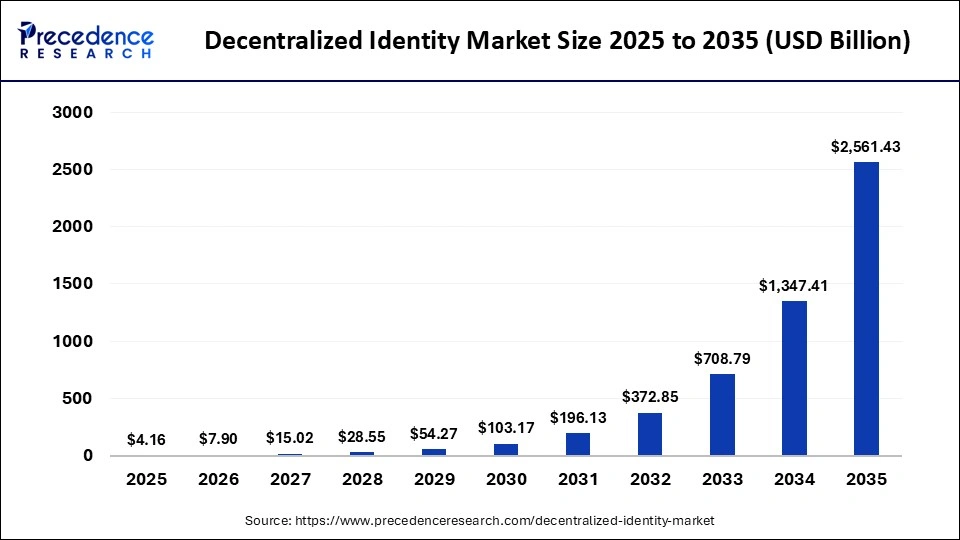
The global decentralized identity market size is predicted to increase from USD 7.90 billion in 2026 to approximately USD 2,561.43 billion by 2035, expanding at a CAGR of 90.10% from 2026 to 2035. The global decentralized identity market is witnessing robust growth, driven by the increasing concerns about data breaches and unauthorized access, and the growing need for user‑centric identity control.
Market Highlights
- North America dominated the global decentralized identity market with a share of approximately 42% in 2026.
- Asia Pacific is expected to grow at the fastest CAGR in the market during the forecast period.
- By identity type, the biometrics (fingerprint/facial/iris) segment held the largest market share of approximately 62% in 2026.
- By identity type, the non-biometrics segment is expected to grow at a remarkable CAGR between 2026 and 2035.
- By vertical, the BFSI (Banking, Finance & Insurance) segment held the largest market share of approximately 33% in 2026.
- By vertical, the IT & Telecom segment is expected to grow at a significant CAGR between 2026 and 2035.
Market Overview
The decentralized identity market includes technologies and solutions that allow individuals and organizations to control, verify, and manage digital identities without relying on centralized authorities. Using blockchain, cryptography, self sovereign identity, and decentralized identifiers (DIDs), these systems enhance privacy, reduce fraud, and streamline authentication across sectors like banking, government, healthcare, and IT & Telecom.
How are AI-driven innovations reshaping the growth of the market?
In the era of a rapidly evolving technological landscape, the Artificial Intelligence (AI) integration is driving innovation and accelerating the growth of the decentralized identity market. The integration of AI with decentralized identity is transforming digital trust by offering user-controlled, blockchain-based, and AI-verified systems. The adoption of AI significantly improves the efficiency and security of issuing and verifying credentials within a decentralized identity ecosystem. AI-powered biometric systems connect identity credentials to their rightful owners, eliminating the risk of fraud by ensuring that the individual presenting the credential is indeed the one to whom it was issued. AI enhances decentralized identity by detecting fraud with behavioral analysis, mitigating deepfakes, automating verification in real-time to detect anomalies, enabling secure agent-to-agent communication, and fostering trust in user-controlled digital wallets.
- In September 2025, AONY (AI On-Chain Name for You), an innovative blockchain identity protocol, announced its official launch. Designed to redefine how users interact with Web3 ecosystems, AONY integrates decentralized identity (DID) standards, AI-driven behavioral analytics, and reputation scoring into a unified on-chain identity solution.
What are the emerging trends in the decentralized identity market?
- The rising concerns over privacy and data security are anticipated to accelerate the growth of the mobile virtual network operator market during the forecast period. Decentralized identity offers a more secure, reliable, and privacy-centric approach by enabling individuals to rightfully own and control their digital identities.
- The stringent regulatory mandates and increasing push towards a unified digital identity wallet are expected to promote the growth of the market during the forecast period.
- The supportive government-led digital ID programs are expected to contribute to the overall growth of the decentralized identity market. Government-sponsored digital identity wallets are changing the way consumers authenticate online.
- The increasing enterprise need for compliant and streamlined onboarding is expected to create significant growth opportunities for the mobile virtual network operator market during the forecast period. Decentralized identity is increasingly being deployed in banking, IT & telecom, e-commerce, and others enables automated, faster, and regulation-compliant onboarding processes.
- The emergence of blockchain technology is anticipated to fuel the expansion of the decentralized identity market in the coming years. The surge of blockchain technology has paved the way for decentralized identity solutions. Blockchain provides a tamper-proof and transparent ledger that securely stores and verifies identity information.
Segmental Insights
Identity Type Insights
What causes the biometrics (fingerprint/facial/iris) segment to dominate the market?
The biometrics (fingerprint/facial/iris) segment held the largest market share of approximately 62% in the decentralized identity market in 2026. Biometric identifiers such as fingerprints, facial recognition, and iris scans offer a strong level of accuracy and security in authenticating an individual's identity. Biometrics offers a smooth and password-less experience, allowing individuals to authenticate their identity by using their distinctive biological traits, such as their face or fingerprint, rather than relying on complex and multiple passwords. Biometric identifiers are unique and difficult to forge or duplicate, which makes them reliable for high-security environments like government services and the BFSI sector. The increasing number of cybercrimes and data breaches is driving the need for biometric security solutions for identity verification.
- In April 2025, Cardano announced the launch of Veridian, a next-generation platform designed to manage decentralized digital identity using the power of its blockchain network. Cardano has presented Veridian, an innovative open-source digital identity platform that promises to revolutionize the way individuals and businesses manage their personal information.
On the other hand, the non-biometrics segment is expected to grow at a remarkable CAGR between 2026 and 2035. Non-biometrics refer to identification and authentication that do not rely on unique biological or behavioral traits. Instead, they use passwords, PINs, security answers, physical ID cards, security tokens, and device-based authentication. Non-biometrics are widely used for privacy & security, and can provide access control without requiring physical presence. Non-biometric authentication is widely used as a critical backup or second layer for biometric password-less security.
Vertical Insights
What has led the BFSI (Banking, Finance & Insurance) segment to dominate the market?
The BFSI (Banking, Finance & Insurance) segment dominates the decentralized identity market, holding approximately 33% market share in 2026. The growth of the segment is primarily driven by the increasing demand for Know Your Customer (KYC), stringent compliance requirements, increasing focus on preventing fraud activities, and increasing focus on improving customer experience. The Banking, Finance & Insurance (BFSI) sector is a major target for cyberattacks. Decentralized identity offers secure and tamper-proof databases, which reduces the risk of identity theft and data breaches. In an era of digital-first banking, decentralized solutions are increasingly replacing paper-based verification with digital wallets.
The IT & Telecom segment is the fastest-growing in the decentralized identity market. The segment's fastest growth is supported by the increasing cases of cyberattacks, the growing need to secure digital & cloud-native applications, the growing demand for secure and seamless identity verification, and stringent data protection regulations. IT & Telecom companies handle a massive amount of sensitive customer data, including authentication credentials, which increases the need for robust and decentralized identity to manage data privacy. The IT sector often integrates cloud-based identity and access management (IAM) to manage complex and large-scale environments.
Regional Insights
How Big is the North America Decentralized Identity Market Size?
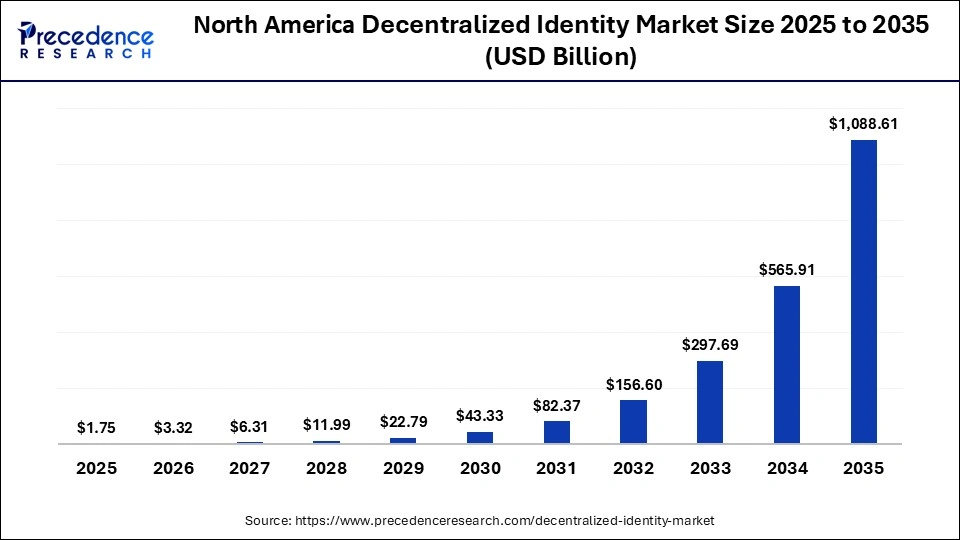
The North America decentralized identity market size is estimated at USD 3.32 billion in 2026 and is projected to reach approximately USD 1,088.61 billion by 2035, with a 90.28% CAGR from 2026 to 2035.
North America Decentralized Identity Market Analysis
North America dominates the market, holding the largest share of approximately 42% in 2026. The region benefits from established technology-driven infrastructure and an increasing focus on enhancing data security against rising identity theft attacks. The growth of the region is also characterized by the early adoption of biometric solutions, growing demand for digital security, significant investments in R&D activities, and rising advancements in blockchain technology. Moreover, the strict regulatory compliance and rising adoption of advanced technology, such as cloud-based identity and access management (IAM) for managing complex and connected infrastructures, significantly contribute to the growth of the decentralized identity market during the forecast period.
- In June 2025, Eicol Exchange announced the official launch of its Web3 Identity System, a decentralized authentication infrastructure designed to redefine trust and interoperability in digital finance. Built on decentralized identity (DID) standards and on-chain signature verification, the system empowers users with self-sovereign credentials that can be used across DeFi, DAOs, NFT marketplaces, and other Web3 ecosystems.
Canada Decentralized Identity Market
The Canada decentralized identity market is evolving rapidly as organizations, financial institutions and government agencies seek more secure and privacy-focused solutions to manage digital identities. Businesses are increasingly investing in decentralized identity platforms to enhance fraud prevention, simplify customer onboarding and comply with stringent privacy regulations. Due to rising cybersecurity concerns and increasing digitalization across energy, healthcare and enterprise sectors, companies are seeking secure authentication systems that reduce dependency on traditional password-based access models. The country benefits from strong government support for digital transformation and secure citizen identity management systems. Growing awareness around cyber resilience and data ownership is creating new opportunities for market growth. The country's government is focusing on secure digital credential systems and trusted online access platforms, through initiatives such as CanadaLogin and GC Issue and Verify. Canadian consumers and businesses are becoming aware of the risks associated with centralized data storage, increasing demand for self-sovereign identity solutions.
What is the Size of the U.S. Decentralized Identity Market?
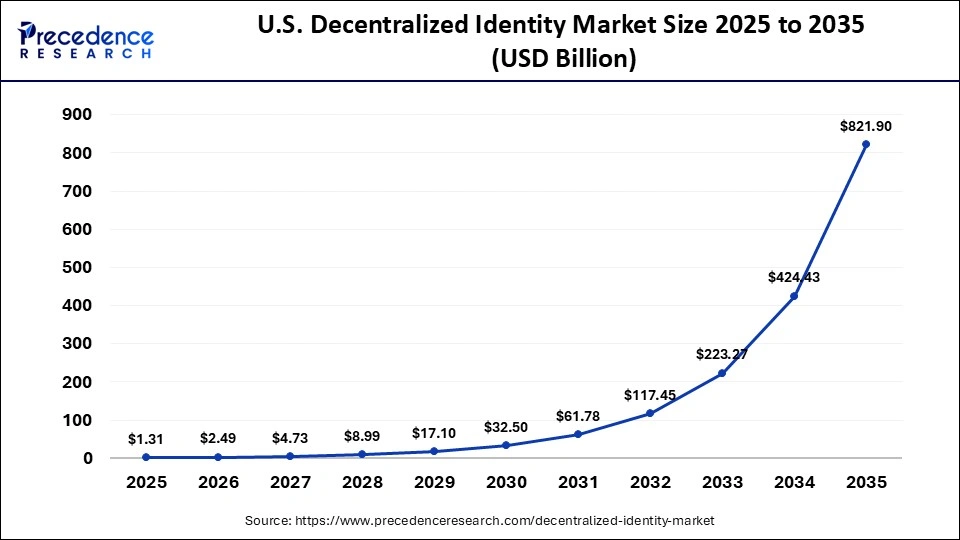
The U.S. decentralized identity market size is calculated at USD 2.49 billion in 2026 and is expected to reach nearly USD 821.90 billion in 2035, accelerating at a strong CAGR of 90.44% between 2026 and 2035.
The Decentralized Identity Market U.S. Analysis
The U.S. leads the market. The U.S. is a major contributor to the market. The country is home to the leading market players such as IBM, Civic Technologies, Microsoft, 1Kosmos, Spruce Systems, Persona Identities, Inc., and others. The country's growth is driven by the rapid adoption of blockchain-based decentralized identity & Zero-Knowledge Proofs (ZKPs), increasing demand for seamless user experiences, rising awareness regarding the significance of data privacy, and strict security regulations. In addition, the growing need for secure and user-centric identity across industries such as IT & telecom, government, healthcare, Banking, Finance & Insurance (BFSI), and others is expected to propel the country's growth during the forecast period.
- In May 2025, the Solana Foundation launched the Solana Attestation Service (SAS). This is a decentralized identity verification protocol designed to simplify compliance and enhance trust across the network. The tool allows applications to validate off-chain data, such as Know Your Customer (KYC) checks and user accreditation. It does this without directly handling sensitive user information.
Asia Pacific Decentralized Identity Market Analysis
Asia Pacific is the fastest-growing region in the market. The region's growth is primarily driven by the rapid pace of digital transformation, growing concerns about identity theft among online users, rising demand for authentication, increasing investments to advance biometric technologies, and rising government initiatives to mitigate risks associated with identity theft and fraud. Moreover, the rising digitalization in numerous industries, such as BFSI (Banking, Finance & Insurance), Government & Public Sector, healthcare & life sciences, IT & Telecom, Retail & E Commerce, and others, is anticipated to propel the demand for decentralized identity as a reliable and tamper-proof method of identity verification. These collective factors are expected to boost the growth of the market during the forecast period.
China Decentralized Identity Market
The China decentralized identity market is emerging as the country adopts blockchain, digital governance, smart cities and data security initiatives. Companies and financial institutions are increasingly adopting blockchain-based identity verification systems to improve cybersecurity, reduce fraud and improve digital transaction efficiency. The country's focus on smart manufacturing, cross-border digital commerce and digital yuan applications is accelerating demand for secure identity verification technologies. The Chinese government has been actively promoting blockchain technology. The country is increasingly adopting cloud computing, e-governance platforms and digital public services, creating long-term opportunities for decentralized identity technologies. Organizations are looking for identity systems that improve data privacy, reduce the risk of centralized data breaches and support secure digital transactions.
India's Decentralized Identity Market Analysis
India's market is experiencing growth. The country's growth is supported by the rapid digitalization, increasing cases of identity theft & cyber-attacks, and rising adoption of biometrics & non-biometric solutions, growing popularity of digital wallets among online users, and strict government compliance requirements. The increasing need for efficient KYC processes propels the adoption of decentralized identity to manage customer data privacy in the country. Several companies are increasingly integrating blockchain technology into digital identity platforms to enhance security and reduce identity fraud activities. The country is also experiencing a strong demand for growing requirements for digital identity solutions in various industries to ensure secure transactions and protect sensitive data. Such a combination of factors is expected to drive the growth of the decentralized identity market in the coming years.
What Are the Driving Factors of The Decentralized Identity Market in Europe?
Europe is expected to grow at a significant CAGR during the forecast period. Europe's decentralized identity landscape is influenced by data protection requirements, digital identity regulations, and initiatives supporting secure cross-border credential verification. To ensure the security of user data along with the ability to provide safe cross-border services, governments promote secure digital identity systems. Public services and fintech have high adoption rates, and secure authentication is a significant factor.
Germany Market Trends
Germany is advancing digital identity wallet initiatives within the European digital identity framework, with an emphasis on secure credential sharing and user privacy. Verified credentials can be stored and shared in a secure manner by the citizens. The government and private sectors are well coordinated in constructing a unified system. Privacy technologies are actively used to secure the data of users with the possibility of verification, which ensures that all data protection standards are followed strictly.
What Are the Driving Factors of The Decentralized Identity Market in Latin America?
Latin America is expected to grow at a significant CAGR during the forecast period. The region of Latin America is expanding because of robust fintech growth and digital services. Countries such as Brazil and Argentina are moving towards decentralized identity to enhance secure financial access. Governments and businesses are investing in digital identity tools to minimize fraud and enhance onboarding in banking and online services.
Brazil Market Trends
Brazil's banking and financial services sector presents opportunities for decentralized identity technologies in customer onboarding, credential verification, and fraud prevention. It contributes to the enhancement of customer onboarding and minimization of the risk of fraud. Large companies also use decentralized identity for their workforce and digital operations. There is also an escalating drive to standardize systems in the international arena, which will aid in securing transactions and enhancing trust in online platforms in industries.
How is the Middle East and Africa Performing in The Decentralized Identity Market?
The Middle East and Africa are expected to grow at a significant CAGR during the forecast period. The region is embracing decentralized identity through national digital initiatives and telecommunication services. The expansion is also backed by the smart city initiatives and the use of more digital services, enhancing trust and access in online government and business platforms.
Saudi Arabia Market Trends
Saudi Arabia is increasing digital identity systems as a national change agenda. Government and smart city services incorporate secure identity platforms. Such systems assist users in obtaining services in a safe way and safeguard information. There is keen emphasis on authentication and security to guarantee trusted digital communication between the public and the private sector services.
Who are the Major Players in the Global Decentralized Identity Market?
The major players in the decentralized identity market include Microsoft, IBM, Accenture, Civic Technologies, Evernym, uPort (ConsenSys), Sovrin Foundation, Ping Identity, SecureKey Technologies, NuID, 1Kosmos, Affinidi, SelfKey, Dock, and Transmute.
Recent Development
- Zetrix AI partnered with the China Academy of Information and Communications Technology (CAIAT) to launch Avtar, a blockchain-based trust protocol for AI-powered digital identities. The platform allows individuals and enterprises to create verified AI agents or digital twins that can securely interact, transact and authenticate themselves. (Source: https://www.thestar.com.my)
- IDEMIA partnered with Indicio to launch an interoperable decentralized identity verification platform for financial services. The solution combines biometric verification, verifiable credentials and privacy-preserving authentication. (Source: https://na.idemia.com)
- In December 2025, Ontology launched Ontello Beta, an app integrating encrypted messaging, on-chain identity, and AI agents, aiming to safeguard user identities while ensuring messages are fully encrypted and stored on-chain within one platform. (Source: https://cryptonews.net)
- In January 2025, Identity.com launched a mobile app for digital identity management on Apple and Google platforms, allowing users to store and share verifiable credentials. The app lets individuals add IDs and proofs of uniqueness, enabling identity validation while retaining data control. (Source: https://www.biometricupdate.com)
- In August 2025, Moca Network, a flagship project by Animoca Brands that is building the world's largest chain-agnostic decentralized digital identity network, announced a partnership with Oyunfor, Turkey's leading digital gaming marketplace. The partnership will integrate Moca Network's AIR Kit software development kit (SDK) into Oyunfor, providing more than 6.2 million Turkish gamers with personalized, credential-based rewards and simplified Web3 onboarding.(Source: https://www.animocabrands.com)
- In November 2025, Blaqclouds, Inc., a leading Web3 infrastructure and blockchain technology company, announced the successful completion of Apollo ID, a next-generation decentralized identity module designed for seamless integration within the Apollo Wallet, DEX.ZEUSx.io, and ShopWithCrypto.io (SWC) ecosystems.(Source: https://www.globenewswire.com)
- In December 2025, Moca Network, a flagship project by Animoca Brands to build the world's largest chain-agnostic decentralized digital identity network, announced the beta launch of MocaProof, a gamified digital identity verification and reward platform that leverages blockchain to simplify and advance data privacy and self-sovereignty. (Source: https://www.animocabrands.com)
Decentralized Identity Market Segments
By Identity Type
- Biometrics (Fingerprint/Facial/Iris)
- Non Biometrics (PKI/Verifiable Credentials/Passwordless)
By Vertical
- BFSI (Banking, Finance & Insurance)
- Government & Public Sector
- Healthcare & Life Sciences
- IT & Telecom
- Retail & E Commerce
- Others (Transport, Real Estate, Media, Travel)
By Region
- North America
- Europe
- Asia-Pacific
- Latin America
- Middle East & Africa
For inquiries regarding discounts, bulk purchases, or customization requests, please contact us at sales@precedenceresearch.com
Frequently Asked Questions





Ask For Sample
No cookie-cutter, only authentic analysis – take the 1st step to become a Precedence Research client
 Get a Sample




 sales@precedenceresearch.com
 Schedule a Meeting
