



Digital Accessibility Software Market Trends, Companies, Revenue / Sales Performance, Subscriber Growth, Pricing Strategies, Cloud Adoption, Infrastructure Expansion, Competitive Landscape, and Industry Outlook
Digital Accessibility Software Market (By Deployment Model: Cloud-Based, On-Premise; By Enterprise Size: Large Enterprises, SMEs; By Solution Type: Web Accessibility Software, Accessibility Testing & Monitoring, Document Accessibility Software, Mobile Accessibility Software, Other Accessibility Solutions; By End User: BFSI, Government and Public Sector, Retail and E-Commerce, Healthcare, Education, IT and Telecom, Others) - Global Industry Analysis, Size, Trends, Leading Companies, Regional Outlook, and Forecast 2026 to 2035
Source: https://www.precedenceresearch.com/digital-accessibility-software-market
 Get a Sample
 Table Of Content


Digital Accessibility Software Market Size and Forecast 2026 to 2035
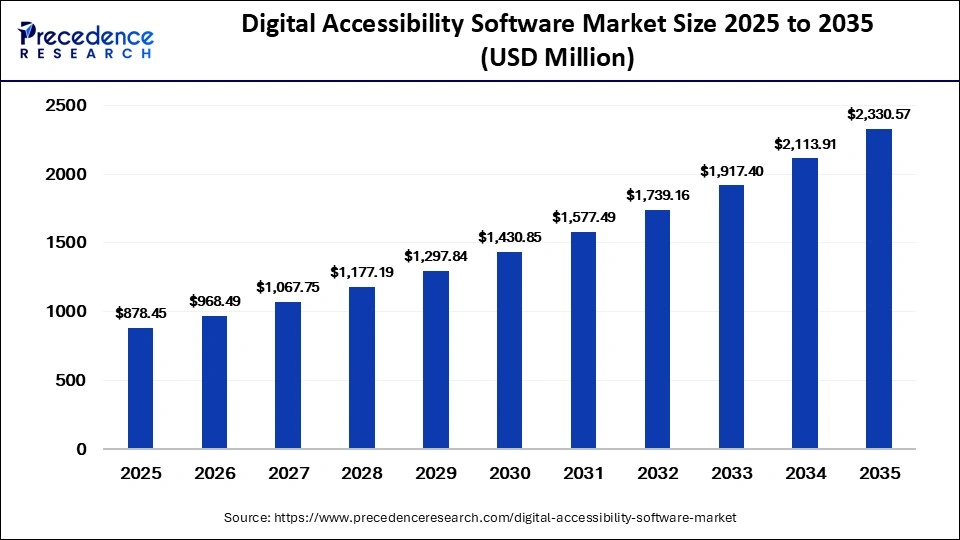
The global digital accessibility software market size accounted for USD 878.45 million in 2025 and is predicted to increase from USD 968.49 million in 2026 to approximately USD 2,330.57 million by 2035, expanding at a CAGR of 10.25% from 2026 to 2035. The market is driven by the growing implementation of strict global regulatory mandates and even compliance laws.
Key Takeaways
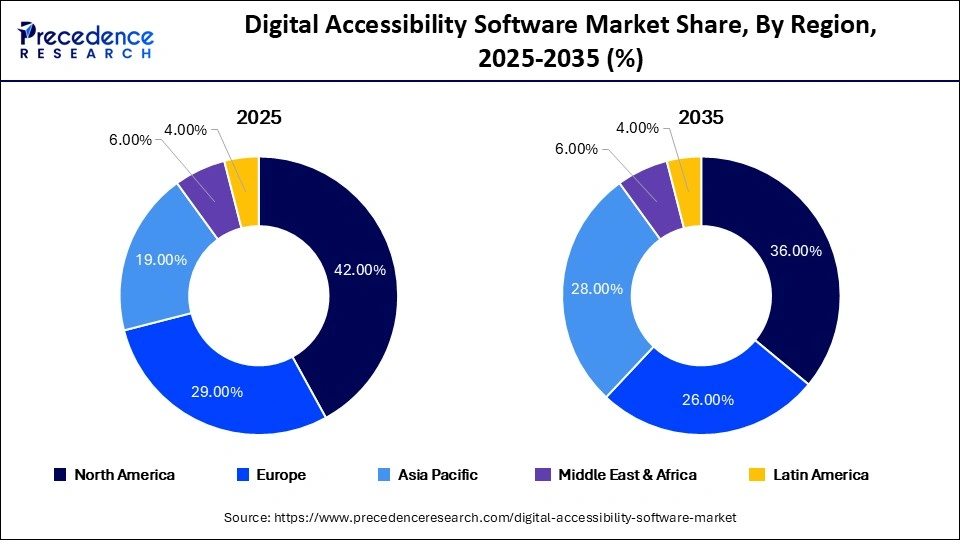
- North America accounted for the highest revenue share of 42% in the digital accessibility software market in 2025.
- Asia-Pacific is expected to grow at the fastest 21.2% CAGR between 2026 and 2035.
- By deployment model, the cloud-based segment dominated the market with a share of 68% in 2025 and is expected to grow at the fastest CAGR of 18.9% in the coming years.
- By deployment model, the on-premise segment held a 32% share of the market in 2025 and is expected to grow at a CAGR of 10.7% during the projection period.
- By enterprise size, the large enterprises segment held a dominant position in the market with a 62% share in 2025.
- By enterprise size, the SMEs segment held a 38% share of the market in 2025 and is expected to grow at the fastest CAGR of 19.6% during the projection period.
- By solution type, the web accessibility software segment held a dominant position in the digital accessibility software market with a 48% share in 2025.
- By solution type, the mobile accessibility software segment held 8% share of the market in 2025 and is expected to grow at the fastest CAGR of 22.4% during the projection period.
- By end user, the government and public sector segment held a dominant position in the market with a 22% share in 2025.
- By end user, the retail and e-commerce segment held a 17% share of the market in 2025 and is expected to grow at the fastest CAGR of 18.9% during the projection period.
Market Overview
The digital accessibility software sector refers to the industry of vendors, platforms, and automated tools that help businesses ensure their websites, mobile application, and even digital content are usable by people with disabilities. It is driven by the global shift toward digital inclusivity, strict legal compliance, and technological advancements. It ensures that websites, mobile apps, and even documents are usable by people with disabilities.
Digital Accessibility Software Market Trends
- Sweeping mandates such as the European Accessibility Act (EAA) and routine U.S. ADA lawsuits mean accessibility is no longer optional. Organizations must demonstrate continuous compliance, shifting buyer behavior from one-time audits to recurring enterprise software subscriptions.
- Budget-friendly, cloud-based solutions and freemium widgets are making accessibility software accessible to small and medium enterprises (SMEs), which currently represent the fastest-growing customer base.
- Industry leaders are preparing for the upcoming WCAG 3.0 framework, which introduces a new scoring model (bronze, silver, gold) to grade organizational accessibility maturity rather than just basic pass or fail metrics.
Market Report Coverage and Key Metrics
| Report Coverage | Details |
| Market Size in 2025 | USD 878.45 Million |
| Market Size in 2026 | USD 968.49 Million |
| Market Size by 2035 | USD 2,330.57 Million |
| Market Growth Rate from 2026 to 2035 | CAGR of 10.25% |
| Dominating Region | North America |
| Fastest Growing Region | Asia Pacific |
| Base Year | 2025 |
| Forecast Period | 2026 to 2035 |
| Segments Covered | Deployment Model, Enterprise Size, Solution Type, End User, and Region |
| Regions Covered | North America, Europe, Asia-Pacific, Latin America, and Middle East & Africa |
Market Dynamics
Drivers
Broader Corporate Shift Toward Digital Inclusivity
Corporate digital inclusivity is the primary driver for the market because firms now view accessibility as a strategic business imperative rather than just a legal obligation. Organizations depend on these tools to tap into a broader customer base, avoid costly lawsuits, and improve their overall brand reputation. Accessibility features such as alt-text, transcripts, and logical page structures enhance search engine optimization (SEO) and site loading speeds, delivering a better user experience for all users.
Restraint
High Upfront Implementation Costs
High upfront implementation costs act as a major market restraint because they need heavy initial investments in software licensing, system audits, and even remediation before any returns are realized. For small and medium-sized enterprises (SMEs), these steep entry barriers usually make digital accessibility software economically prohibitive. Effective implementation demands deep accessibility expertise, which is currently a scarce skill. Businesses must invest in training developers and also designers, or hire external consultants, which significantly inflates short-term spending.
Opportunity
Expanding Digital Operations
Expanding digital operations serves as a massive growth opportunity for the market as it multiplies an organization's consumer touchpoints, necessitating automated solutions to maintain compliance, mitigate legal risks, and even capture a broader customer base. Advanced machine learning tools now enable businesses to automate continuous accessibility testing and also mobile optimization across their rapidly growing digital networks, making ongoing compliance much more affordable and scalable.
Market Segmentation Analysis
Deployment Model Insights
The Cloud-based Segment Dominated the Market with 68% of Market Share in 2025
The cloud-based segment dominated the digital accessibility software market with a share of 68% in 2025 and is expected to grow at the fastest CAGR of 18.9% in the coming years. This is due to SaaS adoption growth, lower deployment costs, and continuous compliance updates. The integration of AI has streamlined intelligent, automated testing and code remediation, making it easier for businesses to bridge the gap between surface-level scans and even genuine compliance.
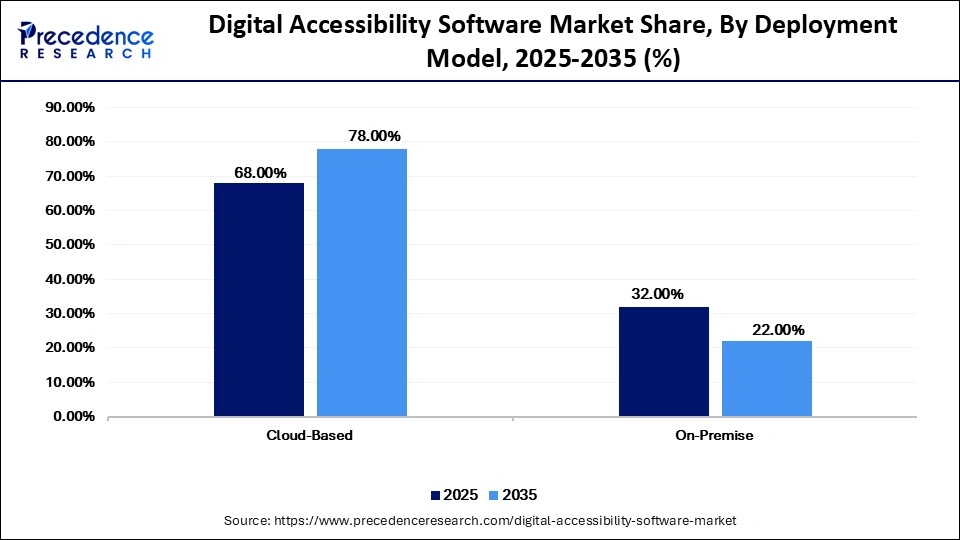
The on-premise segment held a 32% share of the market in 2025 and is expected to grow at a CAGR of 10.7% during the projection period. This is due to data security requirements, internal compliance control, and legacy infrastructure integration. Governments worldwide have heightened penalties for non-compliance, forcing organizations to adopt robust accessibility solutions to reduce legal exposure. Organizations are prioritizing DEI (Diversity, Equity, and Inclusion) programs and striving to provide inclusive user experiences that cater to aging populations and individuals with disabilities.
Enterprise Size Insights
Why Did the Large Enterprises Segment Lead the Digital Accessibility Software Market?
The large enterprises segment held a dominant position in the market with a 62% share in 2025, driven by complex compliance obligations, large digital asset portfolios, and brand reputation management. Organizations prioritize digital inclusivity in their ESG metrics, treating accessible design as a vital component of corporate social responsibility and customer retention rather than an afterthought. Large enterprises now mandate which third-party vendors and digital service providers produce concrete Accessibility Conformance Reports, creating an industry-wide domino effect.
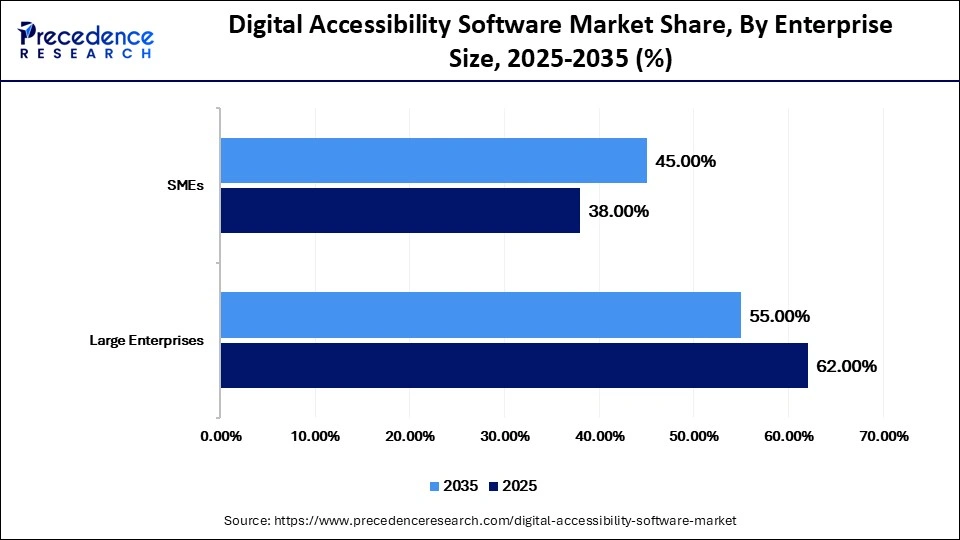
The SMEs segment held a 38% share of the market in 2025 and is expected to grow at the fastest CAGR of 19.6% during the projection period. This is mainly due to affordable SaaS offerings, increasing regulatory awareness, and digital commerce growth. Accessibility features naturally overlap with SEO improvements and even general user experience (UX). Accessible sites rank better on search engines and reduce cart abandonment, directly increasing conversion rates. As investors increasingly prioritize diversity, equity, and inclusion, SMEs are using accessibility software to showcase strong ESG (Environmental, Social, and Governance) values to their stakeholders.
Solution Type Insights
Why Did the Web Accessibility Software Segment Lead the Digital Accessibility Software Market?
The web accessibility software segment led the market with a 48% share in 2025, driven by WCAG compliance requirements, website modernization initiatives, and the growth of online transactions. The enforcement of legal frameworks, like the European Accessibility Act and stringent updates to the ADA and Section 508 in the U.S., demands that digital platforms remain compliant or face severe penalties. AI and machine learning have streamlined the remediation process, enabling developers to automate testing, catch compliance errors early, and even integrate accessibility checks into standard development pipelines.
Digital Accessibility Software Market Share, By Solution Type, 2025-2035 (%)
| Solution Type | 2025 | 2035 | CAGR (%) |
| Web Accessibility Software | 48.00% | 44.00% | 15.20% |
| Accessibility Testing & Monitoring | 24.00% | 27.00% | 18.60% |
| Document Accessibility Software | 15.00% | 14.00% | 15.80% |
| Mobile Accessibility Software | 8.00% | 11.00% | 22.40% |
| Other Accessibility Solutions | 5.00% | 4.00% | 13.50% |
The mobile accessibility software segment held 8% share of the market in 2025 and is expected to grow at the fastest CAGR of 22.4% during the projection period. This is mainly due to mobile-first digital strategies, app accessibility regulations, and rising smartphone usage. With over half of the global population accessing the internet primarily through mobile devices, banking, retail, and payment activities have shifted to mobile apps. Consequently, the need has skyrocketed for specific mobile suites that simulate gestures, run biometric checks, and support OS-level native tools such as TalkBack and VoiceOver.
The accessibility testing and monitoring segment held 24% share of the market in 2025 and is expected to grow at a CAGR of 18.6% during the projection period. This is due to DevOps integration, regulatory audits, and growing software complexity. Technological advancements have propelled market expansion. The integration of AI and machine learning into testing tools enables continuous monitoring and even automated checks to be built directly into development (CI/CD) pipelines.
End User Insights
How the Government and Public Sector Segment Dominated the Digital Accessibility Software Market?
The government and public sector segment held a dominant position in the market, with a 22.00% share in 2025, driven by public accessibility mandates, digital government initiatives, and citizen service modernization. Public sector agencies have updated their vendor solicitations to auto-reject bids that do not include compliant ACRs. This has driven government contractors and agencies to heavily invest in software that can auto-generate these reports efficiently. The integration of AI and machine learning into testing and remediation tools has made continuous compliance monitoring much faster and cheaper to scale across large government databases.
Digital Accessibility Software Market Share, By End User, 2025-2035 (%)
| End User | 2025 | 2035 | CAGR (%) |
| BFSI | 18.00% | 17.00% | 15.30% |
| Government & Public Sector | 22.00% | 21.00% | 15.80% |
| Retail & E-Commerce | 17.00% | 18.00% | 18.90% |
| Healthcare | 12.00% | 13.00% | 18.20% |
| Education | 11.00% | 12.00% | 18.40% |
| IT & Telecom | 10.00% | 10.00% | 16.70% |
| Others | 10.00% | 9.00% | 15.00% |
The retail and e-commerce segment held a 17% share of the market in 2025 and is expected to grow at the fastest CAGR of 18.9% during the projection period. This is mainly due to growth in online shopping, improved customer engagement, and accessibility compliance requirements. Innovation in AI-driven automated testing and machine learning enables businesses to detect, monitor, and quickly fix accessibility barriers. These technologies have lowered the complexity and cost of maintaining compliance.
The BFSI segment held 18% share of the market in 2025 and is expected to grow at a CAGR of 15.3% during the projection period. This is due to regulatory compliance requirements, digital banking expansion, and inclusive financial services initiatives. Banks recognized which are accessible, user-friendly digital platforms attract a wider customer base. Improving digital inclusion also works with modern Environmental, Social, and Governance (ESG) scorecards.
Market Regional Analysis: North America, Europe, Asia-Pacific
U.S. Digital Accessibility Software Market Size and Growth 2026 to 2035
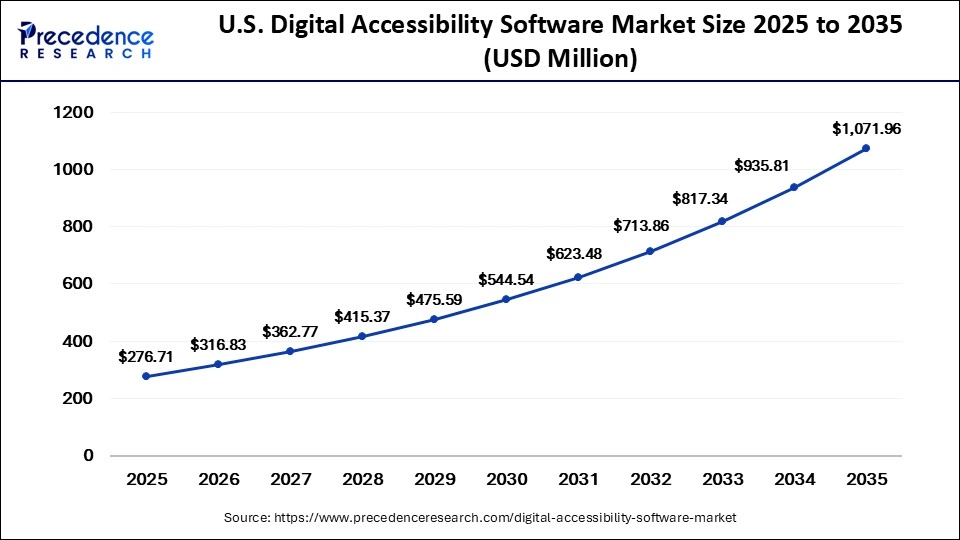
The U.S. digital accessibility software market size was evaluated at USD 276.71 million in 2025 and is projected to reach around USD 1,071.96 million by 2035, growing at a CAGR of 14.60% from 2026 to 2035.
What Led the Global North American Digital Accessibility Software Market Grow in 2025?
North America held a major market share of 42% in 2025. This is due to ADA compliance requirements, strong enterprise digital transformation, and high website accessibility adoption. Companies are heavily using AI, Machine Learning (ML), and Natural Language Processing (NLP) to automate the detection of accessibility issues. AI-driven tools streamline remediation processes, providing real-time captioning, adaptive interfaces, and even automated testing that integrate seamlessly into developer pipelines.
U.S. Market Analysis
The U.S. market is mainly driven by strict legal enforcement of the Americans with Disabilities Act (ADA) for web content, widespread enterprise acceptance of AI-driven remediation tools, and the growing business realization that inclusive design expands market reach and improves customer retention.
Europe: The Second-Largest Market
Europe held the second-largest share of 29% in the digital accessibility software market in 2025 and is expected to grow at a notable CAGR of 15.8% during the projection period, driven mainly by the European Accessibility Act implementation, public-sector compliance mandates, and digital inclusion initiatives. The integration of AI and machine learning into platforms allows businesses to automate compliance monitoring and swiftly detect issues such as missing alt-text or poor navigation structures.
UK Market Analysis
The UK market is driven by stringent regulatory mandates, significant spending power, and even a massive shift toward inclusive business strategies. The integration of AI-driven scanning, cloud APIs, and automated remediation tools in modern DevOps cycles has reduced the expense and complexity of building accessible sites.
Asia Pacific: The Fastest-Growing Region
Asia-Pacific held a 19% share of the market in 2025 and is expected to grow at the fastest CAGR of 21.2% during the projection period, driven by rapid digitalization across enterprises, an expanding internet user base, and government accessibility initiatives. Governments across the region are enforcing strict digital inclusivity laws. Thus, leading examples include the Disability Discrimination Act in Australia and also existing disability legislation in Japan. Additionally, public procurement rules now frequently demand Accessibility Conformance Reports, pushing both public and private sectors to accept compliance software.
China Market Analysis
The market in China and the broader Asia-Pacific region is experiencing rapid growth due to digital transformation, government inclusivity initiatives, and the need to serve a rapidly aging population. Government led digital transformation initiatives and national accessibility policies demand public services, government portals, and corporate digital assets to meet compliance standards.
What Drives the Digital Accessibility Software Market in Latin America?
Latin America held 6% share of the market in 2025 and is expected to grow at a significant CAGR of 17.3% during the projection period, driven by increasing online service adoption, emerging accessibility regulations, and the expansion of e-commerce platforms. Firms increasingly view digital accessibility as both a business opportunity and even a way to avoid legal exposure. By using accessibility software, large enterprises and SMEs alike protect themselves from liability while improving their brand image.
Brazil Market Analysis
The Brazilian market is mainly driven by strict federal mandates, including the Brazilian Inclusion Law (LBI), which legally demands both public and private digital platforms to be accessible. The surge in mobile banking, a rapidly expanding e-commerce sector, and even the implementation of domestic technical standards, such as ABNT NBR 17225, have accelerated enterprise acceptance of accessibility auditing and remediation solutions.
Will the Middle East and Africa Grow in the Digital Accessibility Software Market?
The Middle East and Africa held 4% share of the market in 2025 and are expected to grow at a notable CAGR of 18.1% during the projection period, driven by the adoption of AI, machine learning, and cloud-based platforms that are automating processes like real-time captioning, adaptive interfaces, and text-to-speech, which lowers the barrier to entry for businesses to adopt these tools. Public sector initiatives in countries such as the UAE and Saudi Arabia are embedding digital accessibility standards directly into smart government and national development programs, like Vision 2030.
Saudi Arabia Market Analysis
The Saudi Arabian market is driven by the government's Vision 2030 initiatives, strict national regulatory mandates, and surging investment in digital inclusivity. The Saudi government has earmarked massive funding for digital infrastructure and even disability-focused technology initiatives to build an inclusive digital economy.
Market Competitive Landscape: Leading Companies and Strategies
The digital accessibility software market is highly competitive, with established technology providers, accessibility specialists, and AI-driven startups providing solutions for website, mobile application, and document compliance. Major players differentiate themselves via automated accessibility testing, remediation tools, AI-powered monitoring, developer integrations, and compliance support for standards like WCAG, ADA, and EN 301 549. Cloud-based platforms, continuous monitoring, and real-time reporting are becoming key competitive factors. Vendors are also expanding via partnerships, acquisitions, and product innovation to address evolving regulatory requirements and even enterprise demand. Increasing digital transformation and stricter accessibility regulations continue to intensify competition and drive technological advancements.
Digital Accessibility Software Market Companies
- AudioEye
- accessiBe
- UserWay
- Level Access
- Crownpeak
- Siteimprove
- Monsido
- DubBot
- EqualWeb
- Silktide
- Deque Systems
- TPGi
- QualityLogic
- BOIA (Bureau of Internet Accessibility)
- Accessibility Checker (CKSource)
Recent Development Digital Accessibility Software Market (2025-2026)
- In March 2026, AudioEye, Inc. declared significant advancements to its digital accessibility platform, built to protect businesses as regulatory pressure intensifies and AI fundamentally rewrites the web in real time.(Source: https://www.audioeye.com)
- In October 2025, Level Access announced the launch of new AI accessibility agents and capabilities to help organizations find accessibility issues earlier, fix them faster, and prove progress as they face accelerated development cycles and increasing demands on time and resources. (Source: https://www.businesswire.com)
Segments Covered in the Report
By Deployment Model
- Cloud-Based
- On-Premise
By Enterprise Size
- Large Enterprises
- SMEs
By Solution Type
- Web Accessibility Software
- Accessibility Testing & Monitoring
- Document Accessibility Software
- Mobile Accessibility Software
- Other Accessibility Solutions
By End User
- BFSI
- Government and Public Sector
- Retail and E-Commerce
- Healthcare
- Education
- IT and Telecom
- Others
By Region
- North America
- Latin America
- Europe
- Asia-pacific
- Middle and East Africa
For inquiries regarding discounts, bulk purchases, or customization requests, please contact us at sales@precedenceresearch.com
Frequently Asked Questions





Ask For Sample
No cookie-cutter, only authentic analysis – take the 1st step to become a Precedence Research client
 Get a Sample




 sales@precedenceresearch.com
 Schedule a Meeting
