



Electrocoagulation Market Size, Companies, Share, Production Capacity, Raw Material Pricing, Export & Import Analysis, Manufacturing Cost, Competitive Positioning, and Demand Forecast
Electrocoagulation Market (By Contaminant Type: Inorganic contaminants, Metals, Organic Contaminants , Biological Contaminants; By Application: Wastewater Treatment, Industrial Effluent Treatment, Drinking Water Treatment, Groundwater Remediation; By Electrode Material: Aluminum, Iron, Steel, Titanium, Carbon; By Reactor Type: Batch Reactor, Continuous Flow Reactor, Electroflotation Reactor, Slurry Reactor; By Current Type: Direct Current (DC), Alternating Current (AC), Pulsed Current) - Global Industry Analysis, Size, Trends, Leading Companies, Regional Outlook, and Forecast 2026 to 2035
Source: https://www.precedenceresearch.com/electrocoagulation-market
 Get a Sample
 Table Of Content


What is the Electrocoagulation Market Size in 2026?
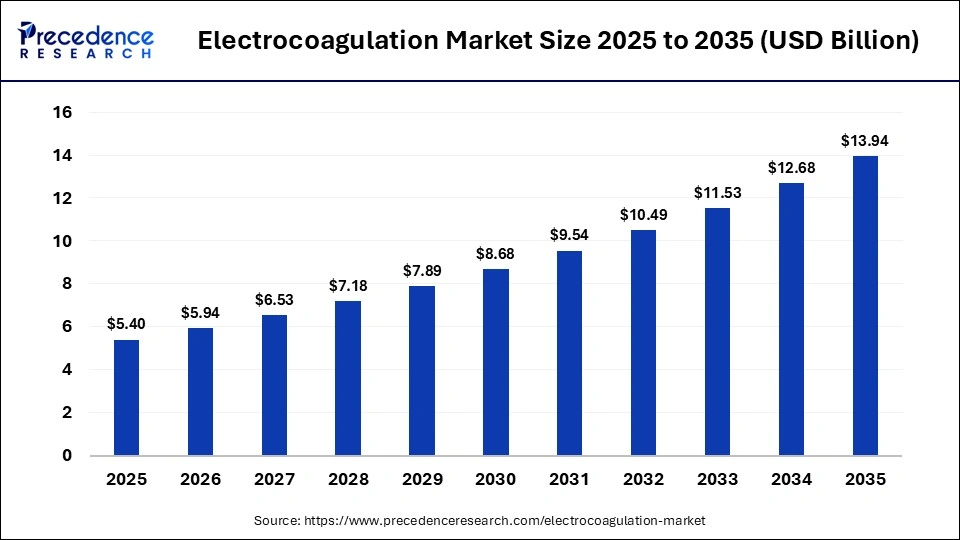
The global electrocoagulation market size accounted for USD 5.40 billion in 2025 and is predicted to increase from USD 5.94 billion in 2026 to approximately USD 13.94 billion by 2035, expanding at a CAGR of 9.95% from 2026 to 2035. The increasing demand for effective wastewater treatment and strict regulations of environmental discharge control drive the market. Rising industrialization and heightened levels of concern about heavy metal contamination are increasing across municipal and industrial sectors.
Key Takeaways
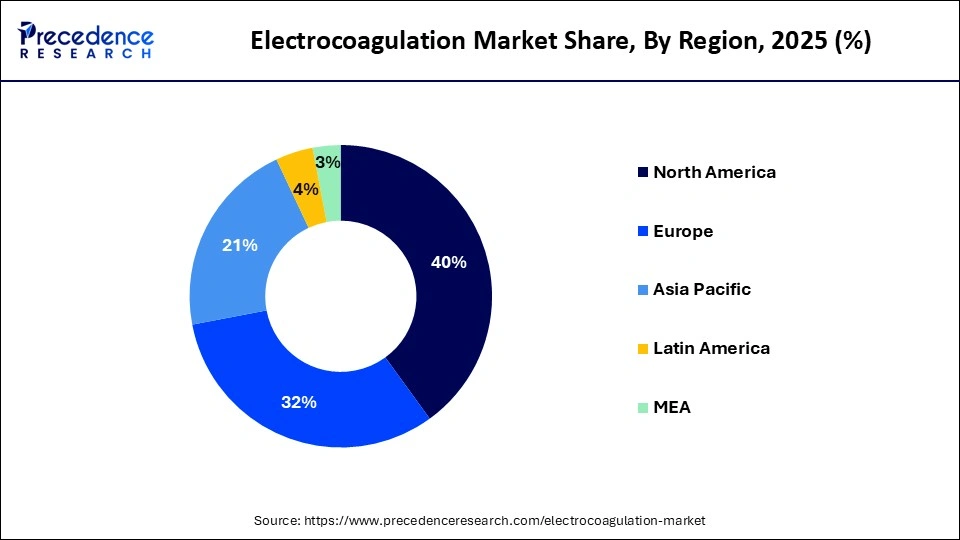
- North America dominated with 40% share in the global market in 2025.
- Asia-Pacific is expected to grow at the fastest CAGR in the market during the forecast period.
- By contaminant type, the inorganic contaminants segment held a dominant position in the market in 2025.
- By contaminant type, the biological contaminants segment is expected to grow at the fastest CAGR in the market between 2026 and 2035.
- By application, the wastewater treatment segment led the global electrocoagulation market in 2025.
- By application, the industrial effluent treatment segment is expected to grow with the highest CAGR in the market during the studied years.
- By electrode material, the iron segment dominated the global market in 2025.
- By electrode material, the titanium segment is expected to expand rapidly in the market in the coming years.
- By reactor type, the batch reactor segment held the largest revenue share of the market in 2025.
- By reactor type, the continuous flow reactor segment is expected to witness the fastest growth in the market over the forecast period.
- By current type, the direct current (DC) segment contributed the biggest revenue share of the market in 2025.
- By current type, the alternating current (AC) segment is expected to gain the highest market share between 2026 and 2035.
Electrification of the Future of Sustainable Water Treatment
The electrocoagulation market is on the rise, where the industries are demanding economical and less chemical water purification technologies. It is cost-effective in the removal of suspended solids, oils, heavy metals, and other contaminants due to the use of coagulation through electricity. Electrocoagulation is ideal compared to traditional treatment with chemicals since it produces less sludge, and its operation can be easily handled. The increase in oil and gas, textile, food processing, and municipal wastewater treatment applications is boosting the growth in the global market.
What is the Role of AI in the Electrocoagulation Market?
Artificial intelligence (AI) plays a vital role in electrocoagulation by automatically adjusting treatment parameters based on real-time water quality data. Predictive maintenance and automated optimization of parameters are improving the work of the electrocoagulation system with the help of AI. Machine learning (ML) software keeps track of voltages, current density, and load of contaminants to optimize the removal efficiency. AI-enabled sensors deliver real-time analytics of water quality and save on energy. Digital control systems also provide remote control of systems and minimize operational costs.
Electrocoagulation Market Trends
- Rising Industry Adoption: Electrocoagulation is witnessing the growing adoption across industries such as oil & gas, mining, food processing, textiles, and municipal wastewater treatment. Industries prefer electrocoagulation due to its effectiveness in removing heavy metals, suspended solids, oils, and complex contaminants.
- Technological Advancements: Continuous improvements in electrode materials, power supply optimization, and reactor design are enhancing treatment efficiency. Advanced control systems now enable precise current density regulation and energy optimization.
- System Innovation: Manufacturers are developing modular, containerized, and mobile electrocoagulation units for on-site deployment. Compact and plug-and-play systems are gaining popularity among small and medium-sized industries.
- Sustainable Development Focus: Electrocoagulation aligns with sustainability goals by minimizing chemical consumption and secondary pollution. The technology supports water reuse and resource recovery initiatives. Lower sludge generation compared to conventional chemical coagulation improves environmental impact.
Market Scope
| Report Coverage | Details |
| Market Size in 2025 | USD 5.40 Billion |
| Market Size in 2026 | USD 5.94 Billion |
| Market Size by 2035 | USD 13.94 Billion |
| Market Growth Rate from 2026 to 2035 | CAGR of 9.95% |
| Dominating Region | North America |
| Fastest Growing Region | Asia Pacific |
| Base Year | 2025 |
| Forecast Period | 2026 to 2035 |
| Segments Covered | Contaminant Type, Application, Electrode Material, Reactor Type, Current Type, and Region |
| Regions Covered | North America, Europe, Asia-Pacific, Latin America, and Middle East & Africa |
Market Dynamics
Driver
Rising Demand for Sustainable and Efficient Water Treatment
The growing demand for eco-friendly, chemical-free, and energy-efficient water treatment technologies is leading to widespread adoption in industries such as oil and gas, textiles, and pharmaceuticals. Stricter environmental regulations aimed at reducing carbon footprints and wastewater toxicity are pushing companies to move away from conventional chemical coagulation methods and promote electrocoagulation as a sustainable alternative, allowing for water reuse and recycling.
Restraint
High Initial Capital Investment and Technical Constraints
Despite associated lower operating costs, the high upfront costs for installing sophisticated, automated, or large-scale electrocoagulation systems pose a significant barrier for small and medium-sized enterprises. Additionally, technical challenges, including electrode fouling, high electricity requirements in certain scenarios, and the need for skilled technicians to manage advanced setups, can limit adoption.
Opportunity
Green Financing and Smart Technology Integration
The expansion of green financing, government subsidies, and tax incentives for environmental upgrades provides robust mechanisms to lower investment barriers and encourage adoption. Moreover, the integration of automation, AI, and IoT technologies into systems is optimizing energy consumption and offering long-term cost benefits, thus boosting the market for advanced, low-maintenance wastewater solutions.
Segment Insights
Contaminant Type Insights
Which Contaminant Type Segment Dominated the Electrocoagulation Market?
The inorganic contaminants segment dominated the market in 2025, because the technology is very effective in the elimination of suspended solids, nitrates, phosphates, and chemical residues. High inorganic loads of pollutants are common in the industrial effluents of mining, chemicals, and manufacturing. Electrocoagulation has the advantage of destabilizing and precipitating these contaminants without the need to use too many chemicals. Regulatory discharge standards also promote the use of inorganic solutions of contaminants by industries. Regular operation of all sorts of variable water blends bolsters the leadership of this segment.
The biological contaminants segment is expected to show the fastest growth over the forecast period, driven by rising concerns over heavy metal pollution, including arsenic, lead, cadmium, and chromium. Tougher environmental laws are imposing advanced cleaning technologies at all industrial locations. Electrocoagulation offers a high level of removal of dissolved metal ions. Increasing mining and factory industries that produce batteries lead to an increase in the generation of metal effluents. The increasingly rising awareness about water toxicity threatens to increase adoption.
Application Insights
Why Did the Wastewater Treatment Segment Dominate the Electrocoagulation Market?
The wastewater treatment segment accounted for the highest revenue share in the market in 2025, as it is largely applied in handling textile, oil & gas, food processing, and chemical wastewater. It is cost-effective and environmentally friendly in its capability to limit the formation of sludge. With governments tightening wastewater reuse and recycling requirements. The rising urbanization and industrialization remain a demand driver.
The industrial effluent treatment segment is expected to gain the highest market share between 2026 and 2035, caused by industrial spills and runoff from agricultural activities. Electrocoagulation systems are efficient in eliminating arsenic, fluoride, and other dissolved contaminants in the groundwater source. Increasing investments in rural and semi-urban water purification activities favor growth. There is improved feasibility through decentralized and modular system deployment. Remediation education programmes also promote the use of remediation technology.
Electrode Material Insights
How the Iron Segment Led the Electrocoagulation Market?
The iron segment led the market in 2025 because of its cost-efficiency and universal nature. Their performance is high in the elimination of turbidity, organic matter, and heavy metals. The iron-based systems are simple to maintain and relocate in different industrial environments. They are less expensive in terms of materials and hence suitable in large scale wastewater plants. Established supply chains also increase their position in the market.
The titanium segment is expected to witness the fastest growth in the market over the forecast period because it has enhanced corrosion resistance and an extended operation cycle. They have also found favor in salty and hostile wastewater conditions. Titanium helps in promoting better electrical conduction and stable operation in continuous operation. Lifecycle costs are more expensive, but they are appealing to adopters in industries. The further increase in demand is promoted by technological advancements in titanium electrodes coated.
Reactor Type Insights
Why Did the Batch Reactor Segment Dominate the Electrocoagulation Market?
The batch reactor segment held the largest revenue share in the market in 2025, as they are simple and can be applied to small to medium-scale operations. They are extensively applied in pilot projects and intermittent treatment. Due to operational flexibility, control of treatment parameters is possible. Reduced initial cost of investment facilitates adoption by small industries. They are designed in the simplest of forms, therefore making them easy to maintain and use.
The continuous flow reactor segment is expected to expand rapidly in the market in the coming years because of the need for high-throughput industrial treatment. They can facilitate continuous processing and increased operational efficiency. Robotics minimizes the human resources and enhances scalability. Continuous systems are becoming popular in large municipal wastewater plants. This can be improved by integrating with smart monitoring technologies.
Current Type Insights
Which Current Type Segment Dominated the Electrocoagulation Market?
The direct current (DC) segment registered its dominance over the global market in 2025 because of consistent and reliable electrode functionality. DC offers consistent coagulant production and effective contaminant removal. Most commercial systems are configured to adapt to direct current power arrangements. DC is highly compatible with various equipment, augmenting the segment's growth. Proven efficiency and operational reliability help to maintain a lead.
The alternating current (AC) segment is expected to grow with the highest CAGR in the market during the studied years, driven by minimizing electrode passivation and improving life. In some applications, AC may be of use to improve energy efficiency. Studies are underway to maximize AC frequency to enhance the removal of contaminants. The increasing popularity of hybrid current systems favors innovation. Segment growth is being driven by industrial facilities that want to enjoy reduced costs of maintenance.
Regional Insights
North America Electrocoagulation Market Size and Growth 2026 to 2035
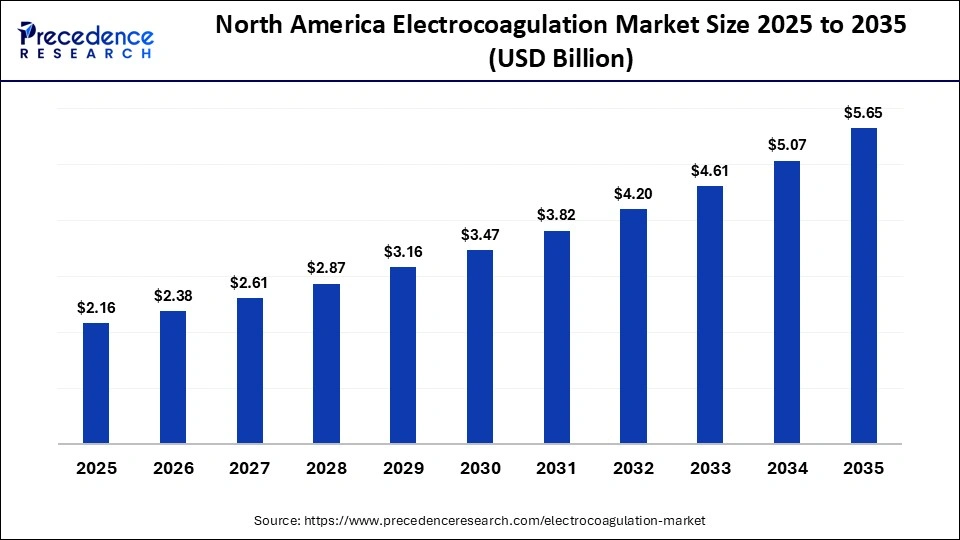
The North America electrocoagulation market size was estimated at USD 2.16 billion in 2025 and is projected to reach approximately USD 5.65 billion by 2035, with a 10.09% CAGR from 2026 to 2035.
Why North America Dominated the Electrocoagulation Market?
North America held a major revenue share of the market in 2025, due to strict regulations of environmental protection and developed wastewater resources. Several sectors with consistently high demand include oil and gas, chemicals, and mining. North American countries invest heavily in renovating their old-fashioned water treatment plants. System efficiency is boosted by technological innovation and robust R&D systems. Adoption is supported by the availability of higher automation and monitoring tools. Environmental compliance requirements also enhance the leadership of markets in the region.
U.S. Electrocoagulation Market Size and Growth 2026 to 2035
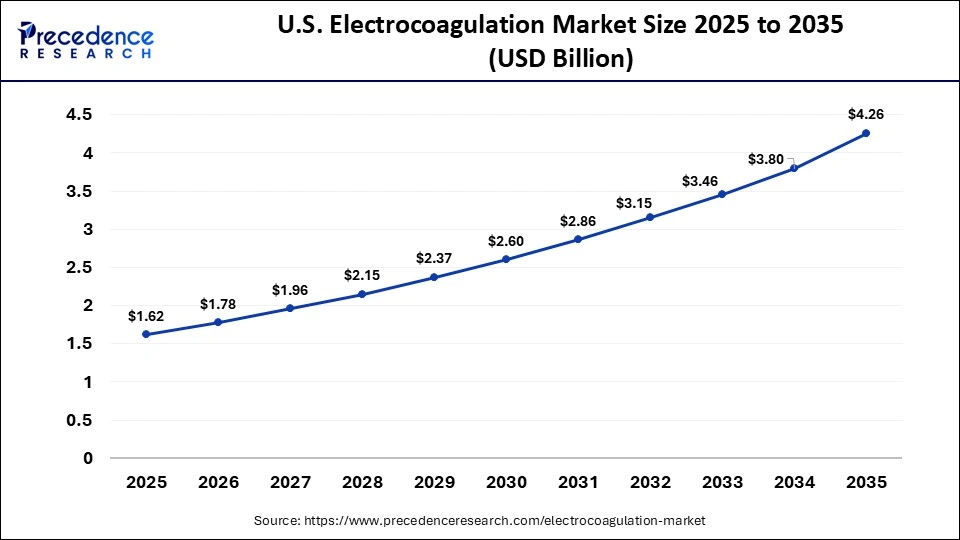
The U.S. electrocoagulation market size was calculated at USD 1.62 billion in 2025 and is expected to reach nearly USD 4.26 billion in 2035, accelerating at a strong CAGR of 10.15% between 2026 and 2035.
U.S. Country-Level Analysis
The U.S. is the first in the country in terms of the strict implementation of industrial discharge laws and water reuse requirements. Canada is investing in water treatment and environmental protection of mining waste. Sustainability at the federal and state levels promotes the use of advanced treatment. Infrastructure modernization is backed by the partnership of the government and the business sector.
Why is Asia-Pacific the Fastest-Growing Region in the Electrocoagulation Market?
Asia-Pacific is expected to witness the fastest growth during the predicted timeframe, following the fast industrialization and production of wastewater. The increasing population in the urban areas strains the municipal treatment infrastructure. Governments are increasing control policies on pollution to overcome water contamination. The growth of production centres leads to the need to adopt effective effluent treatment systems. Systems of deployment of modular systems are facilitated by infrastructure development programs. Increasing environmental awareness increases market penetration.
Country-Level Analysis
China has the greatest investments in terms of massive industrial wastewater treatment at the country level. India has been expanding its regulatory systems to deal with groundwater contamination. Japan highlights the use of modern water recycling. South Korea has initiatives that promote sustainability in industries. Southeast Asian countries are putting funds into decentralized treatment. A combination of these national strategies contributes to the rapid market development in the Asia-Pacific.
Will Europe Grow in the Electrocoagulation Market?
Europe is expected to grow at a considerable CAGR in the upcoming period, because of strict environmental directives on the discharge and reuse of water. Advanced treatment technologies are embraced by sustainability goals and policies of the circular economy. Wastewater recycling programs in industries also increase the growth of the market. Green infrastructure modernization investments are in line with the use of electrocoagulation. Demand is also enhanced by increased awareness of people about water contamination. Competitiveness is brought about by technological advancement in energy-efficient systems.
Country-Level Analysis
The analysis at the country level indicates that Germany is the leader in terms of the innovation of industrial wastewater management. France is committing in municipality water infrastructure upgrades. The UK is also emphasizing groundwater purification and industrial adherence. Italy and Spain are embracing modern systems of treatment in the textile and manufacturing industries. Scandinavian nations place emphasis on water reuse projects that are sustainable. Such concerted activities led to the blistering growth of Europe.
How will Latin America Emerge in the Electrocoagulation Market?
Latin America is emerging as a significantly growing region in the global market, mainly driven by rapid industrialization, stringent water quality regulations, and the need for sustainable, cost-effective water treatment technologies. Governments in Brazil, Mexico, and Chile are enforcing stricter standards on industrial discharge to combat pollution, which is forcing industries to adopt advanced treatment methods. Growing water scarcity has accelerated the need for water recycling and reuse, offering efficient solutions for treating complex wastewater streams for non-potable reuse.
Brazil Market Trends
Brazil is establishing itself as South America's hub for electrocoagulation technology, driven by a high demand for non-chemical wastewater treatment across its expanding agricultural, mining, and steel industries. Supported by stricter mining regulations, increased local manufacturing, and advancements in direct pulsed current technology, Brazil is positioning itself as a regional leader in sustainable, high-efficiency effluent management.
How will the Middle East and Africa grow in the Electrocoagulation Market?
The Middle East and Africa are significantly growing in the global market, with this growth primarily driven by acute water scarcity, rapid industrialization, and stringent environmental regulations aimed at reducing chemical usage in water treatment. Governments, particularly in GCC countries, are enforcing strict standards on effluent disposal. Electrocoagulation is favored for its ability to efficiently remove heavy metals, oil and grease, and suspended solids without adding chemical sludge, facilitating sustainable water management through effective wastewater treatment and reuse.
UAE Market Trends
The UAE is transforming into a high-tech Electrocoagulation hub by prioritizing advanced, sustainable treatment to meet strict quality standards, mainly driven by extreme water scarcity and a goal of near-total reuse. Backed by industrial initiatives like Make it in the Emirates and massive infrastructure investments such as ADNOC's Dh200 billion plan, it is a critical, high-growth market for innovative, eco-friendly water solutions.
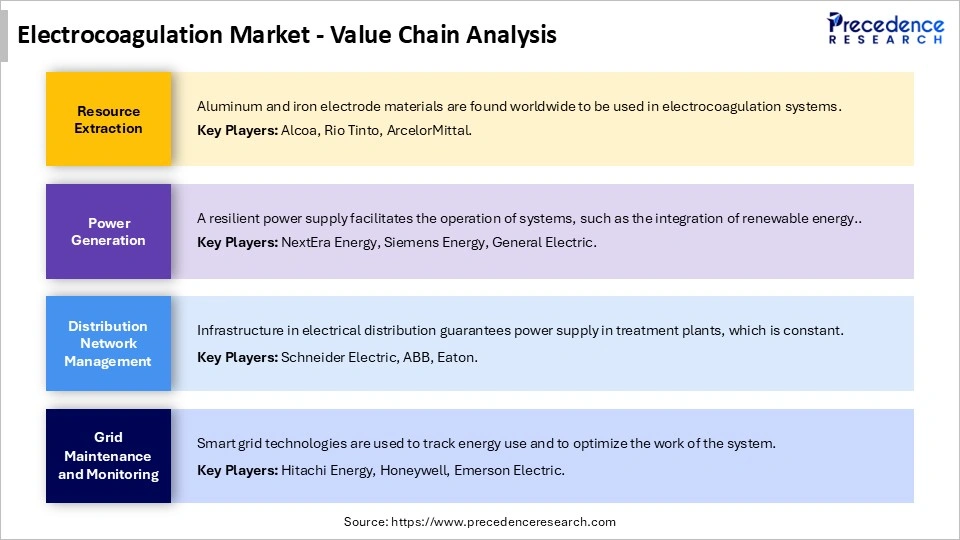
Electrocoagulation Market Value Chain Analysis
Electrocoagulation Market Companies
- Ecolab
- Veolia
- SUEZ
- Aqua-Aerobic Systems
- H2O Innovation
- Aqua-Chem
- Electrocoagulation Technologies
- Envirogen Technologies
- Hoganas
- WaterTectonics
- Water Vision
- Powell Water Systems
- Golder
- Genesis Water Technologies
- Nijhuis Industries
Recent Developments
- In February 2026, researchers from the Indian Institute of Technology (IIT), Guwahati, developed a new electrocoagulation system to effectively remove 99% arsenic from contaminated water at an affordable cost. The system is suitable for use in regions with limited access to complex water treatment infrastructure. (Source: https://assamtribune.com)
- In January 2025, Great Lakes Filters unveiled its patented electrocoagulation (EC) technology that destroys PFAS “forever chemicals” on-site in industrial wastewater and landfill leachate. The system breaks down PFAS at the molecular level, reducing treatment costs and liability while meeting strict discharge limits without secondary processing.(Source: https://www.prnewswire.com)
- In January 2025, the ALT-P project, organized by the United Utilities and other partners, investigated the potential use of alternative methods, such as electrocoagulation, natural coagulants, and reactive media, to substitute the use of chemical dosing in the process of removing phosphorus in rural wastewater works. Tests demonstrated that electrocoagulation was an effective phosphorus treatment method that needed no liquid chemicals or produced fewer health hazards.
Segments Covered in the Report
By Contaminant Type
- Inorganic contaminants
- Metals
- Organic Contaminants
- Biological Contaminants
By Application
- Wastewater Treatment
- Industrial Effluent Treatment
- Drinking Water Treatment
- Groundwater Remediation
By Electrode Material
- Aluminum
- Iron
- Steel
- Titanium
- Carbon
By Reactor Type
- Batch Reactor
- Continuous Flow Reactor
- Electroflotation Reactor
- Slurry Reactor
By Current Type
- Direct Current (DC)
- Alternating Current (AC)
- Pulsed Current
By Region
- North America
- Europe
- Asia-Pacific
- Latin America
- Middle East & Africa
For inquiries regarding discounts, bulk purchases, or customization requests, please contact us at sales@precedenceresearch.com
Frequently Asked Questions
Tags





Ask For Sample
No cookie-cutter, only authentic analysis – take the 1st step to become a Precedence Research client
 Get a Sample




 sales@precedenceresearch.com
 Schedule a Meeting
