



Engineered Wood Market Size, Key Companies, Company Production Capacity, Manufacturing Efficiency, Capacity Utilization, Raw Material Consumption, Cost Structure, Export Trends, Company Expansion Strategies, and Competitive Landscape
Engineered Wood Market (By Application: Construction, Flooring, Furniture, Packaging, Transport, Others; By Type: Plywood, Medium Density Fiberboard (MDF), Cross Laminated Timber (CLT), Laminated Veneer Lumber (LVL), Oriented Strand Board (OSB), Glue Laminated Timber (Glulam), Particle Board; By End Use Industry: Residential, Non-Residential) - Global Industry Analysis, Size, Trends, Leading Companies, Regional Outlook, and Forecast 2026 to 2035
Source: https://www.precedenceresearch.com/engineered-wood-market
 Get a Sample
 Table Of Content


What is the Engineered Wood Market Size?
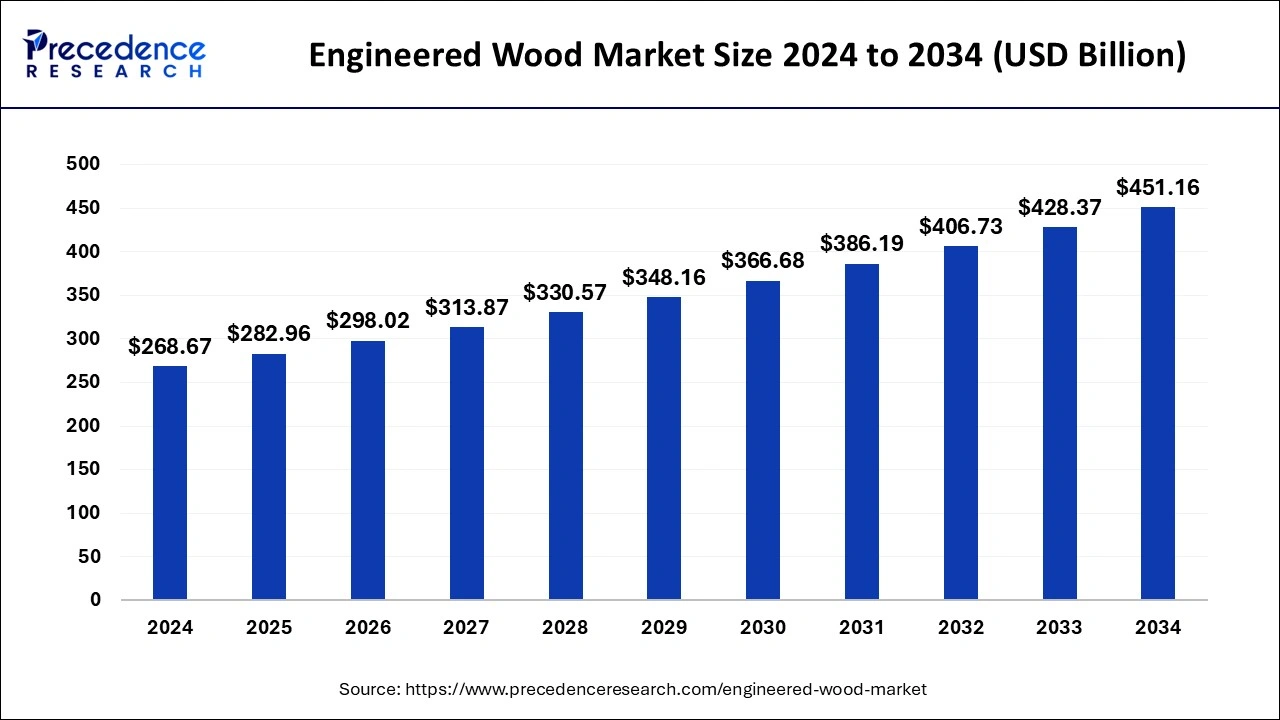
The global engineered wood market size is calculated at USD 282.96 billion in 2025 and is predicted to increase from USD 298.02 billion in 2026 to approximately USD 473.18 billion by 2035, expanding at a CAGR of 5.28% from 2026 to 2035. The surge in population growth demanding sophisticated houses is the key factor driving the engineered wood market growth. Also, the increasing focus on sustainable practices coupled with innovations in furniture design is expected to fuel market growth further.
Engineered Wood Market Key Takeaways
- Asia Pacific dominated the engineered wood market with the largest market share in 2025.
- North America is expected to show the fastest growth over the studied period.
- By type, the plywood segment dominated the global market in 2025.
- By type, the medium-density fiberboard (MDF) segment is expected to grow at the fastest CAGR over the forecast period.
- By application, the construction segment led the market in 2025.
- By application, the furniture segment is expected to grow at the fastest CAGR over the forecast period.
- By end use, the residential segment contributed the maximum market share in 2025.
- By end use, the non-residential segment is expected to grow at a notable CAGR during the projected period.
Market Overview
Engineered wood consists of many wood products created by joining particles, fibers, veneers, and wood strands with different materials to craft an artificial composite material. The engineered wood market encompasses a number of products ranging from roof trusses to plywood. This wood can sometimes be prepared from wood waste. Engineered wood has more benefits as compared to cement, which is responsible for CO2 emissions across the globe. This wood is also biodegradable, renewable energy efficient, and non-toxic, making it the best option while performing construction activities.
Impact of Artificial Intelligence AI on Wood Processing
The integration of artificial intelligence in wood production has transformed the efficiency and quality of wood products. AI-powered machines are capable of accurately cutting, shaping, and grading timber with no wastage. Furthermore, AI has enabled real-time quality monitoring in the industry. This technology can identify the smallest anomalies in wood that the human eye cannot notice. Also, AI proves to be a good solution to optimize inventory management processes.
- In November 2024, EasyODM launched its AI-powered machine vision software. This software, designed for easy integration and use, features capabilities for dynamic and static inspections, on-premises data processing, and a no-code tool set. Highly applicable in industries such as textiles, glass, pharma, wood, and plastic.
Engineered Wood Market Growth Factors
- Ongoing government initiatives promoting green building materials can soon boost engineered wood market growth.
- Technological advancements in wood manufacturing processes are expected to propel market growth shortly.
- Rising investment in construction sectors globally will likely contribute to the market expansion further.
Market Trends
- Engineered hardwood flooring remains a favored option among homeowners, designers, and architects for its durability, versatility, and visual attractiveness. With growing environmental consciousness, sustainability emerges as a significant trend. Homeowners and designers are progressively choosing sustainable flooring options, with engineered hardwood at the forefront.
- Customization is essential when considering flooring selections. Homeowners seek methods to showcase their uniqueness within their spaces, and engineered hardwood provides the versatility to design a genuinely personalized floor. Recently, researchers have created innovative wood modification techniques that endow wood with novel properties that might allow the substitution of conventional non-renewable, petroleum-based materials in different uses, including vehicles, energy storage, construction, and environmental cleanup, moving wood beyond the traditional construction and paper sectors.
- Canada's forest management practices rank among the most sophisticated globally, with approximately 90% of its commercial forests certified as sustainable by independent organizations like the Canadian Standards Association, the Forest Stewardship Council, the International Standards Organization (ISO), and the Sustainable Forests Initiative (SFI). Both CSA and FSC employ 'chain of custody' labeling systems that track the source, harvesting, and processing journey of specific timbers. These improvements in management techniques have coincided with advancements in product development and manufacturing technologies that have resulted in the launch of various new engineered wood products.
Market Scope
| Report Coverage | Details |
| Market Size by 2026 | USD 298.02 Billion |
| Market Size in 2025 | USD 282.96 Billion |
| Market Size in 2035 | USD 473.18 Billion |
| Market Growth Rate from 2026 to 2035 | CAGR of 5.28% |
| Dominating Region | Asia Pacific |
| Fastest Growing Region | North America |
| Base Year | 2025 |
| Forecast Period | 2026 to 2035 |
| Segments Covered | Type, Application, End-use, and Regions. |
| Regions Covered | North America, Europe, Asia-Pacific, Latin America, and Middle East & Africa. |
Market Dynamics
Drivers
Versatility and cost-effectiveness of engineered wood
Engineered wood is highly adopted because of its cost-effectiveness as compared to conventional hardwood. Its structure offers stability, durability, and resistance to warping, which makes it the best fit for many applications, including furniture, flooring, and structural components. In addition, this wood has lower manufacturing and installation costs, along with good flexibility, giving convenient solutions for construction projects.
- In August 2023, DeckWise, a leading U.S.-based producer of hidden deck fasteners, and Arbor Wood Co., a pioneer in thermally modified wood products, formed a strategic partnership to develop and promote a new fastener specifically designed for the thermally modified wood decking industry.
Restraint
The increasing adoption of alternative solutions
The growing adoption of replacements such as foils and plastic laminates over to engineered wood is the major factor hampering the engineered wood market growth. Because of the invariability of ceramic flooring, the alternative options gained traction. Furthermore, due to stringent laws on tree cutting, fewer raw materials are available for manufacturing composite wood, impacting the overall cost of these products.
Opportunity
Increasing wages in major manufacturing hubs
The growing wages in big manufacturing hubs are the latest trend in the market. The key factor impacting the engineered wood market growth is increasing wages in expanding industrialization and urbanization in developing countries. Furthermore, the surge in the global economy due to the growth in the GDP of nations like China and India also leads to raised wages. Several government initiatives have enforced urbanization.
- In November 2024, Fiji launched an initiative to transform aging coconut trees. The initiative promises sustainable development for the Northern Division. Traditionally, "Reduce, Reuse, Recycle" has applied to manufactured goods, but now researchers are extending this philosophy to senile coconut trees, which are over 60 years old and have experienced declining nut production.
Segment Insights
Type Insights
The plywood segment dominated the global engineered wood market in 2025. The dominance of the segment can be attributed to the high versatility, strength, and higher price point of plywood. Plywood has a number of applications in cabinets, furniture, and things that necessitate more strength and durability. Additionally, the segment growth is expected to be driven by a rise in expenditures by key market players on technology and other operations.
- In October 2024, The EU launched an anti-dumping investigation into cheap plywood imports after complaints by the bloc's domestic producers, opening another front in its trade conflict with China.EU producers say there has been a surge in cheap hardwood plywood coming from China, much of which they believe originates in Russia.
The medium-density fiberboard (MDF) segment is expected to grow at the fastest rate in the engineered wood market over the forecast period. The growth of the segment can be linked to the advancements in manufacturing processes and the growing use of furniture due to its affordability. MDF is most commonly used in furniture-making and construction trades. MDF is sold in huge sheets of numerous s thicknesses and can be shaped using normal woodworking tools.
Application Insights
The construction segment led the engineered wood market in 2025. The dominance of the segment can be credited to the increasing demand for this wood for building materials such as panels, beams, and framing used in both commercial and residential projects. Moreover, the growing shift towards eco-friendly construction practices along with the surge in global infrastructure initiatives can expand segment growth in the market further.
The furniture segment is expected to grow at the fastest rate in the engineered wood market over the forecast period. The growth of the segment can be driven by the growing need for more customizable and affordable furniture, especially in rural areas where space-efficient designs are required. In addition, consumers are increasingly drawn towards e-commerce platforms as they offer substitutes for personalization and rapid product shipping.
- In February 2024, EPS launched PC-Mull 815, a biobased acrylic copolymer for high-performance furniture and wood finishes, available in the EMEIA markets. When formulating with PC-Mull 815, manufacturers can achieve exceptional transparency, hardness, leveling, chemical and block resistance," said Massimo Longoni, senior sales manager for EPS Europe.
End Use Insights
In 2025, the residential segment dominated the global engineered wood market. The dominance of the segment can be linked to the surging demand for building materials in residential projects along with the increasing disposable incomes. Furthermore, engineered wood offers equality in texture. quantity, and dimensions.
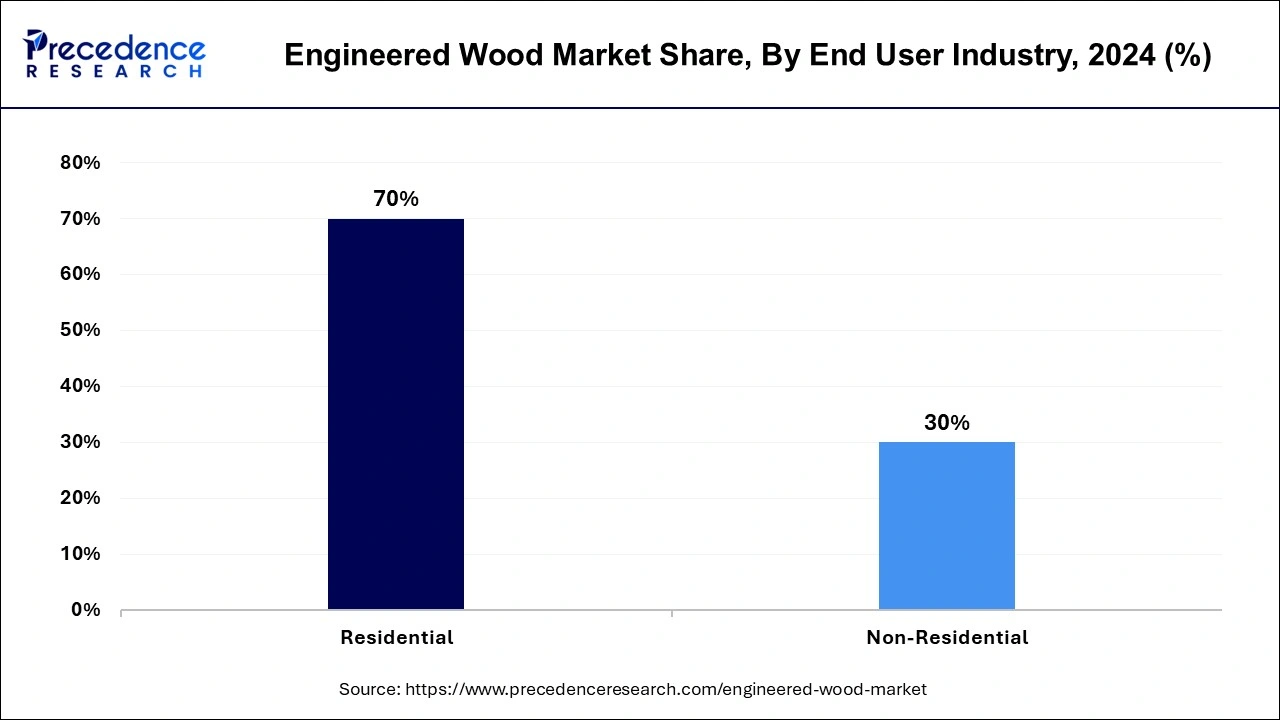
The non-residential segment is expected to grow at the fastest rate in the engineered wood market during the projected period. The growth of the segment is due to the increasing projects of multistory structures which require a significant amount of market. Moreover, for non-residential projects this wood offer adaptability, durability, stability, and cost-effectiveness. The flexibility of engineered wood is beneficial in non-residential applications.
Regional Insights
Asia Pacific dominated the engineered wood market in 2025. The dominance of the region can be attributed to the growing industrial growth, ongoing urbanization, and growing construction activities in developing economies such as China and India. Moreover, Asia Pacific possesses strong population growth, which requires a substantial amount of residential infrastructure to live. Also, government initiatives promoting sustainable construction initiatives can impact regional growth significantly.
Japan Market Trends
Japan is also geared towards the production of engineered wood capable of enduring earthquakes safely. High-performance materials such as CLT and LVL are developed to achieve high-performance in terms of structural performance. Ready-built housing is popularly employed to facilitate rapid urbanization and minimize labor deficits. The growing environmental regulations are also putting pressure on the low-emission and safe bonding materials.
North America is expected to show the fastest growth in the engineered wood market over the studied period. The region's growth can be credited to ongoing innovations in manufacturing techniques. In North America, the U.S. led the market owing to the growing number of investors emerging into agriculture, transport, power, and utilities. The country also exhibits strong economic growth and an escalating real estate sector.
- In Oct 2023, Boise Cascade announced that it had completed the previously announced acquisition of Brockway-Smith Company (BROSCO), a leading wholesale distributor specializing in doors and millwork.
U.S. Market Trends
The U.S. market is expanding, where masses of timber such as CLT and glulam are highly embraced in contemporary buildings. Prefabricated wood elements are being used by builders to save time and minimize labor problems. The change to more environmentally friendly adhesives and low-emission materials to enhance indoor air quality and achieve sustainability objectives is also evident
What Are the Driving Factors of The Engineered Wood Market in Europe?
Europe is expected to grow at a significant CAGR during the forecast period. Europe is concerned with the high quality of engineered wood products like CLT and glulam. Strict environmental regulations and high demand for sustainable construction materials support growth. Prefabrication is a common practice to enhance efficiency. The area promotes sustainable construction with regard to building environmentally friendly structures, and as such, engineered wood has become a favorite in the construction industry, especially in modern construction works.
Germany Market Trends
Germany is concentrated on sustainable production through the recycling of wood and the effective utilization of resources. State-of-the-art manufacturing technologies enhance the accuracy and quality of manufactured wood products. Strong regulations guarantee appropriate sourcing and environmental control. Engineered wood is a significant component of modern building construction since the market supports eco-friendly construction and renovation projects.
What Are the Driving Factors of The Engineered Wood Market in Latin America?
Latin America is expected to grow at a significant CAGR during the forecast period. The increasing urbanization and the need for affordable housing are growing in Latin America. Sustainable forestry is contributing to the provision of raw materials for engineered wood. As construction activities are on the rise, necessitating demand for cost-effective and long-lasting building materials, the market is becoming an important economic contributor.
Brazil Market Trends
Brazil is becoming more reliant on engineered wood panels such as plywood and OSB to construct homes at home. The market in question is moving away from the export-based production that centers on the local demand. Good forestry integration assists in ensuring that there is a steady availability of raw materials and that there is sustainable growth and increased efficiency of the construction supply chain.
Will the Middle East and Africa Grow in the Engineered Wood Market?
The Middle East and Africa are expected to register significant growth during 2026 and 2035, driven by a growing list of projects in the construction pipeline in the hospitality and tourism industry. The engineered panels were rapidly adopted in Saudi Arabia and UAE luxury resorts, entertainment facilities, and mixed-use cities.
Laminated veneer lumber use has expanded, particularly in clear, structural uses and commercial interior finishes, in large infrastructure programs. The Forest Stewardship Council (FSC) revealed in its 2025 report that the volume of certified wood that is purchased by companies in the Gulf construction value chain is expected to rise in the coming years.
Saudi Arabia Market Trends
Saudi Arabia is a major player in the Middle East and Africa market, owing to the expanding hospitality and tourism construction pipeline. Engineered wood was used in larger quantities across hospitality developments and commercial towers for large-scale urban megaprojects.
Larger quantities of laminated timber and decorative panels were used in hospitality developments and commercial towers in large-scale urban megaprojects. Luxury retail expansion also accelerated engineered installations across shopping complexes and entertainment venues.
Competitive Landscape
The engineered wood market remains moderately consolidated across the global construction and furniture industries. Production is tightly controlled by large manufacturing companies that have strategic forestry assets and computerized panel processing plants. Weyerhaeuser and West Fraser operate with diversified engineered timber portfolios that provide sound positions. Stora Enso further developed sustainable timber solutions for infrastructure projects in Europe in 2025.
Recent developments continue reshaping competition throughout engineered wood manufacturing and construction supply chains. Metsä Wood continued to look to industrial offsite construction applications for Kerto LVL in 2025. Production of cross-laminated timber for sustainable commercial building development was expanded by Binderholz. Businesses are increasingly adopting AI-powered quality control solutions that enhance manufacturing accuracy and efficiency. Competition is likely to grow in the future with efforts to build carbon-neutral products through smart manufacturing technologies.
Engineered Wood Market Companies
- Boise Cascade Company
- Celulosa Arauco y Constitucion SA
- Huber Engineered Woods LLC
- Louisiana-Pacific Corporation (LP)
- Norbord Inc.
- Patrick Industries, Inc.
- Raute Group
- Shenzhen Risewell Industry Co., Ltd
- Universal Forest Products, Inc.
- Weyerhaeuser Company.
Latest Announcement by Market Leaders
- In September 2024, Patrick Industries Inc. announced it had acquired Bristol-based Icon Direct Inc. an e-commerce company that does business as RecPro, though financial terms were not disclosed.RecPro's platform focuses on creating and marketing component products, systems, and solutions for the RV and marine end markets.
- In April 2024, LP Building Solutions (LP), a leading manufacturer of high-performance building products, and Lennar Corporation, one of the nation's leading homebuilders, announced a nationwide supply agreement. The partnership signifies an expansion of the existing collaboration between the two industry leaders, leveraging LP's expertise in engineered wood with Lennar's extensive market reach.
Recent Developments
- In April 2026, CitroTech Inc. and Hexion Inc. formed a 50/50 joint venture to develop next-generation fire-retardant solutions for the lumber and building materials industry. This collaboration aims to enhance built-in fire resistance for plywood, OSB, and engineered wood manufacturers on a global scale. (Source: https://www.businesswire.com)
- In May 2025, SPAN FLOORS introduced a unique engineered wood flooring line tailored specifically for staircases. Aimed at contemporary Indian households, the latest product guarantees a combination of classic design, comfort, and security—offering a sophisticated substitute for marble.
- In February 2024, German chemical firms Henkel and Covestro collaborate to promote sustainability in adhesives for load-bearing timber construction. Elements like Cross Laminated Timber or Glued Laminated Timber are used in many indoor and outdoor building applications, including staircases, facades, and structural components. To achieve that goal, materials producer Covestro supplies Henkel with polyurethane-derived raw materials associated with bio-based feedstocks determined through the mass balance method.
- In July 2024, JP Wood Accents announced that it has expanded its product offerings by entering the flooring market as a producer of wide plank-engineered wood flooring. This move aims to cater to both commercial and residential clients, bringing high-quality, durable wood flooring solutions to the market.
- In Sep 2023, West Fraser Timber Co. Ltd. announced that it had entered into an agreement to acquire Spray Lake Sawmills located in Cochrane, Alberta. This acquisition enables West Fraser to grow its footprint in Southern Alberta and expand its Canadian treated wood business.
Segments Covered in the Report
By Application
- Construction
- Flooring
- Furniture
- Packaging
- Transport
- Others
By Type
- Plywood
- Medium Density Fiberboard (MDF)
- Cross Laminated Timber (CLT)
- Laminated Veneer Lumber (LVL)
- Oriented Strand Board (OSB)
- Glue Laminated Timber (Glulam)
- Particle Board
By End Use Industry
- Residential
- Non-Residential
By Geography
- North America
- Europe
- Asia Pacific
- Latin America
- Middle East and Africa
For inquiries regarding discounts, bulk purchases, or customization requests, please contact us at sales@precedenceresearch.com
Frequently Asked Questions
Tags





Ask For Sample
No cookie-cutter, only authentic analysis – take the 1st step to become a Precedence Research client
 Get a Sample




 sales@precedenceresearch.com
 Schedule a Meeting
