



Engineered Polymers in Electric Charging Infrastructure Market Size, Companies, Share, Production Capacity, Raw Material Pricing, Export & Import Analysis, Manufacturing Cost, Competitive Positioning, and Demand Forecast
Engineered Polymers in Electric Charging Infrastructure Market (By Product Type: Thermoplastics, Thermosets, Elastomers; By Application: Connectors, Housing Components, Insulation Systems; By End-Use: Public Charging Stations, Residential Charging, Commercial Charging) - Global Industry Analysis, Size, Trends, Leading Companies, Regional Outlook, and Forecast 2026 to 2035
Source: https://www.precedenceresearch.com/engineered-polymers-in-electric-charging-infrastructure-market
 Get a Sample
 Table Of Content


What is the Engineered Polymers in Electric Charging Infrastructure Market Size?
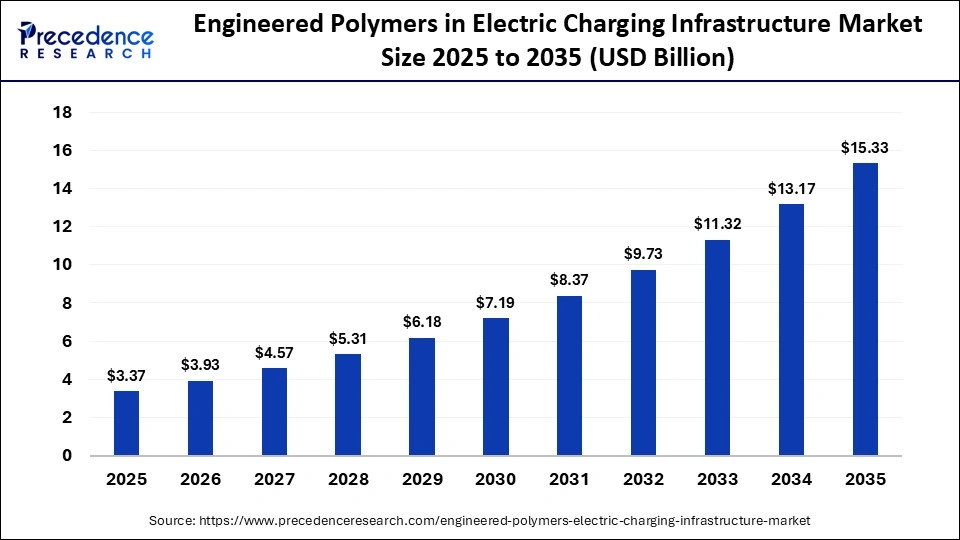
The global engineered polymers in electric charging infrastructure market size was calculated at USD 3.37 billion in 2025 and is predicted to increase from USD 3.93 billion in 2026 to approximately USD 15.33 billion by 2035, expanding at a CAGR of 16.34% from 2026 to 2035.The market is driven by surging demand for eco-friendly vehicles, along with numerous government initiatives to strengthen the EV charging infrastructure.
Market Highlights
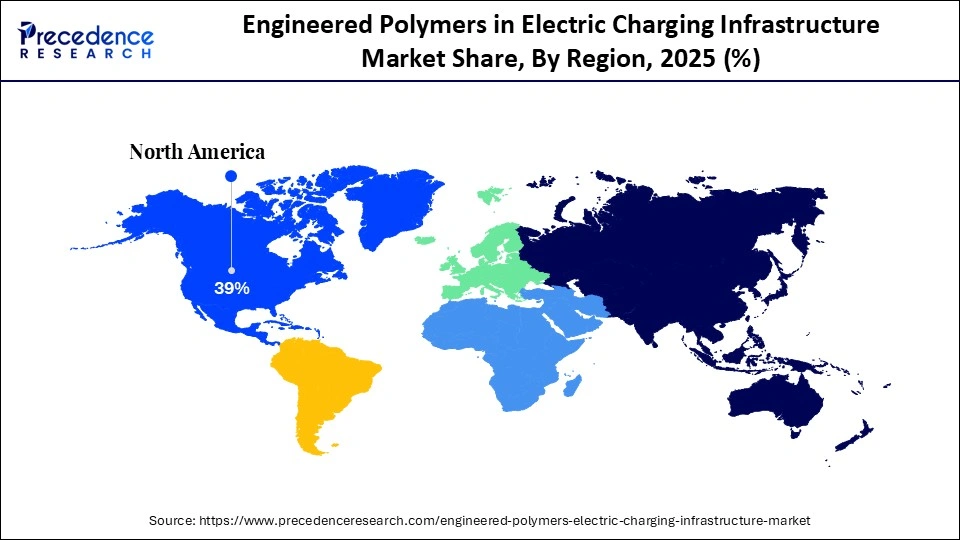
- North America dominated the engineered polymers in electric charging infrastructure market with the largest market share of 39% in 2025.
- Europe is expected to grow at the fastest CAGR during the forecast period.
- By product type, the thermoplastics segment held the largest share of the market in 2025.
- By product type, the elastomers segment is expected to expand at the fastest CAGR during the forecast period.
- By application, the charging cables segment held the largest share of the market in 2025.
- By application, the housing components segment is expected to grow at the highest CAGR between 2026 and 2035.
- By end-use, the public charging stations segment held the highest share of the market in 2025.
- By end-use, the residential charging segment is expected to grow at the fastest CAGR during the forecast period.
Market Overview
The engineered polymers in electric charging infrastructure market is a prominent branch of the advanced materials sector. This market deals with the production and distribution of high-quality polymers for the EV charging providers. These polymers are derived from high-performance thermoplastic materials and come with superior thermal, mechanical, and chemical properties. They are used to replace several traditional materials, including metal, wood, and glass. This market is expected to grow significantly with the rise of the EV industry in different parts of the world.
Why is AI Integral in the Engineered Polymers in Electric Charging Infrastructure Market?
AI plays a crucial role in reshaping the landscape of the market. In the advanced materials sector, AI helps in enhancing design, accelerating material discovery, processing optimization, and predictive modelling. Nowadays, polymer manufacturers have started deploying AI in production units to optimize complicated production processes, enhance sustainability, detect defects, predict biodegradability, and image microstructures. By analyzing large datasets, AI helps manufacturers develop polymers with enhanced thermal stability, durability, and electrical insulation tailored for high-power charging systems. It also supports smart monitoring and predictive maintenance of charging stations, ensuring reliability under extreme environmental conditions.
- In January 2026, Xaloy launched Xalence. Xalence is an AI-enabled platform designed to accelerate polymer processing capabilities.
Engineered Polymers in Electric Charging Infrastructure Market Trends
- Increasing Sales of EVs: The sales of EVs have grown rapidly in several nations, including Canada, China, Germany, the UAE, and Denmark, thus increasing the demand for high-quality charging infrastructure. According to the International Energy Agency, around 6,400,000 BEVs were sold in China in 2024.
- Sustainability and Green Material Development: There is a growing emphasis on eco-friendly and recyclable polymers to align with global sustainability goals. Manufacturers are developing recyclable and bio-based engineered polymers that reduce environmental impact without compromising performance in cables, housings, and connectors.
- Government Investment: The governments of several countries, such as India, the U.S., Japan, and Norway, are investing rapidly in strengthening the EV charging infrastructure. For instance, in November 2025, the government of Illinois in the U.S. announced to invest around US$ 20 million. This investment is made to strengthen the EV charging network in this nation.
- Opening Polymer Recycling Plants: The polymer manufacturers are constantly engaged in opening new recycling plants to deliver eco-friendly polymer solutions to the end-users. For instance, in March 2025, Versalis announced to open a new polymer recycling plant in Porto Marghera, Italy. This new recycling center has been inaugurated to manufacture a bulk quantity of recycled polymers for the end-users.
Market Scope
| Report Coverage | Details |
| Market Size in 2025 | USD 3.37 Billion |
| Market Size in 2026 | USD 3.93 Billion |
| Market Size by 2035 | USD 15.33 Billion |
| Market Growth Rate from 2026 to 2035 | CAGR of 16.34% |
| Dominating Region | North America |
| Fastest Growing Region | Europe |
| Base Year | 2025 |
| Forecast Period | 2026 to 2035 |
| Segments Covered | Product Type, Application, End-Use, and Region |
| Regions Covered | North America, Europe, Asia-Pacific, Latin America, and Middle East & Africa |
Segment Insights
Product Type Insights
Why Did the Thermoplastics Segment Dominate the Market?
The thermoplastics segment dominated the engineered polymers in electric charging infrastructure market in 2025. This is due to the increased use of thermoplastic materials in the production of various EV charging components, such as charging guns, sockets, and charging connectors. Also, the surging focus of the polymer manufacturers in developing sustainable thermoplastics materials has played a prominent role in driving segmental growth. Additionally, several advanced properties of thermoplastic materials, such as superior thermal stability, high density, and enhanced impact resistance capabilities, have made them the preferred choice of manufacturers for developing charging components.
The elastomers segment is expected to grow at the fastest CAGR during the forecast period. The growth of the segment is driven by the growing application of elastomers for manufacturing a wide range of charging cables, gaskets, shielding solutions, and molded rubber, as well as the rising focus of the advanced materials companies in opening elastomer production centers. Several research and development activities performed by the scientists to discover self-healing elastomers are further adding to the segmental expansion. Moreover, the surging adoption of elastomers by EV charger manufacturers due to numerous benefits, including superior elasticity, noise reduction, enhanced durability, high wear resistance, and light weight, is expected to propel the segmental growth in the future.
Application Insights
What Made Charging Cables the Leading Segment in the Market?
The charging cables segment led the engineered polymers in electric charging infrastructure market in 2025. This is mainly due to the growing use of thermosetting polymers in the production of charging cables, along with the increasing emphasis of EV charger companies to use engineered polymers for manufacturing charging cables. Also, partnerships among the EV companies and charger manufacturers to develop high-quality charging cables drove the segment. Moreover, the rising demand for mode 3 charging cables from the public charging stations for delivering fast charging capabilities to the end-users has reinforced the segmental dominance.
The housing components segment is expected to grow at the fastest CAGR between 2026 and 2035. This is due to the rising demand for engineered polymers from the EV charging companies to manufacture highly durable housing components. Additionally, the growing use of high-quality thermoplastic materials for developing CHAdeMO, as well as the surging focus of the EV brands to manufacture housing components by using eco-friendly materials, is expected to propel the growth of this segment in the upcoming years.
End-Use Insights
Why Did the Public Charging Stations Segment Dominate the Market?
The public charging stations segment dominated the engineered polymers in electric charging infrastructure market in 2025. This is owing to the rapid investment by the government in deploying EV charging stations in the urban areas, as well as the growing preference of consumers to charge their EVs in shopping malls. Moreover, the surging use of public charging stations due to enhanced flexibility and superior convenience, as well as the increasing deployment of electric buses in urban areas, has driven the growth of this segment.
The residential charging segment is expected to grow with the fastest CAGR during the forecast period. This is due to the surging application of residential chargers for charging electric bikes and e-rickshaws in developing nations such as India and Taiwan, along with the growing use of thermoplastics to manufacture residential charging solutions. Additionally, the increasing adoption of these charging systems for delivering superior convenience, enhancing cost-savings, and improving battery safety, which in turn is expected to accelerate the segmental growth in the coming years.
Regional Insights
How Big is the North America Engineered Polymers in Electric Charging Infrastructure Market Size?
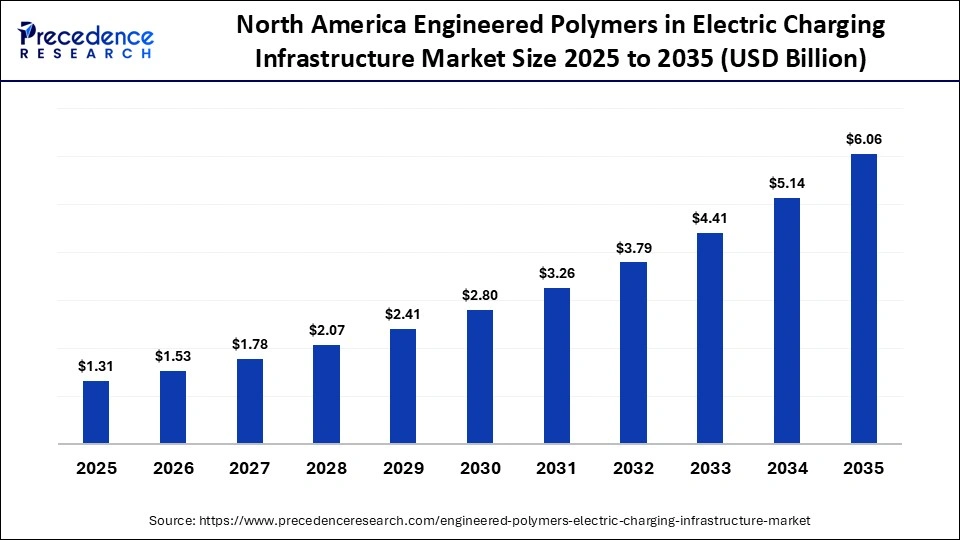
The North America engineered polymers in electric charging infrastructure market size is estimated at USD 1.31 billion in 2025 and is projected to reach approximately USD 6.06 billion by 2035, with a 16.55% CAGR from 2026 to 2035.
What Made North America the Dominant Region in the Engineered Polymers in Electric Charging Infrastructure Market?
North America dominated the engineered polymers in electric charging infrastructure market by holding the largest share in 2025. The region's leadership in the market is attributed to the rapid adoption of PHEVs in the U.S., Canada, and Mexico to lower CO2 emissions. The rapid investment by the government in strengthening the EV charging network, as well as technological advancements in the automotive sector, have played a vital role in shaping the industrial landscape. Moreover, the presence of various market players, such as Celanese Corporation, DuPont de Nemours, Inc., Milliken, and AGC Chemicals Americas Inc, which are focusing on product launches and business expansions are expected to sustain the region's leading position in the market.
- In February 2026, Milliken launched a new range of engineered polymers. This range of polymers finds application in the EV charging sector across the U.S.
What is the Size of the U.S. Engineered Polymers in Electric Charging Infrastructure Market?
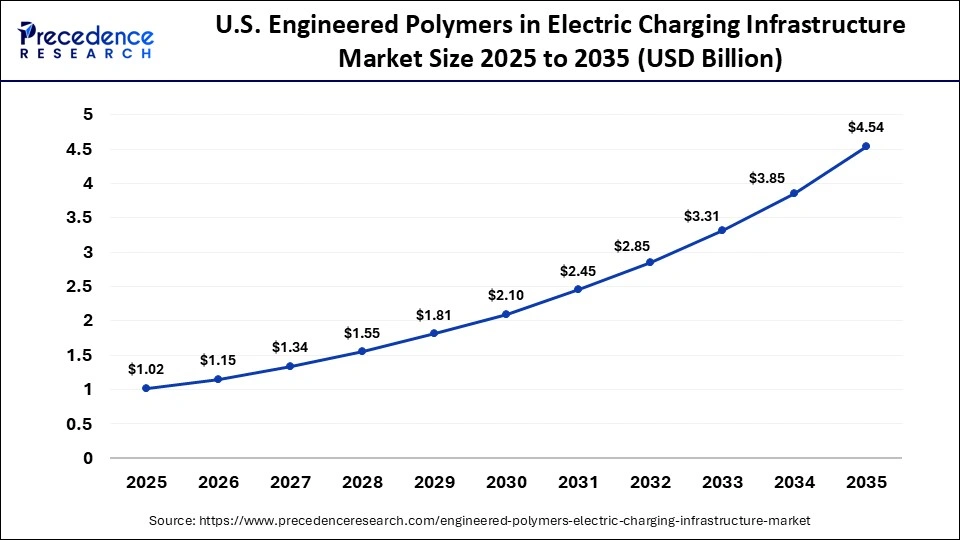
The U.S. engineered polymers in electric charging infrastructure market size is calculated at USD 1.02 billion in 2025 and is expected to reach nearly USD 4.54 billion in 2035, accelerating at a strong CAGR of 16.62% between 2026 and 2035.
U.S. Engineered Polymers in Electric Charging Infrastructure Market Trends
The U.S. is a major contributor to the North American market. This is due to the rising investment by the polymer companies in opening new research and development centers, as well as the rapid expansion of the advanced materials industry. Additionally, the growing sales of electric vehicles and the upsurge in demand for engineered polymers from the EV charging companies are positively contributing to the market.
Why is Asia Pacific Expanding at a Significant Rate in the Market?
Asia Pacific is expanding at a significant CAGR in the market. This is owing to the growing sales of BEVs in several nations, including China, Japan, India, and South Korea. Also, the rise in the number of advanced materials startups, coupled with the rapid investment by the EV charging providers for expanding their charging networks in the APAC region, is adding to industrial development. Moreover, numerous engineered polymer companies, including Asahi Kasei Corporation, Mitsubishi Chemical Corporation, and Sumitomo Chemical Company Limited, are engaged in launching high-quality polymers, which in turn is expected to drive the growth of the engineered polymers in electric charging infrastructure market in this region.
- In September 2025, Mitsubishi Chemical Corporation launched a new range of sustainable polymer solutions in Asia. This new range of polymers finds numerous applications in various sectors, including electronics and automotive.
China Engineered Polymers in Electric Charging Infrastructure Market Analysis
China leads the market within Asia Pacific. This is due to the availability of high-quality raw materials at reasonable prices, along with the deployment of AI solutions in the polymer manufacturing sector. Additionally, the surging sales of electric buses, coupled with numerous government initiatives aimed at developing the EV charging infrastructure, are playing a vital role in shaping the industrial landscape.
How is the Opportunistic Rise of Europe in the Engineered Polymers in Electric Charging Infrastructure Market?
Europe is expected to grow at the fastest rate in the market during the forecast period due to a combination of supportive policy frameworks and strong electrification goals. The European Union's ambitious climate and sustainability targets, such as the Green Deal and Alternative Fuels Infrastructure Regulation, are driving large‑scale deployment of EV charging networks, which in turn creates predictable and expanding demand for advanced polymer materials used in housings, cables, and connectors. Regulatory harmonization and investments in public and private charging stations across countries like Germany, France, and the Netherlands are helping local manufacturers and material innovators scale production and tailor high‑performance, sustainable polymers to regional standards.
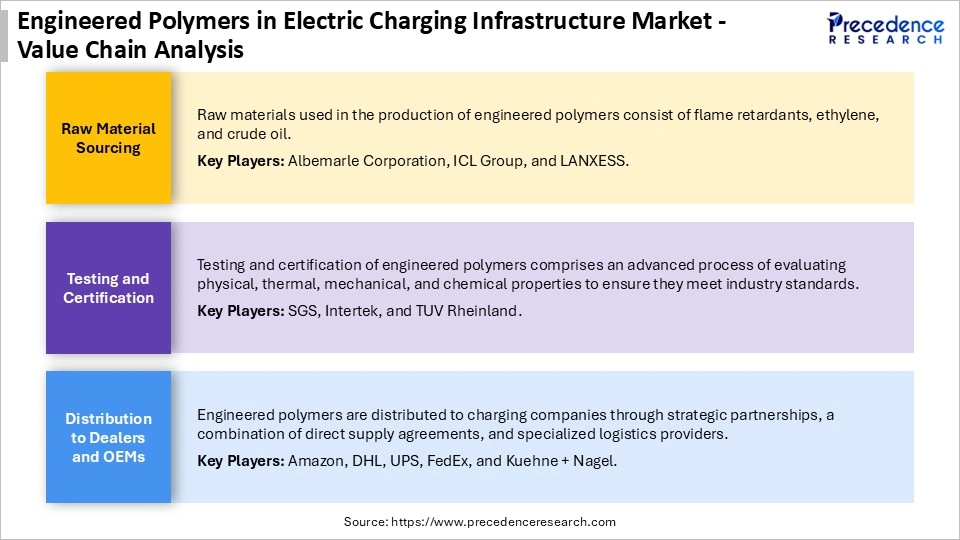
Engineered Polymers in Electric Charging Infrastructure Market Value Chain Analysis
Who are the Major Players in the Global Engineered Polymers in Electric Charging Infrastructure Market?
The major players in the engineered polymers in electric charging infrastructure market include AGC Chemicals Americas Inc., ASAHI KASEI CORPORATION, BASF SE, Dow Chemical Company, Royal DSM NV, Mitsubishi Chemical Corporation, Sumitomo Chemical Company Limited, COVESTRO AG, Daikin Industries Ltd., Evonik Industries AG
Recent Developments
- In February 2026, Cybrid Technologies acquired Suzhou Jinlan Nanotechnology Co., Ltd. This acquisition aims at strengthening the automotive functional materials portfolio across OEMs and aftermarket segments.(Source: https://emobilityplus.com)
- In November 2025, Piersica launched PIRION. PIRION is a high-grade polymer that is expected to enhance lithium-ion battery performance and improve safety.(Source: https://chargedevs.com)
- In May 2025, Sabic launched Ultem resin. These resins are designed for high-voltage EV applications.(Source: https://www.designworldonline.com)
Segments Covered in the Report
By Product Type
- Thermoplastics
- Thermosets
- Elastomers
By Application
- Connectors
- Housing Components
- Insulation Systems
By End-Use
- Public Charging Stations
- Residential Charging
- Commercial Charging
By Region
- North America
- Europe
- Asia-Pacific
- Latin America
- Middle East & Africa
For inquiries regarding discounts, bulk purchases, or customization requests, please contact us at sales@precedenceresearch.com
Frequently Asked Questions





Ask For Sample
No cookie-cutter, only authentic analysis – take the 1st step to become a Precedence Research client
 Get a Sample



 sales@precedenceresearch.com
 Schedule a Meeting
