Europe Composites Market Size, Share and Trends 2026 to 2035
Europe Composites Market (By Product Type: Glass Fiber, Carbon Fiber, and Others; By Resin Type: Thermoplastic, Thermosetting, and Others; By Manufacturing Process Type: Injection Molding Process, Resin Transfer Molding (RTM) Process, Pultrusion Process, Layup Process, Filament Winding Process, Compression Molding Process, and Others; By End-Use Industry: Electrical & Electronics, Automotive & Transportation, Wind Energy, Aerospace & Defense, Pipes & Tanks, Construction & Infrastructure, Marine, and Others) Industry Size, Share, Growth, Trends 2025-2035
 Get a Sample
 Table Of Content


The Europe composites market size accounted for USD 28.14 billion in 2025 and is predicted to touch around USD 47.52 billion by 2035, growing at a CAGR of 5.38% from 2026 to 2035. The market is fueled by demand for lightweight and strong materials, increasing fuel efficiency and reducing carbon emissions in the automotive, aerospace, and wind energy industries.
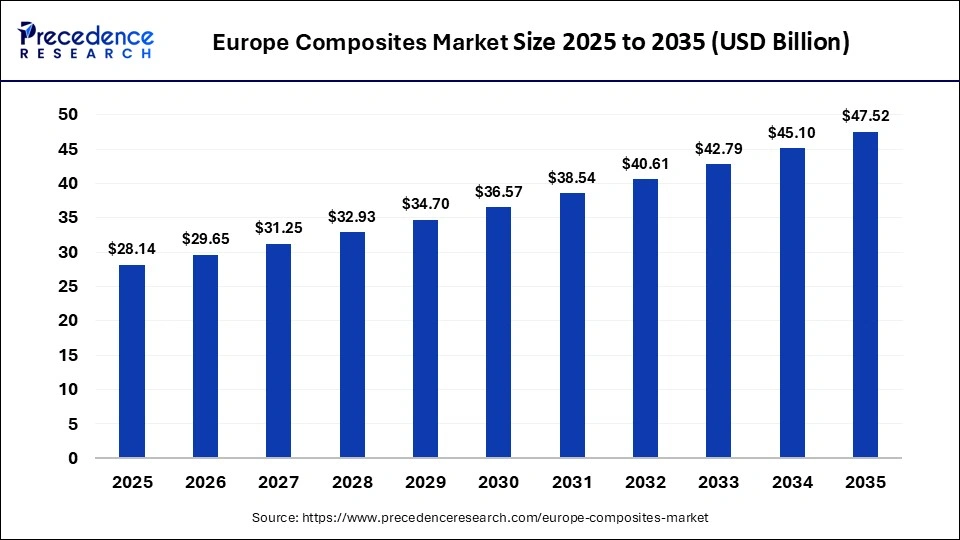
Europe Composites Market Statical Scope
| Reports Attributes | Statistics |
| Market Size in 2025 | USD 28.14 Billion |
| Market Size in 2026 | USD 29.65 Billion |
| Market Size by 2035 | USD 47.52 Billion |
| CAGR 2026 to 2035 | 5.38% |
| Base Year | 2025 |
| Forecast Period | 2026 to 2035 |
The European composites market plays a crucial role in promoting lightweight and fuel-efficient transportation as well as renewable energy. It helps automakers and aerospace companies lower COâ‚‚ emissions and comply with strict regional regulations by replacing heavier metals with high-strength composite materials. More than half of Europe's composite production is used in transportation. Composites help automotive and aerospace original equipment manufacturers (OEMs) to boost fuel economy, cut emissions, and increase the range of electric vehicles.
Europe continues to lead globally in wind energy installations. Composites are vital for creating the large, durable blades required for wind turbines. European environmental regulations and sustainability goals drive the need to lower carbon footprints across various industries, encouraging companies to adopt advanced composite and recycling technologies. A large number of composites are used in construction and infrastructure due to their strength and corrosion resistance.
Europe Composites Market, By Product Type, 2025 (%)
| Segments | Shares (%) |
| Glass Fiber | 68.40% |
| Carbon Fiber | 22.70% |
| Others | 8.90% |
- Glass Fiber - The glass fiber segment, with a share of 68.40% in 2025, plays a dominant role in the Europe composites market due to its excellent mix of high strength, durability, and cost-effectiveness, making it suitable for large-scale, budget-sensitive industrial uses. It is commonly used to substitute heavier metals.
- Carbon Fiber - The carbon fiber segment, with a share of 22.70% in 2025, is essential to the Europe composites market as it helps the region's major export sectors, automotive, aerospace, and renewable energy, achieve strict emission standards and performance criteria. Its exceptional strength-to-weight ratio is crucial for lightweighting, which is important for increasing the range of electric and hydrogen vehicles and for constructing large, efficient offshore wind turbine blades.
Europe Composites Market, By Resin Type, 2025 (%)
| Segments | Shares (%) |
| Thermosetting | 55.10% |
| Thermoplastic | 36.80% |
| Others | 8.10% |
- Thermoplastic - The thermoplastic composites segment, with a share of 36.80% in 2025, is important to Europe's composites industry as it allows for lightweighting to comply with strict vehicle emission regulations, provides shorter production times, and supports circular economy initiatives. Unlike thermosets, these materials can be melted, reshaped, and recycled, which aligns with strict EU environmental regulations.
- Thermosetting - The thermosetting segment, with a share of 55.10% in 2025, is leading the European composites market as it acts as the foundation for large structural applications mainly in construction, infrastructure, and wind energy. These materials provide unmatched durability, heat resistance, and structural strength, making them essential for large-scale components in extreme environments.
Europe Composites Market, By Manufacturing Process Type, 2025 (%)
| Segments | Shares (%) |
| Layup Process | 21.40% |
| Injection Molding Process | 18.60% |
| Resin Transfer Molding (RTM) Process | 16.80% |
| Compression Molding Process | 14.20% |
| Pultrusion Process | 12.30% |
| Filament Winding Process | 9.50% |
| Others | 7.20% |
- Injection Molding Process - The injection molding process segment, with a share of 18.60% in 2025, is crucial in the Europe Composites Market due to its cost-effective, high-volume production of complex, lightweight parts. Driven by the automotive, aerospace, and electronics industries in the region, it enables mass production with quick cycle times while directly supporting European sustainability and vehicle lightweighting objectives.
- Resin Transfer Molding Process - The Resin Transfer Molding (RTM) process, with a share of 16.80% in 2025, plays a crucial role in the European composites market due to its large-scale production of intricate, lightweight, and strong components. By injecting resin into closed molds, it avoids harmful emissions, aligning perfectly with the EU's strict environmental regulations while decreasing the weight of vehicles and aircraft for energy efficiency.
Europe Composites Market, By End-Use Industry, 2025 (%)
| Segments | Shares (%) |
| Automotive & Transportation | 26.10% |
| Construction & Infrastructure | 16.60% |
| Wind Energy | 15.40% |
| Aerospace & Defense | 12.70% |
| Electrical & Electronics | 9.80% |
| Pipes & Tanks | 8.30% |
| Others | 5.90% |
| Marine | 5.20% |
- Electrical & Electronics - The electrical and electronics industry, with a share of 9.80% in 2025, is essential to the European composites market as it helps the region's shift towards clean energy, electric mobility, and grid modernization. Composites offer the required electrical insulation, thermal resistance, and lightweight structural strength to safely support and increase contemporary electronic systems.
- Automotive & Transportation - The automotive and transportation industry, with a share of 26.10% in 2025, leads the European composites market due to the necessity to comply with strict EU emission standards, improve electric vehicle (EV) battery range through weight reduction, and use sustainable materials such as bio-composites.
Competitive Landscape
The European composites market is very competitive and consolidated, driven by a trend towards lightweight and recyclable thermoplastic composites. Key players are leading the market by vertically integrating, providing raw carbon and glass fibers as well as advanced prepregs to important industries such as automotive, aerospace, and wind energy, particularly in Germany, France, and the UK.
- Hexcel Corporation, based in the US with significant operations in Europe, is a top supplier of advanced composites. Their products include carbon fibers, structural adhesives, and honeycomb materials, making them a key supplier for Airbus and other aerospace companies.
- Toray Industries, Inc. is a global leader in carbon fiber production, with major facilities in Europe through Toray Advanced Composites. Their product range includes thermoplastic and thermoset prepregs, woven fabrics, and unidirectional tapes widely used in aerospace, automotive, and sporting goods.
- Solvay SA, headquartered in Brussels, is a major player in the aerospace and automotive industries, along with its material science spin-offs. Their main products consist of structural film adhesives, high-performance resins, and carbon fiber-reinforced PEEK, which are used in high-demand engine and nacelle applications.
- SGL Carbon SE, located in Wiesbaden, Germany, specializes in carbon-based materials. Their primary composite products include carbon and glass fiber fabrics, pre-impregnated materials (prepregs), and tailored composite components for the automotive sector (such as EV battery enclosures) and wind energy.
- Gurit Holding AG, operating from Switzerland, places a strong emphasis on the wind energy and marine industries. Their product offerings include structural core materials like PVC and Balsa, glass and carbon prepregs, formulated epoxies, and 3D kitting solutions for blade manufacturers.
Segments Covered in the Report
By Product Type
- Glass Fiber
- Carbon Fiber
- Others
By Resin Type
- Thermoplastic
- Thermosetting
- Others
By Manufacturing Process Type
- Injection Molding Process
- Resin Transfer Molding (RTM) Process
- Pultrusion Process
- Layup Process
- Filament Winding Process
- Compression Molding Process
- Others
By End-Use Industry
- Electrical & Electronics
- Automotive & Transportation
- Wind Energy
- Aerospace & Defense
- Pipes & Tanks
- Construction & Infrastructure
- Marine
- Others
For inquiries regarding discounts, bulk purchases, or customization requests, please contact us at sales@precedenceresearch.com
Frequently Asked Questions





Ask For Sample
No cookie-cutter, only authentic analysis – take the 1st step to become a Precedence Research client




 sales@precedenceresearch.com
 Schedule a Meeting