



Europe Healthcare Asset Management Market Size, Patient Volume, Treatment Adoption Rates, Pricing Analysis, Regulatory Landscape, Competitive Positioning, and Demand Forecast
Europe Healthcare Asset Management Market (By Product: Radiofrequency Identification (RFID) Devices and Real-time Location Systems (RTLS); By Application: Hospital Asset Management and Pharmaceutical Asset Management; By End User: Hospitals and Clinics, Pharmaceutical Companies, Biotechnology Companies, and Others (Laboratories, Cosmetic Industry, Medical Devices Companies, etc.)) Industry Size, Share, Growth, Trends 2025-2035
Source: https://www.precedenceresearch.com/europe-healthcare-asset-management-market
 Get a Sample
 Table Of Content


The Europe healthcare asset management market size was estimated at USD 9.61 billion in 2025 and is projected to be worth around USD 100.04 billion by 2035, growing at a CAGR of 26.40% from 2026 to 2035. The market in Europe is driven by strict regulations for device traceability, the need to improve hospital bed occupancy rates, increased investments in smart hospital infrastructure, and the growing use of wireless technologies such as RFID and real-time location systems (RTLS).
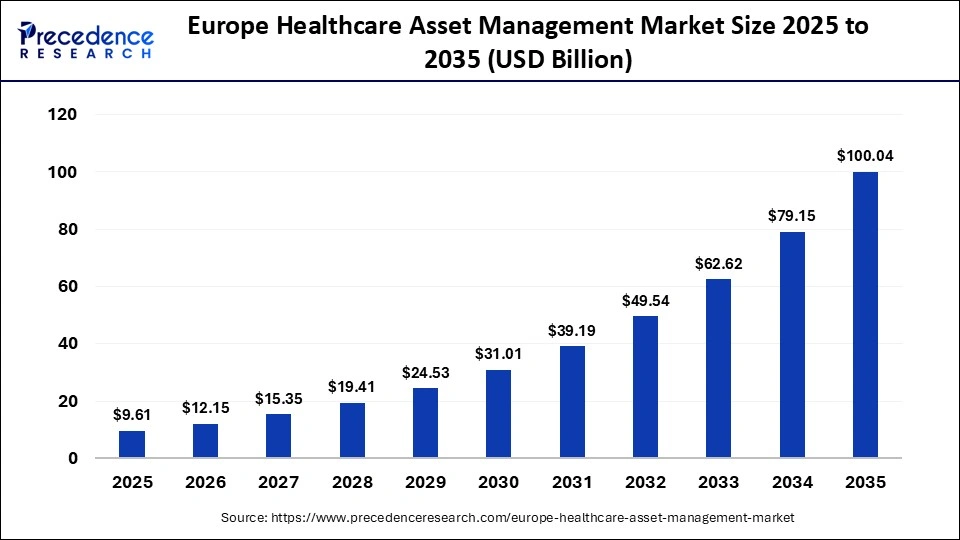
Europe Healthcare Asset Management Market Statical Scope
| Reports Attributes | Statistics |
| Market Size in 2025 | USD 9.61 Billion |
| Market Size in 2026 | USD 12.15 Billion |
| Market Size by 2035 | USD 100.04 Billion |
| CAGR 2026 to 2035 | 26.40% |
| Base Year | 2025 |
| Forecast Period | 2026 to 2035 |
Healthcare asset management (HAM) is crucial in Europe as it increases the tracking, maintenance, and utilization of medical devices and infrastructure. It assists hospitals in managing challenges like an aging population, rising operational costs, significant staff shortages, and stringent regulatory requirements. With a growing elderly population requiring more medical attention, public health systems are under pressure, leading to a higher demand for medical equipment. European health networks are also facing significant labor shortages. Tracking tools help healthcare professionals save time searching for mobile equipment like infusion pumps or wheelchairs, allowing them to concentrate on patient care.
Hospitals reduce waste by avoiding unnecessary purchases of duplicate equipment, cutting rental expenses, and preventing the loss or theft of essential mobile devices. Additionally, European facilities must comply with strict regulations such as the EU In Vitro Diagnostic Regulation (IVDR). Digital tracking systems automatically log maintenance history, safety checks, and compliance audits. Automated maintenance schedules help avoid unexpected device failures, prolonging equipment lifespan and ensuring patient safety.
Europe Healthcare Asset Management Market, By Product, 2025 (%)
| Segments | Shares (%) |
| Radiofrequency Identification (RFID) Devices | 45.00% |
| Real-time Location Systems (RTLS) | 55.00% |
- Radiofrequency Identification (RFID) Devices - The Radiofrequency Identification (RFID) devices segment, with a share of 45% in 2025, plays a key role in the European healthcare asset management market as it allows for real-time tracking of medical equipment, reduces equipment loss, and ensures adherence to strict European Union data and product traceability regulations. It improves workflows in aging hospital systems without needing a direct line of sight.
- Real-time Location Systems (RTLS) - The Real-time Location Systems (RTLS) segment, with a share of 55% in 2025, leads the Europe healthcare asset management market as it automates the tracking of important medical devices such as infusion pumps and ventilators, decreases equipment search times, lowers rental and replacement costs, and guarantees compliance with strict regional data privacy and safety standards.
Europe Healthcare Asset Management Market, By Application, 2025 (%)
| Segments | Shares (%) |
| Hospital Asset Management | 72.00% |
| Pharmaceutical Asset Management | 28.00% |
- Hospital Asset Management - The hospital asset management segment, with a share of 72% in 2025, accounts for the largest revenue share in the European healthcare asset management market as it improves operational efficiency, reduces capital waste, and ensures regulatory compliance across large public and private health systems that are dealing with aging infrastructure and increasing cost pressures.
- Pharmaceutical Asset Management - The pharmaceutical asset management segment, with a share of 28% in 2025, is important in Europe's healthcare asset management market as it guarantees strict cold chain compliance for biologics, helps prevent expensive drug counterfeiting, meets stringent EU regulatory requirements, and improves tracking of high-value inventory across manufacturing plants and clinical supply chains.
Europe Healthcare Asset Management Market, By End User, 2025 (%)
| Segments | Shares (%) |
| Hospitals and Clinics | 55.00% |
| Pharmaceutical Companies | 22.00% |
| Biotechnology Companies | 14.00% |
| Others (Laboratories, Cosmetic Industry, Medical Devices Companies, etc.) | 9.00% |
- Hospitals and Clinics - The hospitals and clinics segment, with a share of 55% in 2025, dominates the European healthcare asset management market as large facilities are under constant pressure to track costly mobile equipment, minimize operational waste, and manage aging clinical infrastructure using automated solutions including RFID and real-time location systems.
- Pharmaceutical Companies - The pharmaceutical segment, with a share of 22% in 2025, is vital in the European healthcare asset management market by safeguarding high-value drug manufacturing infrastructure, avoiding costly production delays, and complying with strict European Union supply chain traceability and compliance requirements.
- Biotechnology Companies - The biotechnology companies, with a share of 14% in 2025, play a crucial role in the European healthcare asset management market due to significant investments in valuable and sensitive laboratory equipment, precision instruments, and R&D tracking systems. These systems need specialized tracking, regulatory compliance, and strict lifecycle maintenance in key life sciences hubs.
Competitive Landscape
The healthcare asset management market in Europe is driven by strict regulations including EU-MDR, the demand for smart hospital systems, and the need to reduce operational waste. Key players in this market include GE HealthCare, Siemens Healthineers, Philips, and specialized tracking providers such as Stanley Healthcare and Zebra Technologies.
- GE HealthCare provides enterprise-level asset performance management, digital tracking solutions, and predictive maintenance for heavy diagnostic imaging and clinical equipment.
- Siemens Healthineers offers fleet management and equipment maintenance services along with smart workflow solutions and operational advice to enhance hospital inventory.
- Philips Healthcare delivers connected workflow tools, asset utilization analytics, and lifecycle management services focused on minimizing equipment downtime in European hospitals.
- Stanley Healthcare features the AeroScout RTLS platform, Hugs infant protection, and mobile asset tracking tags designed to locate valuable clinical equipment and ensure patient safety.
- Zebra Technologies supplies RFID scanners, barcode printing systems, and location solutions that monitor medical supplies, specimen samples, and portable patient monitoring devices.
- CenTrak provides clinical-grade RTLS infrastructure using proprietary multi-mode locating technology for accurate room-level and bed-level asset tracking.
Segments Covered in the Report
By Product
- Radiofrequency Identification (RFID) Devices
- Real-time Location Systems (RTLS)
By Application
- Hospital Asset Management
- Pharmaceutical Asset Management
By End User
- Hospitals and Clinics
- Pharmaceutical Companies
- Biotechnology Companies
- Others (Laboratories, Cosmetic Industry, Medical Devices Companies, etc.)
For inquiries regarding discounts, bulk purchases, or customization requests, please contact us at sales@precedenceresearch.com
Frequently Asked Questions





Ask For Sample
No cookie-cutter, only authentic analysis – take the 1st step to become a Precedence Research client
 Get a Sample




 sales@precedenceresearch.com
 Schedule a Meeting



