



Fire Protection Materials Market Size, Key Companies, Company Production Capacity, Manufacturing Efficiency, Capacity Utilization, Raw Material Consumption, Cost Structure, Export Trends, Company Expansion Strategies, and Competitive Landscape
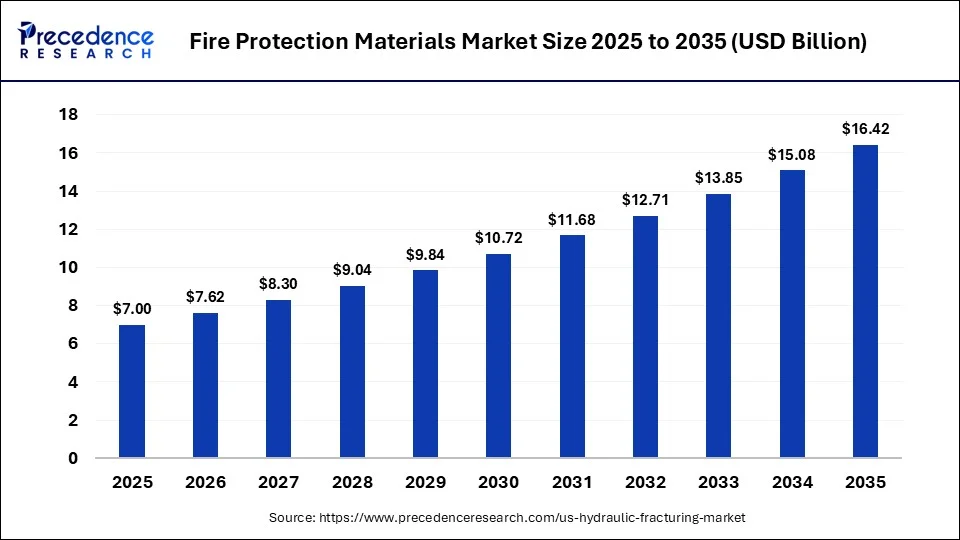
The fire protection materials market was valued at USD 7.62 billion in 2026. The market is driven by stringent fire safety regulations, increasing construction activities, especially in developing countries, and recent advances in fire protection materials. These trends were analyzed by Vidyesh Swar, Senior Research Analyst, to curate this report. His report benefits several stakeholders, including fire protection materials manufacturers, distributors, testing and certification agencies, maintenance providers, and fire safety consultants and engineers.
Source: https://www.precedenceresearch.com/fire-protection-materials-market
 Get a Sample
 Table Of Content


Fire Protection Materials Market Growth, Demand, and Production Forecast 2035
The fire protection materials market is forecasted to expand from USD 7.62 billion in 2026 to USD 16.42 billion by 2035, growing at a CAGR of 8.9% from 2026 to 2035. The expansion of multiple industries, including oil and gas, manufacturing, and residential buildings, increases the demand for fire safety protocols and fire protection materials. Several regulatory authorities have imposed stringent regulations on fire safety. Vidyesh Swar, who has over 5 years of experience in the Chemicals and Materials sector, found that the development of innovative materials, rapid adoption of sustainable chemistry principles, and expanding applications of fire protection materials for electric vehicles and hydrogen infrastructure.
Key Takeaways
- PPG's STEELGUARD 951 offers up to 180 minutes of protection in specified applications.
- By product type, the fire protection coatings segment dominated the market with a share of 27.9% in 2025.
- By material/technology, the intumescent materials segment held the largest market share of 29.4% in 2025.
- By application, the commercial buildings segment accounted for the highest market share of 28.65% in 2025.
- By end-user, the construction & building contractors segment led the market with a share of 30.85% in 2025.
- By region, North America held a major market share of 38.2% in 2025.
- The U.S., Germany, China, Brazil, and Saudi Arabia hold the largest market share in North America, Europe, Asia-Pacific, Latin America, and the Middle East & Africa in 2025.
- Sherwin-Williams FIRETEX FX9502 is an epoxy intumescent system for structural steel.
- The total addressable market (TAM) and serviceable addressable market (SAM) values of fire protection materials were USD 7 billion and USD 4.1 billion in 2025.
How is the Fire Protection Materials Market Growing?
The global fire protection materials market reached approximately USD 7 billion in 2025 and is expected to expand at a CAGR of 8.9% during the forecast period. Fire protection materials are primarily used to prevent ignition, protect structural elements, maintain compartmentation, slow flame and smoke propagation, and preserve the integrity of critical assets during fire exposure. These materials are incorporated into project specifications to ensure consistent fire performance and compliance with applicable building codes, fire regulations, and project requirements. In North America and Europe, specific building codes and standards promote the use of fire protection materials, while in Asia-Pacific, rapid construction and infrastructure investments support market growth.
Expert Analyst - Market Outlook
The demand foViewr these materials is increasing due to the shifting trend toward tested, certified, and application-specific systems. These materials are useful for high-rise residential and commercial buildings, industrial plants, data centers, energy infrastructure, and transportation facilities. By incorporating high-performance fire protection systems into project specifications, stakeholders can significantly improve fire safety while protecting valuable assets and infrastructure.
What are Some Emerging Trends of Fire Protection Materials?
The fire protection materials market witnesses three major structural shifts.
- Need for Passive Protection: Customers prioritize passive protection with the adoption of complete, tested materials rather than standalone systems.
- Growth of Thin-Film and High-Performance Intumescent Technologies: Thin-film and intumescent technologies can provide substantial fire resistance while minimizing added weight and preserving architectural aesthetics.
- Expanding Applications: Fire protection materials are increasingly used across multiple high-specification applications, including data centers, battery plants, LNG facilities, semiconductor fabs, industrial facilities, and transportation hubs.
For e.g. PPG offers STEELGUARD 951 designed for structural steel and offers up to 180 minutes of protection in specified applications.
Expert Analyst View - Market Trends
The market is transitioning from a primarily construction-material opportunity toward a broader asset-protection and compliance market. The most desirable growth pools are increasingly associated with high-value assets where insurance risk, downtime, and fire spread have significant financial consequences. This promotes specific materials, lightweight boards, firestopping systems, and technically unique intumescent coatings over commoditized goods.
Segmentation Analysis
Which Product Type Segment Dominated the Fire Protection Materials Market?
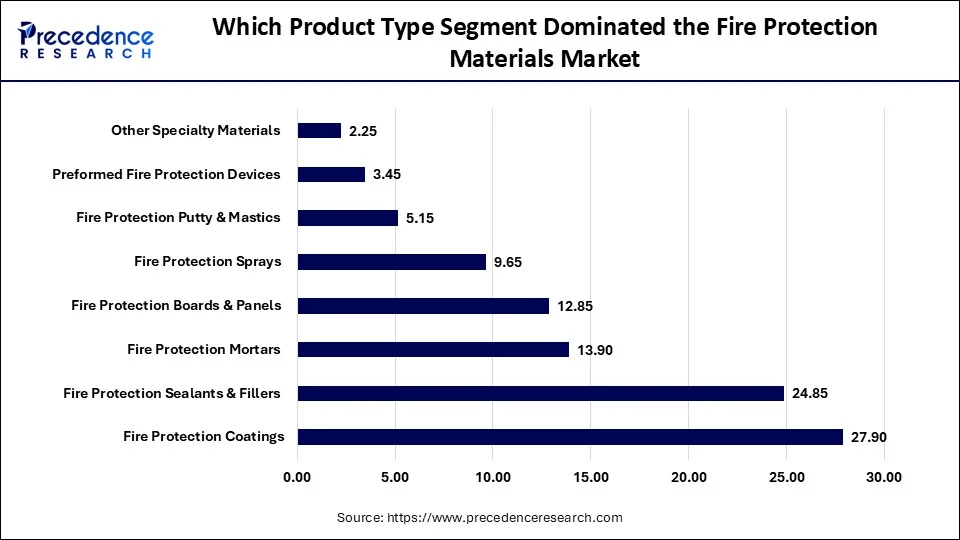
Fire protection coatings held the largest market share of 27.9% in 2025. The fire protection sealants & fillers segment held the second-largest market share of 24.85% in 2025 and is expected to expand at the fastest CAGR of 9.65% over the studied period. The fire protection mortars segment and the fire protection boards & panels segment held significant market shares of 13.9% and 12.85%, respectively.
Expert Analyst View - Product Type
Demand for sealants & fillers is increasing in the coming years due to modern buildings containing increasing numbers of cables, pipes, and ventilation penetrations that are at high risk for flame and smoke. Coatings retain the largest revenue pool, but firestopping sealants and penetration systems offer strong growth. Complex buildings increasingly require service penetrations and compartmentation, driving the demand for sealants and penetration systems.
How the Intumescent Materials Segment Dominated the Fire Protection Materials Market?
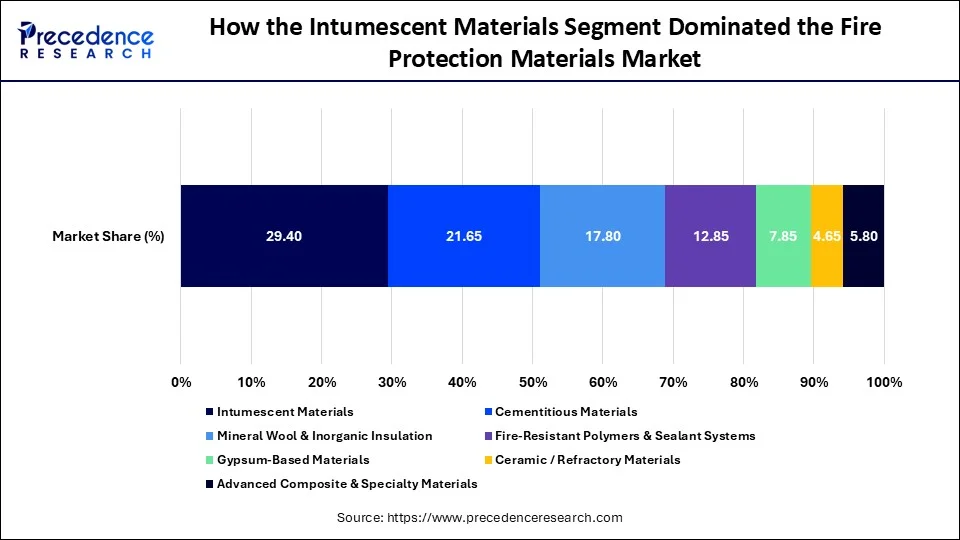
Intumescent materials dominated the market with a share of 29.4% in 2025 and are expected to grow fastest through 2035 at a CAGR of 10.10%. The growing demand for passive protection and the ability of intumescent materials to withstand high temperatures (up to 200oC) are major demand drivers. Some common examples of intumescent materials include flexible silicone joint sealants, acrylic sealants, and some coated insulation boards. Stakeholders also prefer cementitious materials, mineral wool & inorganic insulation, and fire-resistant polymers & sealant systems for various purposes.
Expert Analyst View - Material/Technology
Intumescent materials are particularly important as they can expand substantially when exposed to heat, creating an insulating barrier. Stakeholders and customers mostly prefer multifunctional materials, as these materials provide corrosion resistance, low VOC performance, durability, acoustic properties, and reduced installation times, apart from providing fire protection. This creates opportunities for formulation companies with strong chemistry and certification capabilities.
Which Application Segment Led the Fire Protection Materials Market?
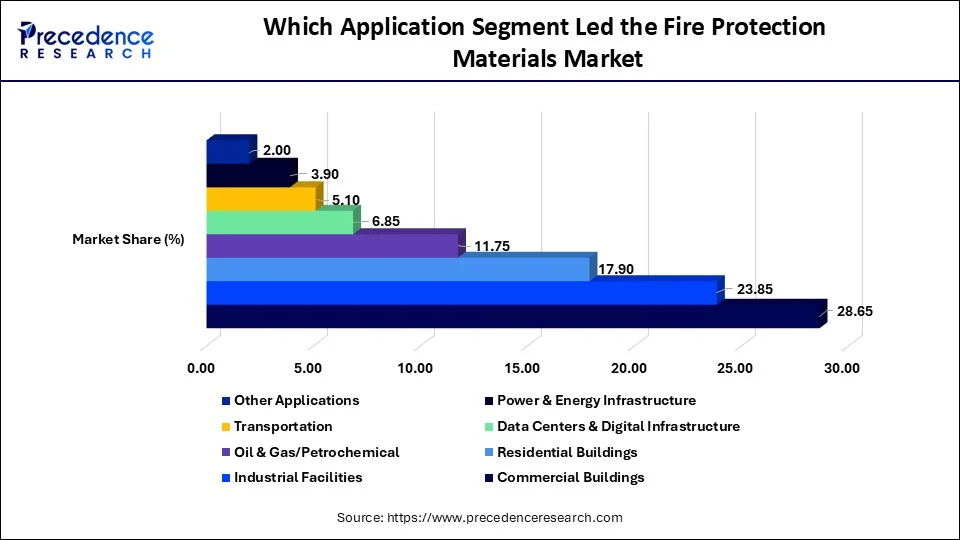
Commercial buildings are the highest application category of fire protection materials, accounting for 28.65% in 2025. The demand is gradually shifting toward data centers & digital infrastructure, growing at a CAGR of 12.4% through 2035. Power & energy infrastructure and industrial facilities also witness significant demand for fire protection materials over the coming years. In these facilities, fire protection is increasingly treated as a critical operational-risk investment.
Expert Analyst View - Application
From the above table, it can be found that the fastest expansion occurs among use cases where fire creates disproportionate economic risk. Despite the current economic contribution of data centers, battery plants, petrochemical facilities, and advanced manufacturing sites being lower, the demand for fire protection materials is the highest for these facilities. The growing development of data centers, increasing use of AI, and significant investments by government organizations for data center construction propel the segment's growth.
Which End-Users Account for the Largest Consumption of Fire Protection Materials?
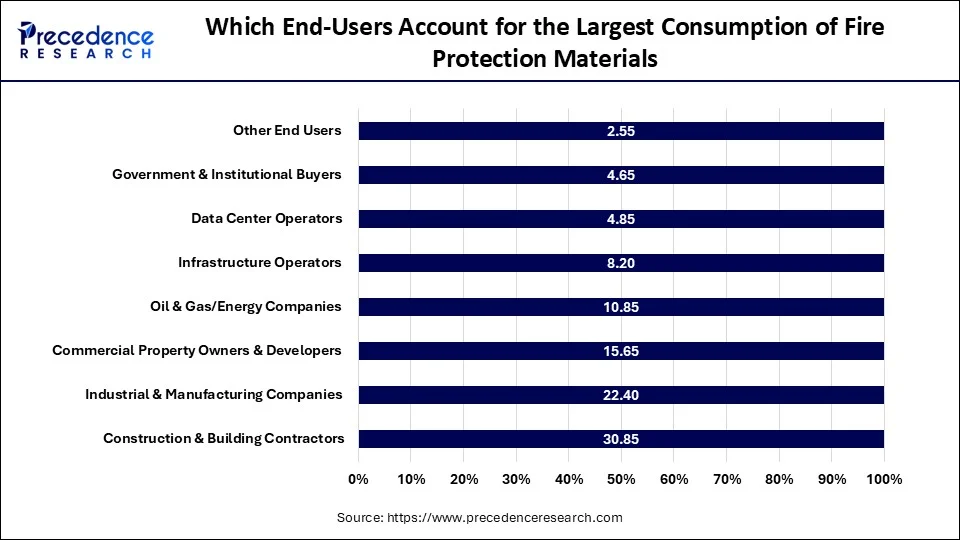
Construction & building contractors are at the forefront of using fire protection materials, accounting for a market share of 30.85% in 2025. Data center operators are expected to become the largest consumers of fire protection materials in the coming years, expanding at a CAGR of 13.25%. Industrial & manufacturing companies and oil & gas/energy companies require fire protection materials due to the growing need for high-value asset protection and operational continuity.
Expert Analyst View - End-Users
Procurement of fire protection materials is based on certain specifications. Both commercial and government buyers prioritize fire-rating documentation, system certification, lifecycle performance, installation productivity, compatibility, and technical support, rather than simply comparing material cost per kilogram or liter.
How are Fire Protection Materials Distributed to End-Users?
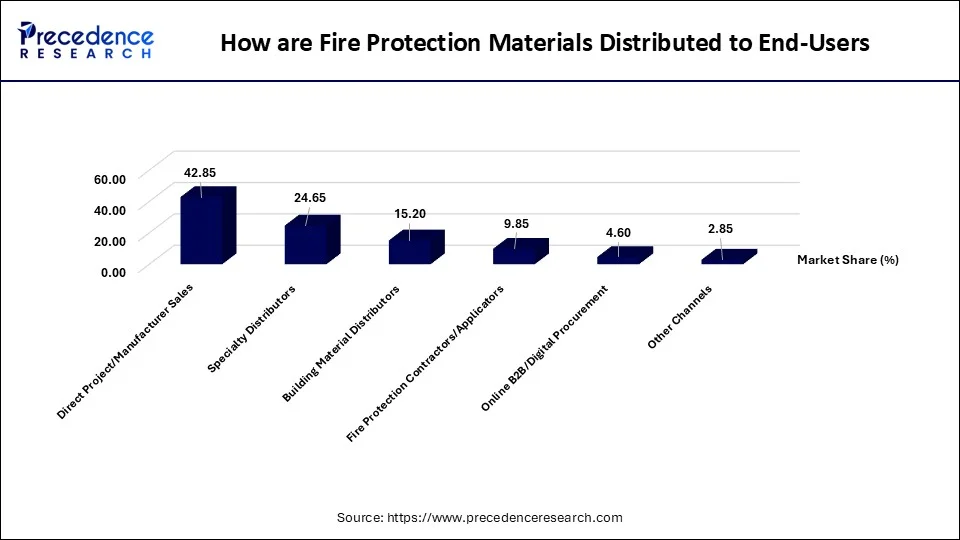
Fire protection materials are generally distributed directly by manufacturers, accounting for a 2025 market share of 42.85%. Manufacturers distribute their products through their dedicated supply chain infrastructure and online platforms. Specialty distributors held the second-largest market share of 24.65% in 2025. The demand for the online B2B/digital procurement distribution channel is increasing rapidly, with a CAGR of 13.1% during the forecast period. Fire protection contractors/applicators will be highly preferred (10.45% CAGR from 2026 to 2035) due to growing installation complexity.
Expert Analyst View - Distribution Channel
Direct sales will remain central for large projects because fire protection is specification-dependent. Manufacturers can directly deliver materials based on specific applications. However, specialist operators represent an increasingly important influence point because improper thickness, surface preparation, or installation can compromise certified performance.
Regional Analysis
Which Regions Offer the Strongest Expansion of the Fire Protection Materials Market?
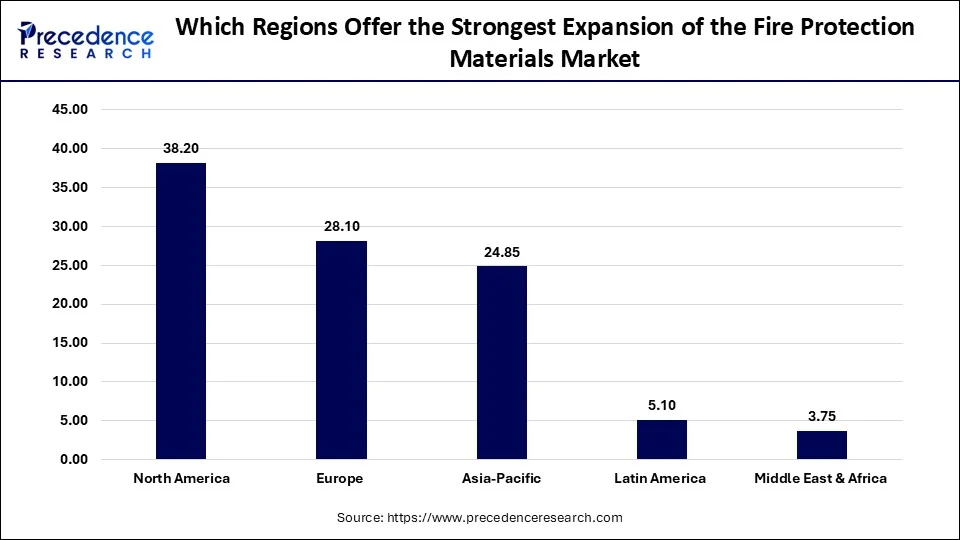
North America dominated the market with a share of 38.2% in 2025 and is expected to show lucrative growth with a CAGR of 8.1% from 2026 to 2035. On the other hand, Asia-Pacific held a lower market share of 24.85% in 2025 but is expected to gain momentum in the coming years, expanding at a CAGR of 10.55%. Europe also witnesses significant growth, with a share of 28.1% in 2025.
Expert Analyst View - Regional Analysis
North America has a well-established infrastructure for adopting fire protection materials and provides specification-intensive, high-value demand. Asia-Pacific's fastest growth is attributed to rapid urbanization, industrialization, and stringent building safety codes. In Europe, the European Union imposes stringent regulations to ensure high safety and environmental performance in buildings and industrial applications.
Latin America's market growth is primarily driven by rising construction activities. Authorities in the Middle East and Africa make constant efforts to build data centers and high-rise buildings, potentiating the use of fire protection materials. These trends suggest that key players can expand their business operations by focusing on emerging economies.
Which Countries are Driving Each Regional Market?
| Region | Key Country | Country Share of Regional Market (%) | CAGR (% | Market Role |
| North America | United States | 84.0 | 8.15 | Largest construction, industrial, and data-center base |
| North America | Canada | 10.5 | 7.65 | Infrastructure and commercial construction |
| North America | Mexico | 5.5 | 9.60 | Manufacturing and industrial expansion |
| Europe | Germany | 22.5 | 9.55 | Industrial and construction base |
| Europe | United Kingdom | 17.5 | 7.80 | Building safety and retrofit |
| Europe | France | 15.0 | 8.10 | Infrastructure and commercial development |
| Europe | Italy | 11.5 | 8.45 | Industrial and construction applications |
| Europe | Spain | 9.0 | 9.70 | Construction and infrastructure |
| Europe | Other Europe | 24.5 | 8.05 | Diverse regional demand |
| Asia-Pacific | China | 43.5 | 11.85 | Industrial scale and construction |
| Asia-Pacific | India | 24.5 | 12.10 | Urbanization and infrastructure |
| Asia-Pacific | Japan | 10.0 | 7.15 | Mature safety-intensive market |
| Asia-Pacific | South Korea | 8.0 | 9.85 | Electronics and advanced manufacturing |
| Asia-Pacific | Australia | 5.0 | 8.10 | Infrastructure and mining |
| Asia-Pacific | Other Asia-Pacific | 9.0 | 9.55 | Emerging construction markets |
| Latin America | Brazil | 48.0 | 9.15 | Largest regional economy and construction base |
| Latin America | Argentina | 10.0 | 8.25 | Industrial and construction demand |
| Latin America | Other Latin America | 20.0 | 8.35 | Infrastructure expansion |
| Middle East & Africa | Saudi Arabia | 29.0 | 10.15 | Energy and mega-project investment |
| Middle East & Africa | UAE | 24.0 | 9.35 | Commercial and infrastructure projects |
| Middle East & Africa | South Africa | 16.0 | 8.10 | Industrial and infrastructure base |
| Middle East & Africa | Qatar | 10.0 | 10.60 | Infrastructure and high-specification construction |
| Middle East & Africa | Other MEA | 21.0 | 8.65 | Emerging infrastructure |
Countries like China and India reflect stronger market expansion over the upcoming years, while established nations like the U.S., UK, and Japan generally show slower growth. In Latin America, Brazil is at the forefront of developing stringent regulations for fire safety. Saudi Arabia and Qatar are expanding at the highest growth rate in the Middle East and Africa during the studied period, owing to the increasing investments in energy and mega-projects and rising construction activity.
Expert Analyst View - Country-level Analysis
- North America: The U.S. remains the primary revenue center with a market share of 84% in 2025, supported by established codes, commercial construction, industrial facilities, and data center investments.
- Europe: Germany held 22.5%, and the UK held 17.5% of market share in 2025. Regulatory compliance and renovation are major growth drivers that create a stable base for certified fire protection in Germany and the UK.
- Asia-Pacific: China and India are major growth centers for fire protection materials, owing to their high demand for construction, industrialization, and improving safety enforcement support. China provides scale, while India offers a particularly strong expansion opportunity.
- Latin America: Brazil offers the highest market growth opportunities, with rapid urban growth in São Paulo and Rio de Janeiro.
- Middle East and Africa: The UAE and Saudi Arabia are expected to grow at a CAGR of 9.35% and 10.15% from 2026 to 2035. They are central to regional demand, particularly through large infrastructure, energy, and commercial developments.
Which Companies are at the Forefront of Product Development?
The fire protection materials market has a presence of global coatings companies, construction-chemicals companies, insulation specialists, and passive-fire-protection specialists.
PPG
PPG's portfolio of fire protection coatings includes the STEELGUARD series that provides multifunctional structural-steel protection. The company's STEELGUARD 951 offers corrosion resistance, along with fire protection, that can provide up to 180 minutes of protection under specified conditions.
Sherwin-Williams
Sherwin-Williams' product portfolio includes FIRETEX made of cellulosic and hydrocarbon materials. FIRETEX FX9502 is an epoxy intumescent system designed for structural steel, while the company's newer products FX1008/FX2008 emphasize faster drying and lower film thickness.
Sika
Sika's specialty lies in sealants, coatings, firestopping systems, mortars, and related construction materials. Its firestopping materials address penetrations and linear joints, while its intumescent materials close openings during fire exposure.
Promat/Etex
Promat offers spray coatings, boards, intumescent paints, firestopping products, and adhesives. It is the leading reference in passive fire protection and high temperature and sound insulation materials for multiple industries.
Other relevant key industries
- 3M
- AkzoNobel
- Hilti
- BASF
- Henkel
- RPM International/Carboline/Nullifire
- Hempel
- Isolatek International
- Morgan Advanced Materials
- Jotun
- ROCKWOOL
- Saint-Gobain
Expert Analyst View - Company Intelligence
According to our Senior Researcher, Aman Singh, companies mostly compete through certification breadth, application productivity, technical support, and system-level support. Key players mainly focus on specification-based materials that provide passive protection. Next-generation fire protection materials are developed that support environmental safety, maintain visibility, and structural integrity.
What are Buyers' Preferences of the Fire Protection Materials Market?
Buyers primarily prefer certified fire resistance ratings, product compatibility, installation time and labor requirements, durability and maintenance interval, VOC profile and sustainability credentials, availability of approved applicators, total installed cost, and technical documentation & engineering support.
- Certified Fire Resistance Rating: Fire resistance ratings matter as they give an idea about structural stability, reduced speed of flames and heat, preserved essential cable systems, and business continuity.
- Product Compatibility: Buyers choose products that demonstrate little or no effect on the piping material. This depends on the strength of the material chosen and the quality of the parts produced from it.
- Installation Time and Labor Requirements: Installation times of fire protection materials vary depending on the service required, facility size, and any extra features that fire safety tools require.
- Total Installed Cost: Buyers also consider the total installation cost of fire protection materials rather than the material cost alone. Installation cost is affected by property size and layout, type of fire protection system, regulatory compliance requirements, and maintenance frequency.
What are the TAM/SAM/SOM Frameworks of the Fire Protection Materials Market?
| Opportunity Layer | Indicative 2025 Value | Definition |
| TAM | ~USD 7.0B | Global fire protection materials across construction and industrial applications |
| SAM | ~USD 4.1B | Addressable passive/high-performance materials across commercial, industrial, infrastructure, and energy applications |
| Serviceable priority pool | ~USD 1.5–1.8B | High-growth applications such as industrial facilities, data centers, energy infrastructure, and advanced manufacturing |
| Illustrative SOM | Project-specific | Depends on geography, certification, channel access, application capability, and manufacturing capacity |
The total addressable market (TAM) value was valued at USD 7 billion in 2025, owing to the growing construction activities, especially in emerging markets, and the increasing development of innovative fire protection materials. The serviceable addressable market (SAM) was valued at USD 4.1 billion in 2025. The serviceable priority pool reached USD 1.5-1.8 billion in 2025, while the value of the illustrative serviceable obtainable market (SOM) depends on project-specific requirements.
Which Strategic Questions Should Companies Answer Before Investing or Expanding?
Product Strategy
- Which fire-resistance ratings are generating the highest-value specifications?
- Where can thin-film intumescent products replace heavier protection systems?
- Which formulations provide the best combination of fire resistance, corrosion protection, and durability?
- Where are low-VOC and water-based technologies becoming procurement requirements?
Commercial Strategy
- Which engineering firms and contractors influence product specification?
- Which markets are most dependent on certified applicators?
- Where does direct selling outperform distributor-led models?
- Which retrofit applications provide recurring demand?
Expansion Strategy
- Should production capacity follow construction demand or industrial mega-projects?
- Which Asian markets offer the strongest combination of growth and regulatory maturity?
- Can regional manufacturing reduce freight and improve project responsiveness?
- Which certifications are essential for entering North America, Europe, or Middle East markets?
Competitive Intelligence
- How quickly are competitors introducing lower-thickness intumescent systems?
- Which companies are expanding into data centers and battery manufacturing?
- Where are acquisitions consolidating coatings, insulation, and firestopping capabilities?
- Which companies have the strongest combination of product certification and installer networks?
Experts Insights
The global fire protection materials market was valued at USD 7 billion in 2025 and is projected to grow at a CAGR of 8.9% during the forecast period, witnessing a shifting trend towards higher-performance, certified, and application-specific protection systems. Major end-users for fire protection materials include industrial facilities, energy infrastructure, and data centers. Our Senior Researcher, Aditi Shivarkar, estimates that stakeholders prioritize intumescent coatings and multifunctional materials, as they provide corrosion resistance, durability, installation efficiency, and aesthetics.
Manufacturers and investors identify applications or places where fire protection materials create premium specifications and recurring replacement or retrofit demand. Companies that are positioned around certified systems, specialized applications, and technically demanding customers have broader opportunities than suppliers competing primarily on commodity material costs.
Our Experts
- The primary market research process was carried out by Vidyesh Swar, Senior Research Associate, who also designed the methodology and did market segmentation, regional trend analysis, buyer intelligence, competitive analysis, and forecasts, laying the foundation for the analytical part of the report.
- Aman Singh, Head of Research, has gathered and checked regulatory policies, company financial information, and various other quantitative information sources, which were obtained independently, thereby increasing the quality of evidence supporting the calculations of the market values.
- Aditi Shivarkar, VP Research, has validated and refined the research material, verified facts, corrected inconsistencies, and completed the research document, making it accurate and to the point.
Fire Protection Materials Market Segments Covered in the Report
By Product Type
- Fire Protection Coatings
- Fire Protection Sealants & Fillers
- Fire Protection Mortars
- Fire Protection Boards & Panels
- Fire Protection Sprays
- Fire Protection Putty & Mastics
- Preformed Fire Protection Devices
- Other Specialty Materials
By Material/Technology
- Intumescent Materials
- Cementitious Materials
- Mineral Wool & Inorganic Insulation
- Fire-Resistant Polymers & Sealant Systems
- Gypsum-Based Materials
- Ceramic/Refractory Materials
- Advanced Composite & Specialty Materials
By Application
- Commercial Buildings
- Industrial Facilities
- Residential Buildings
- Oil & Gas/Petrochemical
- Data Centers & Digital Infrastructure
- Transportation
- Power & Energy Infrastructure
- Other Applications
By End User
- Construction & Building Contractors
- Industrial & Manufacturing Companies
- Commercial Property Owners & Developers
- Oil & Gas/Energy Companies
- Infrastructure Operators
- Data Center Operators
- Government & Institutional Buyers
- Other End Users
By Distribution Channel
- Direct Project/Manufacturer Sales
- Specialty Distributors
- Building Material Distributors
- Fire Protection Contractors/Applicators
- Online B2B/Digital Procurement
Other Channels
By Region
- North Americ
- United States
- Canada
- Mexico
- Europe
- Germany
- United Kingdom
- France
- Italy
- Spain
- Other Europe
- Asia-Pacific
- China
- India
- Japan
- South Korea
- Australia
- Other Asia-Pacific
- Latin America
- Brazil
- Mexico
- Argentina
- Other Latin America
- Middle East & Africa
- Saudi Arabia
- UAE
- South Africa
- Qatar
- Other MEA
For inquiries regarding discounts, bulk purchases, or customization requests, please contact us at sales@precedenceresearch.com
Frequently Asked Questions





Ask For Sample
No cookie-cutter, only authentic analysis – take the 1st step to become a Precedence Research client
 Get a Sample




 sales@precedenceresearch.com
 Schedule a Meeting
