



Flooring Adhesive Market Trends, Leading Companies, Company Revenue / Sales Performance, Plant Utilization, Production Volume, Pricing Dynamics, Supply Chain Performance, Competitive Landscape, and Industry Growth
Flooring Adhesive Market (By Resin: Acrylic, Polyurethane, Polyvinyl Acetate, Others; By Application: Resilient Flooring, Wooden Flooring, Laminate Flooring, Others; By End-Use: Residential, Commercial, Industrial) - Global Industry Analysis, Size, Trends, Leading Companies, Regional Outlook, and Forecast 2026 to 2034
Source: https://www.precedenceresearch.com/flooring-adhesive-market
 Get a Sample
 Table Of Content


What is Flooring Adhesive Market Size?
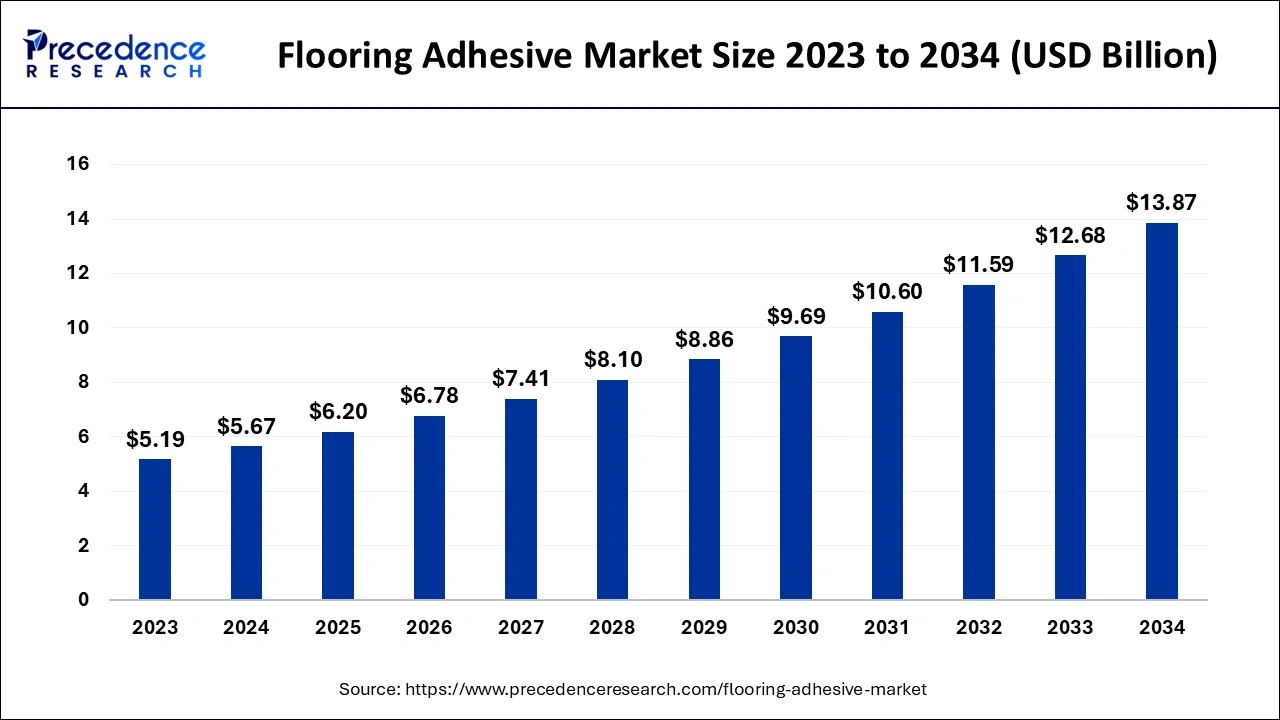
The global flooring adhesive market size is calculated at USD 6.78 billion in 2026 and is predicted to reach around USD 13.87 billion by 2034, expanding at a CAGR of 9.36% from 2026 to 2034. The rising need to inculcate durable, strong, and long-lasting bonds between tiles and substrates is increasing the adoption of the flooring adhesive market.
Market Highlights
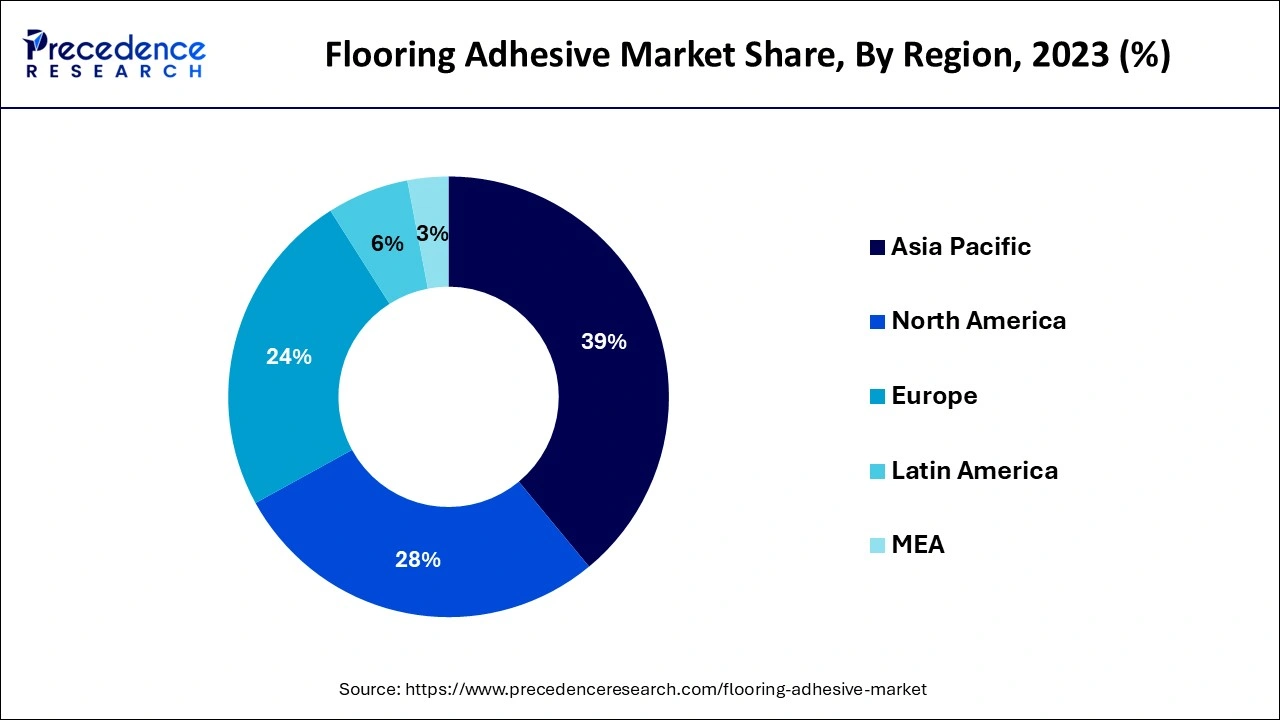
- Asia Pacific dominated the global market with the largest market share of 39% in 2024.
- North America is anticipated to grow significantly during the forecast period.
- By resin, the acrylic segment contributed the largest market share of 42% in 2024.
- By resin, the Polyvinyl Acetate segment is anticipated to grow at the fastest CAGR of 10.22%during the projected period.
- By application, the resilient flooring segment contributed the highest market share of 53% in 2024.
- By application, the wooden flooring segment is expected to show the fastest CAGR of 9.73% from 2025 to 2034.
- By end-use, the commercial segment captured the biggest market share of 35% in 2024.
- By end-use, the residential segment is anticipated to grow at the fastest CAGR during the forecast period.
Market Overview
Flooring adhesive is a material that functions as a fastening agent to stick two or more solid materials by using glue, cement, or other adhesives. The floor adhesives prevent tiles from shifting or cracking while being walked on or placing a heavy object on. Compared to conventional mortar, flooring adhesive helps to minimize overall effort, time, and expenses. There are 5 different types of floor adhesive catering to specific requirements in the construction process. Moreover, they are extremely useful in ensuring a strong, long-lasting bond between the tiles and the substrates underneath.
How is AI changing the Flooring Adhesive Market?
The integration of artificial intelligence (AI) in the flooring adhesive market offers a transformation in lifestyle and business. AI in the adhesive and sealant industry provides software solutions that formulate adhesives to improve service to customers, improve efficiency, and optimize material flows and workflows.
Flooring Adhesive Market Growth Factors
- Flooring adhesive provides excellent bonding strength and durability. This ensures that the tiles are not loose, shifting, or detached when used. Additionally, they as extremely essential in areas with denser foot traffic and places vulnerable to damage from moisture.
- Floor adhesive is a great material to use on the kitchen and bathroom floors as they have a high level of water resistance which helps in fixing tiles in moisture-laden areas.
- The easy-to-use application makes it convenient to use. They are packaged in ready-to-use form which avoids extensive mixing and preparation of mortar cement.
- Tile fixing is one of the more expensive parts of the construction project. However, when the right adhesive is chosen, costly prices can be eliminated, such as admixtures, mortar cement, and labor costs. Additionally, there is no repair and replacement cost.
Market Key Trend
The flooring adhesive market is undergoing a dynamic transformation, driven by sustainability, performance enhancements, and increasing demand across residential, commercial, and industrial sectors. A significant trend is the surge in demand for low-VOC (Volatile Organic Compounds) and eco-friendly adhesives, as environmental consciousness shapes consumer and industry decisions alike. Manufacturers are investing in bio-based adhesives, ensuring safety without compromising on bonding strength.
The growing shift towards modular and luxury vinyl tile (LVT) flooring is positively impacting the adhesive landscape. These modern floorings require strong, fast-curing adhesives that offer durability while withstanding temperature fluctuations and moisture exposure. Moreover, technological advancements in hybrid polymers and reactive adhesives are gaining attention for their long-term stability and compatibility with multiple substrates.
Market Outlook
- Industry Growth Overview: The flooring adhesive market is experiencing robust growth, driven by increasing construction and renovation activities across residential, commercial, and industrial sectors. Rising demand for sustainable, high-performance, and easy-to-apply adhesives is further fueling innovation and adoption in both developed and emerging markets.
- Sustainability Trends: There is strong demand for bio-based, solvent-free formulations. As a result, manufacturers are focusing on reducing VOC emissions, enhancing recyclability, and adopting energy-efficient production technologies to comply with global environmental regulations and promote eco-friendly manufacturing practices.
- Global Expansion: There is significant potential for market expansion worldwide, enabling manufacturers to tap into growing construction and renovation activity across both developed and emerging regions. In particular, fast-growing economies in Asia-Pacific, Latin America, and the Middle East present significant opportunities due to rapid urbanization, rising disposable incomes, and expanding commercial infrastructure.
- Major Investors: Major investors in the market include leading companies such as Henkel AG & Co. KGaA, Sika AG, 3M, and Bostik, which invest heavily in R&D to develop eco-friendly and high-performance adhesives. Institutional investors like BlackRock, Vanguard, and Capital Group also back these firms, supporting technological innovation, sustainability initiatives, and global market expansion.
- Startup Ecosystem: The startup ecosystem in the market is expanding rapidly, with a focus on bio-based, low-VOC, and smart adhesive solutions for sustainable construction. These startups collaborate with material science institutes and major flooring manufacturers to develop high-bonding, moisture-resistant products, leveraging nanotechnology and digital formulation tools to enhance application precision and ensure environmental compliance.
Market Scope
| Report Coverage | Details |
| Market Size in 2025 | USD 6.20 Billion |
| Market Size in 2026 | USD 6.78 Billion |
| Market Size by 2034 | USD 13.87 Billion |
| Market Growth Rate from 2026 to 2034 | CAGR of 9.36% |
| Largest Market | Asia Pacific |
| Base Year | 2025 |
| Forecast Period | 2026 to 2034 |
| Segments Covered | Resin, Application, End-Use, and Regions |
| Regions Covered | North America, Europe, Asia-Pacific, Latin America and Middle East, and Africa |
Market Dynamics
Drivers
The demand in the construction industry
The flooring adhesive market services are highly demanded in construction flooring sectors such as education, retail, and industrial. Adhesives have an extremely versatile role in buildings and construction. Traditional and newly developed construction materials, such as concrete, plastics, wood panels, and much more, need adhesive to have high-quality adhesion, improve performance, and easier application. These benefits are increasing the demand for floor adhesives in the construction industry.
Restraint
Adhesive failure
When the adhesive does not bond properly to the substrate, it happens due to dampness in the subfloor, a curing compound on the surface, or weak material or dust on the surface; this results in the failure of the flooring adhesive market. The common cause of failure is the late placement of sheets. To avoid this problem, a simple thing can be done to prevent the adhesive from drying or setting. Using the wrong adhesive can also lead to this problem, which results in worn or incorrectly-sized notched trowel.
Opportunity
Infrastructure in economic development
The flooring adhesive market has a promising future in the development of infrastructure and economic growth. Infrastructure development is the milestone of economic growth and social progress. The regions with rapid urbanization and economic expansion require robust infrastructure to achieve the development goal. The goals can be supported by facilitating trade and commerce, attracting domestic and foreign investments, improving the quality of life for residents by providing essential services, and promoting sustainable development.
Segment Insights
Resin Insights
The acrylic segment contributed the largest share of the flooring adhesive market in 2024. The dominance of this segment is noted due to its broad utility, which includes primed metals, direct-to-metal, wood, and masonry. Acrylic adhesives are available in a variety of colors and gloss levels. The Superior water-based acrylic floor adhesive is used for resilient tiles and sheets, wood parquet, linoleum, and carpets. It is best installed on concrete, chipboard, hardboard, plywood, and other types of sub-floors. The common applications of acrylics are wall panel bonding, grout sealing, textile bonding, paper stamps, leather tile envelopes, labels, and many more. To conclude, acrylic is a versatile material that is in high demand in various industries.
The Polyvinyl Acetate segment is anticipated to grow at a significant CAGR in the flooring adhesive market during the forecast period of 2024 to 2034. Polyvinyl Acetate adhesive is used mainly for interior applications. The growth of this segment is observed due to its high initial bonding strength and ease of use. They are available for both hot and cold pressing conditions and are suitable for various applications, such as lightweight panels, doors, foil lamination, and solid wood laminations. Additionally, PVA chips are added by applying a standard or moisture-removing primer coat and color coat, resulting in a chip system flooring.
Application Insights
The resilient flooring segment stood dominant in the flooring adhesive market in 2024. The dominance of this segment is due to its highly engineered sheet and tile products, which can withstand heavy use in a variety of commercial and residential buildings. They are firm, and bounce-back property makes them the preferred choice by healthcare and education designers. Compared to other flooring, resilient flooring offers a degree of flexibility under the foot, providing more comfort. Resilient floors are durable and last a long time, which saves money on replacement. Additionally, it reduces noise in places like schools and public places.
- In November 2024, Bona, a global leader in innovative floor care and maintenance solutions, collaborated with a color psychology expert to develop the Bona Resilient Solution Colour Collection.
The wooden flooring segment is anticipated to grow significantly in the flooring adhesive market during the forecast period of 2024 to 2034. Choosing the right flooring adhesive when it comes to wooden flooring is essential. Different types of woods respond better to varying adhesives. Solid wood requires more room to expand and contract with the atmospheric environment. These movements increase the chance of the flooring breaking. To prevent the floorboard from breaking, the right adhesive with great flexibility or elasticity is required. Some trusted brands for wooden flooring in the industry are Ardex, Bostik, Mapei, Tilemaster, and many more.
End-Use Insights
The commercial segment led the global flooring adhesive market in 2024. The dominance of this segment is observed due to the availability of a wide range of adhesives to use in commercial settings. There are various adhesives available, but only four are commonly used within the industry, such as epoxy, polyurethane, acrylic, and pressure-sensitive adhesives. The right floor adhesive should fulfill the environmental requirement intended and be labeled for commercial use. According to the standards, it should attain environmental and health requirements and prevent toxicity, hazardous ingredients, and volatile organic compounds (VOCs).
The residential segment is anticipated to grow at a significant CAGR in the market during the forecast period of 2024 to 2034. The expansion of the segment is noticed due to the rising number of houses that have been remodeled and renovated. According to the U.S. Census Bureau, the average U.S. home is 40 years old and increasing.
Regional Insights
Asia Pacific Flooring Adhesive Market Size and Growth 2026 to 2034
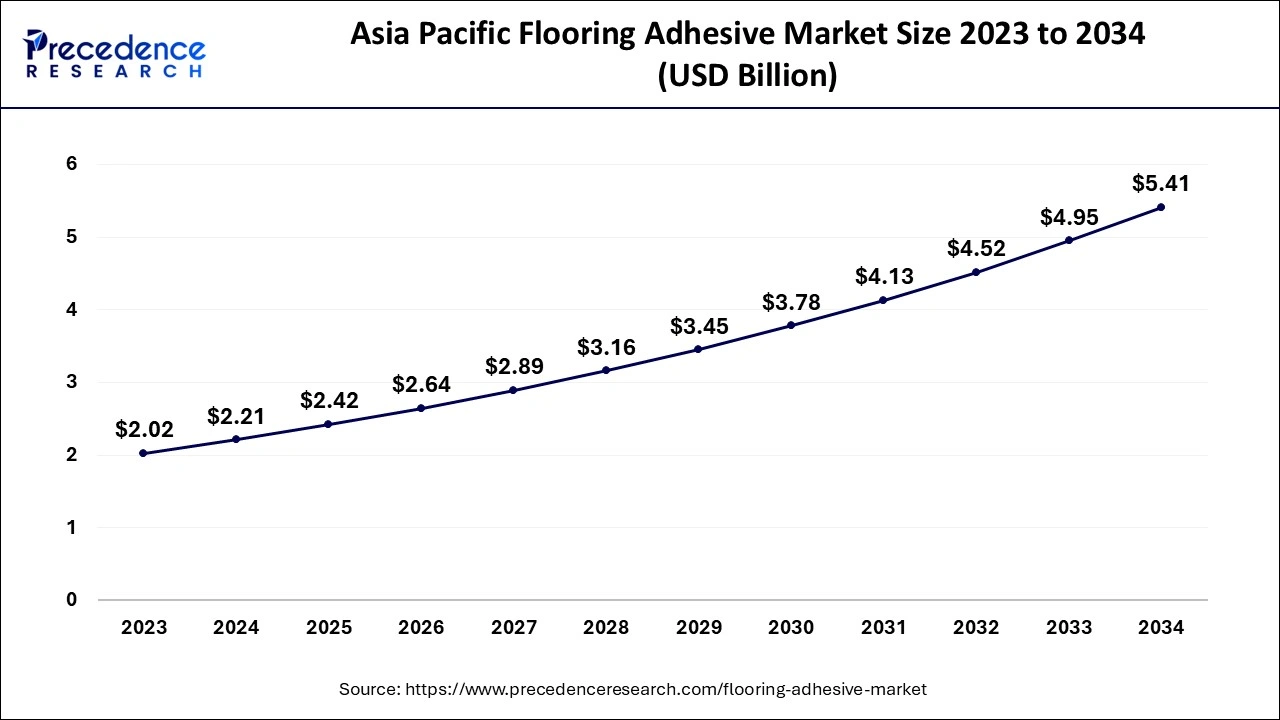
The Asia Pacific flooring adhesive market size is exhibited at USD 2.64 billion in 2026 and is expected to be worth around USD 5.41 billion by 2034, growing at a CAGR of 9.37% from 2026 to 2034.
Asia Pacific dominated the global floor adhesive market in 2024. The dominance of this region is noted owing to Increasing urbanization and rising disposable incomes. The surge in urbanization represents the increasing opportunities for businesses in the region. This rapid pace of urbanization has significantly influenced the construction industry. As cities expand, the population migrates from rural to urban areas, which increases the demand for infrastructure, housing, and related materials.
Asia-Pacific stands out as the dominant region in the global flooring adhesive market, driven by rapid urbanization, infrastructure development, and a booming construction sector. Countries like China, India, Japan, South Korea, and Vietnam are playing a crucial role in market expansion. In China and India, government-backed housing and smart city programs have significantly accelerated flooring applications, with a growing preference for high-performance adhesives that suit diverse climatic conditions. Japan and South Korea, on the other hand, are leveraging technological integration and stringent environmental norms to push forward with green-certified adhesive solutions. Initiatives like India's Smart Cities Mission, China's Green Building Action Plan, and the push for Zero-Energy Homes in Japan highlight the region's forward momentum in sustainable construction, thereby boosting the demand for advanced flooring adhesives.
- Asia Pacific includes 18 megacities, which is expected to demonstrate over a 50% increase in disposable income per capita by 2033.
What Potentiates the Growth of the Flooring Adhesive Market in North America?
North America is anticipated to grow significantly in the flooring adhesive market during the forecast period of 2024 to 2034. The growth of the market in this region is attributed to continuous consumer interest in home improvement projects such as kitchen and bathroom remodeling. Frequently used to replace older or worn flooring. United States has a wide availability of polyvinyl acetate (PVA) adhesive used for porous materials such as wood, paper, and cloth. Additionally, the region has rising commercial building construction, boosting the demand for vinyl, ceramic, and carpet tile products.
North America, while not the largest, is rapidly emerging as one of the fastest-growing regions in the flooring adhesive market. The United States and Canada are at the forefront due to rising trends in home renovation, commercial interior upgrades, and technological innovations in construction materials. The resurgence of the housing sector, especially in suburban regions post-pandemic, has increased the installation of modern floorings such as engineered wood, LVT, and ceramic tiles, all of which rely on high-strength adhesives. Furthermore, stringent environmental regulations by institutions such as the EPA (Environmental Protection Agency) and CARB (California Air Resources Board) have catalyzed the development of sustainable and compliant adhesive solutions. Consumers and contractors alike are shifting towards products that offer low odor, strong adhesion, quick drying time, and mold resistance, ensuring both convenience and long-term durability.
How Big is Europe's Success in the Flooring Adhesive Market?
Europe is experiencing notable growth in the flooring adhesive market, driven by increasing demand for eco-friendly and low-VOC adhesives, rising renovation activities, and stringent construction regulations promoting sustainable materials. Advanced R&D capabilities, technological innovations, and the presence of major adhesive manufacturers further support market development across residential and commercial flooring applications.
Germany's flooring adhesive market grows steadily due to strong construction and renovation activities, particularly in residential and commercial spaces. The country's focus on sustainability, adoption of low-emission adhesives, and advanced manufacturing capabilities support innovation. Stringent environmental standards and government incentives for green building materials further boost market expansion.
The U.K. flooring adhesive market is supported by rising infrastructure modernization, increasing home renovation trends, and growing demand for moisture-resistant and flexible adhesives. Supportive government policies for sustainable construction, along with technological advancements and a strong presence of key international adhesive brands, continue to drive consistent market growth across flooring applications.
How Crucial is the Role of Latin America in the Flooring Adhesive Market?
Latin America offers significant opportunities in the flooring adhesive market, driven by rapid urbanization, expanding construction activities, and increasing adoption of modern flooring materials. Rising investments in residential and commercial infrastructure, along with growing awareness of durable and eco-friendly adhesive solutions, further support regional market development and industrial growth.
Brazil leads the Latin America flooring adhesive market, driven by a strong construction sector, expanding residential and commercial projects, and growing demand for high-performance adhesives. Government initiatives supporting infrastructure development, increased renovation activities, and rising preference for sustainable, low-VOC adhesive solutions further reinforce Brazil's dominant position in the regional market.
What Potentiates the Growth of the Middle East and Africa Flooring Adhesive Market?
The flooring adhesive market in the Middle East and Africa is driven by rapid urbanization, large-scale infrastructure projects, and expanding commercial and residential construction. Rising adoption of modern flooring materials, government investments in smart city development, and growing preference for sustainable, high-performance adhesives further enhance the region's market potential.
The UAE leads the Middle East and Africa flooring adhesive market, driven by rapid infrastructure development, large-scale commercial projects, and expanding residential construction. The country's focus on sustainable building materials, adoption of advanced adhesive technologies, and strong regulatory standards support market growth, while renovation projects, smart city initiatives, and investments in eco-friendly adhesives further reinforce the UAE's market dominance.
Value Chain Analysis of the Flooring Adhesive Market
- Feedstock Procurement
Feedstock procurement begins with sourcing essential raw materials such as resins, polymers, tackifiers, and solvents.
Key Players: BASF SE, Dow Chemical Company, and ExxonMobil Chemical. - Chemical Synthesis and Processing
This stage involves polymerization, blending, and formulation of adhesives using advanced reactors and compounding equipment. The process guarantees optimal viscosity, bonding strength, and curing performance, tailored for different flooring materials such as wood, vinyl, and tile.
Key Players: Henkel AG & Co. KGaA, Sika AG, 3M Company, and Bostik SA. - Waste Management and Recycling
This stage includes post-production waste, such as solvent residues and polymer scraps, which undergo segregation, treatment, and recycling to minimize environmental impact.
Key Players: Sika, Henkel, and H.B. Fuller. - Regulatory Compliance and Safety Monitoring
Compliance requires following safety standards for chemical handling, labeling, and emissions control. Regular audits, environmental monitoring, and employee safety training ensure operations comply with international and regional regulations.
Key Players: European Chemicals Agency (ECHA), U.S. Environmental Protection Agency (EPA), and Occupational Safety and Health Administration (OSHA).
Flooring Adhesive Market Companies
- Bostik – Develops innovative, high-performance adhesives for residential, commercial, and industrial flooring applications, including eco-friendly and low-VOC solutions.
- Dow – Provides advanced polymer-based adhesive technologies and chemical solutions that enhance durability, bonding, and sustainability in flooring applications.
- Forbo Management SA – Offers specialized flooring adhesives and installation systems for resilient, textile, and linoleum flooring, focusing on quality and environmental compliance.
- H.B. Fuller Company – Supplies a broad range of adhesives, sealants, and bonding solutions for various flooring types, emphasizing sustainability and high-performance formulations.
- Henkel AG & Co. KGaA – Produces high-quality flooring adhesives and sealants under brands like Ponal and Loctite, focusing on innovation, eco-friendliness, and strong global distribution.
- LATICRETE International, Inc. – Provides advanced tile and stone adhesives, mortars, and grouts designed for durability, moisture resistance, and ease of application in flooring projects.
- MAPEI – Offers a comprehensive portfolio of adhesives, grouts, and installation systems for diverse flooring materials, emphasizing sustainable and high-performance solutions.
- Parker-Hannifin Corporation – Supports the flooring adhesive market through precision dispensing systems and equipment that improve adhesive application efficiency and consistency.
- Pidilite Industries Ltd. – Develops consumer and industrial adhesives, including flooring-specific products, with a focus on innovation, affordability, and eco-friendly formulations.
- Sika AG – Provides high-performance flooring adhesives and installation solutions, emphasizing durability, chemical resistance, and sustainable construction practices.
Recent updates on flooring adhesive
Construction growth and renovation trends fuel demand
- On 14 March 2025, due to an increase in remodeling projects and construction activities in both the residential and commercial sectors the flooring adhesive market is expanding steadily because of their versatility aesthetic appeal and suitability for contemporary flooring materials adhesive are displacing conventional mechanical fasteners green building projects are increasingly using low VOC and environmentally friendly adhesives. Rapid urbanization and infrastructure improvements in emerging economies are also helping the market.
Product innovation focuses on performance and sustainability
- On 10 April 2025, manufacturers introduced high-performance adhesive tailored for luxury vinyl tiles, engineered wood, and large format ceramic tiles. These adhesives offer stronger bonding, quicker curing times, and improved resistance to moisture and temperature fluctuations. Solvent-free and water-based formulations are seeing increased adoption amid stricter emission regulations hybrid polymer technologies are also being explored for high traffic and wet area installations.
Latest Announcements by Industry Leaders
- In June 2024, Magicrete MD Sourabh Bansal said, “In India, many people still rely on traditional methods like sand and cement for tile installation. While these methods have been in use for decades, they come with significant drawbacks, such as weak adhesion and tile breakage. Countries around the world have embraced tile adhesives, leading to widespread adoption and significant market penetration. However, in India, the penetration of tile adhesives remains at a modest 15 percent, highlighting a substantial opportunity for growth and modernization in the construction industry.”
Recent Developments
- On 18 February 2025, Bostik launched its new light grab LVT adhesive, Bostik GripPro XT, designed for commercial flooring contractors seeking fast installation and repositionability. The product meets EU Ecolabel standards and is being marketed across Europe and North America. Initial trials report reduced installation time by up to 30% compared to traditional adhesive.
- In March 2025, Sika AG expanded its production capacity in Southeast Asia to meet growing regional demand for flooring adhesive in high-rise construction. The new facility includes advanced formulation lines for acrylic and polyurethane-based adhesives. Sika also introduced localized adhesive solutions tailored to humid tropical climates.
- On 7 April 2025, Henkel introduced a range of bio-based flooring adhesives under its LOCTITE brand, aiming to support sustainable construction practices. These products contain up to 40% renewable raw materials and are certified under LED and DREEAM standards. Hankel plans to roll out these adhesives in North America and EMEA, a market, through Q3 2025
- In July 2024, Karta, a sustainable wood flooring specialist, launched a brand-new series of sustainable floors with 18 new, completely natural, plastic-free, and toxin-free floors. This new recycled leather series is made from leather offcuts sourced from the shoe industry. The aim is to continue providing innovative, high-quality, and eco-friendly solutions.
- In June 2024, Magicrete, a producer of AAC blocks, construction chemicals, and precast construction solutions, launched its latest tile adhesive product range. This modern construction technology in India contributes significantly to the ‘housing for all' initiative through its innovative and affordable construction solutions.
Segments Covered in the Report
By Resin
- Acrylic
- Polyurethane
- Polyvinyl Acetate
- Others
By Application
- Resilient Flooring
- Wooden Flooring
- Laminate Flooring
- Others
By End-Use
- Residential
- Commercial
- Industrial
By Geography
- North America
- Asia Pacific
- Europe
- Latin America
- Middle East and Africa
For inquiries regarding discounts, bulk purchases, or customization requests, please contact us at sales@precedenceresearch.com
Frequently Asked Questions
Tags





Ask For Sample
No cookie-cutter, only authentic analysis – take the 1st step to become a Precedence Research client
 Get a Sample




 sales@precedenceresearch.com
 Schedule a Meeting
