



Food Texture Market Size, Share and Trends 2026 to 2035
Food Texture Market (By Type: Gums, Pectins, Gelatins, Starch, Inulin, Dextrins, Others, Cellulose Derivatives; By Application: Dairy Products and Ice Creams, Confectionery, Jams, Layers, Fillings, Bakery, Ready Meals, Sauces, Beverage, Others, Meat Products; By Product: Natural, Synthetic) - Global Industry Analysis, Size, Trends, Leading Companies, Regional Outlook, and Forecast 2026 to 2035
Source: https://www.precedenceresearch.com/food-texture-market
 Get a Sample
 Table Of Content


What is the Food Texture Market Size?
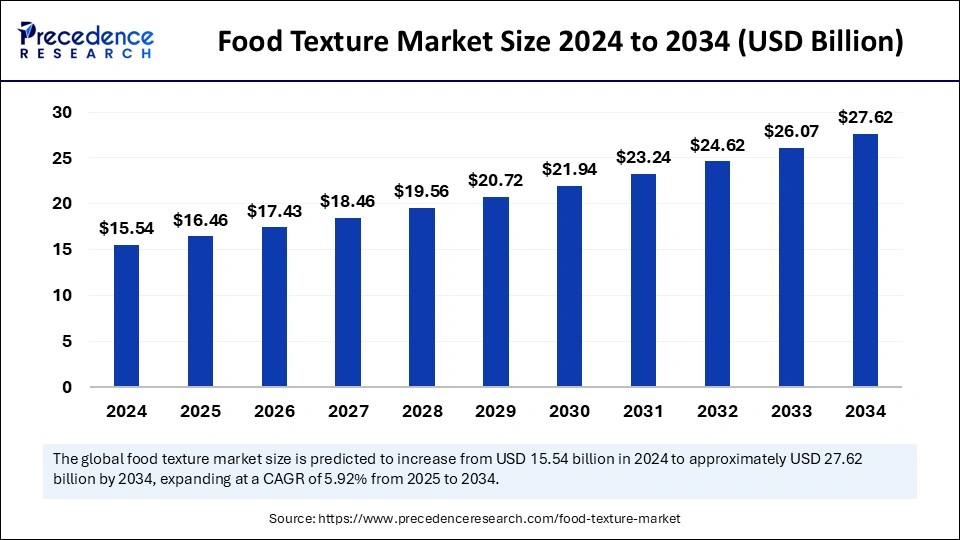
The global food texture market size is calculated at USD 16.46 billion in 2025 and is predicted to increase from USD 17.43 billion in 2026 to approximately USD 29.10 billion by 2035, expanding at a CAGR of 5.86% from 2026 to 2035.
Food Texture Market Key Takeaways
- North America led the global food texture market with the largest share in 2025.
- Asia Pacific is estimated to expand the fastest CAGR between 2026 and 2035.
- By type, the cellulose derivatives segment held the biggest market share in 2025.
- By type, the starch segment is anticipated to grow at a remarkable CAGR between 2025 and 2035.
- By application, the dairy products and ice cream segment captured the highest market share in 2025.
- By application, the bakery segment is expected to expand at a notable CAGR over the projected period.
- By product, the natural segment contributed the largest market share in 2025.
- By product, the synthetic segment is expected to expand at a notable CAGR over the projected period.
Market Overview
The food texture market focuses on ingredients and additives aimed at enhancing texture, consistency, and mouthfeel in food and beverages. Key components in the food industry include hydrocolloids, emulsifiers, starches, and gums, all playing a part to improve stability, viscosity, and sensory appeal. Texture is very important to food formulation as it can influence consumer acceptance, shelf life, and overall quality of the products. The rising demand for processed and convenience foods, plant-based alternatives, and clean-label products is one of the major factors propelling the market growth.
Major applying sectors include dairy, bakery, confectionery, beverages, sauces, and meat substitutes. To manufacture innovative, sustainable, and natural texturizing solutions, manufacturers are investing in R&D. The adoption of plant-based and functional ingredients is shaping the food texture market, as it encourages the development of healthier and more attractive food products. The market is also expected to witness an increase due to the advancement of food technology and growing consumer choice.
Artificial Intelligence (AI) in Food Texture Discovery and Development
Artificial intelligence is transforming the food texture industry via better, more precise automated texture analysis. Deep learning, and specially CNNs, has made food recognition easier through automatic analysis of textures in RGB and spectral images. With predictive models powered by ANNs, food quality may be predicted, which increases uniformity, while reducing mistakes made by humans.AI-based texture analysis is extremely useful in the dairy, bakery, and plant-based sectors, embedded in the products to make sure of mouthfeel, while ensuring quality control. For instance, some models of AI have been developed by researchers to predict with about 90% accuracy softness in bread and tenderness in meat.
Moreover, the combination of hyperspectral imaging and AI is being used to assess freshness and detect adulteration. The role of AI in understanding food texture is getting wide and broad, incorporating innovations into food processing, quality control, satisfaction among clients, while cutting waste by discerning just-in-time spotting of defects.
Food Texture Market Growth Factors
- preference for ready-to-eat food products has continued to spur demand for texturizing agents to enhance the stability, mouthfeel, and overall sensory appeal of the products.
- The texture of upcycled and sustainably sourced ingredients is gaining importance. Consumers are willing to try alternative ingredient-based products if they provide a satisfying texture and help reduce food waste.
- Changing globalization and lifestyles are bringing about an increasing preference for convenience foods, whereby, as such, the increasing demand for convenience foods will feed the growth of the food texture market, especially in developed countries.
- Innovation in food technology continues to dominate research in food formulation. New and innovative multifunctional hydrocolloids and new emulsifiers allow the manufacturers to make food products of high quality, appealing to them, and different from each other.
Market Outlook
- Market Growth Overview: The food texture market is expected to grow significantly between 2025 and 2034, driven by the rising consumer preference, growing health and wellness, and trends towards convenience and processed foods.
- Sustainability Trends: Sustainability trends involve plant-based texturizers, clean label and natural ingredients, and waste reduction.
- Major Investors: Major investors in the market include Cargill, Ingredion, Kerry Group, ADM, IFF, Tate & Lyle, and DuPont.
- Startup Economy: The startup economy is focused on alternative proteins, meat analogs, novel ingredients and processing, and advanced food technology.
Market Scope
| Report Coverage | Details |
| Market Size by 2035 | USD 29.10 Billion |
| Market Size in 2025 | USD 16.46 Billion |
| Market Size in 2026 | USD 17.43 Billion |
| Market Growth Rate from 2026 to 2035 | CAGR of 5.86% |
| Dominated Region | North America |
| Fastest Growing Market | Asia Pacific |
| Base Year | 2025 |
| Forecast Period | 2026 to 2035 |
| Segments Covered | Type, Application, Product, and Regions |
| Regions Covered | North America, Europe, Asia-Pacific, Latin America and Middle East & Africa |
Market Dynamics
Drivers
Plant-Based Product Innovation
The rise in consumer demand for plant-based products is significantly influencing the food texture market. Impossible Foods and Beyond Meat are formulating methods in their innovation to make use of plant-derived proteins and emulsifiers to replicate meat's fibrous, juicy texture. Substitutes for dairy made using plants, like oats and almond milk, are stabilizers and texturizers done to replicate the creaminess of conventional dairy.
The mung bean proteins in Just Egg are recreating the gel-like quality held by eggs. Such trends represent an opportunity for ingredient makers to produce clean-label hydrocolloids, starches, and proteins that build mouthfeel without artificial ingredients. Therefore, plant-based innovation encompasses a change in food texture solutions to respond to consumer needs for authenticity and sustainability.
- November 18, 2024 – Stanford engineers developed an AI technique to analyze plant-based meat texture, enhancing its similarity to animal meat. This innovation supports the growing demand for natural, clean-label alternatives by improving texture and mouthfeel in plant-based products.
Restraint
Limited Functional Alternatives for Certain Textures
One key factor that hinders the growth of the food texture market is the difficulty in accurately reproducing complex textures within plant-based and clean-label products. Although some progress has been made, replicating certain textures using natural or plant-derived ingredients remains an obstacle. For example, gluten-free bakery doesn't get the elasticity and chewiness which gluten delivers, resulting in a product being commonly rather crumbly or dense. Although plant-based meats have taken tremendous steps recently, one still deserves credit for honing in on the marbling and juiciness that animal fat provides for its corresponding mouthfeel.
At the same time, texture issues arise with dairy-free cheese alternatives, which tend to become rubbery or grainy when melted, due to the lack of casein, the key milk protein. These limitations reduce consumer acceptance and slow down market growth. However, research, trials, and consumer testing for developing these functional alternatives take up a lot of time and effort, which hinders their widespread acceptance.
Opportunity
3D Food Printing Reshapes Food Texture Innovation
The advancement of 3D food printing technology is another highly significant emerging factor creating opportunities in the global food texture market. By allowing for precise control over food textures, 3D food printing can create very complex structures with personalized mouthfeel experiences. For example, Austrian food Tech Company Revo Foods has recently introduced to German supermarkets its 3D-printed plant-based salmon filet, a landmark case in the commercialization of 3D-printed food products.
Also, researchers are working on using insect protein powders in 3D printing to create healthy, beautiful food items that tackle the shortcomings of sustainability and consumer acceptance. These new advances signify that 3D food printing in food texture design will foster the fulfilling of changing consumer tastes and support sustainability pursuance efforts.
- In October 2025, British scientists at UWE Bristol developed the first 3D-printed food designed for individuals with dysphagia, a condition causing swallowing difficulties. They utilized an extrusion-based 3D food printer to produce nutrient-rich meals with specific textures and viscosities, enhancing safety and palatability for patients.
Segment Insights
Type Insights
In 2025, cellulose derivatives witnessed the lead in food texture market. Increasing consumer preference for clean-label ingredients sourced from plants is spearheading their cause. Food manufacturers use cellulose derivatives to add texture, maintaining transparency in the ingredient lists. These derivatives provide a naturally derived, attractive alternative to synthetic additives that conform to the demands for minimally processed foods.
The starch segment is anticipated to witness the fastest growth during the forecast period. Rising application of starch-based texturizers, for their multifunctional properties in terms of thickening, gelling, and stabilizing, really gives them a fill up. Since plant-based and gluten-free product demand is skyrocketing, many manufacturers are more and keener to use modified and native starches in order to improve texture while maintaining the integrity of their labels. Further application of starch in dairy, bakeries, and ready-to-eat meals encourages its rapid expansion.
Application Insights
The dairy products and ice cream segment held the largest share in food texture market. The continued demand for premium-textured, indulgent dairy substances has stimulated the growth of texture-enhancing ingredients. Moreover, smooth and creamy texture has become a deciding factor in attracting customers. Hence, manufacturing companies use stabilizers and emulsifiers to improve the mouthfeel consistency in ice creams and dairy-based drinks.
The bakery segment will witness the fastest growth during the forecast period. With market changing trends to the consumers' expectations, soft-chewy and airy baked goods trigger higher demand for texture-modifying ingredients. More and more textures, such as natural hydrocolloids, are being introduced into products. However, these include enzymes and emulsifiers to improve dough stability and expand its shelf life while maintaining its freshness. Growing consumer demand for gluten-free and high-protein bakery products has further contributed to rapid growth.
Product Insights
In 2025, the natural segment led the market. The growing demand for genuinely clean-label food from consumers is convincingly in favor of naturally sourced texturizers. Brands focus on transparency and the least amount of processing, utilizing natural food ingredients, such as pectin, gums, and starches, which can assist in boosting texture without disputing label value. This is further driven by increasing health awareness as well as regulatory backing for natural food additives.
The synthetic segment shows significant market growth due to cost-effective and functionality-cantered options. In several cases, synthetic texturizers provide much better stability and prolonged shelf life with consistent activities. This is vital for large-scale food production. Therefore, with a predominant focus on cheaper commodities along with production efficiency, synthetic ingredients are widely embraced into confectionery, sauces, and ready-to-eat meals. However, modern innovations are essentially required to align synthetic options with increasing clean-label tendencies.
Regional Insights
North America Food Texture Market Trends
North America held the dominating share of the market in 2025; the food texture market is in a state of significant transition, infused by what the consumer's desire; healthier options, technological advancements, and ever-changing regulations. The movement toward clean-label, plant-based, and allergen-free foods have driven manufacturers to seek out new ways of texturizing their products to fit the sensory appeal. In the U.S., government-driven initiatives and industry-led innovations are influencing the food texture market. The Food and Drug Administration (FDA) has put forth proposed regulations for front-of-package (FOP) labelling that call for warning labels on packaged foods high in fat, sugar, and sodium.
The intention is to help arrest the rise in obesity and diseases of lifestyle through consumer nudging toward healthier reformulation by the manufacturers, which in turn impacts texture. Fast-food chains and processed food manufacturers alike are also grappling with alternative creative enhancements of texture while following in accordance with consumer preferences that lean toward more natural and less-processed eating experiences.
- On February 8, 2025, Ingredion Inc. introduced NOVATION Indulge 2940, its first non-GMO functional native corn starch. It enhances gelling and co-texturizing in dairy, dairy alternatives, and desserts, expanding clean-label texturizing options.
Canada Food Texture Market Trends
In Canada, the plant-based and alternative proteins market is growing rapidly with a focus on texture, among other things. NECTAR, a Canadian food innovation research initiative, performed blind taste tests with over 1,150 omnivores to assess the textural integrity of plant-based meat products. The "Taste of the Industry 2024" report reviewed over 54 different plant-based meat products across several categories, with a particular emphasis on enhancing bite, chew, and juiciness-those appealing properties cited by consumers as crucial for acceptance. Add to this the government initiatives supporting agrifood innovation that have also fueled the development of texturizing ingredients from pea proteins, lentils, and seaweed, all helping Canadian food manufacturers to keep pace with a changing landscape.
How did Asia Pacific Grow at the fastest rate in the Food Texture Market?
Asia Pacific Food Texture Market Trends
Asia Pacific is seen to grow at the fastest rate in the upcoming years, driven by urbanization, changing dietary habits, and a blend of some modern and some traditional food composition. More and more consumers are drawn toward processed and convenience foods with a range of textures, and are demanding natural ingredients and clean-label products at the same time. Companies are thus taking advantage of the advanced food processing techniques, fermentation, and plant-based ingredients to enhance textural quality across various food categories, while supported by governments that are encouraging food innovation and sustainability.
China Food Texture Market Trends
Chinese food industry is relying on innovations in texturizing agents and ingredients as processed food consumption continues to grow. Snack, bakery, and confectionery textures are increasingly driven by the demand for a multi-layered, chewy, and crispy experience. One popular product example is Xinqitian's 3D peel-off gummies, which allow consumers to literally peel away layers for a novel textural adventure more evocative of interactive food. China is also pushing for reduced food waste, which has led to the advent of restructured and reformulated foods that, while appealing to texture factors, also protract shelf life.
How did Europe experience notable growth in the Food Texture Market?
Europe's Food Texture Market Set for Remarkable Growth
Europe is observed to grow at a considerable growth rate in the upcoming period, driven by sustainability and regulations as well as changes in consumer-bearing preferences. A greater excellence of texture in alternative proteins and dairy-free products is now required, transforming Europe into an area for the growth of plant-based diets. Natural ingredients instead of artificial texturizers are preferred by consumers; therefore, hydrocolloids and fibres are employed. Such EU policies as the Farm to Fork Strategy favour sustainable kinds of innovation. Modern technologies of fermentation, biotechnology, and HPP continue improving textures, assuring the integrity of products and sensorial appeal.
UK Food Texture Market Trends
The United Kingdom is taking the lead on innovations in food texture, to improve the sensory attraction of alternative protein and sustainable food products. Companies are harnessing the power of extrusion technology and fermentation-derived texturizers to remedy mouthfeel, with brands such as THIS™ and Meatless Farm dealing with things like bite resistance and moisture retention. The Food Standards Agency is now taking active regulation of texturizing ingredients, aimed at ensuring safety and transparency. With the continued influx of investments in food tech startups, the UK is emerging as a leader in next-generation texture optimization for all kinds of food categories.
What are the Advancements in the Food Texture Market in Latin America?
Latin America is witnessing substantial growth in the market. This growth is fueled by the region's expanding packaged food and beverage industry. Brazil and Mexico are leading players, with a growing reliance on hydrocolloids and emulsifiers in confectionery, dairy, and bakery products. The region is also witnessing a rising consumer preference for convenience foods as well as increased investments in retail distribution, which are expected to further drive market growth.
Brazil Food Texture Market Trends: The primary drivers fueling this country's growth include rising consumer awareness regarding food quality and sensory appeal, the proliferation of health-conscious and functional foods, and the increasing popularity of plant-based and alternative protein products. Consumer preference for clean-label and natural ingredients is pushing manufacturers towards plant-based and transparent texture solutions such as lecithin, pectin, and xanthan gum.
What are the Key Trends in the Food Texture Market in the Middle East and Africa?
The Middle East and Africa are witnessing steady growth in the market, driven by a growing demand for packaged foods, beverages, and dairy products. Gulf countries such as Saudi Arabia and the UAE are leading players due to their strong food imports and expanding retail infrastructure. In African regions, rising urbanization and growing youth populations are fueling demand. The region is also witnessing an increasing interest in plant-based alternatives, fueling international partnerships.
Saudi Arabia Food Texture Market Trends: The Saudi government and private investors are seen allocating significant budgets towards research into novel texture modification techniques, including enzymatic, thermal, and mechanical processes, which fosters innovation and propels the market forward. Urbanization and increased disposable incomes are driving innovation in foods with tailored textures for diverse consumer segments, including youth and older adults seeking both indulgence and nutritional benefits.
Value Chain Analysis of the Food Texture Market
- Raw Material Sourcing and Production
This foundational stage involves the cultivation and sourcing of natural ingredients (like corn, potatoes, seaweed, fruits, and plants) or the production of synthetic alternatives that will be processed into texture agents.
Key Players: Cargill Inc., Archer Daniels Midland (ADM), and Avebe. - Processing and Manufacturing
Raw materials are transformed into various texturizing agents (e.g., hydrocolloids, starches, emulsifiers, gelling agents) in this stage through physical and chemical processes.
Key Players: Ingredion Incorporated, DuPont de Nemours, Inc. (IFF), and Tate & Lyle. - Product Development and Formulation
In this stage, the manufactured texture ingredients are integrated into specific food products to achieve desired textural properties, stability, and shelf life.
Key Players: Kerry Group and Givaudan
Food Texture Market Top Companies
- Archer-Daniels-Midland Company (ADM): ADM contributes to the market through its extensive portfolio of plant-based proteins and fibers that provide structural integrity and a "meaty" texture to dairy and meat alternatives.
- Cargill, Incorporated: Cargill is a leading supplier of texturizing solutions, ranging from starches and lecithins to pectins and carrageenans that stabilize and thicken processed foods.
- CP Kelco U.S., Inc.: CP Kelco specializes in nature-based hydrocolloids, such as pectin, gellan gum, and xanthan gum, which are critical for creating precise viscosities and suspension in beverages and sauces.
- Deosen Biochemical (Ordos) Ltd.: As one of the world's largest producers of xanthan gum, Deosen provides the global food industry with essential stabilizers that ensure uniform texture and shelf stability.
- DuPont de Nemours, Inc. (IFF - International Flavors & Fragrances): Following the merger of DuPont's Nutrition & Biosciences with IFF, the company offers one of the world's most comprehensive suites of texturizing polymers and enzymatic solutions.
- Euroduna Food Ingredients GmbH: Euroduna acts as a specialized distributor and developer of high-quality vegetable proteins and functional ingredients that enhance the texture of bakery and meat products.
Other Major Key Players
- Ingredion Incorporated
- Jungbunzlauer Suisse AG
- Kerry Group P.L.C.
- Koninklijke DSM N.V.
Leaders Announcement
- On November 14, 2024, IFF announced the launch of TEXSTAR™, an advanced enzymatic solution designed to enhance texture in dairy and plant-based fresh fermented products. It provides optimal viscosity without added stabilizers, redefining clean-label texturizing.
- On February 21, 2024, Fazenda Futuro announced a reformulation of its product lineup, focusing on improved taste and texture to enhance consumer experience.
Recent Development
- On May 7, 2024, SmartSweets™ introduced newly improved recipes for its popular products, offering better taste and texture. The reformulation aims to enhance the eating experience while maintaining the brand's commitment to low-sugar, flavorful treats.
- On February 28, 2024, Roquette introduced four new multifunctional pea protein ingredients, designed to enhance taste and texture in plant-based and protein-rich foods. This innovation supports the growing demand for high-quality, sustainable protein solutions in the food industry.
Segments Covered in the Report
By Type
- Gums
- Pectins
- Gelatins
- Starch
- Inulin
- Dextrins
- Others
- Cellulose Derivatives
By Application
- Dairy Products and Ice Creams
- Confectionery
- Jams
- Layers
- Fillings
- Bakery
- Ready Meals
- Sauces
- Beverage
- Others
- Meat Products
By Product
- Natural
- Synthetic
By Geography
- North America
- Europe
- Asia-Pacific
- Latin America
- Middle East and Africa
For inquiries regarding discounts, bulk purchases, or customization requests, please contact us at sales@precedenceresearch.com
Frequently Asked Questions
Tags





Ask For Sample
No cookie-cutter, only authentic analysis – take the 1st step to become a Precedence Research client
 Get a Sample




 sales@precedenceresearch.com
 Schedule a Meeting
