


Gene Panel Market Size, Key Companies, Company Production Capacity, Healthcare Infrastructure Growth, Product Utilization, Regulatory Compliance, Company Expansion Strategies, Company Investment Strategies, and Market Outlook
Payal Rabde, a Healthcare Industry Expert, highlights that the gene panel market has reached USD 3.96 billion in 2026 to USD 7.36 billion by 2035, advancing at a CAGR of 13.20%. Key gene panel market companies shaping the market include Illumina Thermo Fisher Scientific, Myriad Genetics while major growth segments span application, Product, technology, end user, region.
Source: https://www.precedenceresearch.com/gene-panel-market
 Get a Sample
 Table Of Content


Gene Panel Market Size, Demand, and Trends Analysis 2035
The gene panel market is forecasted to expand from USD 3.96 billion in 2026 to USD 7.36 billion by 2035, growing at a CAGR of 13.20% from 2026 to 2035.
Key Takeaways
Market Size & Growth Outlook
- Market size in 2025: USD 3.96 billion
- Estimated market size in 2026: USD 4.48 billion
- Projected market size by 2035: USD 13.68 billion
- CAGR (2026-2035): 13.20%
Regional Market Spotlight
- North America led the market in 2025, with a 41.62% share, worth USD 1.65 billion.
- Europe accounted for 25.80% of the market in 2025, worth USD 1.02 billion.
- Asia Pacific accounted for 25.40% of the market in 2025, worth USD 1.01 billion. It is expected to be the fastest-growing region, with a CAGR of 14.46% from 2025 to 2035.
Segmental Spotlight
- By application, oncology held the largest share in 2025, at 47.56%, worth USD 1.88 billion.
- By product, test kits accounted for 58.34% of the market in 2025, worth USD 2.31 billion.
- By technology, hybridization-based panels held a 54.21% share in 2025, worth USD 2.15 billion.
- By end user, hospitals and laboratories accounted for 52.89% of the market in 2025, worth USD 2.09 billion.
Gene Panel Market Size and Forecast, 2025-2035 (USD Billion)
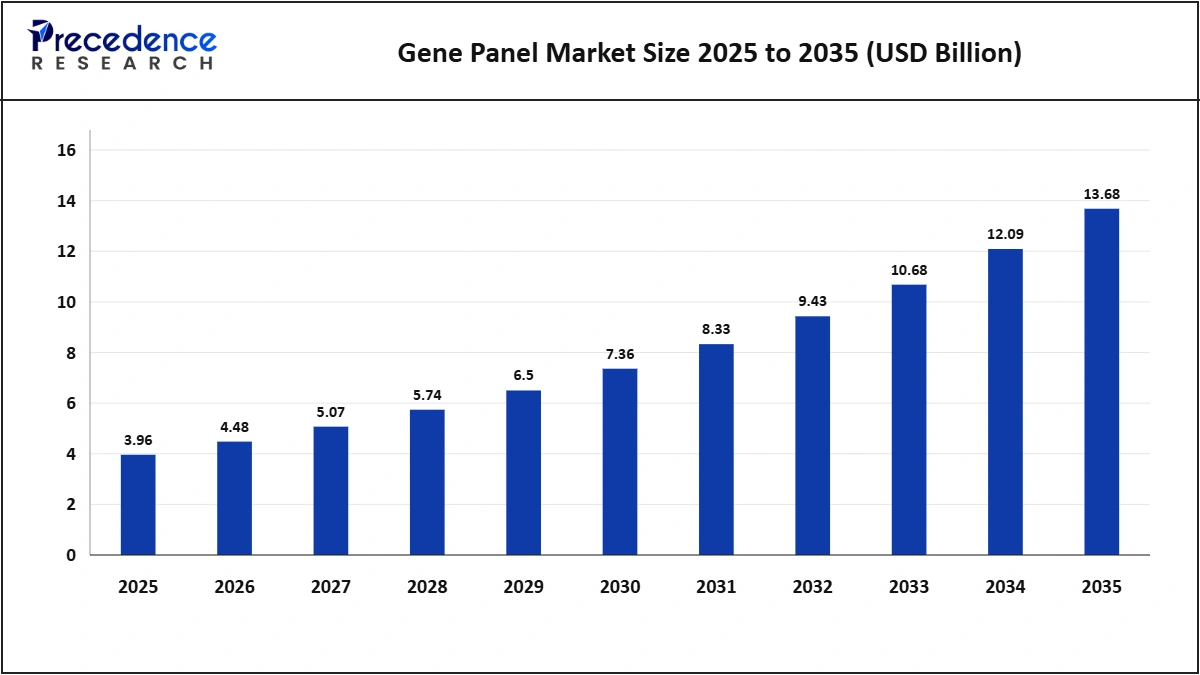
Note: 2025 is the base year, while the figures for 2026-2035 are forecasts.
Sources: Expert interviews, secondary sources, Precedence Research database and Precedence Research analysts.
The gene panel market is expected to grow from USD 3.96 billion in 2025 to USD 13.68 billion by 2035. More doctors are using gene panels to guide cancer treatment, identify inherited conditions and choose suitable medicines. At the same time, falling sequencing costs are making these tests more accessible to laboratories.
FDA-approved panels that help doctors select specific cancer treatments are also creating new demand. Pharmacogenomic testing, which helps predict how a person may respond to a medicine, is another growth area. The market is expected to reach USD 7.36 billion by 2030 and grow at a CAGR of 13.20% from 2026 to 2035.
- Analyst View: We estimated the market by looking at the number of gene panel tests used for different medical conditions and in different settings. We then considered the average prices of test kits and testing services. We also compared the estimates with demand for sequencing supplies used in targeted gene testing.
The estimated test volumes cover cancer testing, inherited cancer and rare disease testing, infectious disease testing, drug response testing, research and pharmaceutical applications.
We compared the total estimate with revenue from leading sequencing, testing and assay companies, as well as published market estimates. This placed our base-year estimate slightly above comparable figures. The expected growth reflects wider use of gene panels in healthcare, while lower test prices and competition from whole exome and whole genome sequencing may limit growth.
Market Trends
- More large gene panels covering many types of cancer are receiving FDA approval.
- Amplicon-based panels allow hospitals to test small samples quickly in their own laboratories.
- Pharmacogenomic panels are increasingly being used to help doctors choose medicines.
- Custom gene panels help pharmaceutical companies select suitable patients for clinical trials.
- Liquid biopsy panels are being used alongside tests performed on tissue samples.
- Testing kits increasingly include software to help analyses and understand results.
Drivers, Restraints and Opportunities
Driver
Personalized cancer care requires testing for many genes that may affect treatment choices. Targeted gene panels can test these genes efficiently and at a reasonable cost. Panels for inherited cancer and rare diseases are also becoming a regular part of medical care. Pharmacogenomic panels help doctors choose medicines and doses based on how a patient may respond. Falling sequencing costs and FDA-approved test kits are making these tests easier to use. Pharmaceutical companies also use gene panels to select patients for clinical trials.
Restraint
Insurance coverage for some tests, especially pharmacogenomic panels and large inherited disease panels, remains limited. As sequencing costs fall, whole exome and whole genome testing may replace gene panels in some cases. Doctors and laboratories may also find it difficult to interpret genetic changes whose effects are not yet clear. Regulatory requirements for laboratory tests are increasing, while price competition is reducing revenue per test.
Opportunity
Pharmacogenomic testing could grow significantly as it becomes more common in primary care and psychiatry. Ready-to-use panels that can be run locally could expand testing in community hospitals and developing markets. Liquid biopsy and minimal residual disease panels offer opportunities for repeated testing over time. Custom panels for pharmaceutical companies could lead to new business partnerships. Asia Pacific also offers strong growth opportunities as access to genetic testing improves.
Market Segmentation: 2025 Share and Value
Gene Panel Market By Application 2025 Share & Size
| Segments | 2025 Share | 2025 Market Value |
| Oncology | 47.56% | USD 1.88 billion |
| Hereditary & Rare Diseases | 22.40% | USD 0.89 billion |
| Infectious Diseases | 10.60% | USD 0.42 billion |
| Pharmacogenomics | 9.80% | USD 0.39 billion |
| Others | 9.64% | USD 0.38 billion |
Note: 2025 is the base year.
Sources: Expert interviews, secondary sources, Precedence Research database and Precedence Research analysts.
Oncology accounted for 47.56% of the market in 2025, worth USD 1.88 billion. Gene panels help doctors identify genetic changes in cancers such as lung, colorectal and breast cancer. These changes can help doctors choose suitable treatments. Many panels are also approved for use alongside specific cancer medicines.
Hereditary and rare disease testing accounted for 22.40% of the market, worth USD 0.89 billion. These panels look for genes linked to inherited cancer risk, heart muscle diseases, epilepsy and other conditions.
Infectious disease panels accounted for 10.60% of the market, worth USD 0.42 billion. Pharmacogenomics accounted for 9.80%, worth USD 0.39 billion, and is the fastest-growing application. These tests help predict how patients may respond to medicines and are increasingly used in psychiatry, cardiology and oncology. Other applications accounted for 9.64% of the market, worth USD 0.38 billion.
Gene Panel Market By Product 2025 Share & Size
| Segments | 2025 Share | 2025 Market Value |
| Test Kits | 58.34% | USD 2.31 billion |
| Testing Services | 41.66% | USD 1.65 billion |
Note: 2025 is the base year.
Sources: Expert interviews, secondary sources, Precedence Research database and Precedence Research analysts.
Test kits accounted for 58.34% of the market in 2025, worth USD 2.31 billion. Laboratories buy ready-made or custom kits to test samples using their own sequencing equipment. FDA-approved kits also allow hospitals to carry out some tests in-house.
Testing services accounted for 41.66% of the market, worth USD 1.65 billion, and are the fastest-growing product segment. Specialist testing companies and reference laboratories offer more complex tests, along with result analysis and reports.
Gene Panel Market By Technology 2025 Share & Size
| Segments | 2025 Share | 2025 Market Value |
| Hybridization-based | 54.21% | USD 2.15 billion |
| Amplicon-based | 45.79% | USD 1.81 billion |
Note: 2025 is the base year. Sources: Expert interviews, secondary sources, Precedence Research database and Precedence Research analysts.
Hybridisation-based panels accounted for 54.21% of the market in 2025, worth USD 2.15 billion. These panels can examine hundreds of genes and detect different types of genetic changes. This makes them suitable for detailed cancer and inherited disease testing.
Amplicon-based panels accounted for 45.79% of the market, worth USD 1.81 billion, and are the fastest-growing technology segment. They need smaller amounts of DNA, use simpler testing steps and can provide results quickly. These features make them useful for small biopsy samples and testing carried out within hospitals.
Gene Panel Market by End User 2025 Share & Size
| Segments | 2025 Share | 2025 Market Value |
| Hospitals & Laboratories | 52.89% | USD 2.09 billion |
| Pharmaceutical & Biotech Companies | 24.60% | USD 0.97 billion |
| Academic & Research Institutes | 22.51% | USD 0.89 billion |
Note: 2025 is the base year.
Sources: Expert interviews, secondary sources, Precedence Research database and Precedence Research analysts.
Hospitals and laboratories accounted for 52.89% of the market in 2025, worth USD 2.09 billion. This segment includes genetic testing carried out in hospital laboratories and specialist testing laboratories.
Pharmaceutical and biotechnology companies accounted for 24.60% of the market, worth USD 0.97 billion, and are the fastest-growing user group. These companies use gene panels to select suitable patients for clinical trials. Academic and research institutes accounted for 22.51% of the market, worth USD 0.89 billion.
- Analyst View: We estimated the value of each segment by matching the number of gene panel tests used in different applications and settings with the types of products and technologies used and their average prices. Oncology and test kits lead because cancer testing makes up a large part of clinical testing, and many laboratories run panels themselves. We expect pharmacogenomics, testing services, amplicon-based panels and pharmaceutical users to gain a larger share of the market.
Regional Analysis
Gene Panel Market By Region 2025 Share & Size
| Region | 2025 Share | 2025 Market Value |
| North America | 41.62% | USD 1.65 billion |
| Europe | 25.80% | USD 1.02 billion |
| Asia Pacific | 25.40% | USD 1.01 billion |
| Latin America | 4.00% | USD 0.16 billion |
| Middle East & Africa | 3.18% | USD 0.13 billion |
Note: 2025 is the base year.
Sources: Expert interviews, secondary sources, Precedence Research database and Precedence Research analysts.
North America accounted for 41.62% of the market in 2025, worth USD 1.65 billion. Demand is supported by Medicare and private insurance coverage for genetic testing, a large number of FDA-approved and laboratory-developed panels, and widespread testing for inherited cancer risks. Pharmacogenomic testing is also gaining coverage in psychiatry and cardiology.
Europe accounted for 25.80% of the market, worth USD 1.02 billion. Demand is supported by national genomic medicine programmes, including England's Genomic Medicine Service, and improving insurance coverage for gene panels in Germany, France and Italy.
Asia Pacific accounted for 25.40% of the market, worth USD 1.01 billion, and is the fastest-growing region. Domestic sequencing companies in China, insurance coverage for cancer gene panels in Japan, and the growing number of genetic testing laboratories in South Korea and India are supporting growth.
Latin America accounted for 4.00% of the market, worth USD 0.16 billion. The Middle East & Africa accounted for 3.18%, worth USD 0.13 billion. In these regions, private laboratories and tests sent to outside specialist laboratories provide much of the available testing. Gulf countries are also investing in population-wide genetic testing programmes.
North America accounted for 41.62% of the market in 2025, worth USD 1.65 billion. Insurance coverage and the availability of many approved tests support demand. Testing for inherited cancer risks is common, while pharmacogenomic testing is expanding.
Europe accounted for 25.80% of the market in 2025, worth USD 1.02 billion. National genomic testing programmes support demand. Insurance coverage is improving in Germany and France, and hospital laboratories are increasingly carrying out gene panel tests themselves.
Asia Pacific accounted for 25.40% of the market in 2025, worth USD 1.01 billion, and is the fastest-growing region. China has a strong domestic sequencing industry, Japan provides insurance coverage for cancer gene panels, and South Korea and India are expanding genetic testing services.
Latin America accounted for 4.00% of the market in 2025, worth USD 0.16 billion. Private laboratories in Brazil and Mexico offer gene panel tests, while sending samples to specialist laboratories remains common.
The Middle East and Africa accounted for 3.18% of the market in 2025, worth USD 0.13 billion. Gulf countries are investing in population-wide genetic testing and rare disease testing, while access to these services remains limited in other areas.
Analyst View: We estimated regional market shares by looking at the number of gene panel tests, laboratory capacity and testing prices in each region. North America leads because genetic testing is widely used and insurance coverage is stronger. We expect Asia Pacific to grow the fastest as local sequencing capacity expands and more people gain access to covered genetic testing.
Top 10 Companies in the Gene Panel Market
| Rank | Company Name | Market-Specific Revenue (USD Billion) | 2025 Share | Key Products / Business | Headquarters |
| 1 | Illumina | 0.72 | 18.18% | TruSight panels, TSO Comprehensive and sequencing platforms | United States |
| 2 | Thermo Fisher Scientific | 0.52 | 13.13% | Oncomine and AmpliSeq panels | United States |
| 3 | Myriad Genetics | 0.24 | 6.06% | Hereditary cancer and pharmacogenomic panels | United States |
| 4 | Agilent Technologies | 0.24 | 6.06% | SureSelect capture panels | United States |
| 5 | QIAGEN | 0.22 | 5.56% | QIAseq targeted panels | Netherlands |
| 6 | Roche | 0.20 | 5.05% | AVENIO and KAPA target enrichment panels | Switzerland |
| 7 | Guardant Health | 0.16 | 4.04% | Liquid biopsy gene panels | United States |
| 8 | BGI Genomics | 0.14 | 3.54% | Clinical gene panels and sequencing services | China |
| 9 | Twist Bioscience | 0.10 | 2.53% | Custom target enrichment panels | United States |
| 10 | SOPHiA GENETICS | 0.06 | 1.52% | Panel analysis software and kits | Switzerland |
Note: Company revenues and market shares are estimates for 2025.
Sources: Company press releases, expert interviews, secondary sources, Precedence Research database and Precedence Research analysts.
Illumina led the gene panel market in 2025, with estimated revenue of USD 0.72 billion and a market share of 18.18%. Thermo Fisher Scientific ranked second, with USD 0.52 billion and a 13.13% share. Myriad Genetics ranked third, with USD 0.24 billion and a 6.06% share.
Illumina has a strong position through its TruSight panels, its FDA-approved TSO Comprehensive pan-cancer panel and the sequencing systems used to run many capture panels.
Thermo Fisher Scientific is a major supplier through its Oncomine and AmpliSeq amplicon panels, which run on Ion Torrent systems. Its products also include fast in-house companion diagnostic tests.
Myriad Genetics is known for its hereditary cancer and pharmacogenomic testing services. Agilent, QIAGEN, Roche and Twist Bioscience supply gene panels and related products for clinical and research laboratories. Guardant Health offers liquid biopsy panels, BGI Genomics has a strong position in China, and SOPHiA GENETICS provides analysis software and test kits.
The top 10 companies accounted for an estimated 65.66% of market revenue in 2025, worth USD 2.60 billion. The remaining 34.34%, worth USD 1.36 billion, was shared by regional panel developers, clinical laboratories, bioinformatics companies and research panel suppliers.
The market is moderately concentrated. Companies compete by offering useful gene coverage, regulatory approvals, approval for use with specific treatments, lower DNA sample requirements, faster results, affordable testing and software that helps interpret results. Custom panels and integrated software also help companies stand out as laboratories look for tests that fit their specific needs.
Recent Developments
- May 2025: Illumina added Pillar Biosciences' oncoReveal CDx to its cancer testing portfolio. The 22-gene companion diagnostic panel runs on the MiSeq Dx system (Source: illumina.com)
- July 2025: The FDA approved Thermo Fisher Scientific's Oncomine Dx Express Test for use alongside specific cancer treatments and for tumour profiling on the Genexus system. (Source: clinicallab.com)
Gene Panel Market Segments
By Application
- Oncology
- Hereditary & Rare Diseases
- Infectious Diseases
- Pharmacogenomics
- Others
By Product
- Test Kits
- Testing Services
By Technology
- Hybridization-based
- Amplicon-based
By End User
- Hospitals & Laboratories
- Pharmaceutical & Biotech Companies
- Academic & Research Institutes
By Region
- North America (U.S., Canada, Mexico)
- Europe (Germany, U.K., France, Italy, Spain, Rest of Europe)
- Asia Pacific (China, Japan, India, South Korea, Taiwan, Rest of Asia Pacific)
- Latin America (Brazil, Argentina, Rest of Latin America)
- Middle East & Africa (GCC, South Africa, Rest of MEA)
Research Methodology
The gene panel market includes ready-made and custom gene panels that use hybridisation capture, amplicon-based sequencing, PCR and microarray technologies. These products are sold as test kits and testing services around the world.
We estimated the 2025 market size by calculating the number of gene panel tests used for different applications and in different settings, along with the average prices of kits and testing services. We then compared the results with revenue from leading sequencing, assay and testing companies.
Market values for each segment, region and company were estimated using information about applications, products, technologies, end users and regional testing activity. We checked the main estimates against company disclosures, regulatory and industry data, and published estimates from other sources. Inputs that could not be matched or confirmed were excluded.
All segment, regional and company figures were aligned with the same 2025 base year. The forecasts for 2026-2035 were then recalculated using a constant CAGR from the 2025 base and checked for consistency.
Analyst View Overall Market
The gene panel market is growing as targeted gene testing becomes more common in cancer care, inherited disease testing and medicine selection. Our estimates connect demand with the number of tests performed and their prices across different applications and settings. This means the forecast depends on how widely these tests are used in healthcare, along with regulatory approvals and insurance coverage.
The main growth opportunities come from pharmacogenomics, test kits that can be used locally and the expansion of genetic testing in Asia Pacific. However, limited insurance coverage and competition from broader sequencing tests could slow market growth.
Sources and References
- Illumina. "Illumina expands clinical oncology portfolio". 2025-05-28. TSO Comprehensive and oncoReveal CDx.
- Business Wire / Thermo Fisher. "Thermo Fisher's NGS assay receives FDA approval as a companion diagnostic". 2025-07-02. Oncomine Dx Express Test.
- Tempus. "Tempus receives FDA approval for tumor-only xT CDx". 2026-05-29. xT CDx panel.
- OncLive. "FDA approves TruSight Oncology Comprehensive assay". 2024-08. TSO Comprehensive approval.
For inquiries regarding discounts, bulk purchases, or customization requests, please contact us at sales@precedenceresearch.com
Frequently Asked Questions
Tags





Ask For Sample
No cookie-cutter, only authentic analysis – take the 1st step to become a Precedence Research client
 Get a Sample




 sales@precedenceresearch.com
 Schedule a Meeting