



Generative AI in Data Labeling Solution and Services Market Trends, Companies, Revenue / Sales Performance, Subscriber Growth, Pricing Strategies, Cloud Adoption, Infrastructure Expansion, Competitive Landscape, and Industry Outlook
Generative AI in Data Labeling Solution and Services Market (By Offering: Labeling Solutions (Platforms and Automation Software), Labeling Services (Managed and Crowdsourced Services), Professional Services and Integration; By Data Type/Labeling Type: Image and Video Labeling, Text / NLP Annotation, Time-Series / Sensor Data Annotation Multimodal and Complex Labeling; By End-User Industry: Autonomous Vehicles and Mobility, Technology and Internet / LLM Providers, Healthcare and Medical Imaging, Other Verticals) - Global Industry Analysis, Size, Trends, Leading Companies, Regional Outlook, and Forecast 2026 to 2035
Source: https://www.precedenceresearch.com/generative-ai-in-data-labeling-solution-and-services-market
 Get a Sample
 Table Of Content


What is the Generative AI in Data Labeling Solution and Services Market Size?
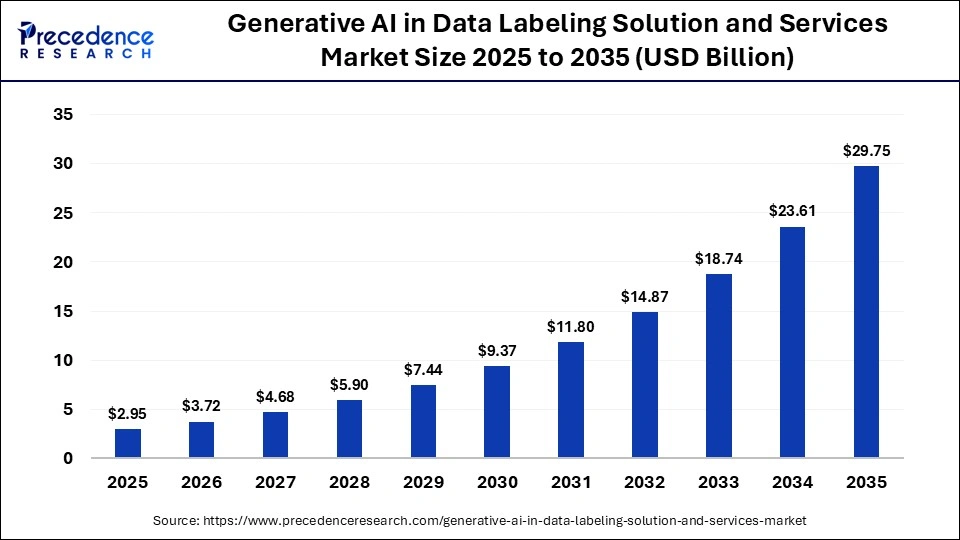
The global generative AI in data labeling solution and services market size was calculated at USD 2.95 billion in 2025 and is predicted to increase from USD 3.72 billion in 2026 to approximately USD 29.75 billion by 2035, expanding at a CAGR of 26.00% from 2026 to 2035.The global generative AI in data labeling solution and services market is witnessing robust growth, driven by the rising need for high-quality training data and rapid technological improvements in generative AI, which is expanding the array of applications across various sectors.
Market Highlights
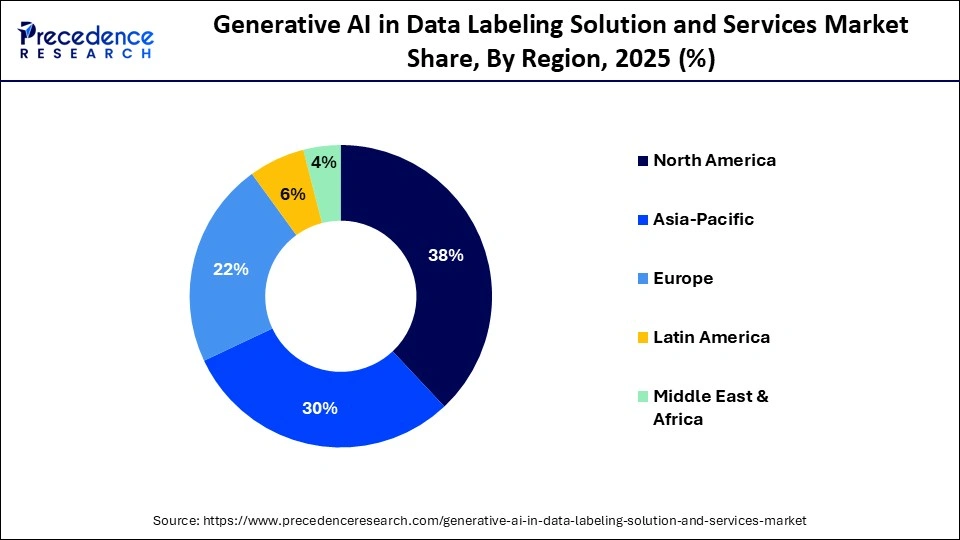
- North America dominated the market, holding the largest market share of approximately 38% in 2025.
- Asia Pacific is expected to expand at the fastest CAGR in the generative AI in data labeling solution and services market between 2026 and 2035.
- By offering, the labeling solutions segment held the largest market share of approximately 44% in 2025.
- By offering, the synthetic data generation and augmentation segment is expected to grow at a remarkable CAGR between 2026 and 2035.
- By data type/labeling type, the image and video labeling segment held the largest market share of approximately 41% in 2025.
- By data type/labeling type, the 3D point cloud and LiDAR annotation segment is expected to grow at a significant CAGR between 2026 and 2035.
- By end-user industry, the technology and Internet / LLM providers segment held the largest share of approximately 24% in the generative AI in data labeling solution and services market during 2025.
- By end-user industry, the autonomous vehicles and mobility segment is expected to expand rapidly in the market with a notable CAGR in the coming years.
Market Overview
The global generative AI in data labeling solution and services market comprises AI-driven software platforms, automation engines, synthetic data generation tools, and managed annotation services that leverage generative models to accelerate, scale, and improve the accuracy of data labeling workflows. These solutions support image, video, text, audio, 3D, time-series, and multimodal datasets used across machine learning, computer vision, NLP, autonomous systems, robotics, healthcare AI, and large language model (LLM) training pipelines.
What are the emerging trends in the market?
- The surge in adoption of AI in industries like automotive, healthcare, finance, and retail and e-commerce spurs the need for reliable, precise, and large-scale labeled datasets, bolstering the market's growth during the forecast period.
- As artificial intelligence (AI) rapidly evolves, particularly in natural language processing, machine learning, and computer vision applications, there is an increasing demand for precise and comprehensive data labeling.
- The rising need for data-driven decision-making in various organizations increases the reliance on generative AI for efficient data labeling, which is expected to bolster the market's expansion in the coming years.
- The rising trend toward multimodal AI systems that process text, images, video, and 3D data simultaneously is expected to contribute to the overall growth of the market.
- The growing need for automation in data labeling is anticipated to promote the growth of the market during the forecast period. Generative AI tools are widely used to automate the annotation process, which reduces the time and high costs associated with manual labeling, allowing for greater scalability.
Market Scope
| Report Coverage | Details |
| Market Size in 2025 | USD 2.95 Billion |
| Market Size in 2026 | USD 3.72 Billion |
| Market Size by 2035 | USD 29.75 Billion |
| Market Growth Rate from 2026 to 2035 | CAGR of 26.00% |
| Dominating Region | North America |
| Fastest Growing Region | Asia Pacific |
| Base Year | 2025 |
| Forecast Period | 2026 to 2035 |
| Segments Covered | Offering, Data Type/Labeling Type, End-User Industry, and Region |
| Regions Covered | North America, Europe, Asia-Pacific, Latin America, and Middle East & Africa |
Segmental Insights
Product Type Insights
What causes the labeling solutions segment to dominate the market?
The labeling solutions segment held the largest market share of approximately 44% in the generative AI in data labeling solution and services market. The segment includes Generative-AI-assisted annotation engines and workflow orchestration, and quality governance tools. The growth of the segment is primarily driven by the increasing demand for high-speed, scalable, and high-quality data annotation to train complex models. Automated tools can process data rapidly and at a lower cost, crucial for meeting the demand for high-quality datasets required for generative AI.
The synthetic data generation and augmentation segment is expected to grow at a remarkable CAGR between 2026 and 2035. The segment includes image, video, text, and simulation-based synthetic datasets. Synthetic data generation and augmentation address significant challenges associated with traditional human-labeled data, including slow processing speeds, high costs, data privacy regulations, and the limited availability of edge-case data. Several industries, like autonomous driving, robotics, and healthcare, face significant challenges in collecting sufficient real-world data for rare or complex events like accidents and rare diseases. Synthetic data allows for the simulation of these critical edge cases, enabling improved model training.
Data Type/Labeling Type Insights
Which Data Type Segment Dominated the Market in 2025?
The image and video labeling segment dominates the generative AI in data labeling solution and services market, holding approximately 41% share. The segment includes autonomous driving datasets and robotics perception data. The growth of the segment is supported by the rising need for high-quality visual content in several AI applications. Image and video data labeling are crucial for developing and training artificial intelligence models used in sectors like healthcare, autonomous vehicles, entertainment, and retail, where images and video data are indispensable.
The 3D point cloud and LiDAR annotation segment is the fastest-growing in the generative AI in data labeling solution and services market. The segment includes autonomous driving datasets and robotics perception data. The segment growth is supported by the rising demand from the autonomous vehicle (AV) and robotics industries, which require 3D spatial awareness. Autonomous driving requires 3D perception for detecting pedestrians, obstacles, and lane boundaries.
End-user industry Insights
Which End-User Industry Segment Dominated the Market in 2025?
The technology and Internet/LLM providers segment dominates the generative AI in data labeling solution and services market, holding approximately 24% share, owing to the growing need for scalable and secure AI model training, utilizing cloud infrastructure and proprietary AI tools. LLMs are widely adopted to automate and improve the accuracy of data labeling, for natural language tasks and multi-modal data like images and video.
The autonomous vehicles and mobility segment is the fastest-growing in the market, owing to the high volume and safety-critical nature of the data required to train self-driving algorithms. The automotive industry is increasingly shifting towards higher levels of autonomy, which increases the demand for high-precision annotated datasets. In addition, the rapid advances in self-driving technologies and rising investments from automotive manufacturers are anticipated to drive the segment's growth during the forecast period.
Regional Insights
How Big is the North America Generative AI in Data Labeling Solution and Services Market Size?
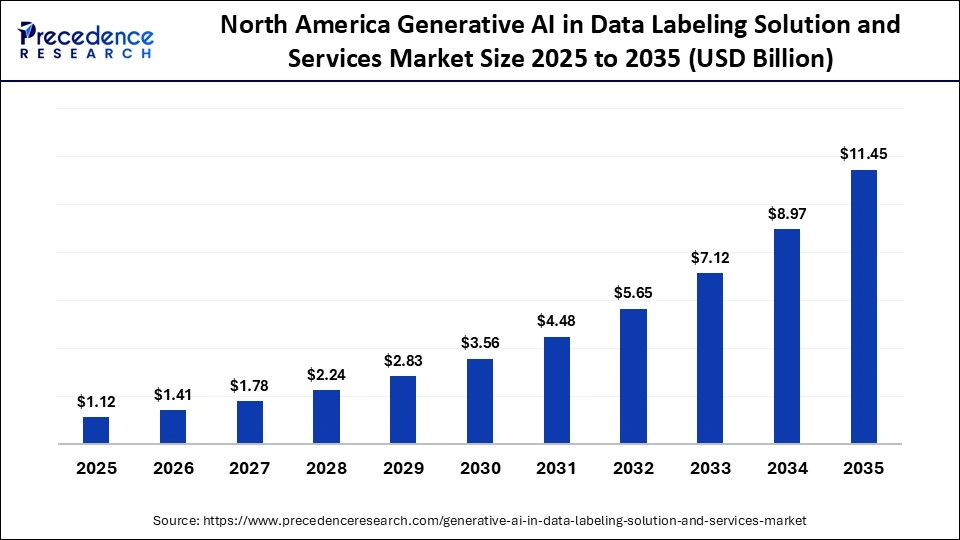
The North America generative AI in data labeling solution and services market size is estimated at USD 1.12 billion in 2025 and is projected to reach approximately USD 11.45 billion by 2035, with a 26.17% CAGR from 2026 to 2035.
North America Generative AI in Data Labeling Solution and Services Market Analysis
North America dominates the market, holding the largest share of 48%. The region has a strong presence of major AI technology firms and research institutions, which drives significant innovation in computer vision, machine learning, and neural networks. The region leadership position is attributed to the growing emphasis on enhancing the speed and accuracy of the labeling process, significant RandD investments, strict data protection regulations, increasing demand for semi-automated and fully automated data labeling techniques, and rising integration with advanced AI models.
What is the Size of the U.S. Generative AI in Data Labeling Solution and Services Market?
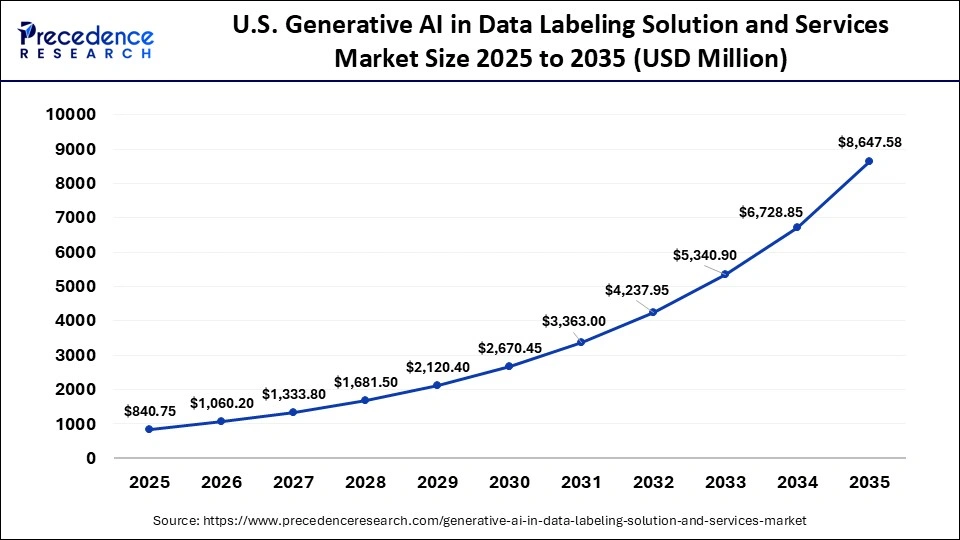
The U.S. generative AI in data labeling solution and services market size is calculated at USD 840.75 million in 2025 and is expected to reach nearly USD 8,647.58 million in 2035, accelerating at a strong CAGR of 26.25% between 2026 and 2035
The U.S. generative AI in data labeling solution and services market analysis
The United States is a major contributor to the market. The country is home to the leading market players such as Google, Amazon, Microsoft, IBM, NVIDIA, Scale AI, Snorkel AI, Labelbox, and others. The growth of the country is also characterized by the strong presence of tech giants, growing demand for high demand for high-quality and compliant data labeling, and rapid adoption across sectors like autonomous vehicles, Healthcare and Medical Imaging, retail and e-commerce, manufacturing and robotics, and financial services.
Asia Pacific generative AI in data labeling solution and services market analysis
Asia Pacific is the fastest-growing region in the market. The region's growth is primarily driven by the strong startup ecosystem, substantial RandD investments, increasing shift towards multimodal AI systems, increasing demand for high-quality and large-scale datasets for advanced AI model training, and growing need for automation in data labeling. Several countries like China, Japan, India, and South Korea are increasingly investing in Generative AI technologies, enhancing data labeling capabilities. The region is also experiencing significant investments and adoption across various sectors such as autonomous vehicles, healthcare, and BFSI, which propels the growth of generative AI in data labelling solutions and services market.
China's generative AI in data labeling solution and services market analysis
China's market is experiencing growth due to the rise in large language models (LLMs) necessitates high-quality training data, accelerating the market's growth in the country. The country's growth is largely driven by the massive investments in AI infrastructure, rapid growth of multimodal and complex data, rising accessibility of foundation models, and rising government funding and policies for data infrastructure and labeling centers. Additionally, the rising adoption of AI applications and machine learning across diverse industry verticals is supporting the market's expansion in the coming years. Such a combination of factors is expected to drive the growth of the generative AI in data labeling solution and services market in the coming years.
Who are the Major Players in the Global Generative AI in Data Labeling Solution and Services Market?
The major players in the generative AI in data labeling solution and services market include Google, Amazon, Microsoft, IBM, NVIDIA, Appen Limited, TELUS International, Scale AI, Labelbox, Snorkel AI, DataRobot, CloudFactory TELUS International
Recent Developments
- In July 2025, Cognizant announced the launch of AI Training Data Services, a new offering designed to help enterprises build, fine-tune, and implement AI models at speed and scale. Leveraging deep experience as a data and AI model training partner to select digital native pioneers. The limited availability of large-scale, accurately annotated datasets can create a significant bottleneck for training machine learning models, especially large language models and computer vision systems. (Source: https://news.cognizant.com)
- In May 2025, Capgemini announced an expansion of its strategic partnership with Mistral AI, a leader in innovative AI model development, and SAP, to help drive growth for regulated organizations by transforming operations and improving business outcomes through a broad range of AI models. Leveraging Mistral AI's revolutionary generative AI (gen AI) models and the SAP Business Technology Platform (BTP), Capgemini aims to develop multiple easily accessible business AI use cases with a lower carbon footprint.(Source: https://www.capgemini.com)
Segments Covered in the Report
By Offering
- Labeling Solutions (Platforms and Automation Software)
- Generative-AI-assisted annotation engines
- Workflow orchestration and quality governance tools
- Labeling Services (Managed and Crowdsourced Services)
- Human-in-the-loop (HITL) services
- Domain-specific annotation teams
- Synthetic Data Generation and Augmentation
- Image, video, text, and simulation-based synthetic datasets
- Professional Services and Integration
- Pipeline integration
- Model tuning and deployment support
By Data Type/Labeling Type
- Image and Video Labeling
- Bounding boxes, segmentation, keypoints
- Video object tracking
- Text / NLP Annotation
- Entity recognition
- Intent and sentiment labeling
- 3D Point Cloud and LiDAR Annotation
- Autonomous driving datasets
- Robotics perception data
- Audio / Speech Annotation
- Time-Series / Sensor Data Annotation
- Multimodal and Complex Labeling
By End-User Industry
- Autonomous Vehicles and Mobility
- Technology and Internet / LLM Providers
- Healthcare and Medical Imaging
- Retail and E-commerce
- Manufacturing and Robotics
- Financial Services
- Government and Defense
- Other Verticals
By Region
- North America
- Europe
- Asia-Pacific
- Latin America
- Middle East & Africa
For inquiries regarding discounts, bulk purchases, or customization requests, please contact us at sales@precedenceresearch.com
Frequently Asked Questions





Ask For Sample
No cookie-cutter, only authentic analysis – take the 1st step to become a Precedence Research client
 Get a Sample




 sales@precedenceresearch.com
 Schedule a Meeting
