List of Contents
What is the Green AI Data Center Market Size?
The global green AI data center market size is calculated at USD 63.25 billion in 2025 and is predicted to increase from USD 67.60 billion in 2026 to approximately USD 123.03 billion by 2035, expanding at a CAGR of 6.88% from 2026 to 2035. The market for green AI data centers is witnessing strong, sustained expansion, driven by rising AI workloads, stricter energy-efficiency mandates, and rapid adoption of renewable-powered, low-carbon digital infrastructure worldwide.
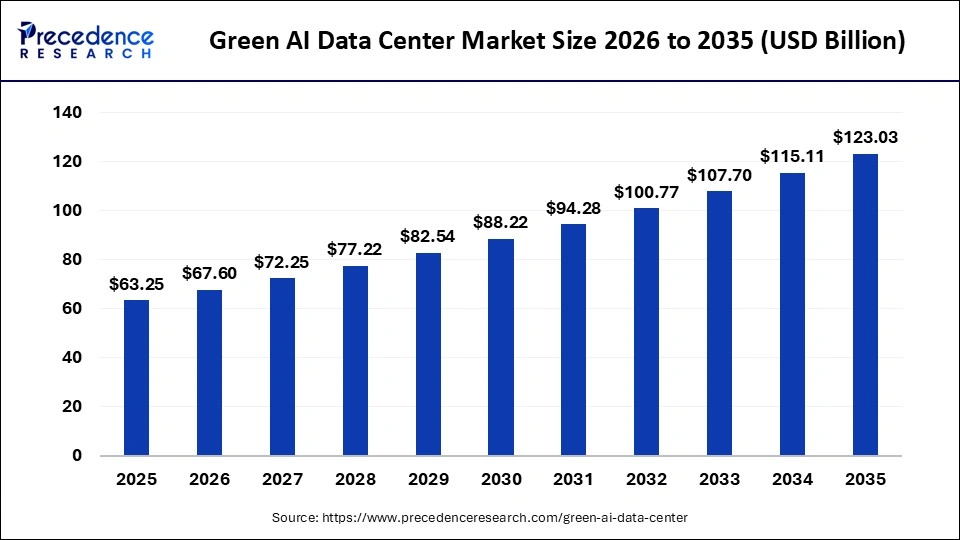
Market Highlights
- North America led the market with a dominant share in 2025.
- Asia Pacific is estimated to expand the fastest CAGR between 2026 and 2035.
- By type, the software segment captured the biggest market share in 2025.
- By type, the infrastructure segment is expected to grow at a notable CAGR from 2026 to 2035.
- By application, the telecommunications segment accounted for the major market share in 2025.
- By application, the energy and utilities segment is anticipated to grow at the fastest CAGR between 2026 and 2035.
How will the Greener AI Data Center Market Evolve into the Era of High-Efficiency Data Centers?
The growing demand for AI-related workloads has encouraged many companies to adopt greener data center practices. These methods are designed to reduce the carbon footprint and encourage sustainability while providing maximum performance at the lowest operational costs. This has driven rapid growth in the green AI data center market as companies adopt environmentally friendly facilities. A large number of new investments in liquid-cooling systems, environmentally sustainable fuels, and AI-optimized chips to improve operational efficiency are underway.
In addition, as more sustainability regulations in many countries are enforced, more data center operators are operating environmentally sustainable data centers. A number of hyperscale Internet Service Providers (ISPs) are just now beginning to utilize the latest in renewable technology in their facilities to achieve net-zero carbon emissions through a combination of green energy sources and new technology. As a result, the green AI Data Centre will play an important role in the evolution of future IT infrastructure.
New Technology Is Changing the Way We Think About Green AI Data Centres
Green AI data centres are designed to be energy-efficient and environmentally friendly while delivering superior performance and computing capabilities. Advanced cooling systems minimise the power required to cool servers through liquid and immersion methods, and AI-based energy management programs reduce carbon footprints and improve efficiency. The integration of renewable energy like solar and wind power into our energy operations makes them less harmful to the environment through smart grid technologies.
In October 2025, Bharti Airtel joined Google and AdaniConneX to build the AI hub, including a subsea cable landing station, clean energy systems and fibre optic network signalling Visakhapatnams emergence as a key AI infrastructure node.
Increasingly modular and scalable designs are now allowing for quicker deployment and lower environmental impact. Together, these advancements are establishing a new benchmark in creating sustainable, cost-effective green AI data centres that will meet the demands of increasing global AI workloads in the future.
Green AI Data Center Market Outlook
The use of AI is increasing the amount of energy consumed by data centres globally. It is essential that data centres are built using Green resources to ensure they can meet the demand for AI applications in a sustainable and efficient way without harming the environment.
The amount of data centre infrastructure being developed globally is increasing at an incredible rate. This is creating new data centre facilities in Asia, Europe, and North America that utilise energy-efficient, low-carbon technologies to meet the increasing demand for AI computing.
The high-performance servers used for AI consume a large amount of power. A green data centre utilises energy-efficient graphics processing units (GPUs), optimised cooling technologies, and innovative hardware development to balance the demands of AI Performance with sustainability goals.
The increase in the use of renewable electricity has enabled data centres to use solar, wind and hydro-power. This has reduced the need to use fossil fuels to power data centres while still enabling them to perform large-scale AI computations with minimal environmental impact.
The implementation of advanced cooling methods, the development of modular designs, and the utilisation of energy-saving software allow data centres to reduce their electricity consumption and their water consumption, thereby enabling data centres to operate AI in an environmentally friendly manner while not sacrificing computing performance.
Market Scope
| Report Coverage | Details |
| Market Size in 2025 | USD 63.25 Billion |
| Market Size in 2026 | USD 67.60 Billion |
| Market Size by 2035 | USD 123.03 Billion |
| Market Growth Rate from 2026 to 2035 | CAGR of 6.88% |
| Dominating Region | North America |
| Fastest Growing Region | Asia Pacific |
| Base Year | 2025 |
| Forecast Period | 2026 to 2035 |
| Segments Covered | Type, Application, and Region |
| Regions Covered | North America, Europe, Asia-Pacific, Latin America, and Middle East & Africa |
Green AI Data Center Market Segmental Insights
Type Insights
Software: The segment continues to be dominant in the green AI data centers industry, because of its pivotal role in optimizing workloads on servers, as well as supporting automation of energy-efficient operation within green A.I. data centres. The integration of solutions into the enterprise allows companies to consistently implement sustainable practices across their multi-cloud environments. The services within this category also offer a continuum of service, including implementation, upgrades, and performance tuning. This all works to provide organizations with an opportunity to achieve efficiency gains consistently without the need for substantial investments in hardware.
Infrastructure: This segment is becoming the fastest-growing category based on the investment of companies in liquid cooling, server sustainability technologies, and next-generation hardware for AI accelerators. This is driven primarily by the need to address both heat density and energy waste as companies run their AI workloads at an increasing level. In addition, new advanced cooling systems, as well as new modular architectures, will help facilities scale their growth in a sustainable manner. Finally, as these investments continue to grow, the expanding use of government incentives supporting green-built data centres is benefiting this segment of the green AI data center market.
Services: This segment is seeing notable growth as it supports the implementation, management, and continuous optimisation of green A.I. data centres, which are important roles that are provided to enterprises through consulting, integration, and managed services. By using managed services, providers are able to help organisations establish, monitor, and maintain low-carbon operations across the entire data centre lifecycle. Service providers also help organisations establish energy-use baselines and help organisations with periodic audits to ensure compliance with federal or other legal guidelines for carbon footprint and environmental sustainability.
Application Insights
Telecommunications: This segment dominates the green AI data center market in 2024, since it depends on low-carbon, high-efficiency data processing capabilities. As 5G has started rolling out, the telecom industry is increasing its reliance on edge sites and virtualised network functions, driving telecoms to focus on sustainable computing practices to support their electricity-intensive workloads. AI-enabled automation and predictive functionality are also contributing to the growth of the manufacturing application sector by providing efficient computing environments to support the operational stability of these processes.
Energy & Utilities: The energy & utility sector is now the fastest-growing application segment as utilities utilize AI technology for variables such as forecasting renewable energy, optimizing their power grids, predicting outages, and managing distributed generation, all of which require very powerful computer systems to complete. All of these items contribute to the need for the industry to lower its overall carbon emissions and rapidly implement green AI data centres. Furthermore, the transition to smart grids as well as the move toward more sustainable operational models will aid in the rapid increase in the implementation of AI within the energy & utility sector.
Technology & Software: This application segment is still a major driver of the green AI data center market due to the heavy reliance on AI data centers to provide the computing power required for model training, cloud-native applications, and deploying large-scale applications. AI data centres provide the technology & software sector with an intelligent method of cooling their systems, distributing workloads optimally, and employing renewable energy-powered structures that allow them to quickly develop new and innovative products without significantly increasing the amount of electricity they use.
Green AI Data Center Market Regional Insights
North America led the green AI data center market for green AI data centers in 2024 due to a combination of several factors that provide the ideal atmosphere for the advancement of commercialized green artificial intelligence (AI) data center solutions. The existence of multiple hyperscalers and large cloud providers with extensive R&D investments allows for energy-aware scheduling, liquid cooling and on-site renewable energy integration that can all take place in a single location, with regulatory incentives and utility programs that promote demand response strategies and green tariffs to align computing loads with renewable energy availability.
Major operators such as Google, Microsoft, Amazon Web Services and Meta deploy advanced thermal management systems, renewable power purchase agreements and AI-driven load balancing across large clusters, which strengthens North Americas leadership in sustainable data infrastructure. State-level clean energy mandates in regions like California, Washington, and New York encourage data centers to adopt solar, wind, and battery storage as part of their base operations. Utilities across the United States and Canada offer green tariffs, real-time energy pricing, and flexible interconnection programs that allow data centers to shift AI workloads toward periods of high renewable generation.
As the global leader in the deployment of renewable energies (60 words), the United States serves as a focal point for hyper-scale cloud hosting and associated service providers, hardware manufacturers, and innovators engaged in the private sectors transition to cleaner energy sources. The confluence of corporate renewables commitments and individual state-level renewable targets enables various pilot programs involving storagebattery technology, renewable energy, and workload orchestration, and the availability of strong financial markets, along with increasing cloud computing demand, accelerates experimental technology deployment, providing a practical proving ground for future global-scale commercialized green AI data centre designs.
- In October 2025, Meta unveiled plans to invest $1.5 billion in a new AI-optimised data center in El Paso, Texas, scalable to 1 GW, aimed at supporting its growing AI workloads and powering future infrastructure.
Canada Green AI Data Center Market Trends
The green AI data center market in Canada is thriving due to the abundance of low-carbon, low-cost artificial intelligence workloads enabled by Canadas ample supply of renewable energy, especially hydropower. Canadas federal government commitments to climate change and clean-energy infrastructure incentives have made it an attractive location for hyperscale. The availability of high-speed internet connectivity, combined with a cool climate and increasing demand for artificial intelligence workloads, is a contributing factor to the growing investment in sustainable data center infrastructure in Canada.
The reasons for the continued growth of Asia Pacific are many; some of the main drivers include the rapid adoption of AI technology, a growing number of internet users in the region, and the increasing focus of many nations on establishing clean energy targets. Governments and telecom or cloud service providers are focused on building new capacity while reducing emissions to achieve a balance between enhancing their industries and addressing climate change. Countries such as Singapore, Japan, South Korea, Australia, India, and China are creating national data center policies that prioritize renewable integration, high-efficiency cooling technologies, and AI-based energy management systems for new builds.
The reduced cost of labour and building materials in the region makes it more attractive to deploy these new green AI data centres due to fewer deployment barriers. Many operators are shifting AI workloads to markets such as Malaysia, Indonesia, and India, where land availability, workforce supply, and construction costs allow faster build-out of energy-efficient facilities compared to mature Western markets. Increased urbanisation and digitisation also create demand for new capacity for both hyperscale players and local businesses, contributing to why the Asia Pacific has the highest growth rate for green AI data centre innovations.
India Green AI Data Center Market Trends
India is now evolving into a key market for green AI data centers for hyperscalers and enterprises that are accelerating AI adoption while achieving the countrys sustainability objectives. In addition, India has a rapidly changing digital ecosystem and a rapidly increasing capacity for renewable energy; this trend is supported by regulatory policies such as data localization that promote the development of green data centers. Due to the high energy demand for operations, data center operators are increasingly constructing solar-powered/energy optimized facilities in order to maintain low operational costs and maximize long-term energy efficiency.
In October 2025, AdaniConneX (part of Adani Enterprises) and Google announced a partnership to build Indias largest AI data centre campus in Visakhapatnam, a gigawatt scale hub backed by green energy infrastructure. The investment is estimated at US D 15 billion over 2026-2030.
China Green AI Data Center Market Trends
China is at the forefront of the Asia-Pacific region in the green AI data center market by leveraging the synergies that exist between cloud providers and power-grid planners at a national level. In addition to leveraging its manufacturing capabilities for specialised equipment for cooling and power distribution, China has built renewables in coordination with the roll-out of renewable generation sources. Additionally, Chinas government provides incentives for improving energy efficiency and for rapidly establishing high-volume industrial-scale containerised green data centres and AI accelerator farms. This combination of factors has enabled China to be the regional leader in developing low-carbon AI infrastructure through high-volume experimentation and deployment activities.
Europe is rapidly growing in its green AI data center sector due to its environmental regulations, high penetration of renewable energy sources and increasing demand for transparent reporting of energy sources. Europe has a strong focus on achieving low-emission operations, promoting innovative techniques such as heat reuse networks, high-efficiency or precision cooling systems, and the development of site locations in close proximity to renewable energy clusters or located in colder climate regions to reduce overall energy demand and operating costs. Countries like Denmark, Sweden, Finland and Norway are preferred locations because they enable renewable-powered operations and allow data centers to channel excess heat into district heating networks that serve residential and commercial buildings.
The combination of supportive electric markets, strict carbon tracking regulations and opportunities for cross-border energy collaboration promotes an attitude within Europe that focuses on efficiency and sustainability. Operators must comply with frameworks such as the EU Climate Law, the Energy Efficiency Directive, the Data Centre Pact, and upcoming sustainability reporting requirements under the Corporate Sustainability Reporting Directive, which accelerates adoption of real-time carbon monitoring, power usage effectiveness optimization tools, and renewable PPAs.
Germany Green AI Data Center Market Trends
Germany has taken the lead in developing Europes green AI data centers. It has combined stringent energy regulations with a well-developed engineering capability to achieve maximum waste-heat recovery, renewable energy resource integration, and high-efficiency cooling systems, all of which have allowed Germany to maintain consistently low carbon operational levels.
The partnership between the utilities, municipalities, and operators of data centers, all of which collaborate to develop and build data centers that provide waste heat to district heating networks, positions Germany as the leading example of scalable, sustainable green data center infrastructure that is aligned with existing regulations.
UK Green AI Data Center Market Trends
The UK Green AI data center market is also benefiting from growing regulatory pressure to reduce carbon emissions and improve energy efficiency through renewable energy, as well as government-funded programs supporting AI development. As demand for AI workloads continues to climb in finance, healthcare, and other sectors, data center owners and operators are also investing in energy-efficient cooling systems, low-carbon electricity, and circular energy models as a way to develop environmentally responsible, high-performance data center facilities.
Growing digitalization in the Middle East and Africa region is rapidly resulting in green AI data centers, certainly having the potential for the emergence of a new region with vast potential for solar or green energy. An increased number of countries developing hybrid-powered solar data centers, microgrids, and high-efficiency cooling systems has mitigated the effects of extreme weather conditions in the region. Operators are using techniques such as indirect evaporative cooling, seawater cooling, and on-site solar arrays to maintain low energy consumption while supporting large-scale AI training workloads. Governments are incorporating green data center strategies into their digital transformation plans, viewing sustainable AI infrastructure as a pathway to economic diversification, job creation and improved digital sovereignty.
- Countries such as the United Arab Emirates, Saudi Arabia, Kenya, South Africa and Morocco are advancing national policies that support renewable-powered ICT hubs, local data hosting and reduced reliance on international data routing, which strengthens long-term regional digital resilience.
- In February 2025, NEOM and DataVolt signed a US$5 billion deal to build a 1.5 GW net-zero AI data-center campus in Oxagon, Saudi Arabia, expected to start operations by 2028.
United Arab Emirates Green AI Data Center Market Trends
The UAE has established itself as the leading country in green AI data center development through its investment in large-scale renewable-energy infrastructure and a high-profile national AI initiative. The UAE government has designated dedicated innovation zones to enable the rapid deployment of green AI data centers. The building of large solar energy parks, along with a reliable power transmission network, has enabled many companies to test the practical application of low-carbon data centre designs.
Green AI Data Center Market Companies
Siemens Xcelerator Global offers the highest levels of reliability, security, and sustainability; a data center that has world-class connectivity and growth potential.
Provides solutions and services to help organizations design, build, and operate more sustainable and efficient AI data centers.
Provide end-to-end integrated solutions to support the global deployment and scale of your next-generation AI-ready data centers.
Daikin Intelligent Data Centre Manager (iDCM) for optimizing cooling, and the acquisition of DDC Solutions and Chilldyne for high-density cooling, as well as supplying chillers
GE Vernova offers microgrid solutions that empower data centers to manage the availability and stability of electrical power.
Provider of electrification and automation solutions that enable the development and operation of "green" and energy-efficient AI data centers.
Offers energy-efficient solutions for AI data centers under the theme "Artificial Intelligence x Greening Intelligence."
Focuses on providing energy-efficient cooling solutions and technologies for data centers, including those supporting AI and high-density computing.
Provides a comprehensive suite of power and cooling solutions that enable the development of green and energy-efficient AI data centers.
Provides advanced data center cooling and HVAC solutions using smart building automation and energy-efficient thermal systems. The company supports large-scale facilities with integrated monitoring, chiller optimization, and sustainability-focused cooling technologies.
Offers end-to-end data center infrastructure solutions, including liquid cooling, modular data centers, and AI-driven thermal optimization. Its FusionDC and iCooling platforms improve energy efficiency for hyperscale and enterprise operators.
Delivers intelligent environmental control and cooling systems for mission-critical facilities with strong capabilities in building automation and predictive maintenance. The company integrates sensors, analytics, and energy management for thermal reliability.
Recent Developments
- In November 2025, Digital Connexion, a JV of Reliance Industries, Brookfield Corporation, and Digital Realty, plans to invest USD 11 billion by 2030 to build a 1 GW AI native data centre campus over 400 acres in Visakhapatnam, Andhra Pradesh.(Source:https://www.business-standard.com)
- In October 2025, Darya.ai and Yotta Data Services signed a strategic collaboration to build Tajikistans first green AI data centre in Darvoz, powered by hydropower, targeting enterprise and government AI workloads while supporting regional AI infrastructure goals.(Source:https://yotta.com)
- In July 2025, Nvidia partnered with YTL Power International (Malaysia) to launch green powered AI infrastructure, combining Nvidia GPUs with sustainable energy to build AI data centres and regional AI capabilities.(Source: https://www.rcrwireless.com)
- In May 2025, Delta launched its AI era solutions under the theme Artificial Intelligence x Greening Intelligence to optimise energy efficiency in the AI era and enable a sustainable AI future at COMPUTEX 2025.(Source: https://www.manufacturingtodayindia.com)
Analyst Review
According to research and analysis, with the increase in demand for electricity driven by the rapidly increasing AI workload, Green AI data centres will be rapidly populated with renewable energy sources, immersion and liquid cooling, and AI-based energy optimisation solutions. However, limited electricity grid capacity, concerns about the use of water, and increased capital expenditures will create regulatory and community risks that could delay Green AI projects. The expanded use of GPUs and semiconductor components will create supply chain bottlenecks that result in additional costs and timeline uncertainty.
The complexity of establishing corporate Scope-3 emissions reporting makes it difficult to substantiate sustainability claims. Providers of modular/edge facilities, on-site generation, and energy management software will have greater market opportunities to achieve superior margins by pairing cooling solutions with operationally driven AI for increased energy efficiency.
Green AI Data Center MarketSegments Covered in the Report
By Type
- Infrastructure
- Software
- Services
By Application
- Manufacturing
- Energy & Utilities
- Retail & E-commerce
- Technology & Software
- Telecommunications
- Other
By Region
- North America
- Europe
- Asia-Pacific
- Latin America
- Middle East & Africa
For inquiries regarding discounts, bulk purchases, or customization requests, please contact us at sales@precedenceresearch.com
Frequently Asked Questions

Ask For Sample
No cookie-cutter, only authentic analysis – take the 1st step to become a Precedence Research client