



Hip Reconstruction Devices Market Size, Companies, Share, Patient Volume, Treatment Adoption Rates, Pricing Analysis, Regulatory Landscape, Competitive Positioning, and Demand Forecast
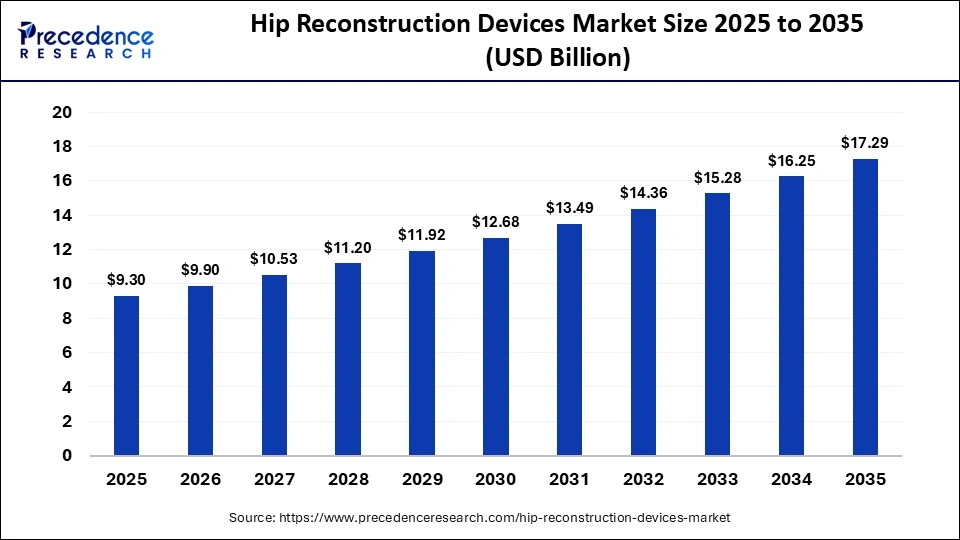
Deepa Pandey, a Healthcare Industry Expert, highlights that the hip reconstruction devices market has reached USD 9.90 billion in 2026 and is on track to reach USD 17.29 billion by 2035, advancing at a CAGR of 6.40%. Key hip reconstruction devices market companies shaping the market include Zimmer Biomet Holdings, Inc., Stryker Corporation, DePuy Synthes (Johnson & Johnson), Smith & Nephew plc, while major growth segments span By Device Type, By Material, By Surgery Type, By End-Use.
Source: https://www.precedenceresearch.com/hip-reconstruction-devices-market
 Get a Sample
 Table Of Content


What is the Hip Reconstruction Devices Market Size in 2026?
The global hip reconstruction devices market size accounted for USD 9.30 billion in 2025 and is predicted to increase from USD 9.90 billion in 2026 to approximately USD 17.29 billion by 2035, expanding at a CAGR of 6.40% from 2026 to 2035. The hip reconstruction devices market is driven by the rising prevalence of osteoarthritis and an aging population, which are increasing the demand for joint replacement procedures worldwide.
Key Takeaway
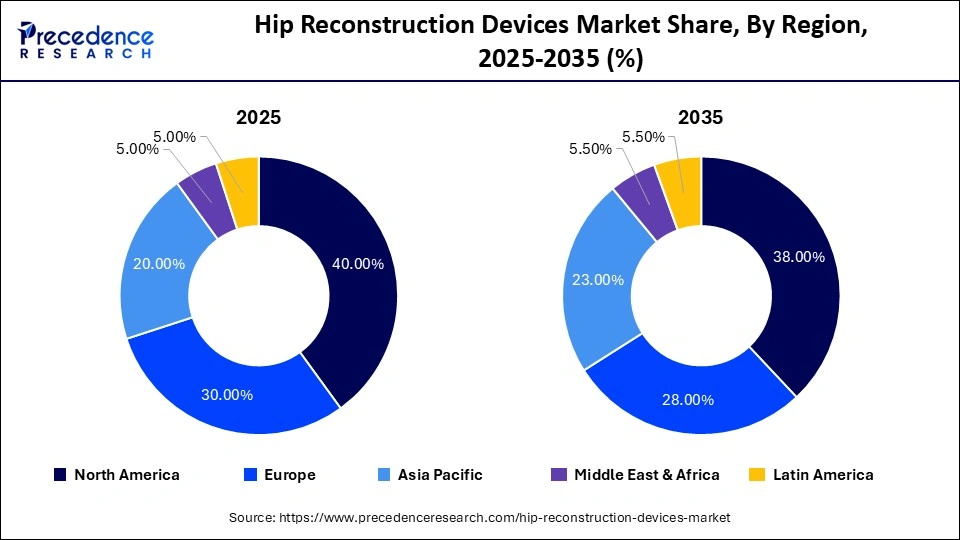
- North America led the hip reconstruction devices market in 2025 with a 40% revenue share.
- Asia Pacific is expected to expand at the fastest CAGR of 9% between 2026 and 2035.
- By device type, the hip arthroplasty (total hip replacement) segment led the market with a 65% share in 2025.
- By device type, the hip revision surgery devices segment is expected to grow at the fastest CAGR of 7.5% in the upcoming period.
- By material type, the metal-on-polyethylene (MoP) segment led the global market in 2025 with a 45% share.
- By material type, the ceramic-on-ceramic (CoC) segment is expected to grow at the fastest CAGR of 8.5% during the forecast period.
- By surgery type, the primary hip replacement surgery segment led the global market with a 75% share in 2025.
- By surgery type, the robotic-assisted hip surgery segment is observed to grow at the fastest CAGR of 15% in the coming years.
- By end-use, the hospitals segment led the global market in 2025 with a 65% share.
- By end-use, the specialty orthopedic clinics segment is expected to expand at the fastest CAGR of 7.2% in the coming years.
Hip Reconstruction Devices: Market Overview
Hip reconstruction devices are medical implants designed to restore mobility and relieve pain caused by arthritis and other hip-related conditions or injuries. Each system has distinct design features, including size, shape, material, and dimensions. Hip replacement surgery, or hip arthroplasty, is performed for patients with significant hip joint damage and is essential for maintaining balance and enabling everyday movement. As hip injuries become more common, continuous innovation in implant technology is critical. A wide range of implant types, tailored to specific injuries and patient preferences, is driving broader adoption and supporting overall market growth.
Impact of Artificial Intelligence on the Hip Reconstruction Devices Market
Artificial intelligence (AI) is revolutionizing the effectiveness of medical devices. In hip and knee surgeries, AI makes things smoother, from planning before the surgery to helping make decisions in the operating room and even following up afterward. For anterior hip procedures, AI tools give surgeons easy-to-follow, real-time feedback right there in surgery, making it easier to get the best outcome. Surgeons using AI for total hip replacements are seeing more accurate placement of prostheses and doing the job faster. Thereby, surgeons and device makers are staying in sync with the latest breakthroughs, making operations more efficient and giving patients better care across the board.
Hip Reconstruction Devices Market Trend
- Adoption of Robotics and Navigation Systems: The growing adoption of robotics and navigation systems is improving surgical precision and procedural consistency, leading to better patient outcomes and increased surgeon confidence.
- Rising Demand for Advanced Reconstruction Solutions: There is increasing demand for ceramic hip resurfacing, mini hip stems, cementless knee replacement solutions, and wider adoption of dual mobility articulation in hip arthroplasty.
- Focus on Performance-Driven Device Innovation: Manufacturers are prioritizing rapid ambulation, reduced blood loss, and streamlined instrumentation, driving innovation in cementless fixation and dual mobility technologies.
Market Scope
| Report Coverage | Details |
| Market Size in 2025 | USD 9.30 Billion |
| Market Size in 2026 | USD 9.90 Billion |
| Market Size by 2035 | USD 17.29 Billion |
| Market Growth Rate from 2026 to 2035 | CAGR of 6.40% |
| Dominating Region | North America |
| Fastest Growing Region | Asia Pacific |
| Base Year | 2025 |
| Forecast Period | 2026 to 2035 |
| Segments Covered | Device Type, Material, Surgery Type, End-Use, and Region |
| Regions Covered | North America, Europe, Asia-Pacific, Latin America, and Middle East & Africa |
Market Dynamics
Drivers
Growing Geriatric Population and Injury Cases
The growing geriatric population is a major driver of the hip reconstruction devices market, as aging individuals are more susceptible to degenerative conditions such as osteoarthritis and hip fractures, increasing the need for joint replacement procedures. Additionally, the rising incidence of trauma and injury cases, including road accidents and sports-related injuries, is further boosting demand for hip reconstruction devices by driving the volume of surgical interventions worldwide.
Restraint
Post-Surgery Risk
Issues such as ceramic fragmentation, abnormal joint noise, and risk of dislocation after hip replacement are limiting the adoption of these devices. Although surgeries are conducted in clean operating rooms, infection may still occur in some cases. In addition, implant materials may trigger allergic reactions.
Opportunity
Advancements in Materials and Manufacturing
Advances in materials and manufacturing technologies create significant opportunities in the hip reconstruction devices market by enabling the development of highly durable, biocompatible implants that improve longevity and patient outcomes. Innovations such as 3D printing and advanced biomaterials also allow for customized implants and minimally invasive procedures, enhancing surgical precision and expanding adoption.
Segmental Insights
Device Type Insights
Hip Reconstruction Devices Market Share, By Device Type, 2025-2035 (%)
| Device Type | 2025 | 2035 | CAGR (%) |
| Hip Arthroplasty (Total Hip Replacement) | 65.00% | 62.00% | 6.0% |
| Hip Resurfacing Devices | 10.00% | 9.50% | 5.5% |
| Partial Hip Replacement Devices | 8.00% | 7.50% | 5.5% |
| Hip Revision Surgery Devices | 10.00% | 12.50% | 7.5% |
| Others (Impingement Devices, etc.) | 7.00% | 9.00% | 8.0% |
The Hip Arthroplasty Segment Led the Market in 2025 With a 65% Share
The hip arthroplasty (total hip replacement) segment led the hip reconstruction devices market in 2025 by capturing nearly 65% share. This is because of its effectiveness in managing advanced hip joint arthritis and its significant role in enhancing the quality of life for older patients. Total hip arthroplasty (THA) is recognized as one of the most cost-effective and consistently successful orthopedic procedures, providing reliable results for individuals suffering from end-stage degenerative hip osteoarthritis, which further encourages its widespread use.
The hip revision surgery devices segment held a 10% share of the market in 2025 and is anticipated to grow at the fastest CAGR of 7.5% throughout the forecast period. This growth is primarily fueled by an aging population and an increasing incidence of failed primary hip replacements necessitating device replacement. The revision hip replacement procedure is more intricate and time-consuming, requiring thorough preoperative planning and the use of specialized implants and instruments to ensure optimal results.
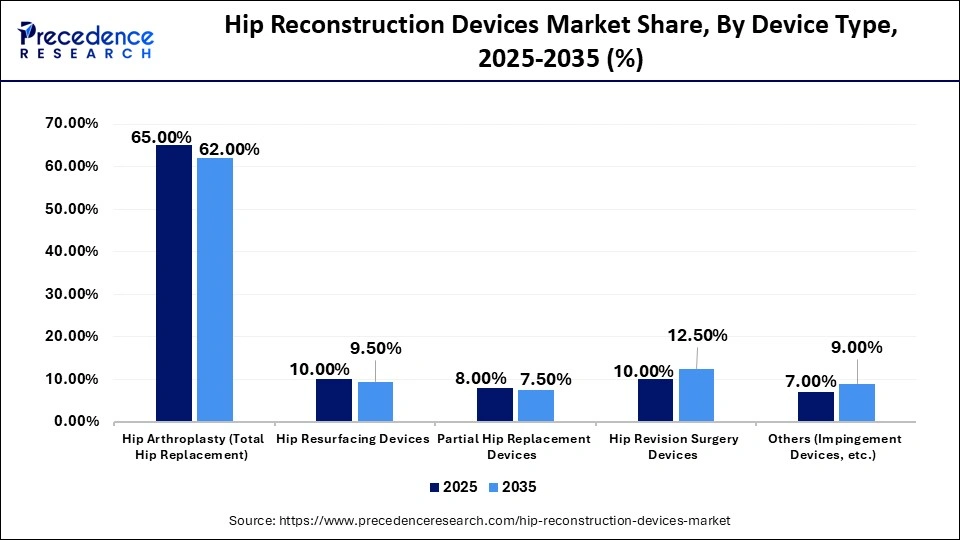
The hip resurfacing devices segment accounted for approximately 10% share of the market in 2025 and is projected to grow at a CAGR of nearly 5.5% in the upcoming years, driven by the rising adoption of hip resurfacing procedures among younger, active patients who require partial joint resurfacing. These devices offer the benefits of metal-on-metal coupling with large-diameter heads and low-profile, thin cups, complemented by optimal support from modular stems.
The partial hip replacement devices segment held approximately 8% market share in 2025 and is expected to grow at a CAGR of 5.5% over the forecast period. This is mainly due to the increasing number of partial hip replacements performed on patients with healthy sections of the hip, which provide benefits such as reduced recovery times and minimally invasive procedures. A partial hip replacement entails substituting the head of the femur with an artificial implant and is generally recommended for specific types of hip fractures where the acetabular socket is intact.
Material Insights
Hip Reconstruction Devices Market Share, By Material, 2025-2035 (%)
| Material | 2025 | 2035 | CAGR (%) |
| Metal-on-Polyethylene (MoP) | 45.00% | 43.00% | 5.0% |
| Metal-on-Metal (MoM) | 10.00% | 9.00% | 4.0% |
| Ceramic-on-Polyethylene (CoP) | 25.00% | 27.00% | 6.5% |
| Ceramic-on-Ceramic (CoC) | 5.00% | 7.00% | 8.5% |
| Hybrid (Ceramic on Metal, etc.) | 15.00% | 14.00% | 7.0% |
The Metal-On-Polyethylene (Mop) Segment Held a 45% Market Share in 2025
The metal-on-polyethylene (MoP) segment dominated the hip reconstruction devices market in 2025, accounting for around 45% share. MoP is recognized as the most utilized material combination due to its excellent balance of durability, cost-effectiveness, and clinical performance. The implementation of metal-on-highly crosslinked polyethylene implants in hip resurfacing arthroplasty has yielded successful short-term outcomes and is regarded as a viable choice for suitably selected patients. Additionally, these hard-on-soft bearings are demonstrating encouraging long-term results, further solidifying the segment's leadership in the market.
The ceramic-on-ceramic (CoC) segment held approximately 5% market share in 2025 and is projected to expand at the fastest CAGR of 8.5% over the forecast period. This is because of its minimal wear rates and is increasingly favored by younger, active patients who prioritize long-term durability. Ceramic materials are biocompatible, exceptionally smooth, and highly resistant to wear, resulting in outstanding long-term survival rates, low complication rates, and favorable functional outcomes. These attributes are driving the broader adoption of CoC implants.
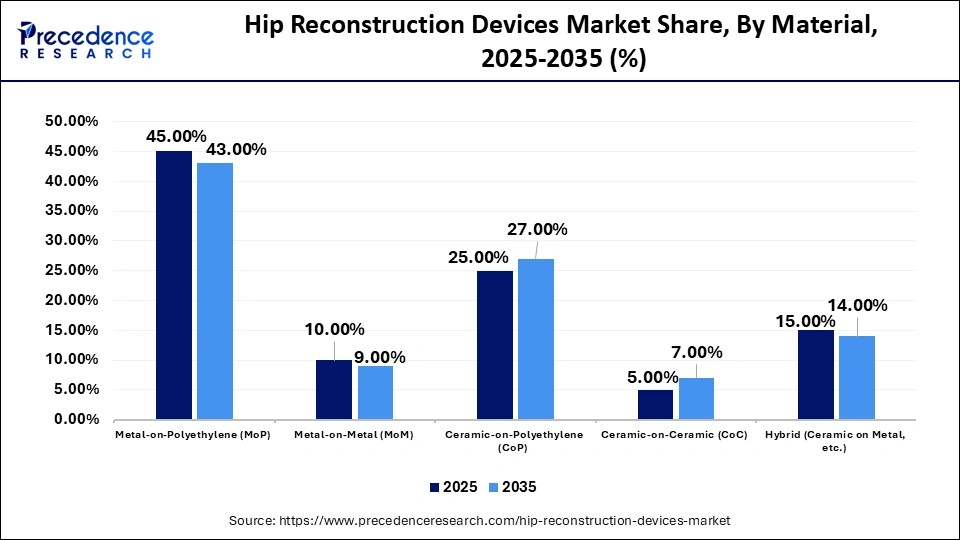
The metal-on-metal (MoM) segment held nearly 10% market share in 2025 and is expected to grow at a CAGR of 4% in the coming years. MoM hip implants are comprised of a ball, stem, and shell, all constructed from metal materials. These implants are linked to a decreased risk of dislocation, when the femoral head dislodges from the hip socket, and a reduced likelihood of device fracture, which endorses their ongoing application in carefully chosen patient populations.
The ceramic-on-polyethylene segment secured about 25% market share in 2025 and is expected to grow at a CAGR of 6.5% in the forthcoming years. This is because of its low wear rates and improved patient outcomes in active elderly patients. The design consists of a ceramic bearing surface for the femoral head paired with a specialized polyethylene socket. Recent advancements in design have enhanced the durability of these systems, while the rigid yet smooth ceramic head decreases friction within the polyethylene socket, thereby minimizing wear and supporting long-term performance.
Surgery Insights
Hip Reconstruction Devices Market Share, By Surgery Type, 2025-2035 (%)
| Surgery Type | 2025 | 2035 | CAGR (%) |
| Primary Hip Replacement Surgery | 75.00% | 72.00% | 5.5% |
| Hip Revision Surgery | 15.00% | 18.00% | 7.0% |
| Minimally Invasive Hip Surgery | 5.00% | 6.50% | 9.0% |
| Robotic-assisted Hip Surgery | 5.00% | 6.50% | 15.0% |
The Primary Hip Replacement Surgery Segment Led the Market in 2025
The primary hip replacement surgery segment led the hip reconstruction devices market in 2025 with approximately 75% share. The segment's dominance is attributed to its extensive application among elderly patients suffering from hip arthritis and other joint ailments. The procedure effectively replaces a damaged or deteriorated hip joint, alleviating pain and enhancing functionality for most individuals experiencing significant joint deterioration due to osteoarthritis, rheumatoid arthritis, and various other conditions.
The robotic-assisted hip surgery segment held about 5% market share in 2025 and is projected to grow at the fastest CAGR of 15% over the forecast period, driven by increased precision, accuracy, and improved patient outcomes. This innovative approach to traditional hip replacement surgery enables surgeons to effectively plan and execute a range of procedures, including total hip, total knee, and partial knee replacements, with a high level of accuracy.
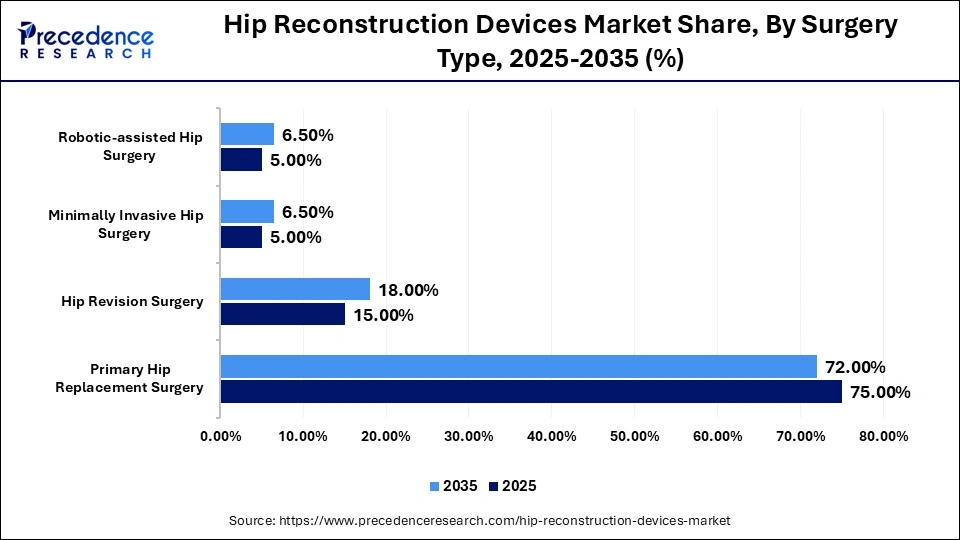
The hip revision surgery segment held a 15% market share in 2025 and is expected to grow at a CAGR of 7% in the upcoming years, driven by rising failure rates of primary replacements, particularly among older patients and those with comorbidities. Revision total hip replacement is frequently required when complications arise from an initial hip replacement, also known as primary hip replacement, or when it does not meet expected performance standards.
The minimally invasive hip surgery segment accounted for approximately 5% share of the market in 2025 and is expected to grow at a CAGR of 9% in the coming years. This is because this approach is becoming increasingly popular due to its advantages in minimizing recovery time, scarring, and overall surgical risks. Typically performed to replace or repair a diseased or damaged hip joint, minimally invasive procedures are often more appropriate for younger, leaner patients. By minimizing tissue disruption, these methods can facilitate faster recovery and reduce postoperative pain, which further encourages their widespread adoption.
End-Use Insights
Hospitals Dominated the Market in 2025 With a 65% Share
The hospitals segment dominated the hip reconstruction devices market in 2025 with approximately 65% share, driven by their ability to handle complex surgeries, advanced infrastructure, and the availability of specialized orthopedic care. Hospitals offer multidisciplinary facilities, coordinated physician teams, and comprehensive postoperative care, further reinforcing their leading position in the market.
Hip Reconstruction Devices Market Share, By End-Use, 2025-2035 (%)
| End-Use | 2025 | 2035 | CAGR (%) |
| Hospitals | 65.00% | 62.00% | 6.5% |
| Ambulatory Surgical Centers (ASCs) | 20.00% | 22.00% | 7.0% |
| Specialty Orthopedic Clinics | 15.00% | 16.00% | 7.2% |
The ambulatory surgical centers (ASCs) segment held approximately 20% share of the market in 2025 and is expected to grow at a CAGR of about 7% in the coming years. This is because they offer cost-effective, outpatient procedures with faster recovery times and reduced patient costs. These specialized facilities are designed for patients who require surgery but do not need an extended hospital stay, typically remaining for less than 24 hours.
The specialty orthopedic clinics segment held 15% market share in 2025 and is projected to grow at the fastest CAGR of nearly 7.2% over the forecast period. The segment's growth is driven by rising demand for personalized orthopedic care and less invasive surgical options. These clinics are led by orthopedic specialists who deliver comprehensive, tailored treatment, combining traditional techniques with cutting-edge innovations such as robotic knee replacement surgery.
Regional Insights
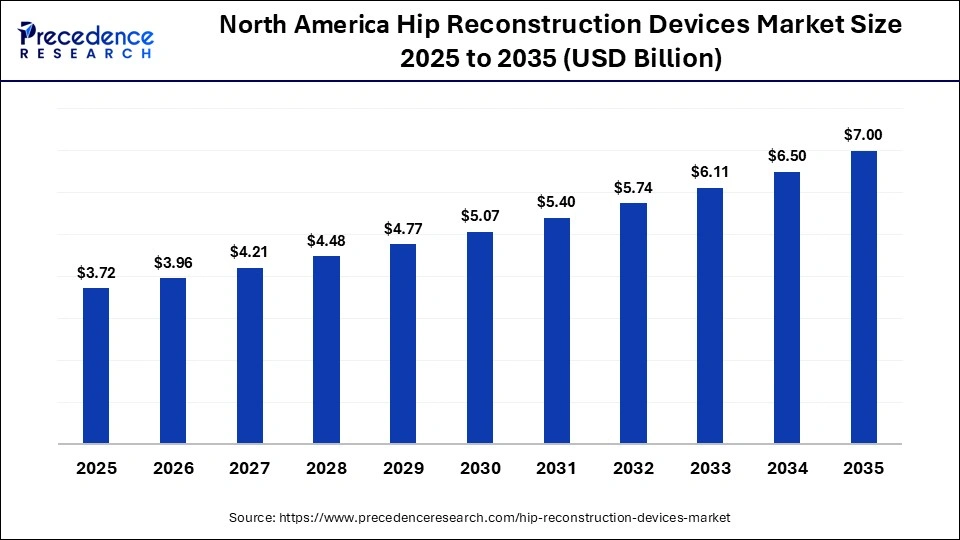
North America Hip Reconstruction Devices Market Size and Growth 2026 to 2035
The North America hip reconstruction devices market size is estimated at USD 3.72 billion in 2025 and is projected to reach approximately USD 7.00 billion by 2035, with a 6.53% CAGR from 2026 to 2035.
Why Did North America Dominate the Hip Reconstruction Devices Market in 2025?
North America held a dominant position in the hip reconstruction devices market, accounting for approximately 40% share in 2025. This leadership is attributed to the region's advanced healthcare infrastructure, widespread adoption of robotic-assisted surgeries, and significant healthcare expenditures. Additionally, the high prevalence of hip fractures and avascular necrosis has further fueled demand for these devices. The market's strength is bolstered by effective reimbursement systems and the significant presence of major device manufacturers.
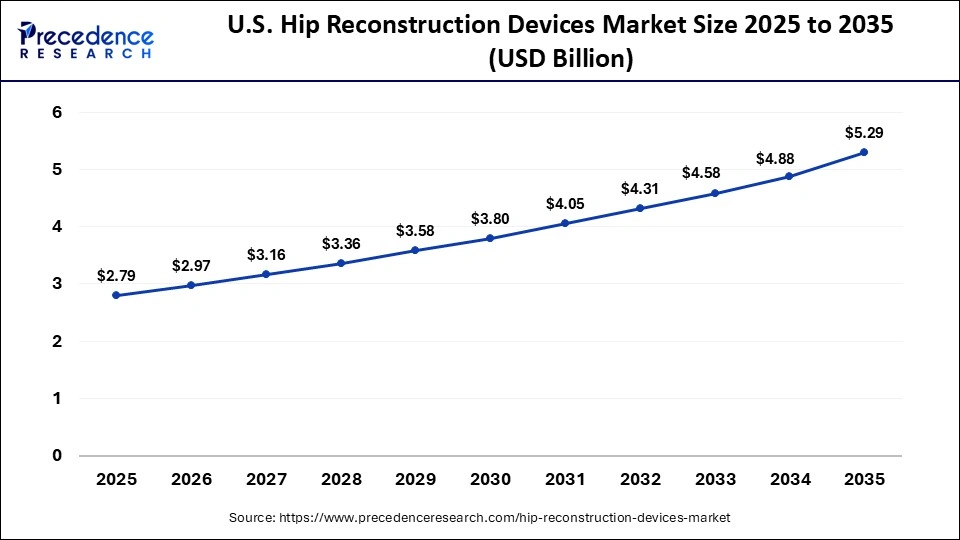
U.S. Hip Reconstruction Devices Market Size and Growth 2026 to 2035
The U.S. hip reconstruction devices market size is calculated at USD 2.79 billion in 2025 and is expected to reach nearly USD 5.29 billion in 2035, accelerating at a strong CAGR of 6.61% between 2026 and 2035.
U.S. Market Analysis
The U.S. is the major contributor to the North American hip reconstruction devices market due to the rising prevalence of osteoarthritis and an aging population, which is increasing the demand for hip replacement procedures. Additionally, advanced healthcare infrastructure, favorable reimbursement policies, and rapid adoption of innovative surgical technologies are further driving market expansion.
Asia Pacific: The Fastest-Growing Region
Asia Pacific accounted for 20% market share in 2025 and is anticipated to grow at the fastest CAGR of 9% in the coming years. This growth is fueled by the expansion of healthcare infrastructure, an aging population, and a rising demand for hip surgeries. Additionally, the regional market benefits from heightened awareness among key stakeholders, increasing per capita income, significant unmet medical needs, and a growing prevalence of orthopedic diseases.
China Market Analysis
China leads the Asia Pacific market due to a rapidly aging population and a rising prevalence of joint disorders and hip fractures, which are increasing the demand for surgical interventions. Additionally, improving healthcare infrastructure, expanding insurance coverage, and greater access to advanced orthopedic procedures are further driving market growth.
How is the Opportunistic Rise of Europe in the Hip Reconstruction Devices Market?
Europe held the second-largest market share of 30% in 2025 and is expected to grow at a 6.5% CAGR over the projection period. This growth is attributed to the rising adoption of minimally invasive surgeries and robotic systems in orthopedic care, an aging population, advancements in joint replacement technology, and an increasing preference for less invasive procedures. Additionally, market expansion is bolstered by favorable reimbursement policies and heightened awareness of early intervention for hip disorders in key countries.
Hip Reconstruction Devices Market Value Chain Analysis
- R&D
This stage focuses on improving implant longevity, surgical precision, and tailored, patient-specific customization for better outcomes.
Key Players: Stryker Corporation, Zimmer Biomet, DePuy Synthes
- Clinical Trials and Regulatory Approvals
Regulatory approvals now increasingly demand robust long-term clinical outcome data instead of relying solely on laboratory testing.
Key Players: MCRA (Musculoskeletal Clinical Regulatory Advisers), Eclevar MedTech, ICON Clinical Research
- Packaging and Serialization
This stage guarantees sterility and full traceability from manufacturing facilities to the operating room.
Key Players: DuPont, Amcor, Nelipak Healthcare Packaging
- Distribution
This stage ensures the delivery of devices from global manufacturers to local surgical care settings.
Key Players: Medacta International, Enovis, MicroPort Scientific
Hip Reconstruction Devices Market Companies
- Zimmer Biomet Holdings, Inc.
- Stryker Corporation
- DePuy Synthes (Johnson & Johnson)
- Smith & Nephew plc
- Wright Medical Group N.V. (Acquired by Stryker)
- MicroPort Scientific Corporation
- B. Braun Melsungen AG
- Exactech, Inc.
- DJO Global (part of Colfax Corporation)
- Arthrex, Inc.
- Medtronic plc
- Corin Group
- Omni Life Science, Inc.
- Hapatec GmbH
- Cerapedics, Inc
Recent Developments
- In March 2026, Maxx Orthopedics, Inc., a rapidly growing global orthopedic device company, announced the launch of the Libertas Keystone™ Hip System, a short, metaphyseal fit-and-fill hip stem.(Source: https://orthospinenews.com)
- In March 2026, with support from the European Union, French company ImpacTell began preparing to commercialize its instrumented hammer, a device that provides orthopedic surgeons with objective and reliable measurements of implant stability. The EU-funded Impactor project was established to develop this instrumented hammer, a medical device designed to help surgeons assess the stability of orthopaedic implants used in hip replacement surgery. (Source: https://cordis.europa.eu)
Segments Covered in the Report
By Device Type
- Hip Arthroplasty (Total Hip Replacement)
- Hip Resurfacing Devices
- Partial Hip Replacement Devices
- Hip Revision Surgery Devices
- Others (Impingement Devices, etc.)
By Material
- Metal-on-Polyethylene (MoP)
- Metal-on-Metal (MoM)
- Ceramic-on-Polyethylene (CoP)
- Ceramic-on-Ceramic (CoC)
- Hybrid (Ceramic on Metal, etc.)
By Surgery Type
- Primary Hip Replacement Surgery
- Hip Revision Surgery
- Minimally Invasive Hip Surgery
- Robotic-assisted Hip Surgery
By End-Use
- Hospitals
- Ambulatory Surgical Centers (ASCs)
- Specialty Orthopedic Clinics
By Region
- North America
- Latin America
- Europe
- Asia-pacific
- Middle and East Africa
For inquiries regarding discounts, bulk purchases, or customization requests, please contact us at sales@precedenceresearch.com
Frequently Asked Questions





Ask For Sample
No cookie-cutter, only authentic analysis – take the 1st step to become a Precedence Research client
 Get a Sample
.webp)



 sales@precedenceresearch.com
 Schedule a Meeting
