


Home Improvement Market Trends, Leading Companies, Company Revenue / Sales Performance, Retail Sales, Production Volume, Consumer Spending, Market Penetration, Competitive Landscape, and Industry Outlook
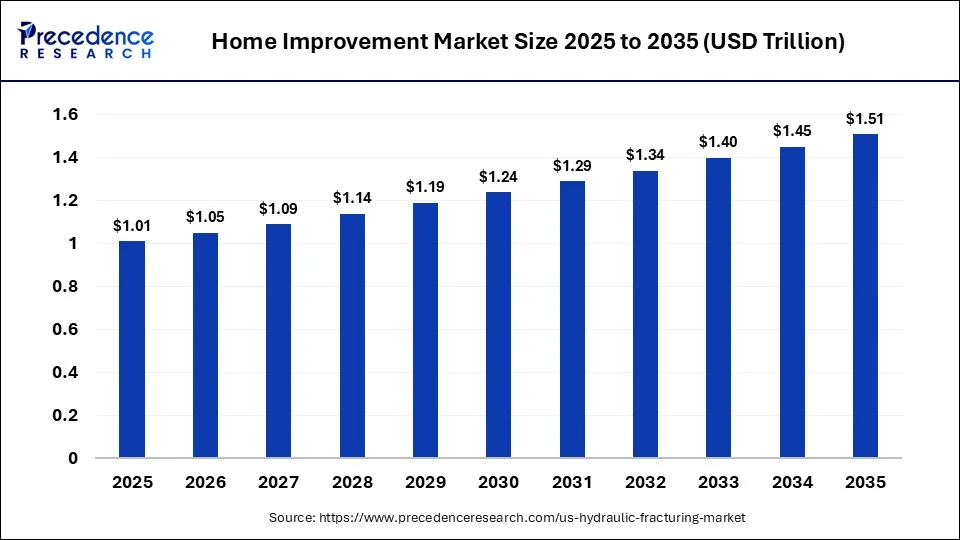
The home improvement size was accounted USD 1.05 trillion in 2026 to USD 1.51 trillion by 2035, growing at a CAGR of 4.12% from 2026 to 2035. The market growth is driven by expanding smart home integration, adoption of energy-efficient and sustainable solutions, remote work adaptations, and maintenance and structural repairs for older residential properties. The analysis was led by Vidyesh Swar, Senior Research Analyst, who brings experience in consumer goods market research. His analysis benefits home improvement manufacturers, retailers, contractors, and other stakeholders by supporting competitive analysis and enabling well-informed decisions.
Source: https://www.precedenceresearch.com/home-improvement-market
 Get a Sample
 Table Of Content


Home Improvement Market Trends, Growth, and Market Size Analysis 2035
The home improvement market is forecasted to expand from USD 1.05 trillion in 2026 to USD 1.51 trillion by 2035, growing at a CAGR of 4.12% from 2026 to 2035. and is valued at approximately USD 1.01 trillion in 2025. The market is driven by rapid adoption of smart home technologies, rising home renovation and remodeling activity, and the expansion of e-commerce and modern retail channels. Vidyesh Swar, our Senior Research Analyst, has over 5 years of experience in the consumer goods industry. According to him, the ongoing developments in smart home solutions and the increasing availability of sustainable home improvement products are accelerating convenience and modernization.
Key Takeaways
- By product type, the structural & building materials segment dominated, with a 22.45% market share in 2025.
- By project type, the kitchen improvement & remodeling segment led with an estimated 18.65% market share in 2025.
- By execution, the professional / DIFM segment accounted for the largest market share of 61.25% in 2025.
- By execution, the DIY segment held the second-largest share of 38.75% in 2025.
- In the U.S., Harvard's Joint Center for Housing Studies estimated owner-occupied home improvement and maintenance spending at USD 509 billion in 2025, and Houzz found that 54% of surveyed homeowners carried out renovation projects in 2025.
- In India, the National Housing Bank accounted for ₹33.53 lakh crore in individual housing loans outstanding as of September 2024, up 14% year over year.
- The Home Depot generated USD 164.7 billion in fiscal 2025 sales, up 3.2% year over year, with more than 2,300 stores.
- Lowe's valued USD 86.3 billion in fiscal 2025 sales, with more than 1,700 home improvement stores, about 16 million customer transactions per week and approximately 300,000 associates.
- Kingfisher generated GBP 7.1 billion in first-half 2026 sales, supported by Screwfix and market-share gains in the UK, Poland and Spain.
- Asian Paints reported INR 30,830.4 crore in FY2025–26 revenue from its Decorative and Home Décor business, highlighting 86.8% of total revenue.
What was the Size of the Global Home Improvement Market in 2025?
The global home improvement market is valued at about USD 1.01 trillion in 2025 and is projected to reach around USD 1.51 trillion by 2035, representing a 4.12% CAGR during 2026 - 2035. The market primarily comprises renovation, repair, remodeling, and replacement activities. Furthermore, it involves modifying existing residential properties, such as kitchens, bathrooms, flooring, roofing, painting, windows and doors, HVAC, plumbing, electrical systems, outdoor living, home decor, and smart-home installations.
The WHO housing and health guidelines highlight the importance of safe, healthy, and sustainable housing in improving public health and quality of life. They also address key factors such as crowding, indoor temperature safety, accessibility, air and water quality, and promote collaboration to encourage sustainable housing.
Insights By Expert Analysts
The market is propelled by an increasing structural base supported not only by exclusive demand for new-home construction but also by recurring demand from aging housing stock, longer homeowner tenure, repair needs, energy-efficiency modifications, and lifestyle-driven remodeling. In the U.S., Harvard's Joint Center for Housing Studies estimated owner-occupied home improvement and maintenance spending at USD 509 billion in 2025, and Houzz found that 54% of surveyed homeowners carried out renovation projects in 2025.
Which Product Category Dominates the Market in 2025?
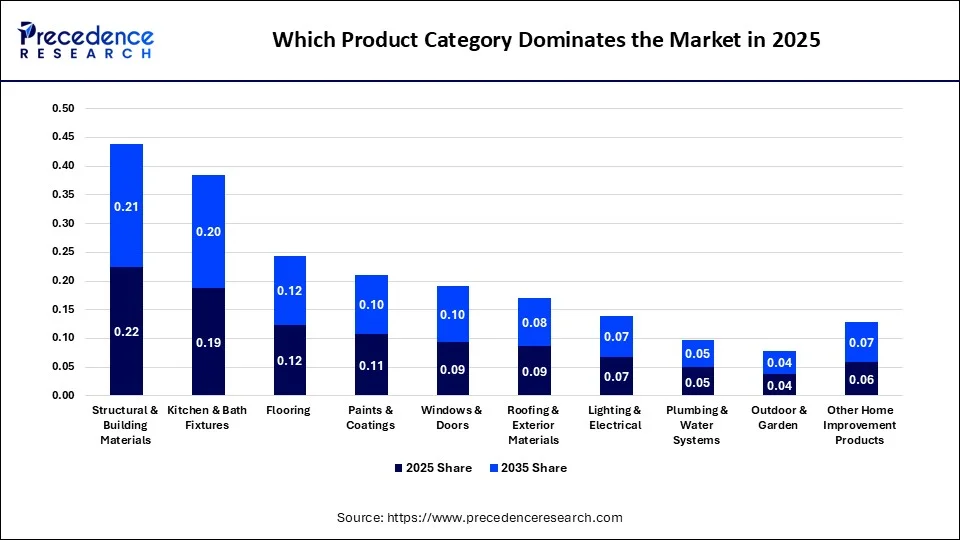
The structural and building materials segment dominated the market with a 22.45% share in 2025 and is expected to grow at a CAGR of 3.58% during the forecast period. This dominance stems from its wide range of repair and replacement activities. A recent market assessment also estimated structural and building materials at about USD 263.6 billion in 2025. Meanwhile, the other home improvement products segment is expected to expand at a CAGR of 5.82%, increasing its share from 5.90% in 2025 to 7.00% in 2035.
Insights By Expert Analysts
The higher-value replacement and upgrade categories are gaining traction as a major competitive opportunity moving beyond basic building materials. In 2025, the kitchen and bath fixtures segment accounted for the second-largest market share of 18.85%, the windows and doors segment reported 9.35%, and electrical systems accounted for 6.75% due to their increasing customer adoption. Other home improvement product segments such as smart-home equipment and energy-efficiency products are intended to capture higher value per project than routine maintenance products.
Which Project Type Accounted for the Largest Homeowner Budgets?
| Project Type | Estimated Share |
| Kitchen Improvement & Remodeling | 18.65% |
| Bathroom Improvement & Remodeling | 13.90% |
| Exterior Replacement & Remodeling | 15.85% |
| Interior Replacement & Remodeling | 13.25% |
| Roofing & Building Envelope | 10.40% |
| HVAC & Energy Systems | 9.15% |
| Flooring | 6.95% |
| Outdoor Living & Landscaping | 5.35% |
| Smart Home & Security | 2.85% |
| Other Projects | 7.70% |
By project type, kitchen and bathroom improvement and remodeling projects, with estimated shares of 18.65% and 13.90%, maintain the most predominant renovation categories. Houzz's 2026 U.S. study highlighted that 26% of renovating homeowners renovated kitchens, 25% renovated guest bathrooms, and 23% renovated primary bathrooms in 2025. Median kitchen renovation spending peaked at USD 24,000, and primary bathroom spending maxed at USD 15,000. Other important key projects include exterior and interior replacement and remodeling, roofing and building envelope, and HVAC and energy systems.
Insights By Expert Analysts
The data highlighted that home improvement spending is increasingly project-led rather than product-led. Major retailers and manufacturers that combine products with design, installation, financing, contractor services, and digital project management can hold larger shares of the customer's overall renovation budget.
How will DIY and Professional Home Improvement Projects Contribute to the Market?
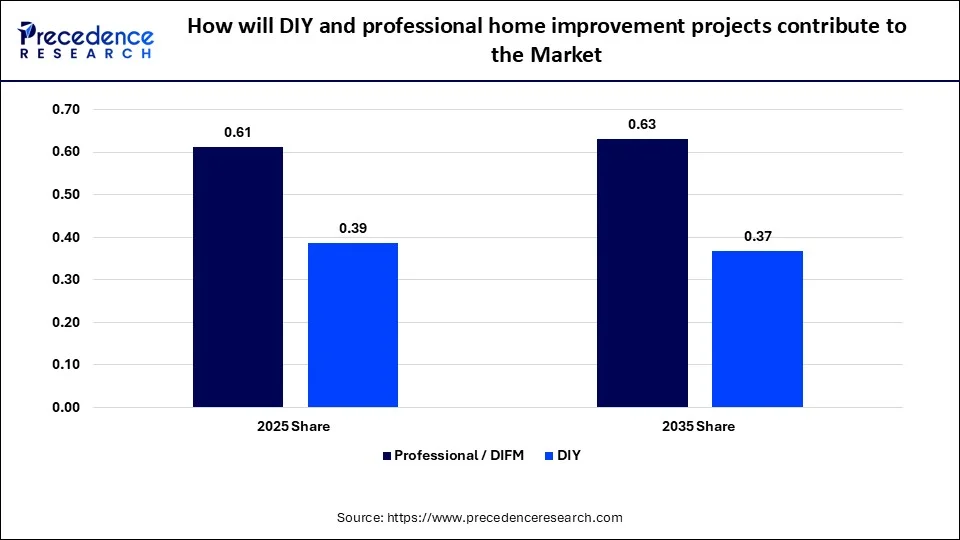
In the home improvement market, the professional project execution segment held the largest market share at 61.25% in 2025 and is expected to grow the fastest, with a CAGR of 4.45%. This is because it includes general contractors, specialist remodelers, electricians, plumbers, painters, flooring installers, HVAC contractors, and other skilled trades. The DIY segment accounted for a 38.75% market share in 2025 and is being rapidly adopted because it comprises homeowner-purchased products installed or managed without full professional project execution.
Houzz's 2026 research highlighted that professionals are especially strong in major projects. In kitchen renovations, 86% of homeowners hired a professional, while bathroom renovations also indicated high professional involvement.
Insights by Expert Analysts
The data indicates that both DIY and professional home improvement projects contribute significantly to the market, with DIY important for painting, décor, gardening, basic repairs, and smaller upgrades, but its complexity is shifting spending toward professional services. Meanwhile, the DIFM channel is further supported by labor shortages, building-code requirements, and increasing installation complexity.
Which Home Improvement Categories are Emerging Fastest?
| Subsegment | Estimated CAGR |
| Smart Home & Connected Security | 8.85% |
| Energy-Efficient Windows & Doors | 7.25% |
| Heat Pumps & HVAC Upgrades | 6.95% |
| Home Energy Management | 6.80% |
| Outdoor Living | 5.65% |
| Lighting & Electrical Upgrades | 4.72% |
| Kitchen & Bath | 4.57% |
| Flooring | 3.73% |
| Structural Materials | 3.58% |
| Paints & Coatings | 3.51% |
Various home improvement categories like smart home & connected security, energy-efficient windows & doors, and heat pumps & HVAC upgrades are gaining traction with estimated CAGRs of 8.85%, 7.25%, and 6.95%, respectively. Other important categories that are strengthening the market include lighting & electrical upgrades, kitchen & bath, flooring, structural materials, and paints & coatings. Home energy management and outdoor living also foster market growth.
Insights By Expert Analysts
The fastest-growing opportunities in the market lie in energy efficiency, electrification, automation, and resilience instead of traditional cosmetic renovation alone. This helps to open doors for manufacturers of heat pumps, insulation, high-performance windows, smart thermostats, solar-related equipment, energy-management systems, and connected security, thereby further contributing to market expansion.
What are Homeowners Purchase Preferences During Renovation Projects?
| Product Category | U.S. Renovating Homeowners Purchasing, 2025 |
| Paint | 62% |
| Lighting Fixtures | 48% |
| Faucets & Shower Heads | 46% |
| Lawn & Garden Supplies | 44% |
| Building Materials | 41% |
| Non-Carpet Flooring | 34% |
| Major Kitchen Appliances | 29% |
This product purchase penetration highlighted various product categories and U.S. renovating homeowners purchasing in 2025. Houzz's 2026 U.S. study offers a useful product-level view of homeowner purchasing behavior. In this, paint represented the largest renovating purchase category with 62%, followed by lighting fixtures, faucets and shower heads, and lawn and garden supplies at 48%, 46%, and 44%, respectively. Other product categories, including building materials, non-carpet flooring, and major kitchen appliances, are also contributing significantly to U.S. renovating homeowners' purchases.
Insights By Expert Analysts
This emphasized that high purchase penetration does not necessarily mean the highest dollar value. Paint and lighting are frequently purchased but relatively lower-ticket. Meanwhile, kitchens, roofing, HVAC, windows, and bathrooms resulted in substantially higher project expenses. This difference is a crucial factor for manufacturers and retailers developing category-specific strategies for product purchase penetration.
Which Region Held the Largest Market Share in 2025?
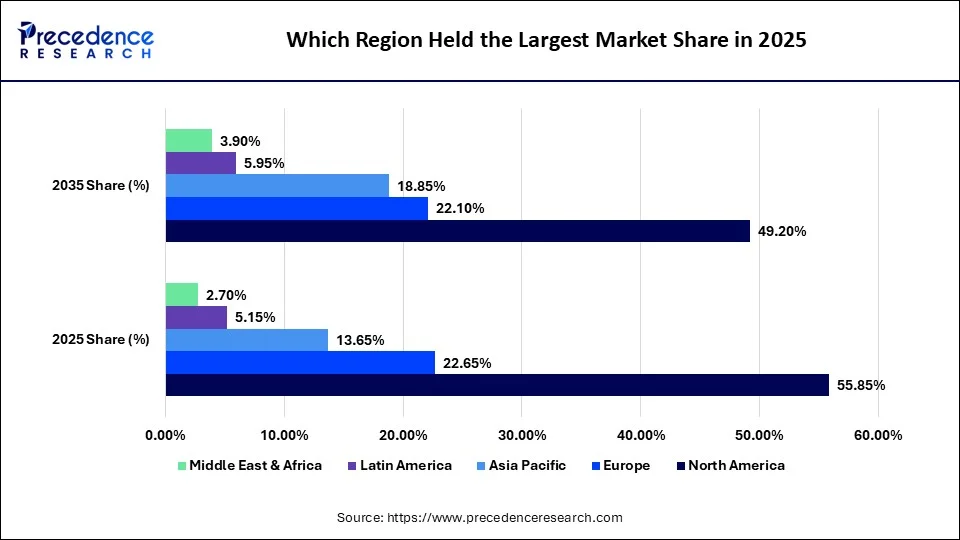
North America led the market with a 51.65% share in 2025 and is expected to grow at the highest CAGR of 3.49% during the forecast period mainly because of its well-established remodeling ecosystem. Asia Pacific is expected to grow at a CAGR of 5.50%, and the Middle East and Africa at 4.80% from 2025 to 2035 mainly due to increasing demand for urban housing and exclusive expansion of residential modernization.
Insights By Expert Analysts
North America held the largest share of 51.65% in 2025, driven by its massive installed residential asset base and mature remodeling ecosystem, while Asia Pacific has stronger structural growth potential with an anticipated CAGR of 5.50%. This is mainly because its most important shift through 2035 is expected to be the gradual increase in its contribution from urban housing, middle-class consumption, homeownership, and expanding residential modernization.
Which Countries are Most Important to the Home Improvement Market?
| Country | Current Market Role | Key Demand Drivers | Outlook |
| Canada | Largest individual market | Aging homes, remodeling, repair, DIY, professional renovation | Mature / High Value |
| United States | Mature North American market | Housing maintenance, renovation, energy upgrades | Mature |
| Germany | Major European market | Energy renovation, building modernization | High-value |
| United Kingdom | Major renovation market | Aging housing, energy efficiency, DIY | Mature |
| France | Major European market | Renovation, energy efficiency, housing upgrades | Moderate–High |
| Japan | Mature Asia market | Aging housing stock, replacement, accessibility | Mature |
| China | Major APAC market | Urbanization, housing modernization, home décor | High potential |
| India | Emerging high-growth market | Urbanization, housing construction, rising incomes | High Growth |
| Australia | Mature/high-spend market | Renovation, outdoor living, housing maintenance | High Value |
| South Korea | Advanced Asian market | Smart homes, apartments, remodeling | High Value |
| Saudi Arabia | Emerging Middle East market | Residential development, premium interiors | High Growth |
| UAE | Emerging premium market | Luxury residential, smart homes, refurbishment | High Value |
The United States represents the largest home improvement market, supported by remodeling, repair, DIY activity, professional renovation, and an aging housing stock. Canada, Germany, the UK, France, and Japan are mature markets driven by renovation, maintenance, energy efficiency, and housing modernization. China, Australia, South Korea, India, Saudi Arabia, and the UAE offer strong opportunities through urbanization, increasing incomes, residential development, smart home adoption, premium interiors, and refurbishment. Overall, mature markets remain high value, while emerging markets, particularly India, China, Saudi Arabia, and the UAE, present greater growth potential.
Insights By Expert Analysts
The United States continues to be the primary hub, but India, China, Southeast Asia, and the Middle East have greater future growth potential. Countries with rapidly expanding housing stock are driving demand for new-home fit-outs and renovations, and developed markets generate stronger replacement and remodeling expenditure.
Why is the United States the Largest Home Improvement Market?
The U.S. has the largest home improvement market because of its massive installed residential base and developed professional and DIY ecosystem. Harvard's Joint Center for Housing Studies projected USD 509 billion in owner-occupied home improvement and maintenance expenditure for 2025. The U.S. also demonstrates substantial project spending. In Houzz's 2026 study, median renovation spending was USD 20,000, while the top 10% of renovation projects valued USD 150,000 or more in 2025.
Insights By Expert Analysts
The U.S. is important for companies selling premium products because homeowners have major access to significant home equity and an established contractor ecosystem. Concurrently, high purchasing costs can delay discretionary remodeling, making repair-and-replace categories relatively adaptable.
Why is Asia Pacific Becoming a Major Growth Potential in the Future?
Asia Pacific is becoming a major growth potential because of rapid urbanization, increasing household incomes, immersive apartment modernization, expanding middle-class consumption, new residential construction, digital commerce, smart-home adoption, and growing demand for branded home products.
In India, the National Housing Bank accounted for ₹33.53 lakh crore in individual housing loans outstanding as of September 2024, up 14% year over year.
In December 2025, India's government housing programs also developed a large installed base. Under the PMAY-G program, 3.86 crore houses were sanctioned, and 2.92 crore were completed for consumption.
Insights By Expert Analysts
India offers strong growth potential, and it extends beyond traditional renovation. The new housing formation, household upgrades, modular kitchens, paints, sanitary ware, flooring, electrical products, lighting, furniture, and home décor drive the broad home-improvement ecosystem. Ultimately, this makes India a preferred market for companies for long-term APAC expansion.
Which Companies are Leading the Home Improvement Market?
| Company | Primary Market | Relevant Position |
| The Home Depot | U.S./North America | Home improvement retail, Pro and DIY |
| Lowe's | U.S./North America | Home improvement retail and professional customers |
| Kingfisher plc | UK/Europe | B&Q, Screwfix and European home improvement |
| Leroy Merlin | Europe/APAC/MEA | DIY, home improvement and renovation |
| Saint-Gobain | Global | Building materials and construction solutions |
| Sherwin-Williams | Global/U.S. | Paints and coatings |
| Masco Corporation | Global | Plumbing, décor and home products |
| Floor & Decor | U.S. | Flooring and hard-surface products |
| Asian Paints | India/International | Paints, décor and home services |
| Bunnings | Australia/New Zealand | Home improvement and hardware |
| Travis Perkins | UK | Building materials and professional trade |
| Ace Hardware | U.S./International | Hardware and DIY |
Among these diversified companies, The Home Depot, Lowe's, and Kingfisher plc led the home improvement market.
The Home Depot is known as a major home improvement company offering retail, professional contractors, and DIY in the U.S. and North America. Lowe's is another leading U.S. retailer serving retail and professional customers. Concurrently, Saint-Gobain operates globally by providing its building materials and construction solutions and supporting the home improvement ecosystem.
Other renowned home improvement companies such as Kingfisher plc, Leroy Merlin, Ace Hardware, and Bunnings offer DIY and hardware, while Sherwin-Williams and Asian Paints offer paints, décor, and home services. Masco Corporation, Floor & Décor, and Travis Perkins make an impact through their plumbing, décor, flooring, and professional trades.
Insights By Expert Analysts
The home improvement ecosystem is highly diversified, with leading companies integrating professional services, retail, and sustainable building solutions. This highlights the strong shift from product-focused sales to end-to-end home improvement offerings.
How Large are the Leading Home Improvement Retailers?
| Company | Latest Reported Sales | Key Operational Indicator |
| The Home Depot | USD 164.7B, FY2025 | 2,300+ stores |
| Lowe's | USD 86.3B, FY2025 | 1,700+ home improvement stores |
| Kingfisher | GBP 7.1B, H1 FY2026 | B&Q, Screwfix and European operations |
| Asian Paints – Decorative & Home Décor | INR 30,830.4 crore, FY2025–26 | 86.8% of company revenue |
The Home Depot generated USD 164.7 billion in fiscal 2025 sales, up 3.2% year over year, with more than 2,300 stores.
Lowe's valued USD 86.3 billion in fiscal 2025 sales, with more than 1,700 home improvement stores, about 16 million customer transactions per week and approximately 300,000 associates.
Kingfisher generated GBP 7.1 billion in first-half 2026 sales, supported by Screwfix and market-share gains in the UK, Poland and Spain.
Asian Paints reported INR 30,830.4 crore in FY2025–26 revenue from its Decorative and Home Décor business, highlighting 86.8% of total revenue.
Insights By Expert Analysts
The competitive landscape is highly fragmented. Large retailers control substantial customer traffic and product assortment, whereas manufacturers compete through brand, distribution, contractor relationships, and product innovation. Overall, the next competitive layer is largely services, digital, installation, and financing, rather than physical retail alone.
What are the Major Trends Changing Home Improvement Demand?
| Trend | Impact on Market |
| Aging housing stock | Drives repair and replacement |
| Longer homeowner tenure | Encourages stay-and-improve projects |
| Energy-efficiency regulation | Supports insulation, windows, and HVAC |
| Smart-home adoption | Supports accessibility and bathroom modifications |
| Aging population | Expands decks, landscaping, and exterior spending |
| Outdoor living | Expands decks, landscaping, and exterior spending |
| E-commerce | Raises DIFM penetration |
| Professional installation | Supports larger renovation projects |
| Home-equity financing | Increases demand for efficient and low-impact materials |
| Sustainability | Improves visualization, planning, and personalization |
| Labor shortages | Increases the value of installation and contractor networks |
Various market trends are significantly driving market adoption. Among these, aging housing stock and longer homeowner tenure are driving repair and replacement and support stay-and-improve projects rather than moving to new homes. Energy-efficiency regulations and sustainability are increasing support for insulation, windows, and HVAC, along with demand for efficient, low-impact materials, ultimately helping lower long-term operating costs.
Concurrently, smart-home adoption and AI-assisted design also benefited the market by driving demand for connected upgrades and accelerating visualization, planning, and personalization. An aging population, Outdoor living, and home-equity financing also support accessibility and bathroom modifications, expanding decks, landscaping, and exterior spending, and thereby supporting larger renovation projects.
Insights By Expert Analysts
The most important change is that aging housing stock, longer homeowner tenure, energy-efficiency regulations, and sustainability sharpen home improvement demands. This convergence is driving home improvement, home services, and digital technology. Retailers with smart-home adoption and AI-assisted designs increasingly need to become project platforms that connect consumers with products, design, financing, contractors, and installation.
How is AI transforming the Home Improvement Market?
AI is transforming the home improvement market mainly due to its integration of emerging AI technologies to accelerate customer and associate experiences and operating efficiency.
- AI is progressively leveraged in:
- Room visualization
- Product recommendations
- Design generation
- Project estimation
- Contractor matching
- Inventory optimization
- Personalized marketing
- Demand forecasting
- Customer-service automation
- Augmented/virtual product visualization
- Insights by Expert Analysts
AI is shifting the home improvement industry not only by replacing the physical installation component but also by reducing friction before purchase. Additionally, design-to-cart conversion, project estimation, and personalized product discovery also represent valuable opportunities for retailers to improve overall project management and optimization.
What are Homeowners Prioritizing in 2025-2026?
| Buyer Priority | Importance |
| Product durability | Very High |
| Installation quality | Very High |
| Price/value | Very High |
| Availability | High |
| Energy efficiency | High |
| Design/aesthetics | High |
| Warranty | High |
| Smart-home compatibility | Increasing |
| Sustainability | Increasing |
| Financing | Increasing |
| Contractor availability | Very High |
Homeowners place very high importance on product durability, installation quality, price/value, and contractor availability when making home improvement purchases. At the same time, buyers also emphasize availability, energy efficiency, design/aesthetics, and warranty for a convenient and reliable solution. Smart-home compatibility, sustainability, and financing are also gaining importance in demand for the product and service offering.
The latest Houzz data indicates that renovation demand remains resilient even as homeowners are becoming more selective. In 2025, 54% of surveyed U.S. homeowners renovated, while median renovation expenditure remained at USD 20,000. High-end renovation expenditure increased, with the 90th percentile reaching USD 150,000.
For 2026 projects, only 50% of renovations, down from over 52% the prior year, which indicates budgetary discipline for future spending.
Insights By Expert Analysts
Nowadays, consumers are not necessarily abandoning renovation but are becoming more selective about where to spend. Homeowners are increasingly shifting from product prices towards combined functionality, durability, aesthetics, and measurable long-term value, highlighting the demand for integrated products and service offerings in the home improvement market.
Where are the Future Opportunities Through 2035?
| Opportunity | Market Potential |
| Kitchen remodeling | Very High |
| Bathroom remodeling | Very High |
| Energy-efficient windows | High |
| HVAC electrification | Very High |
| Smart-home systems | Very High |
| Roofing replacement | High |
| Outdoor living | High |
| Home security | High |
| Aging-in-place modifications | High |
| Professional installation | Very High |
| Digital home-design platforms | High |
| Premium paints and coatings | High |
| Sustainable building materials | High |
| Modular kitchens and storage | Very High in emerging markets |
| Home improvement e-commerce | High |
The biggest future opportunities lie in kitchen remodelling, bathroom remodelling, professional installation, and modular kitchens and storage, with very high market potential in emerging markets. At the same time, roofing replacement, outdoor living, home security, aging-in-place modifications, and home improvement e-commerce are also gaining traction with higher growth potential.
Insights By Expert Analysts
The largest opportunity pool is increasingly clustered around existing-home modernization over purely cosmetic upgrades. Energy efficiency, aging-in-place, kitchen/bath modernization, smart-home integration, and professional installation can attract recurring spending from homeowners maintaining their properties longer.
What are the Biggest Challenges Facing the Home Improvement Market?
| Challenge | Effect |
| High financing costs | Delays discretionary remodeling |
| Skilled-labor shortages | Raises project costs and lead times |
| Material inflation | Compresses consumer budgets |
| Housing affordability | Limits new-home-related spending |
| Contractor availability | Delays renovation completion |
| Economic uncertainty | Shifts demand toward repair. |
| Supply-chain volatility | Affects availability |
| Regulatory requirements | Increases compliance costs |
| Fragmented contractor base | Makes service quality inconsistent |
| Consumer price sensitivity | Increases private-label pressure |
The home improvement market faces challenges of high financing costs, skilled-labor shortages, material inflation, housing affordability, and economic uncertainty. These may delay projects and increase the importance of value-oriented products. Harvard's remodeling outlook and Houzz research both point to financing conditions and household budgets as drivers of remodeling decisions, although underlying renovation activity remains substantial.
What will Determine the Home Improvement Market Growth Through 2035?
Five major structural fundamentals shaping the next phase of the market:
- Existing-home aging and repair requirements
- Energy-efficiency and electrification investment
- Professional installation and skilled-trade availability
- Digital commerce, AI and project-management platforms
- Rising home improvement expenditure in emerging economies
- The competitive battlefield is rapidly expanding from selling products to managing the entire home-improvement journey through discovery, design, financing, product
- selection, delivery, installation, and after-sales service.
Our Experts
- Vidyesh Swar, Senior Research Associate, led the primary research for the home improvement market and also designed the methodology and did market segmentation, regional trend analysis, buyer intelligence, competitive analysis, and forecasts, laying the foundation for the analytical part of the report.
- Aman Singh, Head of Research, has collected and validated information on home improvement market trends, company financials, product offerings, renovation and remodeling activities, and other quantitative data sources, strengthening the evidence and supporting the market values.
- Aditi Shivarkar, VP Research, has validated and refined the research material, verified facts, corrected inconsistencies, and completed the research document, making it accurate and to the point.
Home Improvement Market Segments Covered in the Report
By Product Type
- Structural & Building Materials
- Kitchen Fixtures & Cabinetry
- Bathroom Fixtures
- Flooring
- Paints & Coatings
- Windows & Doors
- Roofing & Exterior Materials
- Lighting & Electrical
- Plumbing & Water Systems
- Outdoor & Garden
- Smart Home Products
- Home Décor
- Other Products
By Project Type
- Kitchen Remodeling
- Bathroom Remodeling
- Interior Remodeling
- Exterior Remodeling
- Roofing
- Flooring
- Windows & Doors
- HVAC Upgrades
- Plumbing
- Electrical
- Outdoor Living
- Smart Home Installation
- Energy-Efficiency Upgrades
- Repair & Maintenance
- Other Projects
By Execution
- DIY
- DIFM / Professional
By End User
- Homeowners
- Landlords
- Property Managers
- Residential Developers
- Rental Property Owners
- Other Residential Users
By Distribution Channel
- Home Improvement Centers
- Specialty Retailers
- Hardware Stores
- Online Retail
- Direct Sales
- Contractor / Professional Distribution
- Wholesale
By Region
- North America
- Europe
- Asia Pacific
- Latin America
- Middle East & Africa
Priority Countries
- United States
- Canada
- United Kingdom
- Germany
- France
- Italy
- Spain
- China
- Japan
- South Korea
- India
- Australia
- Vietnam
- Saudi Arabia
- UAE
- Brazil
- Key Companies
- The Home Depot
- Lowe's
- Kingfisher
- Leroy Merlin
- Saint-Gobain
- Sherwin-Williams
- Masco
- Floor & Decor
- Asian Paints
- Bunnings
- Travis Perkins
- Ace Hardware
- Fortune Brands Innovations
- Ferguson
- James Hardie
For inquiries regarding discounts, bulk purchases, or customization requests, please contact us at sales@precedenceresearch.com
Frequently Asked Questions
Tags





Ask For Sample
No cookie-cutter, only authentic analysis – take the 1st step to become a Precedence Research client
 Get a Sample




 sales@precedenceresearch.com
 Schedule a Meeting