



Industrial Ethernet Market Size, Key Companies, Company Product Portfolio, Digital Transformation, Technology Investment, Adoption Rates, Company Market Share, and Market Outlook
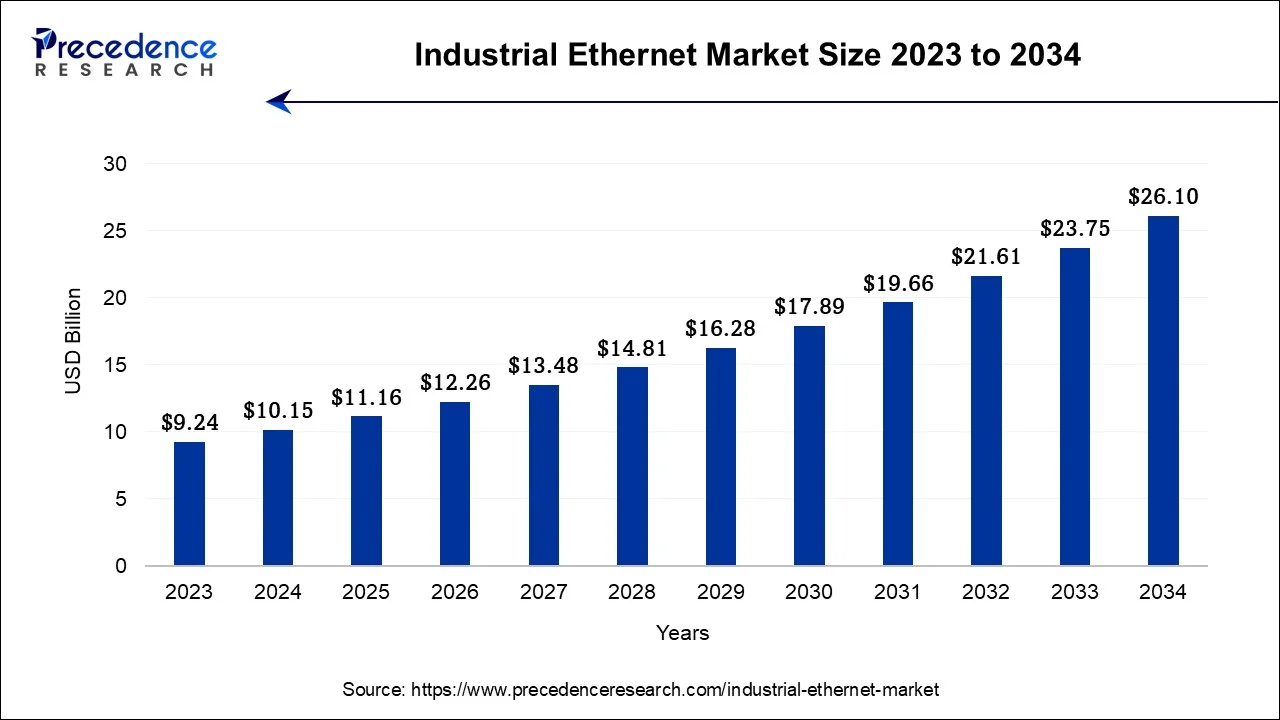
ICT industry specialist Gautam Mahajan estimates the industrial ethernet market at USD 12.26 billion in 2026, with continued technology adoption expected to take the market to USD 26.10 billion by 2034 at a CAGR of 9.90%. Leading industrial ethernet market providers such as ABB Ltd., Robert Bosch GmbH, Analog Devices Inc, B&R Automation are expanding their capabilities across segments including By Offerings, By Protocol, By Protocol, and By Regions.
Source: https://www.precedenceresearch.com/industrial-ethernet-market
 Get a Sample
 Table Of Content


What is Industrial Ethernet Market Size?
The global industrial ethernet market size was estimated at USD 12.26 billion in 2026 and it is predicted to hit around USD 26.10 billion by 2034, expanding at a CAGR of 9.90% during the forecast period 2026 to 2034.
Market Highlights
- Asia Pacific contributed more than 39% of revenue share in 2024.
- North America is expected to witness the fastest growth during the forecast period.
- By Offering, the hardware segment is projected to hold the largest share of the market during the forecast period.
- By Offering, the services segment is expected to show notable growth.
- By Protocol, the PROFINET and EtherNet/IP segment is expected to continue its dominance during the forecast period.
- By End-use Industry, the automotive and transportation segment holds the largest market share.
- By End-use Industry, the aerospace and defense segment will continue to grow at a significant CAGR during the forecast period.
What is the Industrial Ethernet Market?
Electricity played a crucial role in the industrial revolution, enabling more efficient and mass production of several durable goods such as home appliances, automobiles, and others. The world is becoming increasingly connected in the digitalization era, and more advanced networking technologies are being launched for industrial applications. Manufacturers are adopting digital industrialization or Industry 4.0. ethernet allows computers to share files, browse the internet, and access printers and other hardware devices connected to the network. Ethernet is efficient, reliable, and flexible. Ethernet is the most widely embraced networking protocol globally. The low cost required in implementation has made ethernet an attractive networking technology for industrial environments.
Industrial ethernet is about creating an automated network. It has surpassed conventional fieldbus architectures to become the leading connection protocol in factories across the globe. Industrial ethernet is expanding steadily, and several standards bodies continue to develop standards to support it. industrial ethernet (IE) uses ethernet in an industrial setting with protocols. Determinism and real-time control are important factors when defining Industrial ethernet.
Industrial ethernet widens the network's value across industries. Due to rapid technological advancements, ethernet protocols have become one of the most crucial types of transmission in automation technology. Industrial ethernet switches, cables, and connectors need to withstand harsh conditions (heat and cold, vibrations, chemicals, factory noise, and others) in an industrial setting. Industrial Ethernet assists in creating a safe and reliable network infrastructure across all business and production levels.
How is AI Contributing to the Industrial Ethernet Market?
AI gives a boost to the Industrial Ethernet by way of smart automation, predictive maintenance, and real-time optimization. It not only improves the performance but also spots the faults, fortifies the cybersecurity, and makes the network configuration adaptive. The use of machine learning and data analytics leads to the emergence of self-learning networks, which in turn translates into less downtime, more capacity, and the entire manufacturing process being made highly efficient, data-oriented, and resistant to changes, hence, being in sync with the industry 4.0 principles.
Industrial Ethernet Market Growth Factors
- With the increasing demand for establishing robust and reliable communication infrastructure within an organization, the global industrial ethernet industry is expected to show a significant expansion during the forecast period.
- The growth of the Industrial ethernet market is driven by factors such as increasing awareness of Industry 4.0, rapid industrialization, increasing adoption of industrial automation, favorable government initiatives, increasing demand across aerospace & defense applications, increasing investment in network infrastructure, and rapid penetration of advanced ethernet technologies.
- In addition, the industrial ethernet gaining tremendous popularity across the globe owing to its excellent features including its capacity to connect multiple nodes, extended connection distances, higher speeds, and ability to withstand harsh conditions in an industrial setting.
- As Industrial ethernet implementations are accelerating, manufacturers and designers can have better choices for high-speed and factory-friendly form factors.
Market Outlook
- Industry Growth Overview: The market is experiencing a significant expansion, which is mainly attributed to the factors of increased automation, the commencement of Industry 4.0, IIoT acceptance, and high-speed connectivity.
- Sustainability Trends: The main concern is the energy-saving measures, such as Single Pair Power over Ethernet (SPoE) and data processing, to control consumption and achieve net-zero targets.
- Global Expansion: Europe and North America are the frontrunners in implementation, while the Asia-Pacific region is the one with the fastest growth due to the rapid progress of industrialization and smart manufacturing projects.
- Major Investors: The likes of Siemens, Rockwell Automation, Cisco, and Belden are the major players who pour substantial funds into research, innovation, and partnership as a way to rule the market.
- Startup Ecosystem: New companies are working on new ideas like Time-Sensitive Networking (TSN), security enhancement, and catering to special sectors in industrial automation.
Future Outlook and Strategic Recommendations
- Long-Term Industry Outlook: The GNSS market is projected to grow steadily as the demand for its consistent and precise positioning, navigation, and timing grows in autonomous vehicles, precision agriculture, smart infrastructure, and logistics. Long-term market growth is projected to be further helped by multi-frequency, multi-constellation, and resilient GNSS solutions.
- New Business Models: The emerging business models for GNSS providers are positioning-as-a-service, subscription-based correction services, cloud-enabled analytics, and integrated hardware-software solutions. Such models can yield ongoing revenue streams while allowing customers to utilize the growing features and capabilities of positioning without high initial costs.
- Stakeholder Strategic Recommendations: Focus on strategic aspects such as high-precision positioning, integrating AI, cybersecurity, anti-jamming, and collaboration between key industries. In addition, businesses need to enter new markets and innovate cost-efficient, scalable solutions to satisfy the increasing demand in a variety of applications.
Market Scope
| Report Coverage | Details |
| Market Size by 2025 | USD 11.16 Billion |
| Market Size in 2026 | USD 12.26 Billion |
| Market Size in 2034 | USD 26.10 Billion |
| Market Growth Rate from 2025 to 2034 | CAGR of 9.90% |
| Largest Market | Asia Pacific |
| Base Year | 2024 |
| Forecast Period | 2025 to 2034 |
| Segments Covered | Offerings, Protocol, Protocol, and Regions |
| Regions Covered | North America, Europe, Asia-Pacific, Latin America, and Middle East & Africa |
Market Dynamics
Drivers
Increasing adoption of industrial automation
The increasing adoption of industrial automation is expected to fuel the growth of the market during the forecast period. Industrial automation is the control of machinery and processes by autonomous systems through the use of advanced technologies such as robotics and computer software. Industrial ethernet networks deliver uninterrupted and seamless connectivity services between different automation devices.
Connected devices such as actuators, PLCs (Programmable Logic Controllers), sensors, and industrial automation and control systems (IACS) deliver real-time data that can be used for monitoring quality, and cost reduction. Several enterprises across the globe are embracing Industry 4.0 with integrating advanced technologies such as robotics and artificial intelligence to boost productivity.
The use of industrial ethernet hardware plays a crucial role in automation and machine control networks. The rapid adoption of the Industrial Internet of Things (IIoT) and Industry 4.0, and advanced technologies have promoted industrial ethernet's position as a leading technology fueling digital transformation for smart manufacturing. Thereby, the market is expected to get accelerate.
Restraint
The high initial investment is likely to hamper the market
The high initial investment associated with the deployment of the industrial ethernet network is likely to hamper the market. A huge amount of capital is required to set up the infrastructure, implement software solutions, and purchase key hardware components. Small and medium-sized enterprises (SMEs) most often face budget constraints that discourage them from embracing advanced industrial ethernet technologies. In addition, the implementation and establishment of industrial ethernet networks can be complex and need specific professional skills, which can be difficult for enterprises lacking the required resources and is likely to limit the expansion of the global industrial ethernet market during the forecast period.
Opportunity
Several government initiatives
Several government initiatives are projected to boost the growth of the industrial ethernet market. Rising government initiatives in developing nations and increasing expenditure for the introduction of automation aim to boost the manufacturing sector. For instance, India is one of the fastest developing countries in the world with a rapidly expanding industrial industry. Technology-driven processes offer visibility and transparency accelerating the growth of India's manufacturing market and becoming a manufacturing hub in the coming years. India's government's “Make in India” initiative encourages businesses to automate processes in their existing manufacturing facilities with the use of smart technologies.
To strengthen India's manufacturing capabilities and boost the smart manufacturing sector, several initiatives announced by the Indian government such as the Phased Manufacturing Programme (PMP), Atmanirbhar packages, Production Linked Incentive (PLI) Scheme, and others. The Indian government has implemented several initiatives to attract foreign investors, such as Goods and Services Tax, the reduction in corporate tax rates, reforms in the FDI policy, and addressing liquidity issues in banks and non-banking financial companies (NBFCs).
In addition, to encourage investment, several policies have been introduced including the Industrial Park Rating System (IPRS), India Industrial Land Bank (IILB), National Single Window System (NSWS), National Monetization Pipeline (NMP), and National Infrastructure Pipeline (NIP).
Regional Insights
Offering Insights
The hardware segment is projected to hold the largest share of the market during the forecast period. The innovation in hardware products including routers, switches, controllers, connectors, and others is the primary factor boosting the growth of the segment. On the other hand, the services segment is expected to show notable growth. Emerging trends in the communication network and integration with the increasing usage of the Internet of Things (IoT) have resulted in the use of the cloud and networking.
Protocol Insights
The PROFINET and EtherNet/IP segment held the largest share in 2024, with the growing technological advancements across the globe; PROFINET and EtherNet/IP are the most widely used protocols in a variety of industries owing to their several advantages. PROFINET is used to exchange data between controllers and devices in industrial automation. PROFINET is very deterministic and exchanges data in a predefined arrangement. Controllers include Programmable Logic Controllers (PLCs), Distributed Control Systems (DCSs), and Programmable Automation Systems (DDCSs).
Devices include Input and Output (I/O) blocks, Radio Frequency Identification (RFID) readers, drives, process instruments, vision systems, and others. PROFINET boosts productivity with openness, flexibility, efficiency, and performance. Since PROFINET is an open standard, PROFINET products such as PACs, PLCs, Robots, Drives, IOs, Proxies & diagnostic tools are developed by several manufacturers globally.
End-use Industry Insights
The automotive and transportation segment is the leading segment of the market; the rising technological advancements in the automobile industry are anticipated to grow the demand for industrial ethernet systems during the forecast period. Industrial ethernet is becoming an innovative approach and is expected to fuel the transport industry in the coming years. Real-time applications such as Advanced Driver Assistance Systems (ADAS), infotainment systems, and others are positively impacting the market's growth. The automotive industry has unceasingly pioneered new manufacturing processes, propelling the rapid embracing of innovative technologies on the factory floor.
Regional Insights
Asia Pacific Industrial Ethernet Market Size and Growth 2025 to 2034
The Asia Pacific industrial ethernet market size accounted for USD 4.35 billion in 2025 and is estimated to reach around USD 10.31 billion by 2034, growing at a CAGR of 10.04% from 2025 to 2034.
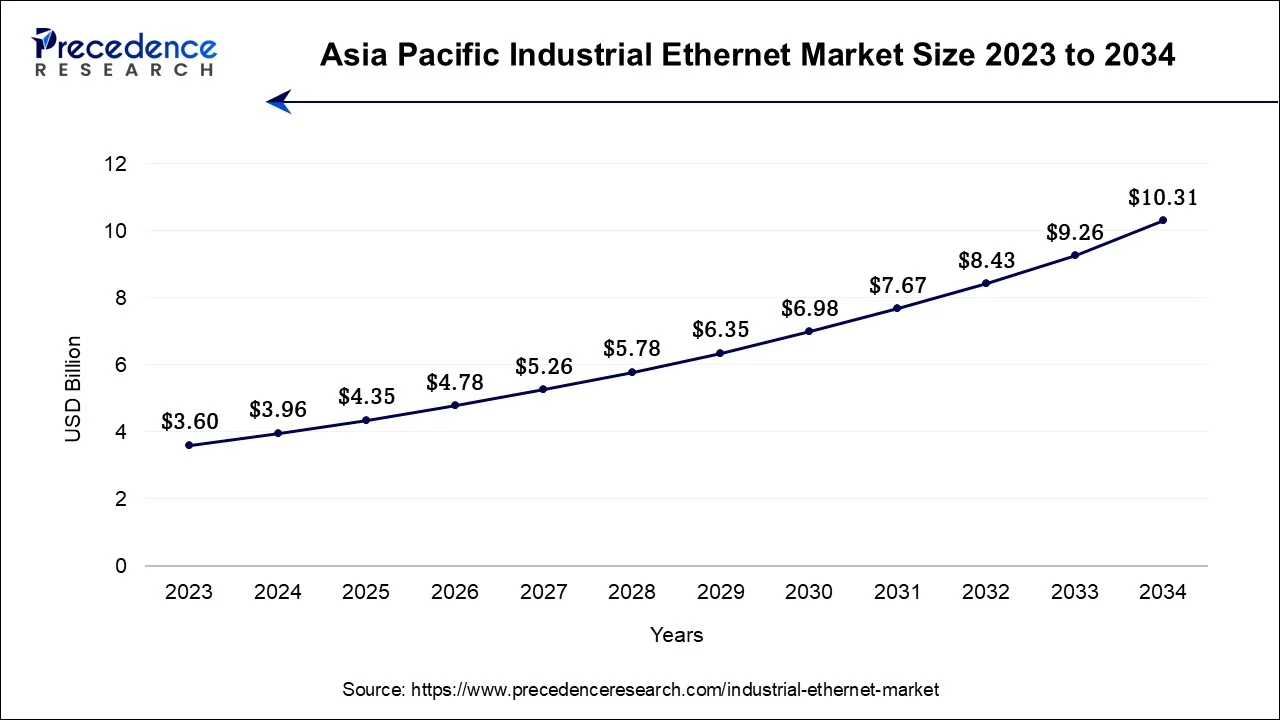
Asia Pacific accounted for the largest share of the Industrial ethernet market in 2024, the region is anticipated to continue its growth during the forecast period. The Asia Pacific industrial ethernet market is characterized by the presence of prominent market players, supportive government policies, rapid adoption of Industry 4.0, increasing investment in industrial automation, and rapid industrialization.
The increasing popularity of industrial ethernet across automotive sectors and consumer electronics in countries such as China, Japan, and India are the major factors behind the dominance of the Asia Pacific industrial ethernet market during the forecast period. Additionally, various initiatives have been by many developing nations such as China, India, Japan, and others, promoting automation and rapid digitalization across all industrial verticals. In a study by HMS Networks on the industrial network market, HMS concludes that the industrial ethernet continues to grow at the fastest growth rate.
China Market Trends
China's ahead in the regional market due to its widespread use of smart manufacturing and industrial automation. More manufacturers are turning to Industrial Ethernet to boost connectivity and make their processes more efficient. The government's push for modernization, along with investments in top-notch manufacturing, keeps speeding up demand in the market.
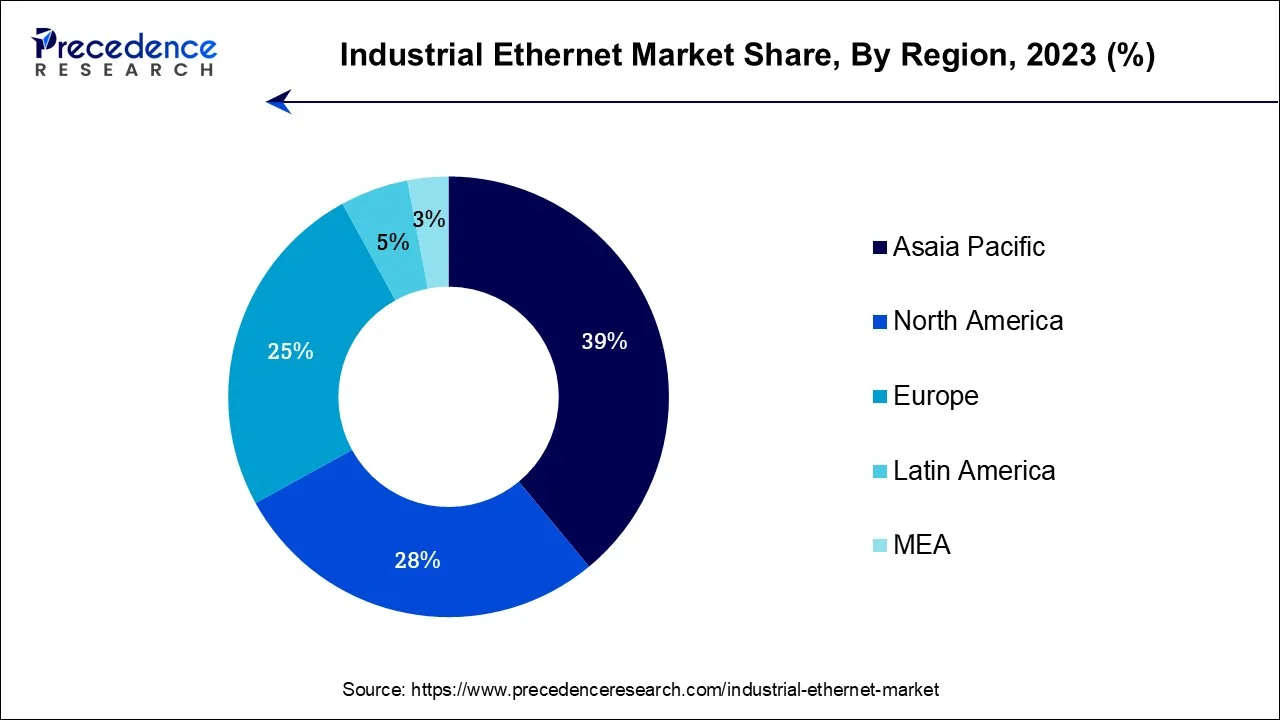
North America is the fastest-growing region in the global Industrial ethernet market. The North American region is experiencing a strong penetration of the Internet of Things (IoT) devices, increasing investments in industrial infrastructure, huge investments in industrial automation, and an upsurge in industrialization. Thereby, these factors create a strong potential for the industrial ethernet market to expand in North America.
United States Market Trends
The U.S. leading regional market, with high adoption of automation tech in areas like manufacturing, energy, and logistics. Companies are using Industrial Ethernet more often to boost data sharing and production efficiency. Plus, there's a rise in spending on smart factories and industrial cybersecurity, driving growth even further.
How Will Europe Become a Notable Region in the Industrial Ethernet Market?
Europe plays a significant role in the industrial Ethernet market, primarily driven by its strong manufacturing base. Countries such as Germany, the UK, France, and Italy are at the forefront of industrial automation and digital transformation, showcasing an early adoption of automation technologies. The emphasis of region on Industry 4.0 and the need for robust, high-speed communication networks in manufacturing, which include sensors, PLCs, and HMIs, enhances efficiency and enables real-time monitoring, ultimately contributing to the growth of industrial Ethernet. Additionally, stringent regulations regarding industrial safety and efficiency, along with substantial investments in upgrading industrial infrastructure, are further fostering market growth in Europe.
Germany Market Trends
In Germany, a strong industrial base drives their big market, plus they lead in Industry 4.0. Their manufacturers use Industrial Ethernet more and more to link machines and control systems efficiently. They keep investing in factory automation and clever production methods, boosting the need for top-notch networking solutions.
How is Latin America growing in the Industrial Ethernet Market
Latin America's Industrial Ethernet market is growing slowly because of increasing automation and updated manufacturing plants. Firms are using more Ethernet systems to boost efficiency and monitor operations better. Investments in mining, energy, and industrial projects are helping too, so the market keeps developing.
Brazil Market Trends
Brazil leads the region with its sizeable market, helped by rising automation in manufacturing, mining, and energy. More plants are using Ethernet networks for dependable communication and better control. The nation keeps seeing growth due to ongoing investments in upgrading factories, digital changes, and smart tech in production.
What are the Advancements of the Industrial Ethernet Market in the Middle East and Africa?
The Middle East and Africa market is growing steadily because of more investments in industrial automation, energy infrastructure, and smart manufacturing. To boost efficiency and network performance, industries are using Industrial Ethernet. With more development projects cropping up, demand across the region is getting a big boost.
UAE Market Trends
The UAE is a big market for industrial growth thanks to ongoing diversification and tech-friendly plans. More manufacturing and energy firms there use Industrial Ethernet to boost automation and real-time data sharing. They keep investing in digital changes, industrial IoT, and advanced infra projects, which help the market expand.
Competitive Landscape
The Industrial Ethernet market is super competitive, with big players dominating. Firms like Siemens, Cisco, Rockwell Automation, Schneider Electric, ABB, Belden, Moxa, and Phoenix Contact take the lead. They fight for dominance with large product ranges, expert industry knowledge, extensive sales networks, and strong technologies.
Uber Eats, DoorDash, Just Eat Takeaway.com, Delivery Hero, and Zomato lead the pack. They boost their positions through mergers, team-ups, subscription services, and more cloud kitchens. Big trends are AI route planning, predicting demand spikes, personalized suggestions, and auto-delivery systems. Despite these advances, red tape, higher labor costs, and making money remain huge hurdles. Looking ahead, further digitization and hooking into quick-commerce will keep shaping who wins in this game.Bottom of Form
Company Profiles - Industrial Ethernet Market
ABB Ltd.
Headquarters: Zurich, Switzerland
Founded: 1988
- Business Overview: Public ABB is a technology leader and global provider of electrification, industrial automation, motion, robotics and digitalization solutions. The company enables industrial customers to gain connected automation and industrial communication technologies for achieving improved asset performance, operational reliability, energy efficiency and productivity.
- Products: It offers industrial Ethernet switches, automation controllers, communication modules, gateways, remote-access solutions, network-management technologies, robotics systems and industrial software platforms. These solutions provide communication between machines, controllers, sensors, and the enterprise.
- Geographic Presence: ABB has a large network of manufacturing sites, research operations, sales offices, distributors and service activities throughout Europe, North America, Asia Pacific, Latin America, the Middle East and Africa.
- Recent Development: ABB further extended its industrial automation and digital connectivity portfolio, in which there was a greater focus on software-defined automation, security in industrial networking, as well as connected assets and data-driven operational management.
- Key Strategies: Industrial automation, digitalisation, cyber security, electrification, connected assets, software integration, energy efficiency and scalable and industrial communication solutions for smart manufacturing.
Robert Bosch GmbH
Headquarters: Stuttgart, Germany
Founded: 1886
Ownership: Privately held
- Business Overview: Robert Bosch is a worldwide technology and engineering firm with its operations spread over mobility, industrial technology, consumer goods, and energy and building technology. It offers industrial connectivity solutions for smart manufacturing, automation, machine communication, Industrial IoT, and Industry 4.0 applications.
- Products: It currently offers industrial Ethernet products, automation controllers, communication systems, sensors, gateways, industrial PC's, edge-computing products, and connected manufacturing platforms. These products leverage better connectivity of machines, visible production, automation, and operational efficiency for manufacturers.
- Geographic Presence: Bosch is active in Europe, North America, Asia Pacific, Latin America, the Middle East and Africa, with a wide manufacturing network, research centers and technology facilities, and a strong sales network.
- Recent Development: Bosch's focus was on connected manufacturing and industrial automation as well as edge computing, artificial intelligence, and digital technologies, which enhanced its manufacturing Industry 4.0 capabilities and boosted factory connectivity.
- Key Strategies: Select industries focused on the industrial internet of things, automation, connectivity, edge computing, cybersecurity, artificial intelligence in manufacturing, and industrial sensor integration, along with the integration of industrial hardware, software, and data services.
Analog Devices Inc.
Headquarters: Wilmington, Massachusetts, U.S.
Founded: 1965
Ownership: Public
- Business Overview: Analog Devices Inc. is a worldwide semiconductor vendor that offers high-performance technologies for industrial, automotive, communications, health care, and consumer use. Its solutions provide reliable connectivity, sensing, signal processing, power management, and data communication to advanced industrial automation environments.
- Products: This includes its Ethernet physical layer devices, transceivers, switches, processors, signal conversion solutions, sensor solutions, interface technologies, and industrial communication solutions for high-performance and time-sensitive networks. These technologies include the ability to connect industrial equipment and to communicate accurate data between field devices and control systems.
- Geographic Presence: Analog Devices operates in North America, Europe, Asia Pacific, Latin America, and other prominent technology markets with customers in the semiconductor, industrial automation, automotive, telecommunications, and infrastructure sectors.
- Recent Development: Analog Devices was still aggregating industry connectivity and edge technology offerings to fuse real-time industrial networking, smart sensing, factory automation, and connected equipment solutions.
- Key Strategies: High-performance semiconductors, industrial Ethernet, edge intelligence, sensor integration, real-time communication, energy efficiency, signal processing, and advanced technologies for the automated industrial environment.
B&R Automation
Headquarters: Eggelsberg, Austria
Founded: 1979
Ownership: ABB Group
- Business Overview: B&R Automation is ABB Automation's global activity in the field of industrial automation, and is a business offering integrated automation and control technology to machine builders and manufacturers worldwide. The solutions it offers include input into flexible production, machine connectivity, motion control, robotics, visualization, and Industry 4.0 applications.
- Products: Industrial controllers, Ethernet-based systems for communications, I/O modules, industrial PCs, machine-vision solutions, robotics, operator interfaces, and automation software. These products help manufacturers to create very connected, synchronized and flexible manufacturing systems.
- Geographic Presence: B&R's global presence is realized via subsidiaries, distributors, engineering centers and service networks in Europe, North America, Asia Pacific, Latin America and other industrial markets.
- Recent Development: B&R built on further integrated automation platforms for real-time Ethernet, machine synchronization, robotics, edge connectivity and software-defined factory and manufacturing environments.
- Key Strategies: Integrated automation, open communication standards, industrial Ethernet, machine vision, robotics, motion control, software integration, digitalization and smart manufacturing solution development.
Moxa Inc.
Headquarters: New Taipei City, Taiwan
Founded: 1987
Ownership: Privately held
- Business Overview: Moxa is a global leader in industrial connectivity, networking, and automation solutions for manufacturing, transportation, energy, utilities, maritime, and other critical infrastructure applications. Its specialty is in the area of reliable communications technologies engineered to withstand harsh industrial environments.
- Products: It offers industrial Ethernet switches, routers, secure gateways, serial-to-Ethernet products, wireless solutions, network management software, industrial computers, and edge connectivity products. Its solutions provide robust and reliable communications between industrial machines, control systems, sensors, and enterprise networks.
- Geographic Presence: Moxa's Regional Office, Distributors, Partners and Service Organisations enable the Company to be present globally in Asia Pacific, North America, Europe, Latin America, the Middle East and other major industrial markets.
- Recent Development: Industrial networking solutions that included time-sensitive networking, high-speed Ethernet, edge connectivity, and reliable industrial automation networking, all of which were conducive to industrial cybersecurity, continued Moxa's industrial networking expansion.
- Key Strategies: Industrial networking specialization, cybersecurity, ruggedized equipment, “Edge connectivity”, network reliability, Industry 4.0, critical infrastructure, and long-term development of industrial communication technologies.
Belden Inc.
Headquarters: St. Louis, Missouri, U.S.
Founded: 1902
Ownership: Public
- Business Overview: Belden provides signal transmission, industrial networking, connectivity, and infrastructure solutions to the industrial, enterprise, and broadcast markets around the world. Its technologies enable companies to create secure, reliable communications networks in any manufacturing, transportation, energy, automation, or critical infrastructure setting, as well as to ensure scalability and cost efficiency.
- Products: It offers a diverse family of products, including industrial Ethernet switches, routers, cables and connectors, wireless products, network management software, fiber infrastructure, rugged networking products and industrial connectivity solutions. Solutions are designed to handle high-speed communications, IT/OT convergence, network resilience, and the transportation of industrial data.
- Geographic Presence: Belden has manufacturing sites, sales offices, and distribution channels in North America, Europe, Asia Pacific, Latin America, and other key industrial/technology markets, as well as technology partnerships.
- Recent Development: Belden has introduced new products and expanded its portfolio regarding efficient, resilient, and scalable IT/OT networks, such as industrial connectivity, wireless orchestration, rugged switching, power options, and high-density fiber infrastructure.
- Key Strategies: Industrial networking, IT/OT convergence, cybersecurity, rugged connectivity, infrastructure with high capabilities, edge networking, network resilience, and integration of communication solutions for connected industrial environments as key areas of interest.
Rockwell Automation
Headquarters: Milwaukee, Wisconsin, U.S.
Founded: 1903
Ownership: Public
- Business Overview: Rockwell Automation's mission is to help transform the world of industrial automation, control, information, and digital technology, globally. Its solutions integrate industrial machines, controllers, software, networks, and production systems, providing increased production productivity, visibility, safety, and operational efficiency.
- Products: Its portfolio includes Allen-Bradley industrial Ethernet switches, controllers, network infrastructure, EtherNet/IP solutions, FactoryTalk software, industrial computers, communication systems, and cyber security technologies. These products provide communication connectivity between the field device, automation system, production equipment, and enterprise applications and enable real-time data exchange.
- Geographic Presence: Rockwell Automation has a wide geographic sales, manufacturing, distribution, and service footprint in North America, Europe, Asia Pacific, Latin America, the Middle East, and Africa.
- Recent Development: Rockwell Automation recently unveiled the EtherNet/IP In-Cabinet Solution and Allen-Bradley Stratix 2100 Unmanaged Industrial Ethernet Switch to deliver greater network reliability, gigabit connectivity, and rapid real-time data access.
- Key Strategies: Industrial automation, ETHERNET/IP, digital transformation, cyber security, smart manufacturing, edge computing, software integration, connected production environments, and industrial data management.
Leaders' Announcements
- In April 2025, ABB partnered with the Instrumentation Technology and Economy Institute (ITEI) to establish a laboratory in Beijing. This facility aims to standardize and implement Ethernet-APL + PROFINET technology in China, focusing on compatibility testing, technology demonstrations, and training to support the digital transformation of the country's process industries. The collaboration seeks to advance industrial communication technology for sustainable development.
Recent Developments
- In August 2026, Belden Inc., a leading global provider of complete connection solutions, announced the launch of new products and portfolio expansions designed to help customers build more efficient, resilient, and scalable IT/OT networks. These range from delivery of industrial connectivity, wireless orchestration and rugged switching to power solutions, high-density fibre infrastructure and life safety cables. (Source: https://www.belden.com)
- In June 2025, HMS Networks launched new product brands Red Lion and N-Tron. The consolidation offers customers simplified and simpler options for cloud connectivity, edge intelligence, asset management, Ethernet switching and operator-interface options. (Source: https://www.arcweb.com)
- In May 2025, Rockwell Automation unveiled its Rockwell Automation EtherNet/IP In-cabinet Solution and Allen-Bradley Stratix 2100 Unmanaged Industrial Ethernet Switch. The products help to improve network reliability, gigabit connectivity, and data access for smarter manufacturing. (Source: https://www.rockwellautomation.com)
- In November 2022, Delta, a global provider of power management and industrial automation solutions. Delta unveiled its extensive range of smart energy-efficient and highly integrated industrial automation hardware and software solutions engineered for Industrial Internet of Things (IIoT) applications at SPS Nuremberg. The demonstration includes a SaaS Digital Dashboard tool. DIACloud Digital Dashboard, that offers remote visualization of cloud data for various applications, and a new Industrial Internet of Things (IIoT) function card for the PLC series to enable several Industrial Internet of Things (IIoT) applications.
- In November 2024, Orca introduced an IO-Link transceiver that enhances communication between sensors and industrial control systems. This product aims to improve connectivity for automation applications, reinforcing the role of IO-Link in driving intelligence on factory floors. Identifying potential malfunctions in machinery helps reduce the risk of unexpected breakdowns, increases uptime, and saves on the cost of replacement parts.
- In November 2024, Renesas Electronics Corp. launched the RZ/T2H microprocessor, designed for high-speed control of industrial robotic motors. This high-performance microprocessor consolidates functions that traditionally required multiple components, thus saving time and costs in FPGA development. It supports various industrial communications on a single chip.
Segments Covered in the Report
By Offerings
- Hardware
- Software
- Services
By Protocol
- EtherCAT
- EtherNet/IP
- PROFINET
- POWERLINK
- SERCOS III
- CC-Link IE
- Others
By End-use Industry
- Oil and Gas
- Automotive & Transportation
- Energy & Power
- Chemical & Fertilizer
- Food & Beverages
- Electrical & Electronics
- Aerospace & Defense
- Others
By Region
- North America
- Europe
- Asia-Pacific
- Latin America
- Middle East and Africa
For inquiries regarding discounts, bulk purchases, or customization requests, please contact us at sales@precedenceresearch.com
Frequently Asked Questions





Ask For Sample
No cookie-cutter, only authentic analysis – take the 1st step to become a Precedence Research client
 Get a Sample




 sales@precedenceresearch.com
 Schedule a Meeting
