






 Request Consultation
Forensic equipment supplies play a critical role in modern criminal investigations by enabling precise evidence analysis and identification. Advanced technologies such as DNA testing, digital forensics, and AI-driven tools are enhancing accuracy, efficiency, and reliability in the pursuit of justice.
Abstract
Forensic science has been formed as one of the foundations of criminal investigations in the present time, as it involves various scientific fields to interpret and analyze evidence. Advanced technologies have greatly enhanced the accuracy, pace, and dependability of forensic producers. This article showcases how innovation, classification of evidence, and the trend of global use impacted the development of forensic science.
Executive Summary
The forensic equipment and supplies industry is experiencing long-term growth, which is caused by the growing use of scientific validation in the judicial process and the growing sophistication of crimes. Digital forensic tools and DNA-based methods are transforming the way of investigation. Automation and artificial intelligence (AI) are enhancing productivity in the laboratory and turnaround time. Consumables like reagents, kits, and sample collection tools have a high demand because they are used on a regular basis. Developing technologies, such as nanotechnology and more sophisticated data analytics, are also increasing sensitivity in detection and depth in analysis. Generally, the industry is moving towards a more integrated, technology-based ecosystem.
Introduction
Forensic science serves as a vital link between the legal system and scientific analysis, facilitating the transformation of physical evidence into practical knowledge that can be used in court. This interdisciplinary field encompasses various scientific disciplines, such as biology, chemistry, and physics, to analyze crime scene evidence, identify suspects, and support law enforcement efforts. As criminal activities grow more complex and sophisticated, the demand for advanced forensic tools and techniques such as DNA profiling, digital forensics, and toxicology has significantly increased. These innovations not only enhance the accuracy and reliability of forensic investigations but also help ensure that justice is served by providing clear and credible evidence that can withstand scrutiny in legal proceedings.
What is the Forensic Equipment Supplies Market Size in 2026?
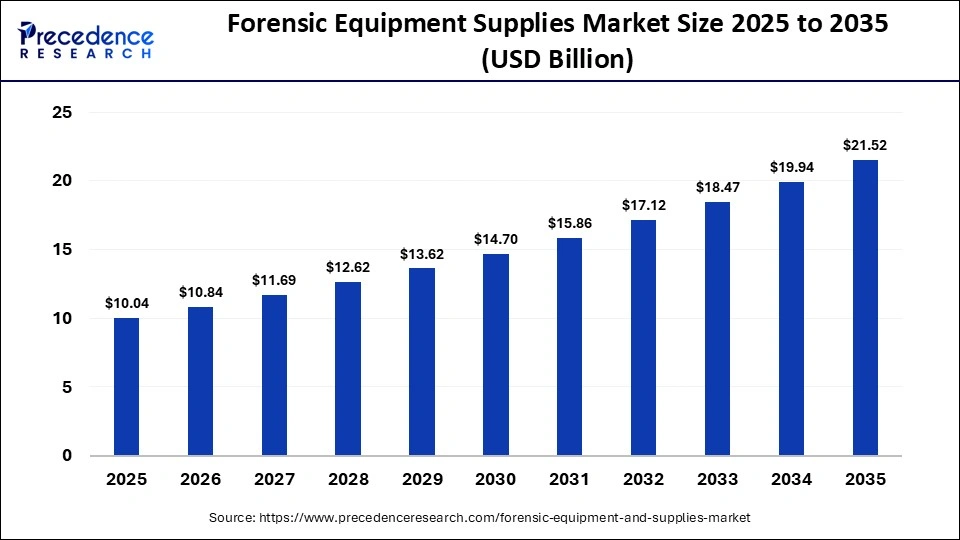
The global forensic equipment supplies market was valued at USD 10.04 billion in 2025 and is projected to grow from USD 10.84 billion in 2026 to approximately USD 21.52 billion by 2035, registering a CAGR of 7.92% during the forecast period from 2026 to 2035. Forensic equipment plays a critical role in modern criminal investigations by enabling accurate collection, analysis, and interpretation of evidence. As crimes become more complex and the need for scientific validation increases, the demand for advanced instruments and consumables is rising globally.
Get a Free Sample Report with Key Market Trends: https://www.precedenceresearch.com/sample/8208
Effect of Technology on Forensic Investigations
The use of technology has radically changed forensic investigations in that it has enhanced the speed and accuracy of processing evidence. Current instruments can create real-time analysis and minimize errors in manual processes, and increase the credibility of findings. The investigative capabilities have also been strengthened with the integration of intelligent systems.
- Suspects Identification: The use of advanced forensic methods, including the use of DNA profiling, biometric identification, and fingerprint analysis, is vital in positively identifying the suspects. These are the most reliable methods of results, and they are common in investigative organizations. They have been used to enhance high rates of case resolutions.
- Use of New Technologies: New technologies, such as AI, cloud computing, and new analytics, are more often involved in the forensic work process. These innovations allow more complex data to be processed faster and enable an easier decision-making process during investigation. Predictive analytics and pattern recognition are also backed by them.
- Documentation: Good documentation systems will be required when it comes to preserving forensic evidence integrity. Digital tools guarantee a better record-keeping process, an appropriate chain-of-custody, and smooth information-sharing. This increases legal transparency and reliability.
- Analysis of Advanced Data: Contemporary forensic investigations are associated with studying huge and intricate data. New and sophisticated computing applications enable specialists to derive meaningful information from various sources of data. This is especially vital in electronic forensics and investigations that are massive.
The Growth of Crime Labs
The growth of forensic laboratories is the manifestation of the growing need to investigate scientifically. Governments and non-governmental organizations are putting money into setting up new laboratories with advanced technologies. Nevertheless, obstacles in the form of case backlog and availability of skilled manpower exist. To solve these issues, one needs to invest in infrastructure, training, and technological improvements on a continuous basis.
- Resource Allocation: The forensic operations require the optimization of resources. Investments in modern machinery, a talented workforce, and training programs are important in ensuring high standards. Planning of the resources is one of the ways that the laboratories can cope with growing workloads and deliver results on time. Cooperation between the state and the non-state is turning out to be one of the most important features in improving the efficiency of resources.
- Quality Control: Quality control is critical in the reliability and credibility of forensic results. Standardized procedures, accreditation systems, and frequent audits are becoming a trend in laboratories. Such measures guarantee uniformity in various testing conditions and increase confidence in forensic results. Quality assurance practices are also critical in limiting mistakes as well as enhancing overall performance.
Nanotechnology Forensic Evidence: Expanding the Scope of Forensic Investigation
Nanotechnology is revolutionizing the field of forensic science by enabling the detection and analysis of extremely minute traces of evidence that were previously challenging to identify. This cutting-edge science focuses on manipulating matter at the nanoscale, which allows for the development of nanomaterials that enhance the sensitivity and specificity of various analytical methods. One key area where nanotechnology is particularly influential is in toxicology, where it has significantly improved the ability to identify trace amounts of harmful substances or toxins in biological samples. In addition, nanotechnology plays a critical role in the analysis of trace evidence, such as hair, fibres, and residues, which can provide crucial information in criminal investigations.
Furthermore, advancements in DNA detection techniques have also benefited from nanotechnology. The incorporation of nanoscale materials can increase the efficiency and accuracy of DNA amplification and analysis, making it possible to extract vital genetic information from very small or degraded samples.
As research in nanotechnology continues to progress, it is expected that its applications in forensic science will expand even further, opening new pathways for investigation and potentially leading to breakthroughs in solving complex criminal cases. These advancements not only enhance the capabilities of forensic scientists but also increase the reliability of forensic evidence in the judicial process, ultimately contributing to more effective law enforcement and justice.
Types of Forensic Evidence
- Physical Evidence: Physical evidence consists of items that are tangible, like weapons, tools, footprints, and fingerprints that are found at crime scenes. They are evidence that has direct or circumstantial connections to links between suspects and crimes.
- Biological Evidence: Biological evidence (blood, saliva, hair, and DNA) assumes the leading place because it can distinguish people. It is common in the study of criminal cases, the determination of paternity, and disaster victimization cases.
- Trace Evidence: Trace evidence is a group of small materials that may include fibres, paint, soil, and glass pieces. These components may form imperative linkages among suspects, victims, and places of crime, albeit minuscule.
- Ballistic Evidence: Ballistic evidence includes examination of guns, bullets, and car cases. It assists in establishing the kind of weapon utilized and recreating shooting incidents.
- Digital Forensics: Digital forensics is concerned with the recovery and analysis of electronic information on computers, smartphones, and server devices. It is becoming significant in the study of cybercrime, fraud, and digital espionage.
- Toxicology: Toxicology is used to study biological samples to identify drugs, alcohol, poisons, and other chemical substances. It is necessary when it comes to overdose, poisoning, and driving under the influence.
| Evidence Type | Approx global usage | Key insights |
| Biological (DNA, blood) | 65-75% | Dominant among criminal investigators |
| Digital forensic | 20-25% | Rapid growth due to cybercrime |
| Physical evidence | 15-20% | Includes fingerprints and weapons |
| Ballistics | 5-10% | Firearm-related cases |
| Toxicology | 10-15% | Drug and poison detection |
Emerging Areas in Forensic Science
- Cyber Forensic Science: The importance of cyber forensic science in contemporary investigations can be seen as one of the most important fields of investigation, given the fact that the number of crimes that are committed in the digital world has multiplied significantly. It includes discovery, replication, elicitation, and analysis of computer server, network, and cloud data. Law enforcers have special tools that help in restoring lost files, tracking electronic tracks, and mining communication tracks on platforms. The use of advanced methods, including encryption analysis, tracking blockchains, and malware forensics, is becoming more common to deal with advanced cyber threats. Field is also critical in addressing financial fraud, identity theft, cyber terrorism, and data breaches, and is therefore essential in the digital world that the world is currently entering.
- Forensic Psychology: Forensic psychology is a kind of psychology that goes hand in hand with the criminal justice system by studying how and why individuals commit crimes and their mental status. It helps in profiling the criminals, assessing the risks, and determining the reliability of witnesses and suspects. Experts in this field tend to help law enforcement agencies reduce the number of suspects through the study of behavior patterns and psychological characteristics. Also, forensic psychologists are instrumental in the court proceedings as they are witnesses who can give expert testimony or they are the ones who examine the levels of mental competence of defendants. This field supplements the investigation procedure with human and behavioral aspects to scientific evidence.
- Mobile Forensics: Mobile forensics is concerned with the retrieval and examination of data on mobile phone devices, including smartphones, tablets, and wearables. As mobile communication gains increased importance, these gadgets have turned out to be worthy sources of evidence during criminal investigations. Investigators are able to access call logs, messages, emails, location, and application usage patterns to recreate events. The deleted or encrypted data can be recovered with the help of advanced tools that allow users to see more about the user activity. Mobile forensics is especially important in the investigation of causes related to cybercrimes, organized crime, and fraud in the digital sphere, where communication trails are especially important.
Forensic Science: Powered by Precision Tools
Forensic investigations rely on a variety of tools used to examine evidence with accuracy and precision. DNA sequencers and PCR systems are employed to amplify and analyze genetic material for identification purposes. Gas chromatography-mass spectrometry (GC-MS) plays a crucial role in identifying and detecting chemical substances in toxicology and drug analysis. High-performance liquid chromatography (HPLC) is used to separate and analyze compounds within complex mixtures. Microscopes, both optical and electron, enable detailed inspection of trace materials such as hair, fibers, and particles. Spectroscopy instruments help determine the composition of materials through light analysis. Automated fingerprint analysis systems compare and match patterns against extensive databases, while digital forensic tools comprising specialized software and hardware are developed to extract and examine electronic data.
Future Prospects of the Industry
The future of the forensic equipment and supplies industry is poised for substantial growth, driven by technological advancements, evolving criminal methodologies, and an increased commitment to scientific rigor in the judicial process. The integration of cutting-edge technologies like AI and advanced data analytics will revolutionize forensic investigations, enhance processing speed and accuracy, while addressing complex datasets. As the demand for DNA analysis and digital forensics rises in response to sophisticated criminal activities, training and education will become vital to developing a skilled workforce adept at utilizing these innovations.
Additionally, the global expansion of forensic solutions, particularly in emerging markets, presents opportunities for manufacturers and suppliers. Compliance with evolving regulations will necessitate standardized equipment and quality control measures, while continuous investment in research and development will drive more sophisticated forensic tools. Environmental considerations may also prompt a shift toward eco-friendly materials, and increased collaboration among forensic laboratories, law enforcement, and technology providers will foster innovation and enhance overall effectiveness. Overall, stakeholders who adapt to these changes will be well-positioned to meet the rising demands of the forensic landscape, contributing significantly to justice and public safety.
Conclusion
The evolution of forensic science, from the very primitive modes of observation up to the very advanced technological mechanisms, leaves the processes of search for accuracy and justice. The next generation of investigative science is also being defined by emerging forensic disciplines, such as cyber forensics, mobile forensics, forensic psychology, and sophisticated instrumentation. With the ever-changing technology, forensic science will be even more involved in the solution of complex cases and in accountability in a world that is more interconnected.
Expert Advise
According to Precedence Research, forensic equipment supplies cater to the evolving needs of criminal investigators and evaluators. The selection of the correct equipment depends on the accuracy, reliability, and legal defensibility. Investigators prefer equipment that is internationally recognized to ensure evidence integrity and courtroom acceptance. Investors and stakeholders invest in high-quality, validated instruments, having widespread use across various applications. Building trust and confidence in forensic equipment is vital for suppliers. Hence, they conduct regular maintenance, calibration, and validation of the equipment according to international standards. All these aspects potentiate the demand for high-quality forensic equipment over the coming years.
About the Authors

Aditi Shivarkar
Aditi, Vice President at Precedence Research, brings over 15 years of expertise at the intersection of technology, innovation, and strategic market intelligence. A visionary leader, she excels in transforming complex data into actionable insights that empower businesses to thrive in dynamic markets. Her leadership combines analytical precision with forward-thinking strategy, driving measurable growth, competitive advantage, and lasting impact across industries.



Aman Singh
Aman Singh with over 13 years of progressive expertise at the intersection of technology, innovation, and strategic market intelligence, Aman Singh stands as a leading authority in global research and consulting. Renowned for his ability to decode complex technological transformations, he provides forward-looking insights that drive strategic decision-making. At Precedence Research, Aman leads a global team of analysts, fostering a culture of research excellence, analytical precision, and visionary thinking.

Piyush Pawar
Piyush Pawar brings over a decade of experience as Senior Manager, Sales & Business Growth, acting as the essential liaison between clients and our research authors. He translates sophisticated insights into practical strategies, ensuring client objectives are met with precision. Piyush’s expertise in market dynamics, relationship management, and strategic execution enables organizations to leverage intelligence effectively, achieving operational excellence, innovation, and sustained growth.