






 Request Consultation
Applied AI is revolutionizing energy and utility systems by enabling predictive maintenance, smart grid operations, renewable integration, and data-driven decision-making for modern power networks.
Energy and utilities are entering a decisive phase of digital transformation as electricity systems become increasingly complex, decentralized, and data-intensive. The electrification of transportation and the growth of distributed energy resources are fundamentally transforming the way power systems are run. Traditional grid management approaches, largely built around predictable supply from centralized power plants, are struggling to keep pace with these dynamic conditions.
Against this backdrop, applied artificial intelligence (AI) is emerging as a critical operational technology for utilities and energy companies. As utilities move towards engaging in operational control systems, they are integrating AI more into their operational control systems, converting colossal amounts of sensor and infrastructure data into intelligence that can be acted upon.
The latest trends in the industry exhibit the pace at which this change is taking place. In some sophisticated energy markets, grid operators are starting to incorporate AI-based monitoring systems that have the ability to process real-time grid data, weather data, and infrastructure data in real time. In this changing landscape, applied AI is coming to be the intelligence layer of modern power grids, which will empower utilities to shift their grid management from reactive to predictive and autonomous energy processes.
What is the Applied AI in Energy and Utilities Market Size in 2026?
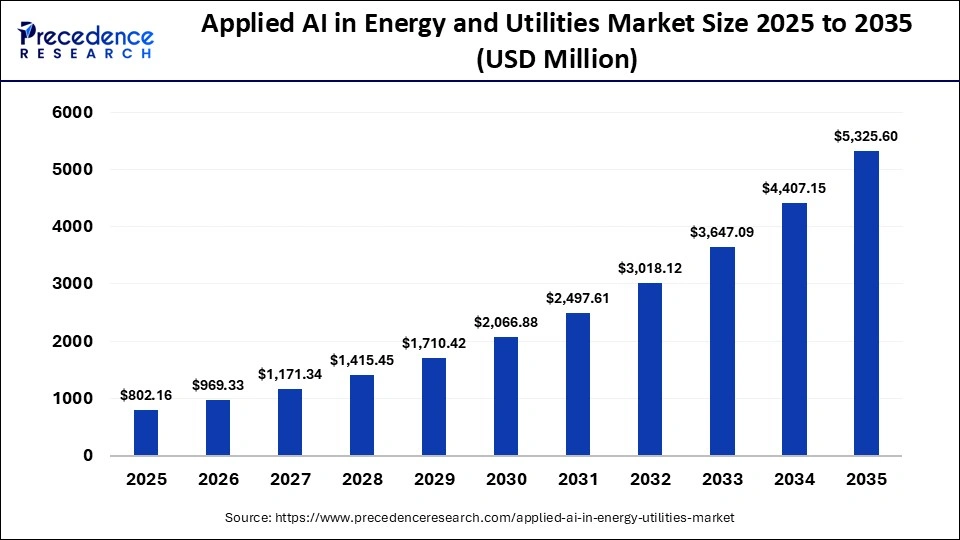
The global applied AI in energy and utilities market size accounted for USD 802.16 million in 2025 and is predicted to increase from USD 969.33 million in 2026 to approximately USD 5,325.60 million by 2035, expanding at a CAGR of 20.84% from 2026 to 2035.
The Energy System is Becoming too Complex for Traditional Operations
Historically, electricity systems used to be built based on a rather basic pattern. Centralized power generation was delivered through transmission lines to distribution networks and finally to consumers. Grid operators could predict demand patterns with reasonable precision, and the generation resources that are largely controlled.Smart meters, grid sensors, substations, weather stations, and distributed energy devices require utilities to now handle megabytes of data. These datasets cannot be analyzed using a human operator and legacy software systems without taking a significant amount of time to ensure that the grid stability remains optimal. The solution to this problem is applied AI that allows utilities to read and measure voluminous streams of complex data.
Machine learning algorithms can identify minor trends in grid behavior, anticipating possible failures, and prescribing operational changes before issues arise. Utilities can predict and prevent problems instead of responding to outages or inefficiencies when and after they occur. This reactive to predictive operation change is among the most eminent changes that take place in the energy industry across the globe.
Where Applied AI is Reshaping Energy Infrastructure?
The use of AI in the energy industry does not have one application. It is permeating through the entire electricity value chain, from generation and transmission to reaching out to customers and the market.
Key Operational Domains for Applied AI
|
Energy Domain |
How Applied AI Is Being Used |
|
Power Generation |
Optimizing turbine performance and improving fuel efficiency |
|
Grid Monitoring |
Detecting faults and identifying potential outages in transmission networks |
|
Renewable Integration |
Forecasting solar and wind generation using weather and satellite data |
|
Energy Trading |
Predicting market price fluctuations and optimizing trading strategies |
|
Consumer Energy Management |
Enabling smart energy usage through AI-driven demand response |
Transformers, power plants, and transmission equipment are continuously producing platforms of operational data. This information is processed by AI models to identify when the wear is starting, the device is becoming hot, or the machine is breaking down. Utilities can schedule maintenance before it fails, minimizing the occurrence of expensive outages and increasing the life of assets. These operational capabilities demonstrate the way that applied AI is changing the energy infrastructure into a data-driven ecosystem that responds rather than being a fixed network.
Real-World Deployments are Moving AI from Experimentation to Core Operations
Over the years, AI projects in utilities remained more of a pilot project and an experiment. That stage is quickly being replaced by the real-life implementation that is directly incorporated into the working environment. Major utilities have started choosing to simulate digital twins of their electricity networks, where virtual representations of the infrastructure are created to provide an approximation of real-time conditions. These AI-powered digital twins enable grid operators to simulate the reaction of the network to the occurrence of sudden spikes in renewable generation or equipment malfunctions.
Utilities are also using AI in the management of grid congestion, especially in markets where there has been a high growth in renewable sources. Machine learning algorithms can estimate the locations of possible bottlenecks in the transmission and suggest the best paths to flow power. This further maximizes the use of renewable sources and takes into account the stability of the systems. These examples highlight how applied AI is transitioning from theoretical potential to mission-critical infrastructure technology.
The Convergence of AI, Smart Grids, and Distributed Energy
The emergence of applied AI is intimately linked to the modernization of electricity networks in general. Utilities around the world are spending hefty sums of money on smart grid technologies. This allows them to monitor and control power systems in real time and automate systems. Smart meters, high-end sensors, and digital substations are producing huge amounts of data that characterize the movement of electricity on the grid. The analysis of such datasets and operational insights that are not immediately obvious is the task of AI systems.
The fast-growing distributed energy resources are transforming the grid architecture. Solar panels on rooftops, electric vehicle charging stations, and microgrids are making consumers participants in electricity markets. It is necessary to have smart coordination solutions that can balance the supply and demand of thousands of small energy sources to run this decentralized energy ecosystem.
Emerging AI Technologies Transforming Utility Operations
Several technological developments are accelerating the integration of applied AI into energy systems.
- Digital Twin PlatformsVirtual replicas of power infrastructure allow utilities to simulate grid conditions and evaluate operational decisions before implementing them in real networks.
- Edge AI for Grid DevicesAI algorithms embedded directly within sensors and substations enable faster analysis of operational data without relying on centralized cloud processing.
- AI-Powered Weather AnalyticsAdvanced weather models integrated with AI algorithms improve renewable forecasting accuracy and support disaster preparedness.
Strategic Shifts Inside Utility Organizations
The emergence of applied AI is not simply transforming the infrastructure of technology but also changing the structure of how energy companies conduct their operations and staffing. Utilities are also creating special AI and data science teams whose responsibility is to develop predictive analytics models and provide support to digital transformation efforts. Such teams usually work closely with engineers, grid operators, and cybersecurity experts to incorporate AI tools into the existing infrastructure.
On the other hand, numerous utilities are entering into collaboration with technological firms that focus on cloud computing and artificial intelligence services. Such partnerships enable utilities to speed up digital innovation by not necessarily constructing elaborate AI systems internally. The next notable organizational change is the creation of data governance systems aimed at providing the security of data used in the operations collected, stored, and analyzed.
The increased dependence of utilities on data-driven decision-making is why it is becoming more significant to ensure the high quality of data and keep sensitive infrastructure data safe. These strategic transformations explain how applied AI is not only affecting the adoption of technology but also the organizational culture in the energy industry.
Challenges Utilities Must Navigate During AI Adoption
Despite its transformative potential, deploying applied AI in critical infrastructure environments presents several challenges that utilities must address carefully. Numerous energy networks had been constructed many decades ago and were using hardware and software platforms that did not include advanced analytics or real-time data processing services. The process of upgrading these systems without interrupting the continuity of operations can be a complicated process.
The use of AI models needs huge amounts of data that are proper and well-organized to work successfully. Most utilities have their operational data spread across various systems. Therefore, it becomes hard to develop holistic datasets that can be used in machine learning applications. These issues will be fundamental to deal with so that the adoption of AI can enhance grid resilience instead of causing new vulnerabilities.
The Next Phase of AI-Driven Energy Systems
In the coming years, the application of AI in the energy and utility industry will gain importance as the entire world's electricity system evolves. Among the most significant future shifts, one can probably point out the rise of an autonomous grid management system. This can take operational decisions in real-time and with minimum human participation. They allow the automatic balance of the energy supply and demand, coordinate distributed resources, and react immediately to infrastructure failures.
The next opportunity lies in the combination of AI and energy storage systems and electric car networks. Smart algorithms have the potential to optimize charging schemes and coordinate battery storage installations. This provides a vehicle that can be used as a distributed energy source that can contribute to grid stability. These innovations suggest that applied AI will become deeply embedded in the architecture of future energy systems.
Conclusion: AI Is Becoming the Operational Brain of the Energy Sector
The energy sector of the world is changing radically due to digitalization, electrification, and the shift towards cleaner energy sources. With the rise in complexity and data-intensive systems of power systems, applied AI is becoming one of the most potent tools that utilities and energy companies can use. AI is dramatically transforming the management of electricity networks by enabling predictive maintenance, renewable forecasting, and advanced energy market analytics.
Those utilities that manage to implement AI in their work will be in a better position to overcome the obstacles of renewable integration and the increasing electricity demand. Furthermore, the applied AI is evolving into the operational brain of modern energy systems, enabling utilities to transform traditional power networks into intelligent, adaptive infrastructure capable of supporting future energy needs.
Expert Advise
Our experts suggest that as the energy and utilities sector undergoes a digital transformation, applied AI is emerging as a cornerstone technology for building smarter and more resilient energy systems. Industry stakeholders must focus on high-impact use cases, such as predictive maintenance, grid optimization, and demand forecasting. With the rapid development of advanced energy infrastructure, the deployment of applied AI algorithms becomes a key priority. Moreover, the shifting trend towards human-AI collaboration streamlines work efficiency and enables data-driven decision-making.
About the Authors

Aditi Shivarkar
Aditi, Vice President at Precedence Research, brings over 15 years of expertise at the intersection of technology, innovation, and strategic market intelligence. A visionary leader, she excels in transforming complex data into actionable insights that empower businesses to thrive in dynamic markets. Her leadership combines analytical precision with forward-thinking strategy, driving measurable growth, competitive advantage, and lasting impact across industries.



Aman Singh
Aman Singh with over 13 years of progressive expertise at the intersection of technology, innovation, and strategic market intelligence, Aman Singh stands as a leading authority in global research and consulting. Renowned for his ability to decode complex technological transformations, he provides forward-looking insights that drive strategic decision-making. At Precedence Research, Aman leads a global team of analysts, fostering a culture of research excellence, analytical precision, and visionary thinking.

Piyush Pawar
Piyush Pawar brings over a decade of experience as Senior Manager, Sales & Business Growth, acting as the essential liaison between clients and our research authors. He translates sophisticated insights into practical strategies, ensuring client objectives are met with precision. Piyush’s expertise in market dynamics, relationship management, and strategic execution enables organizations to leverage intelligence effectively, achieving operational excellence, innovation, and sustained growth.