






 Request Consultation
Chiral chromatography columns use specialized chiral stationary phases to achieve high-selectivity enantiomer separation in pharmaceuticals, biotechnology, and agrochemical testing, enabling accurate analysis and quality assurance.
Chirality is a critical aspect of molecular structure, mainly in pharmaceutical chemistry. It refers to the existence of two mirror-image molecules known as enantiomers, which can have different biological effects. Enantiomers that rotate the plane of polarized light to the right are designated as dextrorotatory forms, while those that rotate it to the left are referred to as levorotatory forms. A racemic mixture contains both enantiomers in equal proportions, resulting in no overall rotation of polarized light, as the effects of the enantiomers cancel each other out.
To ensure the high efficacy and safety of these products, the agricultural, chemical, and pharmaceutical industries often rely on chiral chromatography columns. Unlike standard C18 columns, these specialized columns are engineered to differentiate between enantiomers, providing high-selectivity separations of racemic mixtures.
What are Chiral Chromatography Columns?
Chiral chromatography columns are specialized analytical tools that are extensively used in chromatography systems to separate chiral compounds, or enantiomers, which have the same chemical composition but different spatial arrangements. These columns feature chiral stationary phases that allow for selective interactions with enantiomers, enabling accurate separation and analysis.
Chiral chromatography columns are commonly utilized in biotechnology, environmental, pharmaceutical, and food testing applications. They play an indispensable role in drug development, quality control, and regulatory compliance to ensure the purity and safety of chiral drugs and chemical compounds. The most common types of chiral columns include polysaccharide-based (cellulose/amylose), brush-type (Pirkle-type), macrocyclic antibiotic, cyclodextrin, and protein-based columns.
Major Applications of Chiral Chromatography Columns
- Pharmaceutical Industry: Chiral columns are vital to separate enantiomers in drug development and quality control, ensuring safety and efficacy, as mirror-image molecules often have different biological activities. Over 60% of drugs are chiral, and regulatory bodies like the EMA and FDA often require the separate testing of each enantiomer's toxicology and pharmacokinetics.
- Environmental Monitoring: These columns detect chiral pollutants, such as herbicides, pesticides, and pharmaceuticals, in environmental samples like soil, water, and air. Chiral chromatography assists in determining the environmental fate, degradation pathways, and toxicity of these compounds, ensuring identification of hazardous enantiomers, crucial for assessing ecological impact and aligning with the stringent environmental regulations.
- Agrochemicals: Chiral chromatography is widely used to develop, optimize, and verify the enantiomeric purity of herbicides, pesticides, and fungicides. Their environmental impact can differ by stereoisomer.
- Natural Products and Food Analysis: This technique efficiently authenticates food components, such as identifying adulteration in flavors, fruit juices, and fragrances by measuring specific enantiomeric ratios of compounds. It is widely used to analyze chiral nutritional components, such as amino acids, flavanones, and terpenoids, which helps in ensuring the purity and safety of food additives and natural products
The Role of Advanced Column Chromatography in Chiral Analysis
Enantiomer separation is achieved for various groups of compounds, including nonsteroidal anti-inflammatory drugs (NSAIDs), β-blockers, natural products, agricultural chemicals, and pharmaceutical drugs, through the use of chiral column chromatography.
There are mainly two approaches to separating chiral compounds by column chromatography. The one involves adding a chiral substance to the mobile phase, whereas the other uses a chiral stationary phase (CSP). In both cases, the enantiomers are introduced into an asymmetric environment, which results in the formation of two diastereomers that have different physicochemical properties. This difference is then widely utilized to physically separate the individual enantiomers using techniques such as gas chromatography (GC) and high-pressure liquid chromatography (HPLC). Of these two methods, the use of a chiral stationary phase is the more common.
What is the Chiral Chromatography Columns Market Size in 2026?
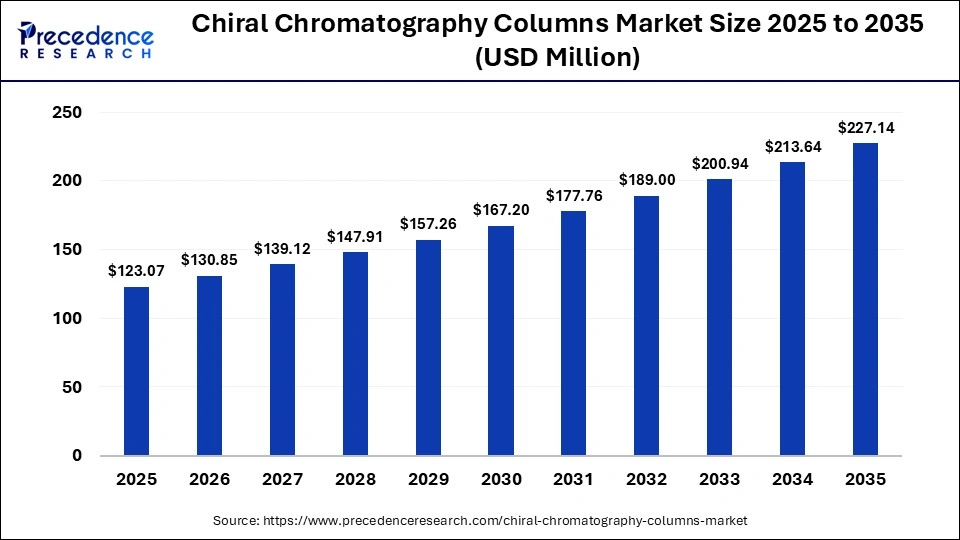
The global chiral chromatography columns market size was calculated at USD 123.07 million in 2025 and is predicted to increase from USD 130.85 million in 2026 to approximately USD 227.14 million by 2035, expanding at a CAGR of 6.32% from 2026 to 2035.
Industry-Focused: The Role of Chiral Columns in Drug Development & Quality Control
Chiral columns are vital for separating enantiomers in pharmaceutical development and quality control, which ensures drug safety and efficacy by distinguishing between mirror-image molecules with different biological effects. They enable compliance with strict regulatory mandates requiring enantiomeric purity for chiral drugs. Chiral drugs are a significant focus in pharmaceutical analysis because enantiomers often exhibit different pharmacological, metabolic, and toxicological properties. The separation of these enantiomers is accomplished using generally Chiral Stationary Phases (CSPs) in High-Performance Liquid Chromatography (HPLC) and Supercritical Fluid Chromatography (SFC).
Role in Drug Development
- Enantiomeric Separation: Asymmetric synthesis and separation are crucial, as enantiomers can have varied toxicity or metabolism.
- Method Development & Screening: Welch Blossmate Chiral Columns are widely utilized to screen for optimal separation conditions.
- Pharmacokinetic Studies: Chiral column chromatography is commonly adopted to isolate individual enantiomers to study their behavior in biological systems.
Role in Quality Control
- Purity Assessment: Food and Drug Administration (FDA) and European Medicines Agency (EMA) strict regulations demand the quantification of enantiomeric purity in the final drug formulation.
- Contaminant Monitoring: Separation techniques can efficiently detect unwanted enantiomers, which may act as impurities.
- Consistency Assurance: Chiral columns in High-Performance Liquid Chromatography (HPLC) systems assist in ensuring that the correct enantiomeric composition is maintained throughout the manufacturing process.
Chiral Stationary Phases: Key to Enantiomer Separation
Chiral Stationary Phases (CSPs) are specialized chromatographic materials that contain chiral selectors, such as cyclodextrins, polysaccharides, and Pirkle-type agents, widely utilized to separate enantiomers by forming transient diastereomeric complexes. They play a significant role in HPLC, GC, and SFC for analyzing chiral drugs and compounds, owing to their high separation efficiency and widespread relevance.
Over a hundred chiral stationary phases have been developed and made commercially available. But none of these are generally considered universal for all the groups of racemic compounds. Choosing the right CSP for the separation of a specific pair of enantiomers often becomes difficult. However, one method is to choose the right CSP based on predictive rules developed for empirical structures. This is supported by insights into the racemic mixture's chemistry and the interaction of the chiral stationary phases.
Types of Chiral Stationary Phases (CSPs)
- Polysaccharide-Based Phases (Cellulose and Amylose) Polysaccharide derivatives, particularly cellulose and amylose phenylcarbamates, are the most popular and versatile CSPs. They are widely known for their high loading capacity and broad selectivity, which makes them excellent for preparative and analytical separations.
- Macrocyclic Antibiotic-Based PhasesThese CSPs, such as Astec CHIROBIOTIC, consist of macrocyclic antibiotics bonded to silica. They are effective for ionic or ionizable compounds and offer high selectivity, mainly in polar ionic modes.
- Pirkle-Type (Brush Type) ColumnsPirkle-type columns use a small chiral molecule bonded to the silica surface. They are highly robust and designed for specific types of interactions, such as π-acid or π-basic interactions.
- Cyclodextrin-Based PhasesCyclodextrins are cyclic oligosaccharides that form inclusion complexes with hydrophobic compounds. They are good for reversed-phase separations and can separate numerous organic compounds.
- Protein-Based PhasesThese columns use proteins (HAS and AGP) bonded to silica. They are considered excellent for the separation of pharmaceuticals under reversed-phase conditions.
Advancements in High-Efficiency CSPs: Insights from HPLC 2023
In the field of chiral chromatography, researchers are continuously exploring ways to enhance efficiency and innovation for improved separation techniques. At the HPLC 2023 conference held in Düsseldorf, Germany, Alberto Cavazzini from the University of Ferrara in Italy presented findings from a team of scientists focused on developing highly efficient chiral stationary phases (CSPs) and a novel method for assessing enantioselectivity.
The researchers investigated various types of CSPs, including polysaccharide-based phases, macrocyclic antibiotics, and brush-type phases, to identify key factors affecting the kinetic performance of chiral separations. They analyzed the impact of particle geometry, particle pore size, and the loading of chiral selectors to optimize chiral chromatography efficiency across different chromatographic modes, including reversed-phase (RP), normal-phase (NP), hydrophilic interaction liquid chromatography (HILIC), and supercritical fluid chromatography (SFC).
One notable highlight of the study was the use of synthetic brush-type CSPs featuring inverted chirality. These innovative CSPs demonstrated promising results in achieving high-resolution chiral separations. Additionally, the researchers made a significant breakthrough by proving that enantioselectivity can be assessed without the need for both enantiomers.
Expert Opinion
According to our industry experts, chiral chromatography columns are increasingly critical in the pharmaceutical and biotechnology sectors due to their role in separating enantiomers, which is essential for developing safe and effective drugs. With growing regulatory emphasis on enantiomeric purity and the rise of stereospecific therapeutics, companies investing in high-performance chiral chromatography technologies can gain a competitive edge by ensuring faster drug development cycles and higher-quality outcomes. Advanced columns with optimized chiral stationary phases and high-resolution separation capabilities reduce time and material costs, improving overall operational efficiency.
The demand for these columns is further driven by the expansion of personalized medicine, high-throughput screening, and contract research organizations (CROs), which rely on precise, reliable analytical tools to meet client and regulatory requirements. While the upfront cost of advanced chiral columns and associated instrumentation can be significant, the long-term ROI through accelerated R&D, reduced failure rates, and compliance with global quality standards makes them a strategic investment. Businesses that adopt these technologies are well-positioned to capitalize on the growing global pharmaceutical and biotech markets while maintaining high standards of product safety and efficacy.
Summary
Chiral chromatography columns are important tools for the separation of enantiomers. By using advanced and custom-built chiral selectors, these columns can convert simple mirror-image molecules into distinct peaks in a chromatogram. Mastering modern pharmaceutical and chemical analysis relies heavily on understanding fundamental interaction mechanisms, such as the three-point rule for molecular recognition and systematically screening different chromatographic modes (Normal Phase, Reverse Phase, Supercritical Fluid Chromatography).
About the Authors

Aditi Shivarkar
Aditi, Vice President at Precedence Research, brings over 15 years of expertise at the intersection of technology, innovation, and strategic market intelligence. A visionary leader, she excels in transforming complex data into actionable insights that empower businesses to thrive in dynamic markets. Her leadership combines analytical precision with forward-thinking strategy, driving measurable growth, competitive advantage, and lasting impact across industries.



Aman Singh
Aman Singh with over 13 years of progressive expertise at the intersection of technology, innovation, and strategic market intelligence, Aman Singh stands as a leading authority in global research and consulting. Renowned for his ability to decode complex technological transformations, he provides forward-looking insights that drive strategic decision-making. At Precedence Research, Aman leads a global team of analysts, fostering a culture of research excellence, analytical precision, and visionary thinking.

Piyush Pawar
Piyush Pawar brings over a decade of experience as Senior Manager, Sales & Business Growth, acting as the essential liaison between clients and our research authors. He translates sophisticated insights into practical strategies, ensuring client objectives are met with precision. Piyush’s expertise in market dynamics, relationship management, and strategic execution enables organizations to leverage intelligence effectively, achieving operational excellence, innovation, and sustained growth.