



Food Additive Market Size, Key Companies, Company Market Share, Production Volume, Consumption Trends, Pricing Analysis, Export & Import Dynamics, Competitive Positioning, and Demand Forecast
Food Additive Market (By Product: Sweetness, Flavors and enhancers, Enzymes, Fat replacers, Emulsifiers, Probiotics, Prebiotics, Dietary fibers; By Source: Synthetic, Natural; By Application: Beverages, Bakery and confectionery, Convenience foods, Frozen desserts and dairy, Sauces and dressings, Others) - Global Industry Analysis, Size, Trends, Leading Companies, Regional Outlook, and Forecast 2026 to 2034
Source: https://www.precedenceresearch.com/food-additive-market
 Get a Sample
 Table Of Content


What is the Food Additive Market Size?
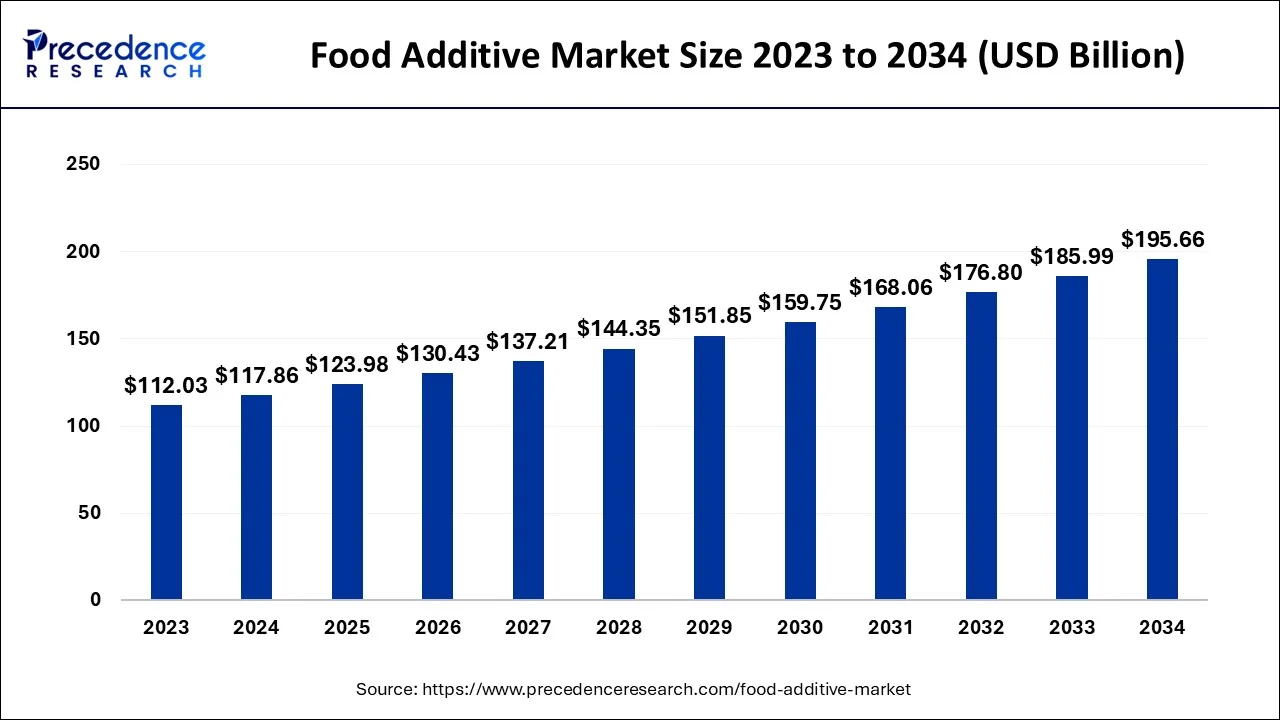
The global food additive market size is accounted at USD 123.98 billion in 2025 and predicted to increase from USD 130.43 billion in 2026 to approximately USD 195.66 billion by 2034, growing at a CAGR of 5.20% from 2025 to 2034. The market is growing due to increasing demand for processed and convenience foods worldwide.
Market Highlights
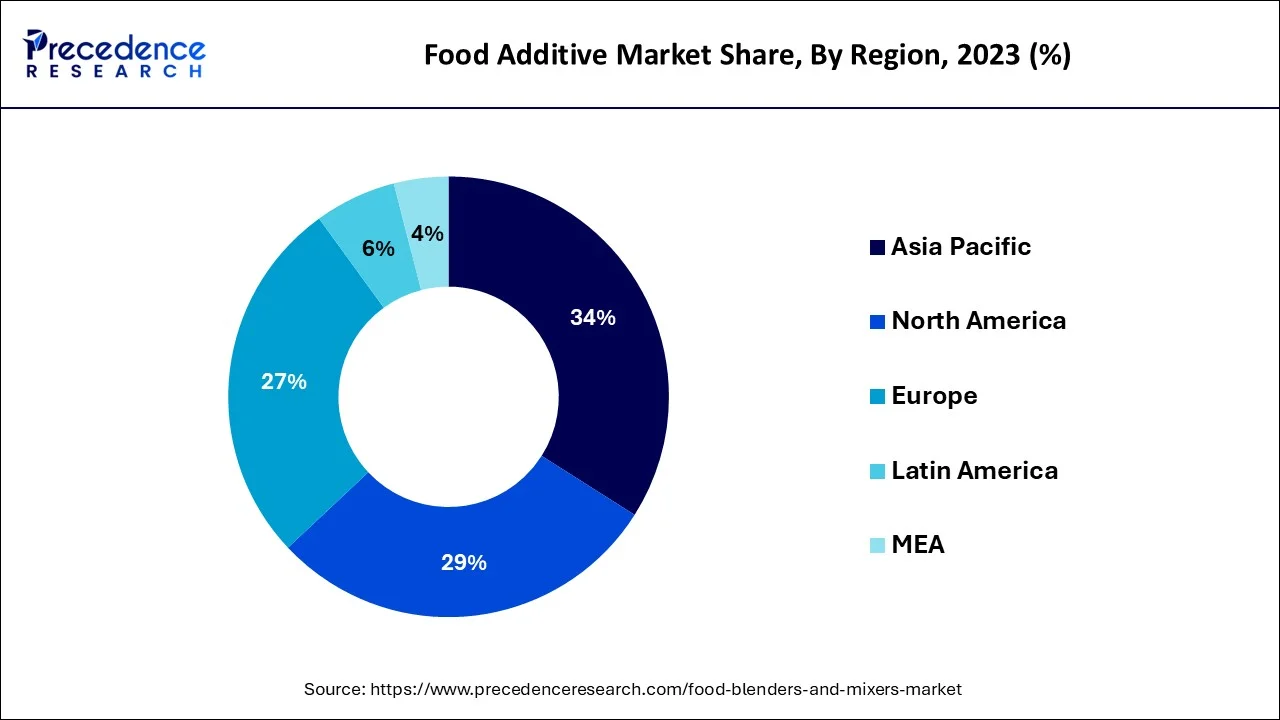
- Asia Pacific led the global market with the largest market share of 34% in 2024.
- By source, the U.S. food additive market size was valued at USD 23 billion in 2024.
- The enzymes product segment is poised to grow at a CAGR of 6.6% from 2025 to 2034.
- By product, the sweetness segment has accounted for about 57% of the market share in terms of revenue in 2024.
- By application, the bakery and the confectionery segment had a share of about 32% of the overall market in the 2024 in terms of revenue.
Market Overview
Rising Demand for Processed Foods Fuels Food Additive Market Growth
The food additive market is experiencing significant growth due to increased global consumption of packaged, processed, and convenience foods. Preservatives, sweeteners, flavor enhancers, color, emulsifiers, and stabilizers are examples of food additives that are frequently used to enhance the taste, texture, shelf life, and general quality of products. The industry is expanding due to growing urbanization, shifting dietary habits, and rising consumer demand for ready-to-eat goods. Additionally, businesses are being encouraged to innovate and create sustainable ingredient solutions by the growing demand for clean labels and natural additives, which is bolstered by strict food safety standards and growing health consciousness. Further driving the market's expansion are technological developments in food processing and the growth of the food and beverage sector.
Impact of AI on the Food Additive Market
By speeding up ingredient discovery, streamlining product formulations and enhancing quality control procedures, artificial intelligence (AI) is revolutionizing the food additive industry. AI-powered analytics assist producers in determining consumer preferences, forecasting market trends, and creating novel additive solutions that satisfy the growing demand for functional and clean-label foods. AI also makes it possible to monitor production processes in real time, improves supply chain efficiency, and guarantees adherence to food safety laws through automated quality checks and predicative maintenance. These capabilities are assisting businesses in lowering development costs, increasing operational effectiveness, and expediting the release of novel food additive products.
Food Additive Market Trends
- Rising Demand for Clean-Label Ingredients: Consumers are increasingly preferring natural, organic, and minimally processed food products, driving demand for clean-label food additives.
- Growing Adoption of Natural Food Additives: Manufacturers are replacing synthetic additives with plant-based and naturally sourced ingredients to meet evolving consumer preferences.
- Increasing Consumption of Convenience and Processed Foods: The busy lifestyles of consumers and rapid urbanization are boosting the demand for processed and ready-to-eat foods, thereby increasing the use of food additives.
- Technological Advancements in Food Processing: Innovations in food processing technologies are enabling the development of advanced additives that improve taste, texture, stability, and shelf life.
- Expansion of Functional and Fortified Foods: Rising health consciousness is encouraging the incorporation of functional ingredients and nutritional additives in food products.
- Stringent Food Safety and Regulatory Standards: Regulatory authorities across various countries are emphasizing food safety, prompting manufacturers to invest in high-quality and compliant additive solutions.
- Increasing Use of Additives in Plant-Based Foods: The growing popularity of plant-based and vegan products is driving demand for additives that enhance texture, flavor, and product stability.
Market Outlook
- Industry Growth Overview: The global food additives market has a forecasted increase in growth driven by an increase in processed food consumption, technology advancements, and changes in diet that are focused on safety and nutritional aspects of the food supply.
- Sustainability Trends: Many manufacturers are implementing green chemistry, biodegradable packaging, and renewable sourcing of ingredients, which reduce carbon footprint, and utilize more efficient processes to reduce waste - all of which support the viability for circular economy-based production policies and practices.
- Global Expansion: Asia-Pacific and Latin America are developing as major hubs for growth due to increased urbanization, better access to Western-style diets, and improved trading partnerships on a global scale.
- Startup Ecosystem: Innovative food science-based startup companies are beginning to enter the food additive marketplace, offering alternative enzyme-based sweetening options, natural-based flavoring solutions, and specially designed deconstructed formulation inclusion to help consumers meet their dietary wish lists, re-engineering the landscape of the global food additive supply chain.
Market Scope
| Report Coverage | Details |
| Market Size in 2026 | USD 130.43 Billion |
| Market Size in 2025 | USD 123.98 Billion |
| Market Size by 2034 | USD 195.66 Billion |
| Market Growth Rate from 2026 to 2034 | CAGR of 5.20% |
| Largest Market | Asia Pacific |
| Base Year | 2025 |
| Forecast Period | 2026 to 2034 |
| Segments Covered | Product, Source, Application, and Regions |
| Regions Covered | North America, Europe, Asia-Pacific, Latin America and the Middle East & Africa |
Market Dynamics
Driver
Rising Demand for Processed and Convenience Foods
One of the main factors driving the food additive industry is the rising consumption of processed, packaged, and ready-to-eat meals brought on by hectic lifestyles and fast urbanization. The increasing demand for convenience foods is supported by food additives, which are essential for improving shelf life, flavor, texture, and appearance. Additionally packaged food goods are now more accessible due to the growth of contemporary retail channels and e-commerce platforms. The demand for convenience foods is rising worldwide due to the expanding working population and rising disposable incomes.
Restraint
Stringent Regulatory Frameworks and Health Concerns
Market expansion is being hampered by stringent laws governing the use and approval of food additives as well as rising consumer concerns about the possible health risks of artificial additions. Manufacturers have been forced to engage in compliance initiatives and reformulators' scrutiny. Commercialization of novel additives may also be delayed by protracted approval processes. A move away from some synthetic chemicals is also being encouraged by growing consumer knowledge of artificial components.
Opportunity
Growing Demand for Natural and Clean Label Additives
The market has a lot of room to grow due to consumers' growing demand for natural, organic, and clean-label food items. To fulfill evolving customer expectations and obtain a competitive edge, manufacturers are investing more in plant-based, naturally produced, and sustainable food additives. Innovative clean label sustainable food additives. Innovative clean label solutions are being supported by developments in biotechnology and natural component extraction technologies. Additionally, the growing demand for functional and health-conscious meals is opening up new markets for producers of natural food additives.
Segments Insights
Product Insights
Sweetness segments dominated the food additive market in 2025 because they are widely used in processed meals, dairy products, confections, beverages, and baked goods. Growing customer demand for low-calorie foods, sugar substitutes, and functional drinks has contributed to the segment's expansion. Additionally, producers have been urged to add both natural and artificial sweeteners to food formulations due to rising health consciousness and the rising incidence of diabetes and obesity.
The enzyme segment is projected to witness the fastest growth during the forecast period due to the growing demand for natural and clean-label food ingredients. Without the use of artificial additives, enzymes increase food processing efficiency, improve product quality, and prolong shelf life. The industry is expanding due to the increasing use of enzymes in meat processing, dairy, beverage, and bread applications.
Source Insights
Natural segment accounted for the largest market share in 2025 due to consumers becoming more interested in clean label, organic, and minimally processed food items. Manufacturers are using naturally derived chemicals because of growing knowledge of the possible health dangers connected to synthetic substances. The transition to natural substitutes has also been facilitated by strict laws limiting synthetic additives.
The synthetic segment is anticipated to expand at the fastest rate during the forecast period because it is more affordable, has a longer shelf life, and is consistently of higher quality than natural substitutes. Because they provide improved stability and functionality, synthetic additives are frequently utilized in large-scale food manufacture. Their widespread use in packaged and processed meals keeps the market expanding.
Application Insights
The beverages and confectionery segment led the market in 2025 owing to baked goods and confectionery products frequently containing additives, including sugars, emulsifiers, flavors, colors, and preservatives. Segment dominance has been greatly aided by rising consumption of cakes, pastries, chocolates, and snacks, especially in cities. The need for food additives in this market has been further bolstered by product innovation in high-end bakery products.
The bakery and confectionery segment is expected to register the fastest growth during the forecast period because of the rising demand for ready-to-drink items, flavored water, energy drinks, and functional drinks. In beverage formulations food additives are essential for improving flavor, color, texture, and shelf life. Growing consumer demand for fortified and health-focused beverages is propelling the segments of expansion.
Geography Insights
The Asia Pacific region dominated the food additive market in 2025, primarily driven by population expansion, quick urbanization, and an increase in processed and convenience food consumption. Growing food and beverage production sectors in nations like China, Japan, and India have greatly aided regional development. The regions' market demand has been further bolstered by rising disposable incomes and shifting eating habits.
Regional Insights
Asia Pacific Food Additive Market Size and Growth 2026 to 2034
The Asia Pacific food additive market size accounted for USD 44.35 billion in 2026 and is expected to be worth around USD 67.50 billion by 2034, at a CAGR of 5.35% from 2026 to 2034
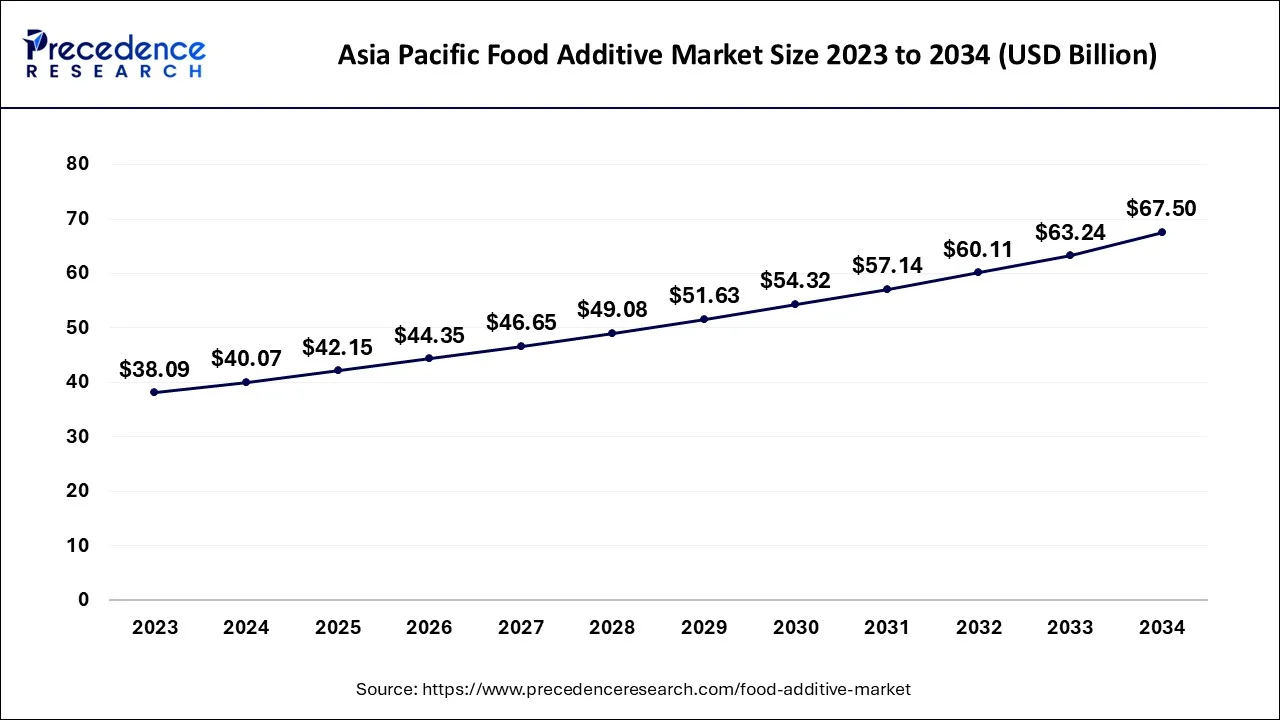
The Asia Pacific region will dominate the market. It has had the largest market share in terms of revenue even in the past. There has been a increase in the demand for fast food in many nations across the Asia Pacific region. Increase in the population of the countries like China as well as India will create greater demand for additives. The demand for food additives in these nations will have a positive impact on the market.
The North American region and the European region will also grow well during the forecast. Due to an increased consumption of ready to cook meals and breakfast products. Hectic lifestyle of the people in this region will drive the market growth.
India Food Additive Market Trends
The Indian food additive market is expanding rapidly owing to rising consumption of packaged and ready-to-eat foods, shifting dietary habits, and growing urbanization. The country's need for food additives is being driven by the expansion of the food processing sector, rising disposable incomes, and an expanding middle class. Additionally, the market is expanding due to rising consumer awareness of food quality, shelf life enhancement, and the growing appeal of functional and fortified foods. Food additives are becoming more widely used in India as organized retail and e-commerce channels grow.
Surging Demand for Convenience and Plant-Based Foods Drives the North America Market
North America is anticipated to witness the fastest growth during the forecast period due to growing consumer demand for natural, functional, and clean-label food items. Strong consumer awareness of health and wellness in the area is pushing manufacturers to create cutting-edge additive solutions. Additionally, the presence of large food manufacturers and ongoing developments in food processing technologies are promoting regional market expansion.
North America was the fastest-growing food additives market, with the U.S. leading the region. The use of food additives increased approximately 28% from 2020 to 2023 because of growing demand in convenience foods categories, and demand for convenience foods for 65% of U.S. households. Canada provided significant growth of food additives, bolstered by rapid urbanization and an increase in processed foods. The plant-based food additives in North America totaled USD 3.2 billion in 2023, and there was growing popularity and movement for natural ingredients.
U.S. Food Additive Market Trends
The U.S. food additive market is witnessing significant growth due to the nation's high consumption of packaged, processed, and convenience foods. Innovative additive solutions are being developed by manufacturers in response to growing consumer demand for clean label, natural, and functional food products. Major food and beverage corporations, cutting-edge food processing technologies, and strict food safety laws all contribute to the market's expansion. The market is also growing due to growing consumer demand for natural colors, preservatives, and sugar alternatives.
Clean-Label Movement and R&D Investments Fuel the Market Growth
The European food additives market experienced notable growth during the forecasted period. Demand for clean-label and natural food additives is up due to health awareness and plant-based eating. There was increased demand in enzymes, probiotics, and clean-label additive categories. The German manufacturers maintained and increased their focus on R&D to develop sustainable bio-sourced food additives that could be used in food processing. Germany, along with the EU in general, faced considerable market challenges in regulatory issues; however, the food additive market continually grew through 2025 in Germany, due to continuing technological innovation, and projected that the regional food additives market growth would be roughly 4% through 2029.
What is Causing Growth in Food Additives Across Europe?
Europe remains one of the most mature food additives markets in the world, fueled by rigorous regulatory frameworks focused on food safety and sustainability. The European Union's intention to ban all synthetic additives has accelerated the move towards the use of organic colorants, natural emulsifiers, and plant-based preservatives.
As well, the UK, German, and French markets indicate a willingness to invest in innovation, eco-friendly and sustainable packaging, and provide transparency in labeling practices, thereby positioning themselves at the forefront of the sustainable and health-conscious food additive market development.
What is Contributing to Growth in Food Additives Across Latin America?
The Latin American food additives market continues to grow, driven in part by shifting consumer preferences toward packaged and convenient food. Brazil, Mexico, and Argentina are leading the pack in flavoring and coloring agent consumption. Additionally, the increasing penetration of international food chain retailers and the innovation of local manufacturers are also factors supporting continued market growth. Furthermore, the demand for naturally occurring preservatives as well as clean-label claims should also propel overall market activity throughout the region by 2030.
How can the Food Additive Market Expand in Brazil?
Brazil is transitioning toward shifting consumer choices, including demand for clean labels, growth in functional foods, urbanization, and convenience. Brazil's National Health Surveillance Agency (ANVISA) revised authorized substances and updated Brazil's positive lists for food additives and processing aids across several food categories.
How does the Food Additive Market Majorly Impact the Significant Growth of MEA?
MEA is expected to grow significantly in the market in the coming years, propelled by government mandates and health trends, local manufacturing investments, halal and clean-label compliance, etc. The Middle East experiences innovations in salt-tolerant crops and soil bio-engineering, which have enabled sustainable yields in specific environments. A holistic framework aids in transforming food and water systems. An integrated green transition balances resilience, economic growth, and sustainability.
What is the Major Footprint of Saudi Arabia in the Food Additive Market?
Saudi Arabia is transforming due to Vision 2030 local manufacturing incentives, stricter SFDA health and safety mandates, and a shift toward clean-label and functional foods. The Saudi Food and Drug Authority (SFDA) has continued efforts to improve service quality, enhance product availability, and align with its strategic plan.
Government Initiatives in the Food Additive Market
China
- In May 2026, China submitted draft amendments for food flavors and food additives standards. It has removed some substances from the food flavors standard for compliance and deleted some natural and synthetic flavoring substances.)(Source: https://www.fas.usda.gov)
United States
- In January 2026, the U.S. Food and Drug Administration (FDA) released its human foods program 2026 guidance agenda and priority deliverables. This program will focus on major areas such as reducing chronic diseases through better nutrition, food chemical safety, and microbiological food safety. (Source: https://www.cov.com)
Germany
- In March 2026, the U.S. Department of Agriculture reported that Germany's food processing industry remains the fourth largest industrial sector. The Federation of German Food and Drink Industries stated that Germany produced an estimated USD 270.1 billion in processed food and beverages in 2024. (Source: https://www.fas.usda.gov)
Brazil
- In April 2026, Brazil revised its food additives regulation, and this revision updates the maximum limits, technical functions, and conditions of use for food additives and processing aids. According to this regulation, the newly authorized food additives are lecithin, glycosphingolipids, and phosphates. (Source: https://global.foodmate.net)
Saudi Arabia
- In December 2025, the Saudi Food and Drug Authority (SFDA) announced a 60% increase in the availability of feed products in the Kingdom of Saudi Arabia during the first half of 2025. This growth is fueled by a comprehensive set of measures that are implemented to increase the number of available products. (Source: https://www.sfda.gov.sa)
Investments in the Food Additive Market
- In July 2026, Evonik Industries AG invested US$100 million to upgrade its U.S. drug substance contract manufacturing site. It further aims to improve capabilities, meet the growing demand for U.S.-based CDMOs, and invest in next-generation technologies. (Source: https://www.evonik.com)
- In May 2026, Tate & Lyle expanded its collaboration with BioHarvest to boost next-generation sweetener innovation. BioHarvest is supported by the investment of more than $100 million in its technology platform. It operates an expanding CDMO division and a direct-to-consumer business. (Source: https://www.tateandlyle.com)
- In July 2026, Ingredion Incorporated, a leading global ingredient solutions provider, reported its annual net sales of approximately $7.2 billion for the year 2025. The company is renowned for turning vegetables, grains, fruits, and other plant-based materials into value-added ingredient solutions for the beverage, food, brewing, animal nutrition, and industrial markets. (Source: https://ir.ingredionincorporated.com)
- In September 2025, Novozymes invested in UV technology for the adoption of a new UV-based filtration system by Danish company Lyras. It will replace energy-consuming and labor-intensive filtration methods with raslysation technology. (Source: https://www.ingredientsnetwork.com)
Collaborations in the Food Additive Market
- In May 2026, Archer Daniels Midland formed a partnership with Hill's Pet Nutrition in EMEA and North America to support farm resilience through regenerative agriculture. The company aims to boost the adoption of regenerative agriculture practices across farms in Minnesota and Illinois in the U.S., as well as Hungary in Europe. (Source: https://www.adm.com)
- In June 2026, Cargill, Inc. announced that it has strengthened Belgium as a strategic European food innovation and manufacturing hub. The company invested €56 million in edible oils, research and innovation capabilities, and its Mouscron gourmet chocolate facility to support evolving customer demand across Europe. (Source: https://www.cargill.com)
- In September 2025, Kerry Group showcased next-generation food innovation at Fi Asia Bangkok 2025, which is further inspiring the future of sustainable nutrition. Under the theme “Reformulate for Impact,” the company introduced delicious, science-led, insights-driven, and beverage concepts that are designed to meet evolving consumer demands for sustainability, taste, and nutrition. (Source: https://asiafoodjournal.com)
- In October 2025, BASF SE and International Flavors & Fragrances Inc. (IFF) announced a strategic collaboration to drive next-generation enzyme and polymer innovation. This collaboration aims to boost the development of IFF's Designed Enzymatic Biomaterials technology platform and generate next-generation enzyme technologies for personal care, fabric, and dish, as well as industrial cleaning applications. (Source: https://www.basf.com)
How is this Value Chain Enhancing Efficiency and Profitability in the Food Additive Industry?
The value chain for food additives consists of several stages that connect together for quality, efficiency, and sustainability from sourcing to distribution. The value chain is critical in ensuring product quality and compliance with regulatory requirements worldwide.
- Raw Material Procurement: Focuses on sourcing natural ingredients responsibly, such as plant-based colorants, natural sweeteners, and preservatives. Suppliers highlight agricultural responsibility and ethics in harvesting.
- Manufacturing & Processing: Makes use of technology and food science to manufacture safe food additives and to replicate the highest standard of quality. Investment in R&D by manufacturers aims at the health-conscious consumer with new food versions and enhancers.
- Distribution & Retail Network: Uses technology-based supply chains and smart logistics to arrive on time and at the destination. Distribution and retail companies fund electronic commerce and traceable systems for consumer assurance and accountability.
Top Companies in the Food Additive Market and Their Offerings
- Evonik Industries AG: Core food additive and processing products like silica-based flow aids and carriers, nutraceutical and dietary additives, food processing and synthesis aids, etc.
- Tate & Lyle PLC: Sweetening and sugar reduction, soluble fibres, upcycled citrus fibres, protein fortification systems, pectins and gums, high potency sweeteners, etc.
- Ingredion Incorporated: Sugar reduction and alternative sweeteners, clean-label starches and texture additives, emulsifiers, plant stabilizers, functional nutrition and gut health, etc.
- Novozymes A/S: Baking and milling biosolutions, dairy and cheese cultures, plant-based foods and analogues, flavor, taste, and health bioactives.
- Archer Daniels Midland: Natural emulsifiers, texture stabilizers, flavors, colors, and enhancers, sweeteners, sodium reducers, functional biotics, health additives, and animal feed additives.
Food Additive Market Companies
- Evonik Industries AG
- Tate & Lyle PLC
- Ingredion Incorporated
- Novozymes A/S
- Archer Daniels Midland
- Cargill, Inc.
- Chr. Hansen A/S
- Kerry Group
- BASF SE
- Kalsec Inc.
Key Market Developments
A distribution partnership between Solevo and Tate & Lyle Will increase its focus on providing high quality beverages as well as food ingredients. This announcement was made in the year 2020 which shall introduce the ingredients like soluble fibers and sweeteners that shall be low in terms of calorie.
Recent Developments
- In April 2025, Godrej Industries' chemicals business acquired the food additives business of Savannah Surfactants. The Savannah business will be part of the specialty chemicals sector. The addition of this food additives business will expand our specialty offerings and build a larger specialty business going forward.
- In April 2025, the U.S. Food and Drug Administration (FDA), in partnership with the National Institutes of Health (NIH), the agency intends to conduct comprehensive research on the impact of food additives on child health and development. The agency's move signals a broader shift in the oversight of food additives.
Segments covered in the report
By Product
- Sweetness
- HIS
- HFCS
- Sucrose
- Others
- Flavors and enhancers
- Enzymes
- Fat replacers
- Protein
- Starch
- Fat
- Emulsifiers
- Mono, Di-Glycerides & Derivatives
- Lecithin
- Stearoyl Lactylates
- Sorbitan Esters
- Others
- Probiotics
- Prebiotics
- Dietary fibers
By Source
- Synthetic
- Natural
By Application
- Beverages
- Bakery and confectionery
- Convenience foods
- Frozen desserts and dairy
- Sauces and dressings
- Others
By Geography
- North America
- Europe
- Asia Pacific
- Latin America
- Middle East and Africa (MEA)
For inquiries regarding discounts, bulk purchases, or customization requests, please contact us at sales@precedenceresearch.com
Frequently Asked Questions
Tags





Ask For Sample
No cookie-cutter, only authentic analysis – take the 1st step to become a Precedence Research client
 Get a Sample




 sales@precedenceresearch.com
 Schedule a Meeting
