






 Request Consultation
Generative AI is reshaping fulfillment and logistics by enabling smarter automation and real-time decision-making. This blog highlights its role in route optimization, warehouse management, and demand forecasting. It also covers benefits, challenges, and the future of AI-driven supply chains.
Generative AI (GenAI) has proved to be a boon for multiple domains and industries. Advanced technology has enabled industries to automate multiple tasks, resulting in cost savings, time savings, and reduced effort in repetitive tasks. It has also helped reduce manual intervention, resulting in fewer mistakes and lower waste, which is beneficial for the industry. GenAI has also propelled the logistics and fulfilment industry in multiple ways, such as route optimization, warehouse management, automation of manual tasks, and cost savings. Hence, technological advancements are highly adopted by the industry for multiplied profits.
What is Generative AI in Fulfillment and Logistics?
GenAI is a type of AI that helps the fulfillment and logistics industry in managing warehouse tasks, optimizing shipping routes, providing synthetic training data, and automating documents. AI performs several tasks for the industry rather than just analyzing the existing industry data. GenAI helps the industry simulate situations and allows the logistics company to prepare itself for the “what if?” scenarios strategically and technically. It eases the process of solving problems technically and digitally. Forecasting different types of situations, advanced preparation, and cost savings are other top-ups fueling the usage of GenAI in the fulfilment and logistics industry.
What is the Generative AI in Fulfillment and Logistics Market Size in 2026?
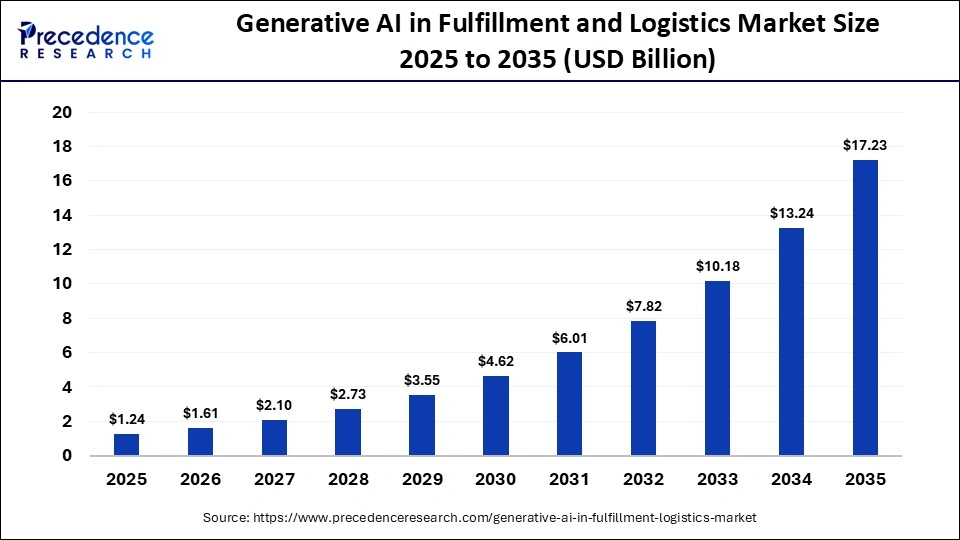
The global generative AI in fulfillment and logistics market size was valued at USD 1.24 billion in 2025 and is expected to grow from USD 1.61 billion in 2026 to approximately USD 17.23 billion by 2035, registering a CAGR of 30.10% from 2026 to 2035. The growth is driven by increasing demand for efficient management of complex supply chains, cost optimization, and streamlined warehouse operations. Additionally, cloud-based services support workflow automation for shippers, retailers, and manufacturers.
Get a Free Sample Report with Key Market Trends: https://www.precedenceresearch.com/sample/8236
Contribution of AI in Fulfillment and Logistics
Warehouse Layout Optimization: One of the major benefits of the advanced technology involves warehouse layout optimization. The procedure involves analyzing inventory data, order patterns, and traffic for designing efficient layouts to lower the travel time and maximize space utilization. GenAI also ensures the smooth working of factors such as faster picking, improved safety, and higher throughput. It ensures that highly demanded products are easily accessible with the help of real-time slotting as per order volumes and product demand. The technology also helps simulate scenarios to predict the workflow impact and select the best option before final physical changes.
Dynamic Picking Paths: GenAI helps the industry in selecting the best route by analyzing real-time data to generate, simulate, and adapt navigation routes for human pickers and autonomous robots. It also processes factors such as warehouse congestion, product location changes, and enhances priority for real-time picking paths to minimize travel time. It also helps the industry by simulating situations that may slow delivery times, along with reconfiguring picking paths and dealing with obstacles to ensure a smooth workflow. It also analyzes historical picking data to suggest better product placement, fueling the industry’s growth.
Real-Time Route Optimization: GenAI helps the industry by analyzing datasets along with conditions such as traffic, vehicle capacity, and weather. It suggests alternate routes easily to avoid delays and maintain delivery timelines. Proactive routing decision over reacting and messing up situations is another beneficial pointer of GenAI. Optimizing routes with multiple stoppages to save time and maintain fuel efficiency is also one of the major advantages of the technology. Maintaining safety, real-time navigation, and ensuring safety in high-risk zones is also a major market-elevating factor.
Automated Documentation: Another major benefit of involving GenAI in the fulfillment and logistics industry is automating documentation work. The procedure involves classifying, segregating, and minimizing unstructured data to lower manual efforts. The procedure helps create technical documentation, extract data from PDF or images, summarize long documents, and analyze content in real time. AI tools help generate accurate, comprehensive summaries of lengthy reports, financial documents, and patient records. They can automatically categorize lengthy documents and route them to appropriate teams based on context and content.
Customer Communication: GenAI helps the industry provide instant, personalized, and 24/7 intelligent chatbots, automated email drafting, and real-time sentiment analysis. It enhances productivity by summarizing complex tickets, maintaining a knowledge base, and offering multilingual capabilities. Such systems are ideal to enhance customer experience by lowering the waiting period and providing tailored results. It analyzes past interaction data to improve the customer experience and provide relevant and beneficial information to the customer. It helps to provide a touch of personalization and enhance customer loyalty with human-like assistance.
Supplier Negotiations: GenAI enables supplier negotiations by acting as a strategic partner, automating preparation, simulating scenarios, and drafting communications for enhanced cost savings. The procedure also involves steps such as analyzing past market results, market conditions, and competitor pricing to create negotiation strategies. It can manage thousands of deals at the same time and select the best option among them for optimal decision-making. GenAI also helps accelerate the procurement process by generating customized RFI/RFQ templates, drafting, and refining emails to suppliers. It can search for new, capable, and profitable suppliers to evaluate their potential to broaden the competitive landscape.
Advantages and Drawbacks of Generative AI in Fulfillment and Logistics
Advantages
- Intelligent Demand Forecasting: GenAI helps in analyzing massive and real-time datasets, including social media trends, weather conditions, and economic trends. It also analyzes past market database and market trends to predict demand at a granular level to lower overstocking and minimize safety stock. Different types of AI tools help forecast disruptions and optimize delivery routes to enable proactive adjustments for improved fleet utilization. GenAI also predicts immediate shifts in demand, enables rapid re-routing of goods, and reduces supply chain lag. Forecasting also helps firms optimize transportation and reduce delivery truck fleets, along with lowering carbon emissions.
- Improved Resilience: GenAI helps create multiple simulation scenarios to explain the impact of such situations, along with suggesting ideal remedies to deal with such situations even before they crop up. By scanning unstructured data, it detects disruption risks before human analysts or traditional systems. In case of disruptions, AI helps reroute shipments, rebalance inventory across locations, and update replenishment plans in a matter of a few minutes, to save time. Generative AI is also ideal for avoiding excessive stocking and managing inventory. It continuously calculates safety stock levels to avoid any mismanagement.
- Improved Cost Reduction and Efficiency: GenAI analyzes route conditions and immediately suggests alternative routes in case of any obstructions in the current one. Hence, it helps the industry save time, fuel, and other costs related to the whole procedure. GenAI also helps enhance last-mile deliveries, along with improving delivery time windows. It ensures vehicle capacity and helps utilize its maximum potential to reduce the number of empty trips. It helps ensure a smooth connection between warehouse robots and human labor to handle items and speed up the picking and packing processes.
Drawbacks
- High Upfront Investments: Adopting GenAI by a company also requires substantial investments for building AI infrastructure. Capital expenditure is also required to fund the licensing of sophisticated models, along with paying for the computing power needed to run those models. Additional costs are also required for investing in integrating siloed information into unified datasets. They also require continuous monitoring and retraining with new data to prevent model drift and avoid them becoming obsolete. Companies also require costs to hire AI and data science experts for enhanced and ideal information, further adding to the expenditures list.
- Workforce Training: Another disadvantage observed by the industry involves a lack of skilled workforce. It may make companies face pushback from employees due to the fear of losing jobs. Hence, companies are required to invest time and resources to sensitively manage change and ensure employees' trust in technology and use it for the company’s advancement.
Useful AI Tools for the Fulfillment and Logistics Industry
- Blue Yonder: GenAI tools help in leveraging GenAI and agentic AI to transform supply chain management from reactive to proactive, automating complex decision-making processes in the industry. They enable autonomous logistics operations and intelligent fulfillment. They also act as an expert assistant for transportation managers to use natural language to interact with data. GenAI simplifies time-consuming and tedious tasks, such as uploading and validating carrier rates, which are helpful for staff to focus on other required domains.
- SAP IBP (JOULE): GenAI tool enables advanced automation, proactive insights, and conversational natural language interaction across fulfilment and logistics processes. The tool helps supply chains move from digital to autonomous systems. This tool planner uses natural language to interact with Joule to ask questions about planning models, variables, and constraints.
- GigaSpaces eRAG: It is an AI-powered tool bridging the gap between large language models and live, structured enterprise databases, for accurate, real-time insights for fulfillment and logistics. The tool directly connects to live systems to ensure responses are grounded in current operational data.
Conclusion
GenAI in fulfillment and logistics plays a massive role in handling different types of operations effectively and seamlessly. GenAI helps the industry manage costs, improve efficiency, and save time and costs in different types of repetitive and manual tasks. It also helps the fulfillment and logistics industry by managing multiple operations at the same time and choosing the right option for lower wastage.
Expert Advise
Our experts suggest that generative AI is a rapidly evolving technology with widespread applications across diverse sectors, including fulfillment and logistics. GenAI performs various functions, such as predictive demand and inventory planning, smart route optimization, and operational support. The growing demand for fully autonomous supply chains, the growth of multi-agent collaboration ecosystems, and the increasing development of smart city infrastructure drive the future use of GenAI tools in the fulfillment and logistics industry. Moreover, investors can generate massive ROI through reduced logistics costs and improved asset utilization.
About the Authors

Aditi Shivarkar
Aditi, Vice President at Precedence Research, brings over 15 years of expertise at the intersection of technology, innovation, and strategic market intelligence. A visionary leader, she excels in transforming complex data into actionable insights that empower businesses to thrive in dynamic markets. Her leadership combines analytical precision with forward-thinking strategy, driving measurable growth, competitive advantage, and lasting impact across industries.



Aman Singh
Aman Singh with over 13 years of progressive expertise at the intersection of technology, innovation, and strategic market intelligence, Aman Singh stands as a leading authority in global research and consulting. Renowned for his ability to decode complex technological transformations, he provides forward-looking insights that drive strategic decision-making. At Precedence Research, Aman leads a global team of analysts, fostering a culture of research excellence, analytical precision, and visionary thinking.

Piyush Pawar
Piyush Pawar brings over a decade of experience as Senior Manager, Sales & Business Growth, acting as the essential liaison between clients and our research authors. He translates sophisticated insights into practical strategies, ensuring client objectives are met with precision. Piyush’s expertise in market dynamics, relationship management, and strategic execution enables organizations to leverage intelligence effectively, achieving operational excellence, innovation, and sustained growth.