






 Request Consultation
Malaria diagnostics are rapidly advancing with the integration of AI, digital tools, and portable devices. This blog highlights key diagnostic methods, emerging technologies, and future trends. Learn how innovation is improving early detection and supporting global malaria control efforts.
One of the most dangerous infectious diseases in the world, especially in tropical and subtropical areas, is malaria. Effective treatment for lowering transmission and avoiding serious complications and fatalities all depend on an early and precise diagnosis. From conventional microscopy techniques to quick diagnostic tests and now sophisticated molecular and AI-based detection systems, malaria diagnostics have undergone tremendous change over time.
Technological developments, digital healthcare, and growing international efforts to eradicate malaria are all influencing the future of malaria diagnostics. Modern diagnostic tools are transforming how malaria is detected and managed, enabling earlier interventions, reducing the burden on healthcare systems, and supporting global efforts to eliminate the disease. The development of innovative diagnostic solutions and upcoming trends in malaria diagnostics are examined in this blog.
What is the Malaria Diagnostic Market Size in 2026?
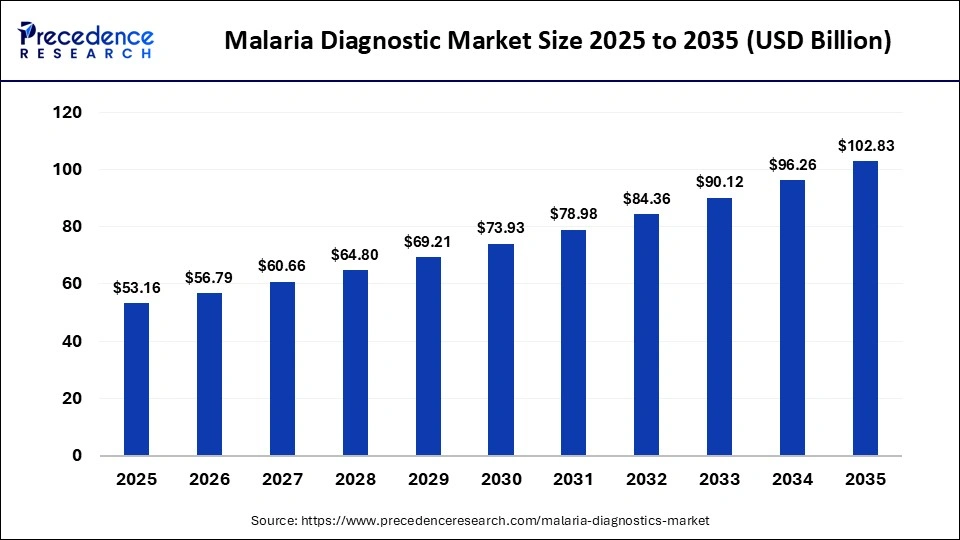
The global malaria diagnostic market was valued at USD 53.16 billion in 2025 and is expected to grow from USD 56.79 billion in 2026 to approximately USD 102.83 billion by 2035, registering a CAGR of 6.82% during the forecast period from 2026 to 2035. This growth is driven by the rising prevalence of malaria cases, increasing demand for rapid diagnostic tests, and expanding government initiatives focused on early detection and effective malaria control programs.
Get a Free Sample Report with Key Market Trends: https://www.precedenceresearch.com/sample/8229
A Comprehensive Look at Malaria Diagnostic Methods
Malaria diagnostics encompass a range of techniques designed to detect the presence of Plasmodium parasites quickly and accurately. Key methods include rapid diagnostic tests (RDTs) for point-of-care detection, microscopy for detailed parasite identification, and PCR-based molecular testing for high-sensitivity detection and confirmation. Together, these approaches provide healthcare professionals with the tools to diagnose, monitor, and manage malaria effectively across diverse settings.
Types of diagnostic methods include:
- Microscopy
Microscopy has been the most popular technique for diagnosing malaria for many years. This technique involves putting a sample of blood on a glass slide, staining it, and looking at it under a microscope to find malaria parasites. Because it can identify the type of malaria parasite and calculate parasite density, microscopy is regarded as the gold standard in many healthcare settings. However, this approach is difficult in rural and isolated areas where malaria is most prevalent because it requires trained technicians, laboratory facilities, and time.
Clinical diagnosis based on symptoms like fever, chills, sweating, headaches, and exhaustion is another conventional approach. However, because the symptoms of malaria are like those of other infections, like dengue or typhoid, symptom-based diagnosis is not always reliable. This raises the possibility of drug resistance and complications because it frequently results in incorrect diagnosis and treatment. Faster and more precise diagnostic technologies were created because of these constraints.
- Rapid Diagnostic Tests (RDTs)
Malaria diagnosis has been transformed by Rapid Diagnostic Tests (RDTs), which offer fast results without requiring laboratory equipment. These tests use a test strip to find malaria antigens in a tiny sample of blood. Because results are typically available in 15 to 20 minutes, they are very helpful in emergencies, community health centers, and rural clinics.
RDTs are easy to use, cost-effective, and do not require highly trained staff. They have played a major role in expanding malaria testing in developing countries, especially in regions with limited laboratory infrastructure. Governments and global health organizations have widely adopted RDTs in malaria control programs to improve early diagnosis and treatment.
But RDTs have certain drawbacks as well. Some tests are unable to distinguish between different species of malaria, and they might not be able to identify extremely low parasite levels. Because malaria antigens can linger in the blood even after treatment, false positive results can occasionally happen. RDTs are still one of the most crucial instruments for diagnosing malaria in spite of these drawbacks.
- Molecular Diagnostic Technologies
Polymerase Chain Reaction (PCR) and other molecular diagnostic techniques have greatly increased the precision of malaria detection. PCR finds malaria parasite DNA in blood samples and can detect extremely low infection levels that RDTs or microscopy might miss. Because of this, molecular diagnostics are especially helpful for advanced hospital research labs and malaria surveillance initiatives.
Accurately identifying malaria species, tracking drug resistance trends, and detecting mixed infections are all made possible by molecular diagnostics. However, the use of these technologies is restricted in rural and low-resource environments due to the need for specialized equipment, skilled workers, and higher costs. As technology develops, scientists are trying to create molecular diagnostic tools that are affordable and portable for use in field environments.
How is Digital Microscopy Enhancing Malaria Detection?
One of the emerging trends in malaria diagnostics is digital microscopy and automated parasite detection. In digital microscopy, blood smear images are captured using digital microscopes and analyzed using software to detect malaria parasites. Automated detection systems reduce human error and improve diagnostic accuracy.
Additionally, these systems support telemedicine services, store patient data, and facilitate remote image sharing with experts. In areas without access to qualified laboratory technicians, digital diagnostics are especially helpful. Digital microscopy systems are being used more frequently by hospitals and diagnostic labs to increase productivity and diagnostic precision.
The Future of Malaria Diagnosis: Artificial Intelligence at Work
It is anticipated that artificial intelligence (AI) will be crucial to the future of diagnosing malaria. AI-based systems are able to automatically identify malaria parasites with a high degree of accuracy by analyzing blood smear images. Thousands of malaria images are used to train machines learning algorithms, which allow them to swiftly and precisely identify infected cells.
AI-based diagnostic tools can help healthcare professionals in remote locations speed up diagnosis and increase accuracy. Digital microscopes, cloud-based platforms, and smartphones can all be integrated with these systems to facilitate data sharing and remote diagnosis. By evaluating massive datasets and forecasting malaria outbreaks using environmental and health data, AI technology also aids in malaria surveillance. Although AI-powered diagnostic systems are still in the early stages of development and adoption, it is anticipated that they will revolutionize malaria diagnosis in the years to come by improving testing speed, accuracy, and accessibility.
Malaria Detection in Your Pocket: Smartphone-Based Diagnostics
Another cutting-edge advancement in malaria diagnostics is the use of smartphone-based diagnostic instruments. Researchers have created smartphone attachments that can take pictures of blood samples and use apps to analyze them. These tools can identify malaria parasites and deliver findings in a matter of minutes. Smartphone diagnostics are especially helpful in isolated and rural locations without access to laboratory facilities. Healthcare professionals can take blood samples, use smartphones to analyze them, and use cloud-based systems to transmit the results to physicians or labs. This shortens the time needed to make treatment decisions and enhances access to diagnosis.
Smartphone-based diagnostics also support data collection and disease monitoring, which helps governments and health organizations track malaria cases and plan control programs.
On-the-Spot Malaria Detection: Advancements in Point-of-Care Devices
Malaria can be diagnosed at the patient's location rather than in a lab thanks to portable testing devices known as point-of-care diagnostic devices. These tools include rapid test analyzers, portable PCR machines, and portable diagnostic readers. Because they allow for early diagnosis and prompt treatment, point-of-care diagnostics are becoming increasingly crucial in malaria control initiatives.
These devices are extensively utilized in emergency response programs, mobile clinics, rural healthcare facilities, and community health initiatives. As healthcare systems concentrate on expanding access to diagnostic services in underserved and remote areas, there will likely be a greater need for portable diagnostic devices in the future.
The Power of Research: New Frontiers in Malaria Diagnostics
Malaria diagnostics are becoming more innovative thanks to research and development efforts. Businesses and academic institutions are attempting to create diagnostic technologies that are more precise, quick, and economical. Biosensors, digital diagnostic platforms, AI-based detection systems, and diagnostic tests based on nanotechnology are some of the major research areas.
Additionally, researchers are concentrating on creating diagnostic tests that can identify drug-resistant strains of malaria, distinguish between different malaria species, and detect malaria at very early stages. These developments will be crucial to efforts to eradicate malaria and promote global health.
The Roadblocks in Malaria Detection and Diagnosis
Malaria diagnosis still faces several difficulties despite advances in technology. The absence of diagnostic infrastructure in rural and isolated areas where malaria is most prevalent is one of the main obstacles. Many healthcare facilities lack sophisticated diagnostic tools, laboratories, and skilled personnel.
The price of cutting-edge diagnostic tools like digital diagnostic systems and molecular diagnostics presents another difficulty. Low-income areas find it difficult to obtain these technologies.
Additionally, shortages of diagnostic kits in high-risk areas can occasionally result from supply chain and distribution issues. Concerns about false positive and false negative results are also present in the diagnosis of malaria, particularly in rapid diagnostic tests. For healthcare systems and diagnostic firms, ensuring diagnostic accuracy and quality control continues to be a significant challenge.
What’s Next in Malaria Diagnostics: Future Trends and Insights
Global health initiatives, digital healthcare automation, and the development of novel diagnostic technologies opens door for the growth of the malaria diagnostic industry. AI-based diagnostic systems, portable molecular diagnostic devices, smartphone-based diagnostic devices, biosensor-based detection technologies, and cloud-based disease monitoring systems are some of the key emerging trends. Real-time data sharing, remote diagnosis, and disease surveillance will be made possible by digital health platforms. To support the goals of eradicating malaria, governments and international health organizations are expected to invest more in testing programs and diagnostic infrastructure.
In the future, malaria diagnostics will become faster, more accurate, more portable, and more accessible. The integration of AI, digital health, and portable diagnostic devices will transform malaria diagnosis and help reduce malaria cases and deaths worldwide.
Traditional microscopy has given way to rapid diagnostic tests, molecular diagnostics, digital microscopy, and AI-based detection systems in the field of malaria diagnostics. The speed, accuracy, and accessibility of diagnostics have all improved with each technological development. Molecular diagnostics increased accuracy, rapid diagnostic testing increased testing in rural areas, and digital and artificial intelligence technologies are currently revolutionizing disease monitoring and malaria detection.
Automation, AI smartphone diagnostics, and portable point-of-care devices are the future of malaria diagnostics. These technologies will enhance early detection, assist medical professionals, and fortify global malaria control initiatives. Malaria diagnostics will be essential to international efforts to control and eventually eradicate the disease with further study funding and technological advancement.
About the Authors

Aditi Shivarkar
Aditi, Vice President at Precedence Research, brings over 15 years of expertise at the intersection of technology, innovation, and strategic market intelligence. A visionary leader, she excels in transforming complex data into actionable insights that empower businesses to thrive in dynamic markets. Her leadership combines analytical precision with forward-thinking strategy, driving measurable growth, competitive advantage, and lasting impact across industries.



Aman Singh
Aman Singh with over 13 years of progressive expertise at the intersection of technology, innovation, and strategic market intelligence, Aman Singh stands as a leading authority in global research and consulting. Renowned for his ability to decode complex technological transformations, he provides forward-looking insights that drive strategic decision-making. At Precedence Research, Aman leads a global team of analysts, fostering a culture of research excellence, analytical precision, and visionary thinking.

Piyush Pawar
Piyush Pawar brings over a decade of experience as Senior Manager, Sales & Business Growth, acting as the essential liaison between clients and our research authors. He translates sophisticated insights into practical strategies, ensuring client objectives are met with precision. Piyush’s expertise in market dynamics, relationship management, and strategic execution enables organizations to leverage intelligence effectively, achieving operational excellence, innovation, and sustained growth.