






 Request Consultation
Introduction to the Artificial Intelligence and High-Performance Computing (HPC) Market
The rapid evolution of AI and HPC markets is driven by the limits of traditional computing and the demand to process exponential amounts of data. Accelerated computing, using parallel processing hardware such as GPUs, serves as the backbone, enabling massive calculations to run simultaneously and thus making it the only viable architecture for modern, compute-intensive workloads. Supercomputers utilize accelerated architectures to process complex physical, biological, and chemical simulations. This enables rapid breakthroughs in climate modeling, drug discovery, along with genomics, accelerating research at a speed previously impossible.
NVIDIA’s undisputed leadership in AI GPUs and HPC infrastructure stems from its proprietary CUDA software ecosystem, continuous hardware innovation, such as the Blackwell and Vera Rubin architectures, and thus, highly integrated systems that combine computing, networking, and memory. However, surging need and supply constraints are driving fierce competition across the entire hardware stack.
NVIDIA remains the dominant AI hardware supplier, commanding the data-center AI accelerator market, with fiscal 2026 data center revenues skyrocketing.
Intel Corporation
- Technologies: Gaudi AI processors, Arc discrete GPUs, along with Xeon CPUs featuring built-in Neural Processing Units (NPUs).
- Market Strategies & Positioning: Following recent restructuring, Intel is largely pivoting away from attempting to compete with NVIDIA for massive-scale training. Instead, it depends on expanding its foundry business and aiming heavily on edge AI, PCs, and inference optimizations.
- Innovation: Integrating AI capabilities directly into standard client computing processors.
Broadcom
- Technologies: High-speed networking switch chips as well as custom Application-Specific Integrated Circuits (ASICs).
- Market Strategies & Positioning: Broadcom is less of a direct GPU rival and more of a specialized infrastructure enabler. It thus acts as a core design and manufacturing partner for hyperscalers building their own custom silicon, thus, making it a critical player in the AI ecosystem.
- Innovation: Unmatched expertise in interconnect fabrics, essential for clustering massive volumes of AI chips.
Understanding the AI and HPC Competitive Landscape
AI and HPC are now foundational strategic priorities because of the explosion of generative AI and complex modeling. This technology race is reshaping infrastructure to the point of driving massive energy reallocation across global power sectors, changing focus toward high-density power grids and even direct liquid cooling to support AI accelerators.
Surging demands for AI training, inference, simulation, along with digital twins are shifting semiconductor design from monolithic GPUs to heterogeneous architectures, thus combining CPUs, NPUs, and GPUs. Companies are adopting modular chiplet designs and even advanced 3D packaging to bypass memory bottlenecks and enhance computational density. Industries are merging AI with robotics and digital twins, demanding hardware capable of generating vast amounts of synthetic training data in real-time.
Why Accelerated Computing Has Become Essential
GPUs and AI accelerators deliver extreme parallel computing performance by breaking complex mathematical problems, such as matrix multiplications, into millions of smaller, concurrent tasks. This is achieved by utilizing thousands of dedicated processing cores, high-bandwidth memory (HBM), and thus, specialized mixed-precision arithmetic engines, which are heavily interconnected to scale across entire data centers.
AI Infrastructure Is Transforming the Semiconductor Industry
To decrease dependency on a single GPU hardware supplier, massive organizations are collectively investing hundreds of billions into custom AI silicon, data center construction, along with alternative semiconductor architectures. This massive capital expenditure creates opportunities for multiple chip manufacturers beyond traditional GPU vendors. Firms such as Broadcom and Marvell design along with manufacture custom Application-Specific Integrated Circuits (ASICs) directly for hyperscalers, acting as a major alternative to standard GPU providers.
As AI data centers grow, the chokepoint is changing from raw compute to data movement. Manufacturers of smart Network Interface Cards (NICs), high-bandwidth Ethernet chips, along with Co-Packaged Optics (CPO) are capturing massive market share to allow ultra-low latency within massive server clusters.
Key Trends Driving Competition
Generative AI, sovereign AI, along with custom silicon represent foundational shifts in 2026, transitioning the competitive landscape from monolithic, GPU-centric dependency to a highly diversified, distributed, and even regionally fragmented AI hardware and infrastructure ecosystem. Nation-states and domestic telcos for example, in the EU, India, and the Middle East, are prioritizing data sovereignty over purely global public clouds, thus allocating tens of billions to localized, secure, and domain-trained compute infrastructures. Moreover, this decentralizes the hyperscaler monopoly and even creates opportunities for regional providers and integration service providers.
Compact, low-power accelerators along with specialized NPUs are moving generative capabilities to autonomous vehicles, IoT, and consumer devices. This decentralizes computing away from centralized data centers and then opens up new revenue streams in downstream electronics and industrial robotics.
High Performance Computing Market Size and Forecast 2026 to 2035
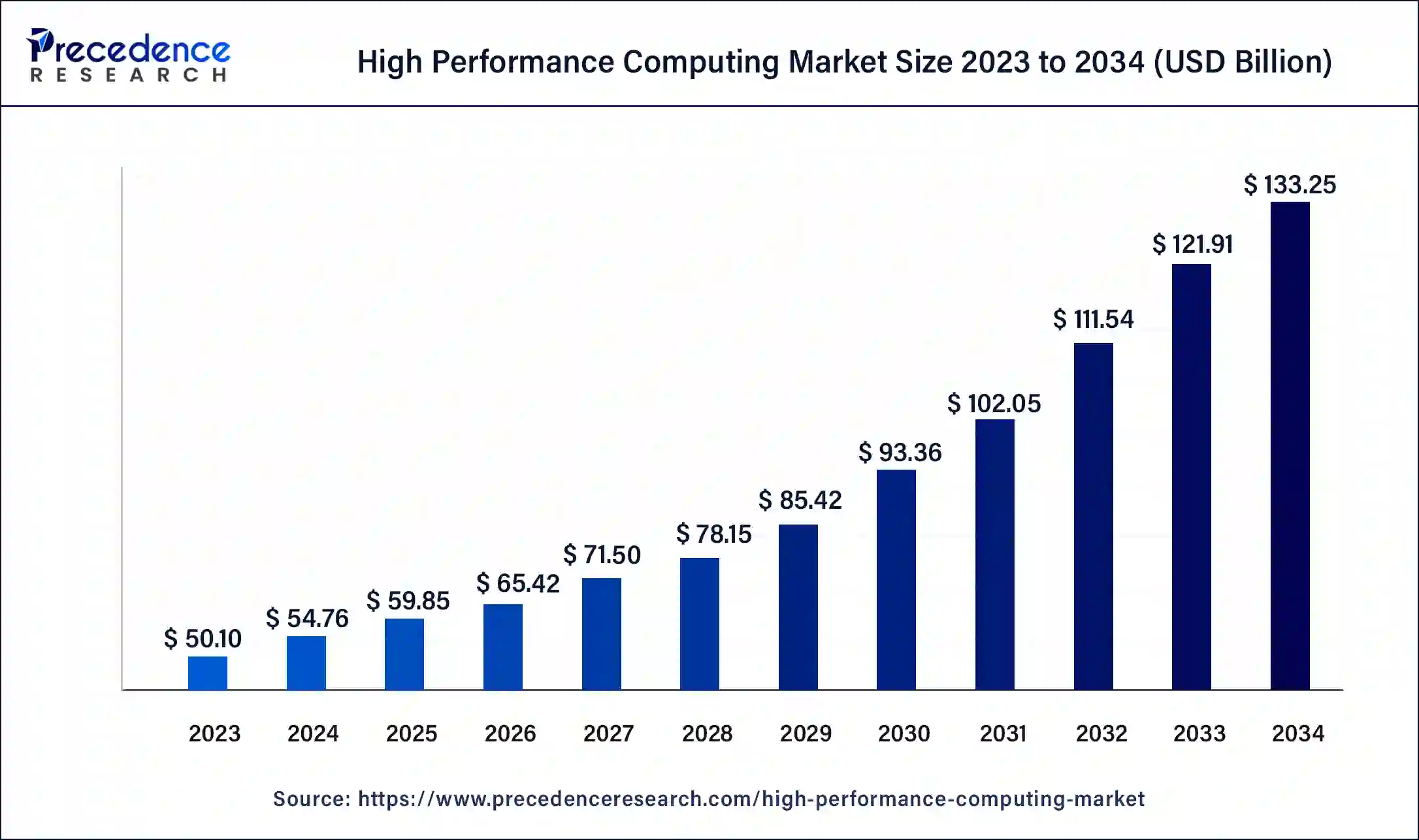
The global high-performance computing market was valued at USD 59.85 billion in 2025 and is projected to grow from USD 65.42 billion in 2026 to USD 141.62 billion by 2035, registering a CAGR of 9.8% during the forecast period from 2026 to 2035.
Get a Free Sample Report with Key Market Trends: https://www.precedenceresearch.com/sample/1572
Top NVIDIA Competitors in Artificial Intelligence and High-Performance Computing
Leading competitors to NVIDIA include hyperscalers building custom silicon such as Google, AWS, Microsoft, Meta, merchant silicon providers such as AMD, Intel, specialized hardware startups like Cerebras, and also networking powerhouses such as Broadcom and Marvell. These firms compete by combining GPU innovation, custom AI processors, integrated hardware-software ecosystems, and cloud-native AI platforms.
AMD (Advanced Micro Devices)
AMD is revolutionizing from a standalone chip vendor into a full-stack, rack-scale data center powerhouse to directly challenge NVIDIA. By combining Instinct AI accelerators, EPYC processors, along with ROCm software into integrated, turnkey systems such as the Helios rack-scale solution, AMD provides hyperscalers and enterprises with a highly scalable, open option for large-scale AI training and inference.
Intel
Intel’s 2026 AI and computing strategy prioritizes highly scalable inferencing, disaggregated client GPUs, along with open software ecosystems. The firm targets enterprise choice, leveraging new architectures and even hybrid cloud-to-edge models to counter dominant competitors. Intel pushes an open, standards-based, unified programming model through oneAPI. Designed to work natively across CPUs, GPUs, and Gaudi accelerators, oneAPI minimizes vendor lock-in and enables developers to optimize hybrid workloads using tools like oneMKL and oneDNN.
Broadcom
Broadcom dominates the modern AI hardware ecosystem by changing from a traditional semiconductor vendor to the premier architect of custom hyperscaler silicon. Broadcom provides the underlying technological building blocks, including DSPs, SerDes, and PCIe switches, necessary to build robust gigawatt-scale AI clusters. This enables the world's largest tech labs to train frontier models at a fraction of the cost.
Marvell Technology
Marvell builds end-to-end infrastructure for accelerated AI, high-speed interconnects, supplying custom ASICs, and data center switching to hyperscalers. The firm is driving next-gen AI workloads, optimizing power efficiency and decreasing reliance on traditional merchant silicon.
Qualcomm
Qualcomm’s edge-to-cloud computing strategy centers on power-efficient, heterogeneous hardware which distributes AI workloads across devices, vehicles, and even data centers. By combining purpose-built NPUs, CPUs, and GPUs, Qualcomm thus delivers high performance-per-watt, allowing complex models to run locally without cloud dependency.
Google (Tensor Processing Units - TPU)
Google’s AI ecosystem combines purpose-built hardware, expansive foundation models, along with scalable cloud orchestration into a unified infrastructure. It allows enterprises to train, tune, and deploy large-scale models securely, thus leveraging hardware specifically optimized for tensor operations.
Amazon Web Services (Trainium and Inferentia)
AWS Trainium and Inferentia are purpose-built custom silicon chips designed to improve AI workloads and drastically reduce cloud costs. Integrated natively into Amazon Bedrock, they allow enterprises to run highly scalable, cost-efficient generative AI and even cloud-native workloads while minimizing dependency on traditional GPUs.
Microsoft (Azure Maia AI Accelerator)
Microsoft's AI strategy is a vertically integrated, end-to-end ecosystem. By combining in-house custom silicon such as the Maia 200 accelerator, deep infrastructure investments with OpenAI, and heterogeneous hardware from partners such as AMD, Microsoft enables massive cost reductions along with optimal cloud inference economics for enterprise deployments.
Meta Platforms (MTIA)
Meta’s custom MTIA chips are central to its strategy to decrease reliance on third-party processors such as Nvidia. Built alongside industry giants, these specialized chips target power-efficient inference along with training, specifically accelerating Meta’s massive recommendation systems and Llama model development.
NVIDIA's Competitive Advantages in AI and HPC
NVIDIA maintains a commanding market share in AI accelerators because it offers an integrated ecosystem rather than just selling chips. By co-designing hardware, proprietary software, and even networking into massive AI supercomputers, they create deep technical switching costs and development moats that competitors continually struggle to match.
Networking Technologies
Training frontier AI demands thousands of GPUs to act as a single, unified brain. This means networking is just as crucial as compute power.
- NVLink & NVSwitch: NVIDIA NVLink offers high-speed, chip-to-chip and node-to-node interconnects, enabling GPUs to share memory pools.
- InfiniBand/Ethernet Fabric: Technologies such as the NVIDIA Spectrum platform and BlueField DPUs offload networking tasks from the host CPU, allowing low-latency data transfers across massive GPU clusters.
CUDA Software Ecosystem and Developer Adoption
Nvidia’s ecosystem creates formidable switching expenses for enterprises by integrating hardware and software. Because deep learning along with AI models are heavily compiled to target Nvidia’s proprietary architecture, migrating to alternative hardware demands rewriting low-level code, validating numerical stability, and facing severe performance penalties that increase time-to-market.
CUDA: Serving as the foundation for the ecosystem, CUDA enables developers to tap into parallel processing capabilities. Millions of codebases across PyTorch, TensorFlow, along with JAX have been written with CUDA as the default target, thus creating strong developer inertia.
TensorRT: An inference optimizer that compresses and accelerates trained models, enabling deployment with low latency. Replicating the specific matrix mathematics along with tensor fusion techniques of TensorRT without dropping performance demands a complete rebuild of the deployment pipeline.
Leadership in AI Data Centers
Nvidia’s market supremacy hinges on its transformation from a standalone chip vendor into an integrated systems supplier. The company pairs its high-performance GPUs with the CUDA software ecosystem, proprietary interconnects such as NVLink, and networking tech like InfiniBand/Spectrum-X. This full-stack approach delivers the lowest cost per token and fastest time-to-market for large-scale AI. To lower the acceptance barrier for standard corporate IT, Nvidia has expanded into air-cooled enterprise servers with standard x86 and then Ethernet support, bypassing the need for complex, liquid-cooled data centers.
End-to-End AI Computing Platform
NVIDIA integrates these disparate technologies into a unified ecosystem to change its business from merely selling individual chips to becoming the foundational operating infrastructure for all of AI. This full-stack strategy creates massive performance synergies, drives new markets, and then establishes an incredibly strong competitive moat. Real-world data is scarce, expensive to collect, and risky to experiment with. By unifying AI frameworks with physically accurate simulation platforms such as Omniverse, NVIDIA enables developers to virtually train robots, generate synthetic data, and validate safety protocols before ever deploying into the real world.
Market Share Analysis of AI and HPC Competitors
Leading companies across the AI hardware along with infrastructure stack include major players in cloud deployments, GPUs, and HPC systems. The landscape is currently defined by a mix of hyperscale cloud providers and even specialized AI hardware manufacturers.
- Hewlett Packard Enterprise (HPE): Offers the Cray supercomputing line and even fully integrated AI platforms, pairing high-speed networking along with liquid-cooled infrastructure for industrial-grade AI and research.
- Dell Technologies: Provides purpose-built AI servers, such as the PowerEdge XE9680 equipped with NVIDIA or AMD GPUs, designed specifically to manage large language model training inside on-premises corporate datacenters.
AI Training Accelerator Market
NVIDIA dominates the AI training landscape, holding roughly 80% market share. AMD provides high-performance Instinct GPUs and open-source software, capturing market share. Intel Gaudi accelerators lag in large-cluster deployments, while Cerebras focuses on wafer-scale computing for extreme model parameters.
Company / Provider: NVIDIA
- AI Training Performance & Scalability: Unmatched multi-node scalability for large language models.
- Software Support: The NVIDIA CUDA platform is highly mature and needed by most production ML frameworks.
- Hyperscaler Adoption & Ecosystem: Deepest integration across Microsoft Azure, AWS, and Google Cloud.
AI Inference Processor Market
The shift toward inference-focused processors is driven by the explosive expansion of "agentic" and conversational AI. Because running these models is fundamentally different from building them, and hyperscalers build custom Application-Specific Integrated Circuits (ASICs) to bypass the high costs, hardware scarcity, and power constraints of general-purpose GPUs.
Natural Language Generation: Processors such as Microsoft Maia and AWS Inferentia feature native low-precision tensor cores, for example, FP8 and FP4, and massive, high-bandwidth memory architectures programmed to keep large language models constantly fed with data.Nvidia Dependency: For years, the industry relied on Nvidia's GPUs and their proprietary CUDA software ecosystem, thus making cloud providers vulnerable to supply chain bottlenecks and premium pricing. Custom chips enable tech giants to diversify their hardware fleets.
High-Performance Computing Market
GPU vendors and AI accelerator providers, such as NVIDIA, Google, and Intel, support these sectors because combining AI with traditional simulation yields vast computational speedups, greater energy efficiency, and new scientific breakthroughs. AI hardware is highly adaptable, enabling these providers to scale workloads across massive computing centers. Integrating AI with traditional physics models, for example, utilizing NVIDIA’s FourCastNet for weather forecasting, generates rapid, high-resolution predictions. In drug discovery, AI-based molecular dynamics can screen thousands of compounds per second, thus completing work in hours that would take CPUs weeks.
Competitive Landscape of the AI and HPC Industry
NVIDIA remains the dominant force in the AI hardware along with software ecosystem, commanding roughly of the data center GPU market with products such as the Blackwell and Vera Rubin architectures. Its primary rivals include traditional silicon vendors, emerging custom ASIC developers, along with major cloud hyperscalers building proprietary AI solutions.
Intel is leveraging its historical x86 CPU dominance and even its foundry business to capture the growing AI inference and enterprise upgrade market.
- Hardware: The Gaudi 3 accelerators offer a cost-effective alternative for power-conscious enterprise deployments.
- Software: Heavy investment into open standards via the oneAPI initiative and SynapseAI to counter CUDA's lock-in.
- Strategy: Targeting cost-sensitive customers who are not bound to proprietary cloud-specific silicon.
Comparison Based on AI Hardware Innovation
Modern AI workloads, like LLMs, demand immense parallel processing, billions of matrix operations, and rapid data movement. These technologies work together to overcome physics and also memory constraints, driving performance to scale seamlessly from edge devices to global data centers. AI models are growing at an exponential rate. Moreover, scalable hardware enables systems to be seamlessly clustered together across thousands of nodes in data centers, thus ensuring that training and inference times shrink as compute resources expand.
The ultimate metric of these combined elements. Thus, by merging specialized processing, advanced packaging, and also massive bandwidth, systems can achieve peak trillions of operations per second (TOPS/FLOPS).
Comparison Based on Software Ecosystems
The entire ecosystem, from proprietary low-level drivers such as NVIDIA CUDA to cloud platforms and even high-level enterprise software, must work together to translate human-readable Python code into the complex matrix operations thus, executed by specialized AI hardware.
- AWS & Azure AI: Cloud ecosystems that abstract away the underlying silicon to offer scalable, enterprise-grade AI infrastructure; for example, AWS Trainium or Inferentia and managed services such as Azure OpenAI.
- Developer Tools & Enterprise Software: Compilers, debuggers, and container orchestration tools, like Kubernetes, that enable companies to seamlessly integrate models into secure, production-grade applications.
Comparison Based on Cloud and Enterprise Integration
Building a robust AI ecosystem depends on multi-dimensional partnerships. Hyperscale cloud providers provide global capacity; enterprise vendors embed security; system integrators drive deployment; research institutions accelerate innovation; and AI infrastructure providers supply specialized compute fabrics. Collaborations with universities and labs, such as NVIDIA's academic deployments, test frontier models, advance algorithm development, and offer early access to specialized AI infrastructure. Vendors, for example, Salesforce and IBM, ensure AI deployments align with strict corporate governance, data privacy standards, and then regulatory compliance.
Strategic Investments, Partnerships, and Acquisitions
Leading AI semiconductor firms, such as NVIDIA, AMD, Intel, and Broadcom, secure their competitive edge by transforming from simple chipmakers into full-stack infrastructure providers. Thus, they achieve this by delivering integrated hardware and software ecosystems.
- Supply Chain Resilience: Advanced node production demands massive capital, leading companies to partner primarily with dedicated foundries such as TSMC to secure capacity for complex, multi-die architectures.
- Software & Systems Focus: Instead of solely buying design talent, and acquisitions increasingly target software-stack and system-integration capabilities.
- Examples: NVIDIA bought Mellanox to dominate high-speed networking. AMD strengthened its compiler software by obtaining Nod.ai, and fortified its data center rack deployment skills by acquiring ZT Systems. Intel obtained Habana Labs to bolster its deep learning accelerators.
Investments in AI Chip Innovation
Investments in these technologies are driven by the urgent demand to overcome the physical limits of traditional semiconductors. They remove data bottlenecks, reduce energy costs, and scale compute power to meet the explosive needs of modern AI models. They offer the massive parallel processing power demanded to train and run increasingly complex Large Language Models (LLMs) and deep learning algorithms. Moreover, it replaces traditional copper wiring with optical connections to move data between GPUs and servers at the speed of light. This drastically decreases latency and energy consumption in large-scale data centers.
Cloud and Hyperscaler Partnerships
Collaborations across major cloud providers such as AWS, Microsoft Azure, Google Cloud, Oracle Cloud, enterprise customers, and AI infrastructure providers are essential as AI requires massive, specialized computing scale, along with businesses demanding flexible, multi-cloud environments. No single firm possesses all the required capital, computing power, and enterprise data to succeed alone. Enterprise customers refuse to tie themselves to a single cloud. Providers must collaborate to enable businesses to run split-stack operations, for example, keeping databases in Oracle Cloud while training AI models in Google Cloud or AWS.
Manufacturing and Supply Chain Expansion
The explosion of generative AI along with data-center workloads has rendered traditional single-chip manufacturing obsolete. AI processors such as GPUs demand massive, continuous data transfers, thus making their performance heavily dependent on both cutting-edge processing power and how their components are associated and supplied. Standard memory is too slow to feed AI processors. HBM offers the rapid memory bandwidth needed, so AI chips don't sit idle while waiting for data. A secure HBM supply is currently one of the most vital and constrained chokepoints in AI hardware.
Industry Applications Driving AI and HPC Competition
Industries are driving a massive need for AI accelerators and High-Performance Computing (HPC) platforms to process colossal data volumes, fuel Generative AI, and even enable real-time analytics. Computing limits have created a demand for specialized hardware that drastically enhances computational speed and energy efficiency over traditional CPUs.
- AMD: Specializes in high-density memory along with cost-effective AI inference (the process of running a trained AI model). They provide high-performance CPUs and GPUs tailored for enterprise data centers.
- Intel: Bridges general-purpose compute and accelerated computing, thus specializing in CPUs for foundational control tasks, data pre-processing, and even flexible AI deployments.
Generative Artificial Intelligence
These technologies form an interconnected ecosystem which moves AI from experimental concepts to scalable, commercial applications. Businesses implement these capabilities together to automate tasks, generate content, and even derive actionable, data-driven insights. Systems are programmed to process and synthesize multiple data types simultaneously, such as combining text, audio, images, along with video, for a richer understanding of context.
Scientific Research and Supercomputing
Supercomputers power modern research by simulating physical phenomena along with processing massive datasets at unprecedented speeds. They allow rapid breakthroughs across science and also engineering, transforming how we understand biology, design advanced technology, and handle global challenges.
- Genomics: Supercomputers process and work with petabytes of Next-Generation Sequencing (NGS) data, cutting analysis times from months to hours. They are broadly applied in precision medicine and disease modeling.
- Quantum Research: High-performance computing offers the critical infrastructure needed to simulate, test, and control complex quantum circuits and even algorithms before implementing them on physical quantum processors.
Cloud Computing and Enterprise AI
Enterprises adopt these modern technologies to move AI pilots into full-scale production. They offer the agility to scale rapidly, reduce infrastructure costs, and then enforce strict governance. Together, they form a cohesive roadmap to automate processes, unify scattered data, and even drive a data-driven culture. Moreover, AI IaaS removes the heavy burden of hardware ownership by offering specialized, high-performance environments, such as on-demand GPU access for model training and inference. This allows firms to control data locality and achieve predictable latency without massive capital expenditures.
Autonomous Vehicles and Robotics
AI processors are demanded to support these fields as they transition systems from pre-programmed, rigid tools into intelligent, adaptive agents capable of interacting with the physical world. Moreover, specialized AI chips process immense streams of sensor and visual data with zero delay, allowing the real-time autonomy demanded for safety and efficiency. AI processors bridge the gap between digital models and real-world actions. They allow robots and drones to adapt to unstructured, real-world environments without constant human supervision.
Emerging Trends Reshaping AI Computing Competition
Interconnected forces are challenging the semiconductor industry from general-purpose CPUs to purpose-built, highly specialized architectures. Moreover, competition is no longer solely defined by transistor miniaturization, but by who can master the entire hardware stack, lower data-transfer bottlenecks, and then solve the critical constraint of power. Hyperscalers, for example, Google, Meta, Amazon, and Microsoft, are bypassing general-purpose hardware by deploying custom Application-Specific Integrated Circuits (ASICs). This change decreases reliance on external suppliers such as Nvidia, significantly reduces operating costs, and enables companies to tune hardware directly to their specific generative AI and inference workloads.
Rise of Custom AI Silicon
Cloud providers are programming custom, proprietary AI chips, Application-Specific Integrated Circuits (ASICs), to bypass the "general-purpose tax" of traditional GPUs. This transition assists them in drastically lower operational costs, optimizing performance for specific software stacks, and establishing vertical independence. Hardware and software are co-designed. For example, AWS pairs its chips with custom compilation frameworks, while Google uses hardware such as Tensor Processing Units (TPUs) to accelerate specific model architectures.
Proprietary chips enable providers to build cloud instances that deliver significantly better price-to-performance metrics than off-the-shelf merchant silicon.
Energy Efficiency Becoming a Competitive Advantage
Innovations across the AI hardware and infrastructure stack are essential because explosive expansion in computing demands is creating severe physical, financial, along with environmental bottlenecks. Without these advancements, scaling AI will quickly become economically and even ecologically unsustainable. High-performance AI clusters generate heat densities exceeding those of a nuclear reactor core. As traditional air cooling is mathematically insufficient for modern racks, data centers demand Direct-to-Chip and Immersion Cooling to prevent hardware failure and keep facilities running reliably.
Challenges Facing NVIDIA Competitors
Competing with NVIDIA is an uphill battle across multiple bottlenecks, from NVIDIA’s deep software lock-in to constrained worldwide manufacturing pipelines. To challenge this dominance, tech giants and semiconductor companies are aggressively investing in open software stacks, custom silicon, and strategic collaborations to bypass the NVIDIA moat. The AI research and developer community is deeply entrenched in CUDA-native environments such as PyTorch and TensorFlow, making it challenging for alternative architectures to attract widespread, organic adoption.
Competing Against NVIDIA's Software Ecosystem
The challenge of matching CUDA, AI libraries, enterprise support, developer communities, and ecosystem maturity boils down to network effects and even lock-in. Because NVIDIA developed CUDA as a tightly integrated, proprietary stack nearly two decades ago, it accumulated massive institutional knowledge and framework support, along with reliability that hardware competitors struggle to replicate. Corporate tech stacks demand reliable, backwards-compatible software and tested cluster management. Enterprises usually choose CUDA to avoid downtime, support tickets, along with performance bugs, even when hardware costs are high.
Scaling Manufacturing and Global Supply Chains
AI chip production struggles with hardware delays as physical integration now matters more than just printing raw silicon. Modern AI accelerators demand heavily interconnected dies to avoid data bottlenecks, thus making fabrication speed dependent on specialized memory, complex packaging techniques, and a deeply strained, even geographically concentrated global supply chain. AI workloads demand extreme data transfer rates, depending on HBM stacks that are vertically integrated with the processor. HBM is vastly larger along with more complicated to build than standard memory, consuming remarkably more silicon wafer space and taking over production lines. As only a few suppliers manufacture HBM at scale, supply is severely constrained.
Future Outlook for Competition in AI and High-Performance Computing
The future AI competitive landscape is defined by massive worldwide infrastructure investment and relentless innovation. Enterprise acceptance is pushing hardware limits, transforming computing into a sovereign and architectural race. Established semiconductor giants along with emerging accelerator developers are locked in intense competition to meet unprecedented compute needs. Moreover, national security and data privacy concerns have sparked a global drive to build localized AI factories and even compute resources to govern and commercialize AI models at regional levels.
To prevent vendor lock-in, open software ecosystems are becoming a core infrastructure pillar. This gives developers, along with enterprises, the freedom to mix-and-match hardware without being bound to proprietary software stacks.
AI Infrastructure Demand Will Continue Expanding
Enterprise AI deployment, sovereign AI projects, hyperscale cloud expansion, and scientific computing collectively sustain long-term need for AI accelerators and HPC platforms by shifting market dynamics from hardware-scarce phases to vast, sustained infrastructure pipelines. These four pillars enforce continuous upgrades and massive hardware volume. Because AI model complexity grows exponentially, and the accelerator density per cluster increases with each generation. Hyperscalers are creating immense “AI factories” demanding high-bandwidth memory (HBM), ultra-fast networking fabrics, along with liquid cooling technologies. Because model training and even continuous fine-tuning are perpetual, this guarantees sustained bulk procurement of top-tier accelerators.
Software Ecosystems Will Define Long-Term Market Leadership
Hardware performance is no longer the sole metric for computing supremacy. Today, how easily, scalably, and securely technology can be built and even deployed has become just as vital. The battle centers around abstraction layers. Developers favor frameworks that strike the right balance between ease of experimentation and even production-ready performance across different hardware types. Moreover, for long-term adoption, technologies must integrate securely with existing legacy systems, regulatory compliance requirements, and even business workflows.
Conclusion: Competition Is Accelerating Innovation Across AI and High-Performance Computing
NVIDIA maintains undisputed leadership in the AI and HPC markets via its fully integrated hardware-software ecosystem. Its mature CUDA software framework thus creates deep developer loyalty and high switching expenses, while continuous architectural advancements, like the Blackwell and Vera Rubin systems, deliver highly optimized computing, networking, and even memory capabilities. AMD continues to challenge NVIDIA's flagship GPUs with its Instinct accelerator line, while Intel leverages its expansive data center Xeon install base. Qualcomm is targeting edge and cloud inference with its Cloud AI 100 line.
Huawei, constrained by trade restrictions, has built a formidable, thus, localized Chinese ecosystem consisting of the Ascend semiconductor series and even the CANN software stack.
About the Authors

Aditi Shivarkar
Aditi, Vice President at Precedence Research, brings over 15 years of expertise at the intersection of technology, innovation, and strategic market intelligence. A visionary leader, she excels in transforming complex data into actionable insights that empower businesses to thrive in dynamic markets. Her leadership combines analytical precision with forward-thinking strategy, driving measurable growth, competitive advantage, and lasting impact across industries.



Aman Singh
Aman Singh with over 13 years of progressive expertise at the intersection of technology, innovation, and strategic market intelligence, Aman Singh stands as a leading authority in global research and consulting. Renowned for his ability to decode complex technological transformations, he provides forward-looking insights that drive strategic decision-making. At Precedence Research, Aman leads a global team of analysts, fostering a culture of research excellence, analytical precision, and visionary thinking.

Piyush Pawar
Piyush Pawar brings over a decade of experience as Senior Manager, Sales & Business Growth, acting as the essential liaison between clients and our research authors. He translates sophisticated insights into practical strategies, ensuring client objectives are met with precision. Piyush’s expertise in market dynamics, relationship management, and strategic execution enables organizations to leverage intelligence effectively, achieving operational excellence, innovation, and sustained growth.