






 Request Consultation
Advanced photolithography equipment enables precise microchip manufacturing through UV light, photomasks, and wafer scanners. With High-NA EUV and AI-assisted monitoring, these systems ensure high yield, process efficiency, and global competitiveness in semiconductors for AI, 5G, and electric vehicles.
What is Photolithography Equipment?
The photolithography equipment, also known as a photolithography stepper or scanner, is a semiconductor manufacturing machine. The machine uses high-intensity UV light, a photomask, and photoresist to transfer intricate, microscopic, and geometric patterns onto a silicon wafer, thereby creating microchips. The entire procedure is also crucial for transferring electrical circuits and patterns onto wafers. The photolithography equipment consists of high-precision machines for semiconductor manufacturing, enabling the creation of microscopic transistor patterns.
What is the Photolithography Equipment Market Size in 2026?
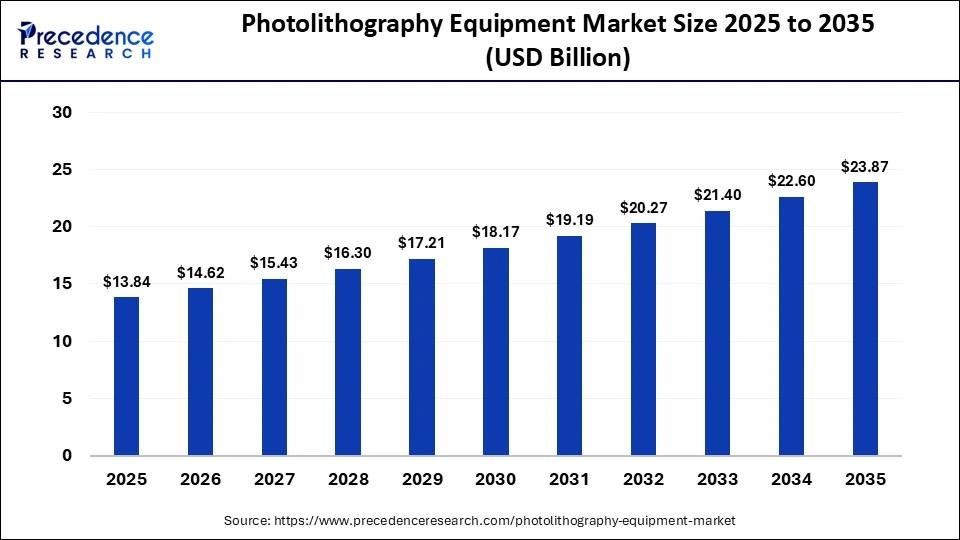
The global photolithography equipment market size accounted for USD 13.84 billion in 2025 and is predicted to increase from USD 14.62 billion in 2026 to approximately USD 23.87 billion by 2035, expanding at a CAGR of 5.60% from 2026 to 2035.
Types of Photolithography Equipment
- EUV Lithography: Extreme ultraviolet lithography (EUV) uses 13.5 nm during chip manufacturing. EUV light is absorbed by air and glass; these systems use advanced reflective multilayer mirrors in a vacuum.
- Wafers/Scanners: Wafers or scanners are known as the primary machines to project circuit designs from a mask onto the wafer. Wafer track systems used for coating, mask aligning, or spin coating are operated with EUV or DUV exposure. Such systems are also helpful to achieve nanometer-level precision for chip manufacturing.
- Photomask: It includes specialized tools for fabrication, inspection, and repair of optical templates to transfer circuit patterns onto silicon wafers. Such systems range from high-precision electron-beam writers to manual mask aligners for microfluidics and research.
- Mask Aligner: It is a high-precision machine used to align a photomask and expose it to UV light to transfer a pattern.
Uses of Photolithography Equipment
- Semiconductor Manufacturing: The primary use of photolithography equipment involves semiconductor manufacturing by printing and creating transistor structures and circuit layers on silicon wafers for microchips.
- Flat Panel Displays: Photolithography equipment is essential for forming submicron pixel circuits on glass substrates in electronic devices such as TVs, smartphones, and advanced display technologies.
- Research and Prototyping: The segment majorly focuses on speed, flexibility, and cost-efficiency. The segment’s role is also to prove the design work before committing to the massive expenses of industrial mass production.
Technological Advances in Photolithography Equipment
- EUV Adoption: EUV technology is essential for manufacturing advanced chips at 7nm, 5nm, 3nm, and below. The technology is also helpful for replacing complex multi-patterning steps required by DUV systems. It also helps in reducing manufacturing costs and cycle times.
- High-NA EUV: Such systems use larger optics to increase resolution from 13nm to 8nm. The technology is also essential in the future of photolithography equipment for manufacturing 2nm logic nodes.
- Role of AI - AI algorithms help analyze vast datasets to identify microscopic defects with ease and improve the yields in some facilities. Advanced technology in sensors and AI monitoring equipment helps rectify failures to lower the chances of downtime by at least 20%. Advanced models and algorithms are also useful to predict pattern deformations on wafers for real-time adjustments and mask designs.
Future Landscape of the Photolithography Equipment
Growing demand for advanced chips in AI, 5G, and automotive, with EUV leading manufacturing, provides some of the major opportunities for the growth of the field. Some of the key emerging opportunities involve:
- Next Gen Tools: the next-generation tools provide advancements in nanoimprints and maskless lithography to provide a specialized, cost-effective alternative for MEMS, sensors, and quantum computing.
- AI and 5G Demand: Growth in AI, 5G, and 3D packaging is driving the need for higher precision and higher throughput.
- Sustainability Initiatives: Growing focus on energy-efficiency, eco-friendly, and waste-reducing lithography systems, to create a niche system for sustainable and green technology.
Challenges and Opportunities Faced by the Photolithography Equipment Sector
Challenges
- Technical Issues at the Nanoscale: The random behavior of individual photons at extreme EUV wavelengths, known as photon shot noise, causes variation in patterns. It also leads to line edge roughness that can ruin chip functionality.
- High NA EUV Integration: The high numerical aperture extreme ultraviolet (NA EUV) integration increases the NA to create shallower depth of focus, making it difficult to maintain sharp patterns across the entire wafer.
- Anamorphic Optics: Such mirrors halve the exposure field size, forcing manufacturers to stitch two separate mask patterns together with picometer-level precision.
Opportunities
- The HPC Boom: AI accelerators are the major driver of the sector. The upcoming high NA EUV is essential for the chips to provide them with higher density. The sector also observes higher demand for 3D IC stacking and chiplets, where patterns are created on interposers connecting different chips.
- Geopolitical Shifts: The segment majorly focuses on subsidizing local chip production to ensure supply chain security. Countries such as India are establishing semiconductor missions to create a massive new market for equipment vendors.
- AI Integrated Equipment: Higher adoption of software creating lithography process allows fabs to stimulate runs and identify errors before even touching the wafer. Advanced technology also helps the sector to predict when a laser or lens needs calibration. It helps to lower the chances of downtime by at least 20%, highly helpful for the manufacturers.
An Engaging Journey through Global Insights
Asia-Pacific’s Contribution to Semiconductor Foundries
Asia-Pacific has a major growth in the photolithography equipment sector. This leadership is highly propelled by growing semiconductor foundries in Taiwan, South Korea, Japan, and China.
- China: The country had the largest revenue share of the domain in 2025. It had also faced export restrictions on EUV tools.
- Taiwan: The country acts as a nerve center for advanced nodes. The region leading global EUV adoption was also termed as the first pilot High-NA EUV tools for sub-2nm development.
- India: The country is the emerging hub for photolithography equipment, where the growth of the sector is fuelled by government initiatives like the India Semiconductor Mission, which is helpful to explore local lithography opportunities.
- South Korea: The photolithography equipment sector is majorly driven in the region by companies such as Samsung Electronics and SK Hynix. The market in the region also heavily focuses on logic and high-density DRAM production.
- Japan: The country is a provider of vital components for the domain, including high-precision optics and photoresists.
Latest Photolithography Equipment Trends
- The transition to sub-2 nm nodes is helping the next generation of scanners to enter high-volume manufacturing.
- The sector’s growth in the region is also propelled by growing local semiconductor manufacturing.
- The big giant names of photolithography equipment are also expanding their NIL technology in the region, which functions like a stamp and consumes at least 90% less energy than EUV.
- Advancing technology in the sector in the region is helping to connect specialized components within a single package.
North America: Technological Advances Driving Photolithography Equipment Demand
The sector’s role in the region is mainly characterized as a global leader in R&D and advanced node adoption. The sector’s growth in the region is also driven by AI, growth in cloud computing, and the reshoring of chip manufacturing.
- U.S.: The region has a major contribution in the photolithography equipment sector due to massive investments in domestic semiconductor fabrication and advanced chip production for AI and 5G. The region is also home to world-leading equipment suppliers and IDMs.
- Mexico: The country’s expanding role in electronics assembly and manufacturing has helped the sector to grow. The USMCA trade agreement and the ProMexico initiative helped in fueling the technological collaboration and investment in the local semiconductor supply chain.
- Canada: The country contributes through specialized R&D and participation in the broader North American semiconductor ecosystem, supported by technical innovations.
Latest Photolithography Equipment Trends
- The CHIPS and Science Act in the region has catalyzed a multi-billion-dollar expansion of domestic fabrication capacity.
- The major shift of the sector from EUV to High NA EUV has also helped the sector to grow rapidly in the region.
- Higher usage of AI in the sector is helpful for equipment lifecycle management and patterning precision.
- The industry’s focus has also shifted towards advanced packaging, which is helpful for the sector’s growth.
Conclusion
The photolithography equipment sector has observed various changes in its technology through its growing years. The changes were also fluctuating as per the region’s demands globally, along with the supportive technological advancements. Supportive government policies also have a major role in the growth of the photolithography equipment sector.
Expert Advise
According to Precedence Research, the need for photolithography equipment is burgeoning with the massive demand for semiconductors. The rapid proliferation of AI, 5G, and electric vehicles, along with the rapid adoption of digitization across various sectors, promotes the use of semiconductor chips. The future of photolithography equipment is promising, driven by emerging government policies that support the integration of semiconductors in numerous sectors and encourage the indigenous manufacturing of semiconductors to fulfill global demand.
About the Authors

Aditi Shivarkar
Aditi, Vice President at Precedence Research, brings over 15 years of expertise at the intersection of technology, innovation, and strategic market intelligence. A visionary leader, she excels in transforming complex data into actionable insights that empower businesses to thrive in dynamic markets. Her leadership combines analytical precision with forward-thinking strategy, driving measurable growth, competitive advantage, and lasting impact across industries.



Aman Singh
Aman Singh with over 13 years of progressive expertise at the intersection of technology, innovation, and strategic market intelligence, Aman Singh stands as a leading authority in global research and consulting. Renowned for his ability to decode complex technological transformations, he provides forward-looking insights that drive strategic decision-making. At Precedence Research, Aman leads a global team of analysts, fostering a culture of research excellence, analytical precision, and visionary thinking.

Piyush Pawar
Piyush Pawar brings over a decade of experience as Senior Manager, Sales & Business Growth, acting as the essential liaison between clients and our research authors. He translates sophisticated insights into practical strategies, ensuring client objectives are met with precision. Piyush’s expertise in market dynamics, relationship management, and strategic execution enables organizations to leverage intelligence effectively, achieving operational excellence, innovation, and sustained growth.