



Photolithography Equipment Market Trends, Companies, Revenue / Sales Performance, Manufacturing Yield, Fab Capacity, Export & Import Dynamics, Supply Chain Analysis, Competitive Landscape, and Growth Forecast
Photolithography Equipment Market (By Process: Ultraviolet UV, Deep Ultraviolet (DUV), Extreme Ultraviolet (EUV), Others; By Light Source: Mercury Lamp, Fluorine Laser, Excimer Laser, Others; By Wave Length: 370nm -270nm 270nm - 170nm, 70nm - 1nm; By End-Use: Integrated Device Manufacturer (IDMs), Foundry) - Global Industry Analysis, Size, Trends, Leading Companies, Regional Outlook, and Forecast 2026 to 2035
Source: https://www.precedenceresearch.com/photolithography-equipment-market
 Get a Sample
 Table Of Content


What is the Photolithography Equipment Market Size in 2026?
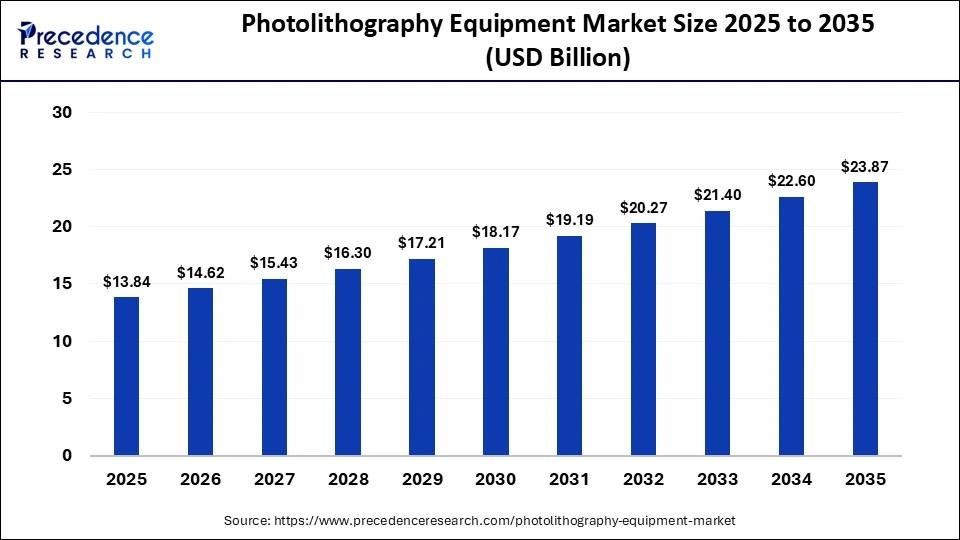
The global photolithography equipment market size accounted for USD 13.84 billion in 2025 and is predicted to increase from USD 14.62 billion in 2026 to approximately USD 23.87 billion by 2035, expanding at a CAGR of 5.60% from 2026 to 2035. The photolithography equipment market is observed to grow rapidly due to factors such as growing demand for compact electronic devices, propelling demand for advanced technology such as IoT, AI, and ML, along with the advancing semiconductor industry.
Key Takeaways
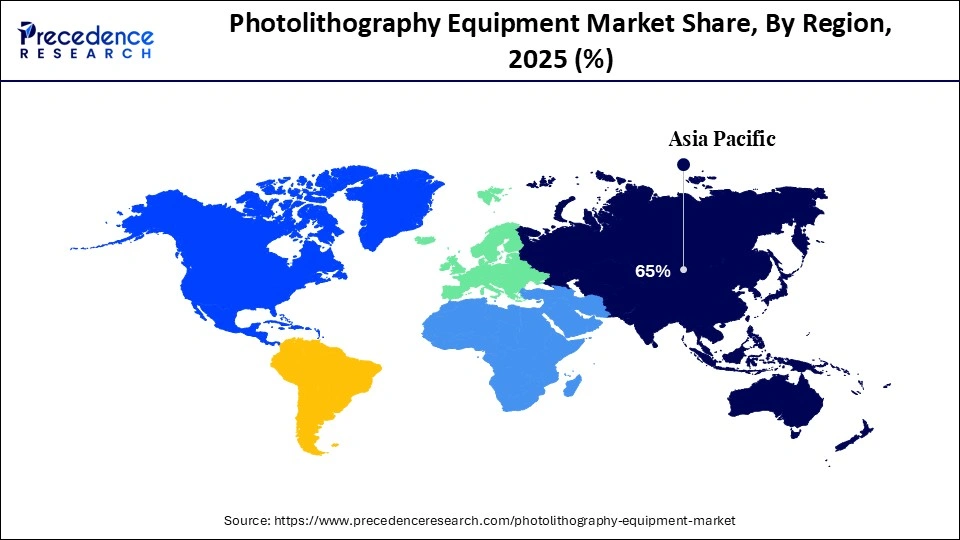
- Asia-Pacific led the global market with the largest market share of 65% in 2025.
- North America is expected to be the fastest-growing region in the foreseeable period.
- By process, the ultraviolet (UV) segment dominated the global market in 2025.
- By process, the deep ultraviolet (DUV) segment is expected to expand significantly in the foreseeable period.
- By light source, the excimer laser segment registered its dominance over the global market in 2025.
- By light source, the mercury lamp segment is expected to grow at a notable CAGR in the coming years.
- By wavelength, the 270nm to 170nm segment held the largest market share in 2025.
- By wavelength, the 370nm to 270nm segment is expected to show lucrative growth in the coming years.
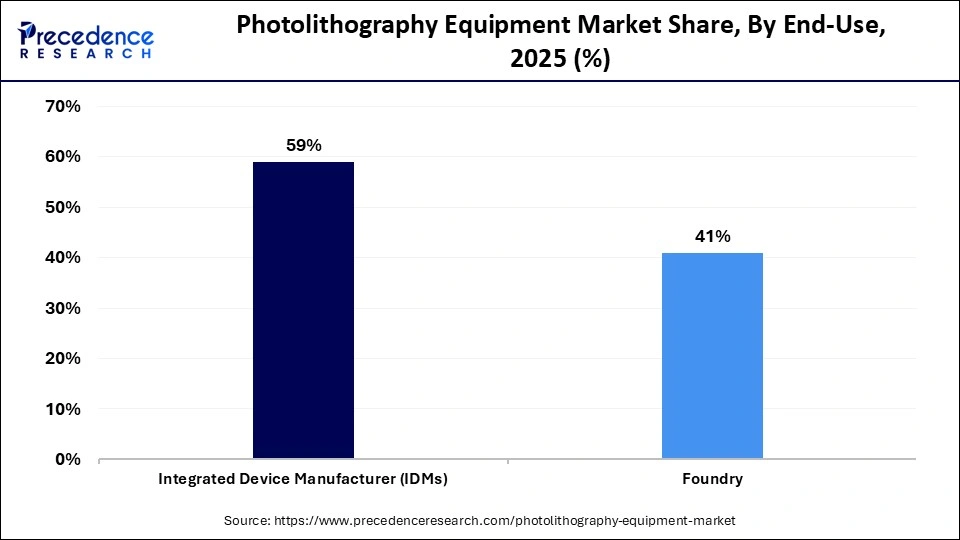
- By end use, the integrated device manufacturers (IDMs) segment contributed the biggest market share of 59% in 2025.
- By end use, the foundry segment is expected to show the fastest growth over the forecast period.
What is the Photolithography Equipment Market?
The photolithography equipment industry involves the use of machinery such as extreme ultraviolet (EUV), deep ultraviolet (DUV), and i-line to transfer circuit patterns onto semiconductor wafers. The market also involves sales and servicing of tools to create microchips, along with paying attention to advanced packaging demand. The market is also abbreviated as the global trade of optical systems useful for semiconductor fabrication and other industries requiring precision work to transfer geometric patterns from a photomask onto a substrate. Such silicon wafers are treated with a light-sensitive chemical known as photoresist.
Role of Technology in the Growth of Photolithography Equipment Market
- Use of Advanced Process Nodes: The major shift of the industry from DUV to EUV has helped manufacturers to produce chips with higher densities, helpful for domains such as AI, 5G, and high-performance computing. Advancements in wavelength control are also essential for the production of compact, smart, and efficient memory chips. The segment is also driven by higher requirements of 2nm and below, leading to higher adoption of high-NA EUV.
- Automation and Software Optimization: The optimization and usage of AI and ML in the industry help propel the market's growth. The procedure helps in enhancing the manufacturing process along with improving yields. The segment also signifies the shift of the market from mechanical procedures to intelligent, data-driven manufacturing focused on 7nm node production. The segment also highlights the importance of automation in alignment, wafer handling, and process control to lower human error.
- Use of Innovative Materials and Techniques: Higher usage of materials and techniques supporting the whole procedure is one of the major factors helpful for the growth of the segment. The development of metal-oxide resists and chemically amplified resists helps to improve resolution and sensitivity for finer pattern transfer. Advanced methods such as Nanoimprint Lithography (NIL) are cost-effective alternatives for 3D structures and legacy nodes to diversify the market's technological base.
Photolithography Equipment Market Trends
- AI-Driven Optimization: Generative AI is highly utilized to optimize lens and mask designs. It also helps reduce trial-and-error iterations. The advanced technology also helps in real-time monitoring and predictive maintenance to lower downtime and improve yields.
- Relevance of DUV: DUV systems are cheaper to operate than EUV systems and hence are highly preferred for high-volume manufacturing of mature modes.
- Growing Advanced Packaging: This is majorly driven by 3D stacking, 2.5D interposers, and Fan-Out Wafer-Level Packaging (FOWLP). Advanced packaging is highly preferred by the industry ahead of LED, micro-electromechanical systems (MEMS), and power devices. The segment's growth is also driven by the growing need for sub-10-micron interconnect pitch in AI chips.
Market Scope
| Report Coverage | Details |
| Market Size in 2025 | USD 13.84 Billion |
| Market Size in 2026 | USD 14.62 Billion |
| Market Size by 2035 | USD 23.87 Billion |
| Market Growth Rate from 2026 to 2035 | CAGR of 5.60% |
| Dominating Region | North America |
| Fastest Growing Region | Asia Pacific |
| Base Year | 2025 |
| Forecast Period | 2026 to 2035 |
| Segments Covered | Process, Light Source, Wave Length, End-Use, and Region |
| Regions Covered | North America, Europe, Asia-Pacific, Latin America, and Middle East & Africa |
Segmental Insights
Process Insights
Which Process Segment Dominated the Photolithography Equipment Market?
The ultraviolet (UV) segment held the largest market share in 2025, as UV systems are the primary tools for manufacturing CMOS image sensors, power devices, analog ICs, and MEMS. The segment's growth is propelled by growing demand for automotive electronics, IoT devices, and 5G infrastructure. UV is also a cost-efficient solution for manufacturers in search of dependable, mature technologies to offer a high throughput and lower the overall capital expenditure.
The segment's demand is also driven by the higher expansion of UV-LED photolithography due to growing demand for miniaturization, energy efficiency, and sustainability. The major shift of the market observed from traditional mercury vapor lamps to higher-precision excimer laser-based systems is also a major market driver.
The deep ultraviolet (DUV) segment is expected to show lucrative growth in the market over the coming years. DUV operates at shorter wavelengths compared to conventional UV systems. It also enables finer patterning and improved resolution. Hence, it proves to be suitable for high-volume semiconductor manufacturing applications. The segment also provides a cost-effective, high-throughput solution for nodes above 7nm.
Light Source Insights
Why Did the Excimer Laser Segment Dominate the Photolithography Equipment Market?
The excimer laser segment accounted for the highest market share in 2025, as they provide high-energy and short-wavelength light. The segment observes growth due to its stability and high-intensity light output for precise wafer processing and high-throughput fabrication. The widespread use of excimer lasers in advanced semiconductor lithography equipment is another major factor propelling the segment's growth.
The mercury lamp segment is expected to witness significant growth in the market over the forecast period. The segment's growth is mainly driven by factors such as cost-effectiveness, higher reliability, and high-intensity light sources. Such factors are crucial for non-critical, mature-node semiconductor manufacturing, advanced packaging, and MEMS. Mercury lamps are also a cost-effective option compared to excimer lasers or EUV sources, further elevating the segment's growth. Growing demand for fan-out wafer-level packaging, requiring precise lithography, is also a major market driver. High-pressure mercury lamps provide intense, broad-spectrum UV light suitable for exposing large surface areas in semiconductor manufacturing.
Wave Length Insights
Which Wave Length Segment Led the Photolithography Equipment Market?
The 270nm to 170nm segment led the market in 2025. The segment consists of crucial DUV tools like ArFi, due to their higher performance and lower cost compared to EUV. The range is also supportive for smaller, efficient, and connected electronic devices, including 5G, IoT, and automotive applications. The growing need of the market for precision and cost-effective options is leading to significant investment in R&D, which is also a major driver of the market.
The 370nm to 270nm segment is expected to grow at a significant CAGR in the coming years. The segment has a major contribution in manufacturing semiconductor devices that do not require ultra-fine features to support high-volume production of power devices. It is also a dependable and lower-cost alternative for manufacturers to maintain their profitability and legacy chip production. The demand for smaller electronic devices is leading to continued investment in the market. The segment's growth is also supported by integrated device manufacturers to maintain high-volume production cycles.
End Use Insights
How the Integrated Device Manufacturers (IDMs) Segment Dominated the Market?
The integrated device manufacturers (IDMs) segment held a dominant position in the photolithography equipment market in 2025. IDMs control the entire semiconductor production cycle, including fabrication, leading to higher demand for high-end equipment for greater transistor density, performance, and energy efficiency. They are major investors in EUV systems for 5nm chip production.
The segment also observes growth as IDMs upgrade existing lines and expand fabrication facilities for the purchase of new photolithography tools. IDMs involved in DRAM and NAND manufacturing also help to create higher demand for advanced DUV lithography systems. The segment's growth is also driven by the collaboration of IDMs with equipment suppliers to develop next-generation technology to allow the industry to continue scaling down feature sizes.
The foundry segment is expected to grow with the highest CAGR in the market during the studied years. The segment's growth is majorly driven by massive and continuous investments in cutting-edge EUV and DUV technologies to enable 3nm, 2nm, and smaller nodes, along with pushing the equipment vendors to develop precise and advanced lithography tools. The segment also plays a central role in manufacturing for consumer electronics, automotive, and data centers. Tech giants today adopt fabless models and rely completely on foundries for production.
Regional Insights
Asia Pacific Photolithography Equipment Market Size and Growth 2026 to 2035
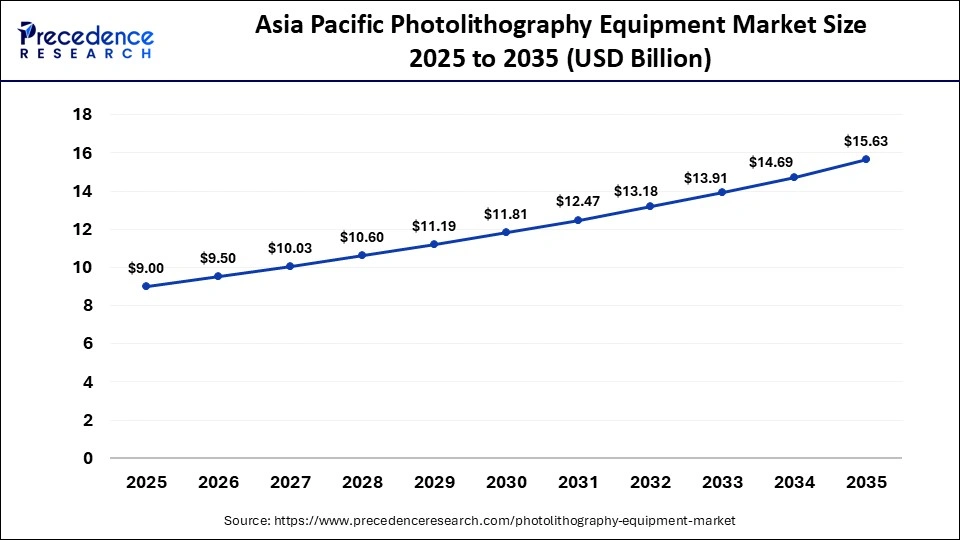
The Asia Pacific photolithography equipment market size is expected to be worth USD 15.63 billion by 2035, increasing from USD 9.00 billion by 2025, growing at a CAGR of 5.67% from 2026 to 2035.
Why Did Asia-Pacific Dominate the Photolithography Equipment Market?
Asia-Pacific held a major market share in 2025. Heavy investments in semiconductor manufacturing in various Asian countries are one of the major factors propelling the growth of the market. Growing demand for advanced lithography technologies, inclusive of EUV and DUV for advanced node fabrication, is also a major market driver. The demand for the market is also fuelled by factors such as 5G, AI, and IoT technologies, along with massive investments in advanced packaging.
Taiwan Market Trends
Taiwan has a major contribution in the growth of the market due to the country's massive investment in advanced nodes, along with accounting for a major portion of global high-end lithography system installations. The country also observes major investments in EUV and mature node fab technologies to support expanding demand.
How is North America Growing in the Photolithography Equipment Market?
North America is expected to host the fastest-growing market in the coming years. The market in the region is driven by higher demand for advanced semiconductor manufacturing, AI, and IoT applications. The market's demand is also propelled by growing demand for advanced chips, advancements in AI technology, and the growing demand for high-performance chips. The market heavily relies on the EUV and DUV systems essential for producing cutting-edge and small-node semiconductors.
U.S. Market Trends
The market in the region is driven by domestic semiconductor manufacturing incentives and advanced node development. Monopoly of EUV systems is helpful for the manufacturing of 5nm, 3nm, and advanced node fabrications, and is also a major market driver in the foreseeable period.
Photolithography Equipment Market Supply Chain Analysis
- Raw Material Procurement: This stage involves the procurement of raw materials, such as photoresist, calcium fluoride, transistors, and silicon wafer.
Key Players: JSR Corporation, Tokyo Ohka Kogyo Co., Ltd. (TOK), Shin-Etsu Chemical Co., Ltd., FUJIFILM Corporation, DuPont de Nemours, Inc., Merck Group, Sumitomo Chemical Co., Ltd., and Allresist GmbH
- Wafer Fabrication: The stage involves a highly automated layer-by-layer process involving coating, exposure, and development. The main aim of the procedure is to achieve nanometer-level precision in defining the 3D structures.
Key Players: Applied Materials, Inc., Tokyo Electron Ltd. (TEL), Lam Research Corporation, and KLA Corporation.
- Lifecycle Support and Recycling: This stage is primarily focused on extending the productive life of expensive machines rather than disposing of them directly.
Key Players: Nikon Corporation, ASML Holding NV, Canon Inc., SÜSS MicroTec SE, Veeco Instruments Inc., and Onto Innovation.
Photolithography Equipment Market Companies
- ASML
- Shanghai Nikon Precision Machinery Co., Ltd.
- Canon Optical Equipment (Shanghai) Co., Ltd.
- Veeco Instruments Inc.,
- Conax Technologies
- TSMC
- Nikon Corporation
- SUSS Microtec SE
- Holmarc Opto-Mechatronics (P) Ltd
- KLA Corporation
Recent Developments
- In October 2025, Axelera AI unveiled its Europa chip, an AI processor unit (AIPU), designed to support high-performance edge computing use cases, including generative AI and computer vision applications. The chip features eight second-generation AI cores incorporating Axelera's advanced Digital In-Memory Compute (D-IMC) technology.(Source: https://www.datacenterdynamics.com)
- In June 2025, Semiconductor Manufacturing International Corporation (SMIC), China's leading chip producer, announced trials for the country's first domestically produced advanced chipmaking equipment. The company is testing a DUV lithography machine to reduce reliance on U.S. imports and Western technology, and increase the production capacity of advanced AI processors. (Source: https://www.ft.com)
Segments Covered in the Report
By Process
- Ultraviolet UV
- Deep Ultraviolet (DUV)
- Extreme Ultraviolet (EUV)
- Others
By Light Source
- Mercury Lamp
- Fluorine Laser
- Excimer Laser
- Others
By Wave Length
- 370nm -270nm
- 270nm - 170nm
- 70nm - 1nm
By End-Use
- Integrated Device Manufacturer (IDMs)
- Foundry
By Region
- North America
- Latin America
- Europe
- Asia-pacific
- Middle and East Africa
For inquiries regarding discounts, bulk purchases, or customization requests, please contact us at sales@precedenceresearch.com
Frequently Asked Questions





Ask For Sample
No cookie-cutter, only authentic analysis – take the 1st step to become a Precedence Research client
 Get a Sample




 sales@precedenceresearch.com
 Schedule a Meeting
