






 Request Consultation
Progressive cavity pumps are vital in modern industrial processes, delivering reliable, high-precision fluid transfer. With AI-powered monitoring, predictive maintenance, and IoT integration, these pumps enhance safety, reduce energy consumption, and extend service life. Industries including oil & gas, chemical processing, and wastewater treatment benefit from PCPs’ ability to handle viscous, abrasive, or sensitive fluids efficiently and sustainably.
In industries where precise and reliable fluid transfer is critical, choosing the right pumping solution can make all the difference. Progressive cavity pumps have emerged as a preferred choice for handling a wide range of fluids, from highly viscous and abrasive materials to shear-sensitive liquids. Their unique design ensures smooth, pulsation-free flow, making them ideal for complex industrial processes where efficiency, consistency, and minimal maintenance are top priorities.
The demand for progressive cavity pumps is growing alongside the increasing need for efficient fluid handling solutions across various sectors. These pumps are renowned for delivering consistent flow even under challenging conditions, making them invaluable in industries such as oil and gas, wastewater treatment, food and beverage, and chemical processing. Their ability to handle viscous, abrasive, and sensitive fluids reliably sets them apart from conventional pumping systems.
As industries strive to improve operational efficiency and transfer fluids in a cost-effective manner, the adoption of progressive cavity pumps is expected to rise. Innovations in pump design, materials, and automation technologies have made these pumps more reliable and durable, allowing them to meet the high standards required in modern industrial operations.
Can AI and Smart Technologies Unlock the Next Revolution in Industrial Fluid Handling?
The Artificial Intelligence in PCPs provides dynamic information on flow, pressure, vibration, and temperature. Predictive algorithms are useful for forecasting component wear, optimizing rotor speed, and controlling working parameters to meet process requirements. This reduces downtime, maintenance costs, energy consumption, and extends the pump’s lifecycle.
- Digital Twins and Simulation Models: These allow operators to simulate pump operations under different conditions, improving efficiency and reducing the risk of operational errors.
- Maintenance Virtual Assistant: Powered by AI, the virtual assistant guides field operators in maintaining the system, troubleshooting issues, and performing adjustments to ensure timely and effective interventions.
Application of Progressive Cavity Pump in Various Industries:
- Oil & Gas: Progressive cavity pumps are utilized in artificial lift, heavy crude transport, and multiphase fluid handling, and they are used to maintain constant flow.
- Water and Wastewater: PCPs are the most appropriate options in terms of sludge, slurry, and wastewater treatment due to the low-shear mode of operation and solids-tolerant structure, which enables municipalities and industries to meet the high-quality environmental criteria.
- Chemical & Food Processing: PCPs handle viscous, abrasive, and sensitive fluids without ruining the quality of the product, which is practical in ensuring uniformity in the processing of chemicals, pharmaceuticals, and food.
- Mining & Power: The processes of transportation of high-viscosity slurry, dewatering, and chemical dosing are premised on high-capacity PCPs, which can be safely, efficiently, and reliably operated.
Key Challenges in Scaling Industrial Pump Applications
- Legacy Systems and Traditional Methods: Many industrial facilities are working with outdated pumping systems, and it will take time to implement the latest technologies of PCPs. Integration of modern pumps is done, and this includes the redesign of the operation, training, and sometimes the infrastructure of the plant.
- Lack of Technical Labor: AI-powered high-throughput pumps demand technical labor in the automation, predictive maintenance, and optimization of the process. The lack of licensed personnel can mitigate the full exploitation of the novel services.
- Capital Investment Pressures: Capital is required to introduce high-performance PCPs, which are implemented using smart monitoring and AI. The companies must balance the ROI, operational effectiveness, and energy conservation benefits with life cycle costs.
What is the Progressive Cavity Pump Market Size in 2026?
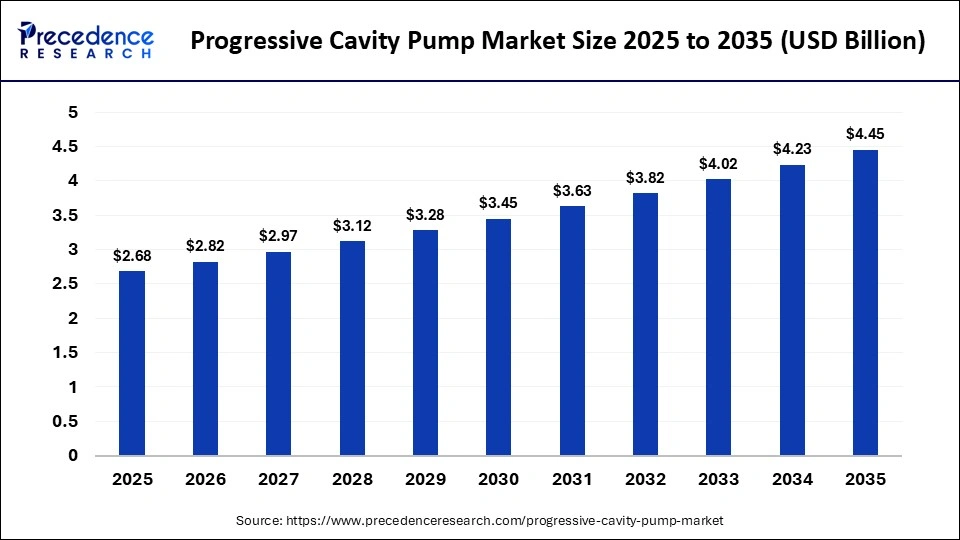
The global progressive cavity pump market size was calculated at USD 2.68 billion in 2025 and is predicted to increase from USD 2.82 billion in 2026 to approximately USD 4.45 billion by 2035, expanding at a CAGR of 5.20% from 2026 to 2035.
Expert Opinion
According to Precedence Research, progressive cavity pumps (PCPs) are a critical investment for industries seeking efficient and reliable fluid handling solutions. Their unique design allows for smooth, pulsation-free flow, making them ideal for handling viscous, abrasive, or shear-sensitive fluids in sectors such as oil and gas, wastewater treatment, chemical processing, and food and beverage. For companies, the value of PCPs extends beyond operational performance; they help reduce downtime, minimize maintenance costs, and optimize energy usage, contributing directly to improved ROI.
The integration of AI, IoT, and advanced materials is further enhanced by the capabilities of PCPs, enabling real-time monitoring, predictive maintenance, and process optimization. This not only increases pump efficiency and lifespan but also allows businesses to achieve higher operational consistency and safety. Companies that invest strategically in R&D, digitalization, and a robust global service network are likely to gain a competitive edge, as these pumps support both productivity and sustainability objectives.
In today’s industrial landscape, PCPs are more than just equipment; they are a strategic asset that drives operational excellence, cost-effectiveness, and long-term business growth.
Innovation-Driven Industry Trends
- Smart Monitoring and IoT Integration: If the progressive cavity pumps are equipped with sensors and linked to IIoT, they will be able to track the flow, pressure, and vibration of the pumps in real time. This will be in a position to identify abnormalities, preemptive maintenance, and optimization of operations, improving reliability and reducing failure.
- Expansion of Wastewater Usage: An upsurge in environmental standards and global demands for clean water are encouraging the application of the PCPs to sludge, slurry, and viscous fluid management. Their operation, being a low-shear, pulse-free mode of operation, contributes to better wastewater treatment, and, therefore, they are required in municipal and industrial usage.
- Expansion in Oil and Gas: PCPs have been used in artificial lift, multiphase fluid handling, and heavy crude transportation. Their ability to remain in steady flow even when pressures and viscosities change is what ensures safe, efficient, and reliable operation in oilfield and pipeline applications.
- Energy Efficiency and Sustainability: The efficiency of industrial pumping is being increased with a changing speed drive, artificial intelligence control, and optimization of processes. These are the solutions that reduce the cost of operations and carbon footprint and encourage sustainable management of fluids in the chemical, oil & gas, and water treatment industries.
Dive into Innovators Driving the Future of Industrial Fluid Solutions
- Atlas Copco: Produces and supplies compressors, pumps, generators, power tools, and assembly systems under such brands as ABAC, AGRE, AIRnet, ALUP, Balma, and American Pneumatic Tools. Its business operations are directly present in more than 70 countries, and its sales are made in more than 180 countries across the world.
- NETZSCH Technologies: It has an extensive assortment of pumps, which are used in the environment and energy, chemical, pulp and paper, food and pharmaceuticals, and oil and gas industries. The company manufactures more than 75,000 pumps every year and dedicates a lot of money to research and development in the quest to make them efficient and reliable.
- DOPAG INDIA PVT LTD.: The company deals with pumps, automated dispensing systems, and mixing systems of automotive, renewable energy, aerospace, and medical industries. The company has over 40 countries, such as Germany, France, India, Singapore, the Netherlands, the U.S., and China, where it offers custom-made solutions to complex industrial processes.
Next-Generation Progressive Cavity Pump Breakthroughs
|
Company/ Brand |
Product |
Description / Key Feature |
|
SEEPEX |
BN with Smart Joint Access (SJA) |
Progressive cavity pump with an inspection-friendly joint to save time in both challenging environments, with reduced downtimes and easy access. |
|
NETZSCH |
Hermetically Sealed NEMO PCP Upgrade |
Eliminates toxic liquids/gaseous leakages, minimizes the number of maintenance requirements, and minimizes operational expenses. |
|
Seepex/SEEPEX |
Modular Progressive Cavity Pump Range |
Ongoing development of modular PCP models, such as pumps designed to suit a different application (industrial, hygienic, dosing). |
Investment and Innovation
A large investment by the manufacturers is being directed towards high-performance progressive cavity pumps, which can operate on highly viscous, abrasive, or solid fluid in oil and gas, wastewater treatment, chemical processing, and food applications. These innovations allow tracking performance in real time, optimizing the use of energy, and detecting faults in advance, minimizing the amount of time spent on the operation of the equipment, and extending its service.
Strategic Initiatives Fueling the Growth of Progressive Cavity Pumps
- Atlas Copco opened a new manufacturing plant in Pune, India, for the production of GV3 oil-injected and ZH+ centrifugal compressors, representing a multi-million-dollar investment in both regional industrial infrastructure and high-performance pump production.
- NETZSCH Technologies unveiled a hermetically sealed modification to their NEMO progressive cavity pumps, investing in safer, maintenance-free sealing arrangements to reduce costs and enhance workplace safety.
- Xylem Inc. has been heavily investing in smart water management innovations, including AI-powered pump monitoring systems, as part of a multi-year initiative to modernize fluid handling infrastructure worldwide.
- Seepex GmbH has expanded its European research and manufacturing capacities, investing in high-capacity pump designs with energy-efficient drive systems for use in wastewater and chemical applications.
- Firms are coming up with high rotor-stator geometries, corrosion-resistant alloys, and high-durability elastomers to increase the reliability of pumps in arduous environments. The pumps of high power and high capacity are being designed to satisfy the increasing needs of large-scale industry developments, especially in the Asia Pacific and the Middle East, where high industrialization and the development of infrastructure are also causing demand.
The Future of Industrial Fluid Handling
Progressive cavity pumps (PCPs) are installed in ways that are transforming industrial fluid handling across the globe. The integration of AI, IoT, and advanced materials is making operations smarter, safer, and more energy-efficient. High-power, high-capacity pumps are increasingly being deployed in industries such as oil and gas, mining, chemical processing, and wastewater management. Companies that invest in R&D, digitalization, and a global service network are well-positioned to gain prominence. By combining smart technologies with process optimization, the industrial pumping sector is evolving to deliver safer, more reliable, and sustainable operations.
About the Authors

Aditi Shivarkar
Aditi, Vice President at Precedence Research, brings over 15 years of expertise at the intersection of technology, innovation, and strategic market intelligence. A visionary leader, she excels in transforming complex data into actionable insights that empower businesses to thrive in dynamic markets. Her leadership combines analytical precision with forward-thinking strategy, driving measurable growth, competitive advantage, and lasting impact across industries.



Aman Singh
Aman Singh with over 13 years of progressive expertise at the intersection of technology, innovation, and strategic market intelligence, Aman Singh stands as a leading authority in global research and consulting. Renowned for his ability to decode complex technological transformations, he provides forward-looking insights that drive strategic decision-making. At Precedence Research, Aman leads a global team of analysts, fostering a culture of research excellence, analytical precision, and visionary thinking.

Piyush Pawar
Piyush Pawar brings over a decade of experience as Senior Manager, Sales & Business Growth, acting as the essential liaison between clients and our research authors. He translates sophisticated insights into practical strategies, ensuring client objectives are met with precision. Piyush’s expertise in market dynamics, relationship management, and strategic execution enables organizations to leverage intelligence effectively, achieving operational excellence, innovation, and sustained growth.