



Progressive Cavity Pump Market Trends, Companies, Contract Wins / Project Pipeline, Installed Capacity, Power Generation, Government Investment, Technology Adoption, Competitive Positioning, and Growth Forecast
Progressive Cavity Pump Market (By Power Rating: Up to 50 HP, 51 to 150 HP, Above 150 HP; By Pumping Capacity: Up to 500 GPM, 501 to 1000 GPM, Above 1000 GPM; By End Use: Oil & Gas, Water & Wastewater, Food & Beverage, Pulp & Paper, Chemicals, Others) - Global Industry Analysis, Size, Trends, Leading Companies, Regional Outlook, and Forecast 2026 to 2035
Source: https://www.precedenceresearch.com/progressive-cavity-pump-market
 Get a Sample
 Table Of Content


What is the Progressive Cavity Pump Market Size in 2026?
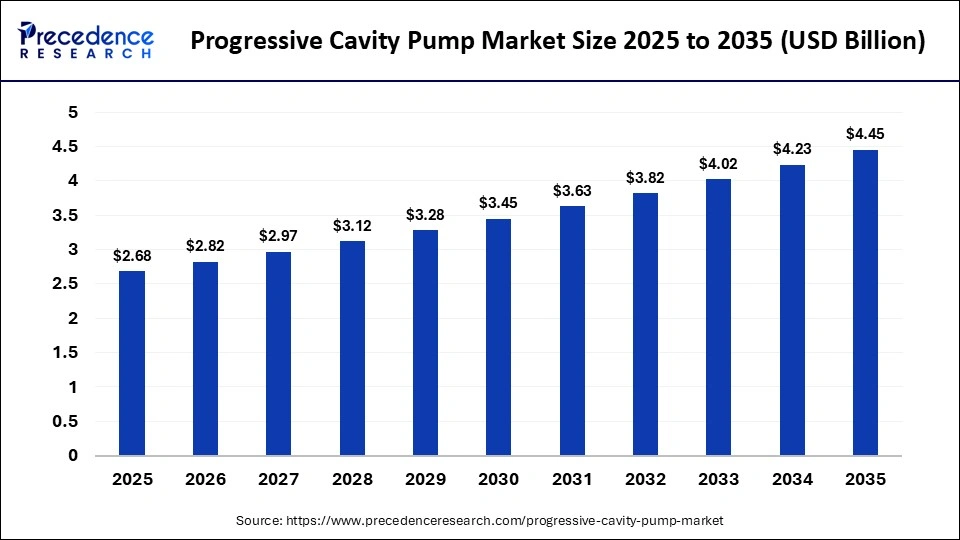
The global progressive cavity pump market size accounted for USD 2.68 billion in 2025 and is predicted to increase from USD 2.82 billion in 2026 to approximately USD 4.45 billion by 2035, expanding at a CAGR of 5.20% from 2026 to 2035. The progressive cavity pump market is primarily driven by the growing need to easily pump viscous and abrasive fluids in various industries.
Key Takeaways
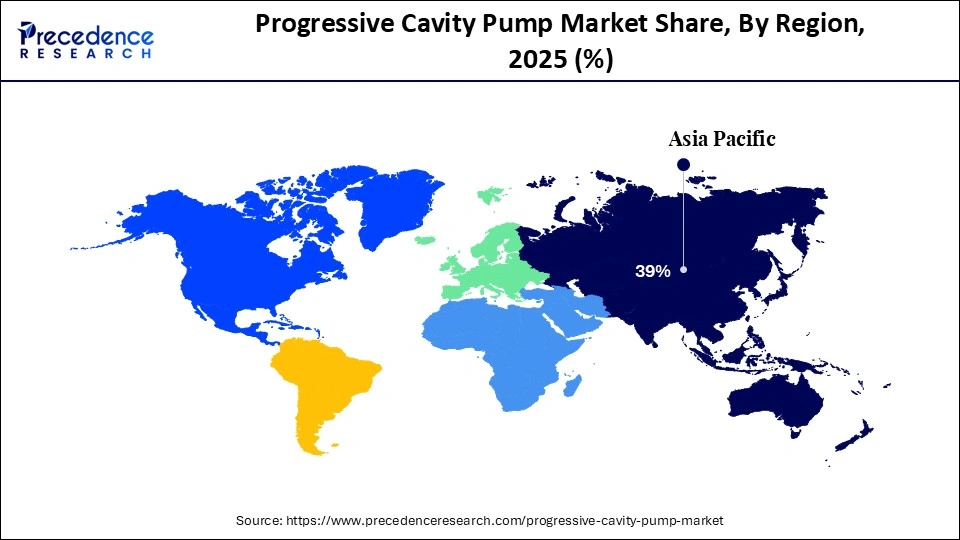
- Asia Pacific accounted for the largest share of 39%in 2025.
- The North America is expected to experience the fastest growth over the forecast period.
- By power rating, the up to 50 HP segment held a major market share in 2025.
- By power rating, the above 150 HP segment is anticipated to grow at a significant rate in the market over the forecast period.
- By pumping capacity, the up to 500 GPM segment held a significant share of 54% in 2025.
- By pumping capacity, the above 1000 GPM segment is anticipated to grow at the fastest rate over the forecast period.
- By end use, the water & wastewater segment held the largest share of the market in 2025.
- By end use, the oil & gas segment is anticipated to expand at the highest CAGR in the market over the forecast period.
Market Overview
A progressive cavity pump is a rotary positive displacement pump, also known as a screw pump, which transfers fluids through a series of small, fixed shape cavities created between a helical rotor and stator. Such a mechanism leads to low shear and mild handling of fluids, which makes PCPs especially effective in carrying highly viscous, abrasive, or solids-filled fluids, e.g., sludge, slurries, and thick industrial liquids. Progressive cavity pumps are popular in sectors such as oil & gas, wastewater treatment, food & beverage, and chemicals because of their constant flow properties and capability to operate with different pressure levels. Moreover, the use of progressive cavity pumps is being greatly increased by technological advancements in the design and production methods.
How is AI Integration into Progressive Cavity Pumps Revolutionizing the Market?
The incorporation of artificial intelligence in progressive cavity pumps is transforming the landscape of the market. AI technology is improving the efficiency and predictive maintenance of pump operation. AI-powered monitoring systems integrated with sensors and Industrial Internet of Things (IIoT) platforms allow the collection of real-time data on key operational parameters such as pressure, temperature, vibration, and flow rate. By analyzing this data, predictive maintenance strategies can be implemented to detect potential faults before they lead to equipment failure. This approach helps reduce unexpected downtime, extend equipment lifespan, and lower maintenance costs.
Industries such as oil and gas, wastewater treatment, chemicals, and food processing are increasingly adopting AI-enabled progressive cavity pump systems. These advanced systems improve process reliability, optimize energy consumption, and enhance overall operational efficiency in fluid handling and production processes.
Progressive Cavity Pump Market Trends
- Integration of Smart Sensors and IoT Monitoring: Industries are increasingly integrating pumps with smart sensors and IoT–based monitoring systems. These technologies enable real-time performance tracking, predictive maintenance, and operational optimization. As a result, industries can detect issues early, reduce unexpected downtime, and improve the efficiency and reliability of complex industrial fluid-handling processes.
- Growing Use in the Oil & Gas Industry: The adoption of progressive cavity pumps is expanding in the oil & gas sector, particularly in applications such as artificial lift systems and heavy crude oil transfer. These pumps are capable of handling high-viscosity fluids while maintaining a consistent flow rate under varying pressure conditions. This capability makes them highly effective for enhancing oil extraction and transport operations.
- Advancements in Pump Materials and Design: Manufacturers are focusing on developing pumps with improved elastomers, corrosion-resistant materials, and enhanced rotor-stator designs. These technological advancements increase pump durability, reduce wear, and ensure efficient operation when handling abrasive fluids and harsh chemicals commonly found in industrial environments.
Market Scope
| Report Coverage | Details |
| Market Size in 2025 | USD 2.68 Billion |
| Market Size in 2026 | USD 2.82 Billion |
| Market Size by 2035 | USD 4.45 Billion |
| Market Growth Rate from 2026 to 2035 | CAGR of 5.20% |
| Dominating Region | Asia Pacific |
| Fastest Growing Region | North America |
| Base Year | 2025 |
| Forecast Period | 2026 to 2035 |
| Segments Covered | Power Rating, Pumping Capacity, End Use, and Region |
| Regions Covered | North America, Europe, Asia-Pacific, Latin America, and Middle East & Africa |
Segment Insights
Power Rating Insights
What Made Up to 50 HP Power Rating the Dominant Segment in the Market?
The up to 50 HP segment dominated the progressive cavity pump market with the largest share in 2025. This is mainly due to its versatility, efficiency, and the ability to be applied in a wide variety of small to medium industrial applications. Pumps with this range of power rating are commonly used in wastewater treatment, food processing, chemical, and pharmaceutical industries, where step-by-step control of the flow and delicate treatment of viscous or shear-sensitive fluids are needed.
Many industrial operations, including sludge transfer, slurry handling, and the pumping of low- to medium-viscosity fluids, require compact and efficient pumps that can deliver consistent and reliable performance. Progressive cavity pumps in the up to 50 HP category effectively meet these requirements while maintaining operational stability. Additionally, their relatively lower operational and maintenance costs make them an attractive option for end users seeking cost-effective and reliable fluid-handling solutions across various industrial processes.
The above 150 HP segment is expected to grow at a significant rate in the upcoming period because of the increasing demand from heavy industrial sectors that require the handling of large volumes of fluids. Pumps with above 150 HP are particularly used in oil & gas, mining, and chemical processing industries for treating large amounts of fluids, whereby high viscosity, abrasive, or solid content fluids require pumping over long distances or in high-pressure conditions. Rapid industrial development and modernization are key factors driving the growth of this segment. Many large-scale industrial operations require pumps that can deliver high flow rates while maintaining reliable performance and minimizing operational downtime.
Pumping Capacity Insights
Why Did the Up to 500 GPM Segment Lead the Progressive Cavity Pump Market?
The up to 500 GPM segment led the market, accounting for the largest share in 2025. This is because pumps with this capacity are commonly used in wastewater treatment, food & beverage processing, chemical, and pharmaceutical industries, where tight control of the flow rate and treatment of the viscous or shear-sensitive fluid is of utmost importance. The domination of this segment is also attributed to the strong demand for pumps capable of handling moderate flow rates in processes such as sludge transfer, slurry handling, and the pumping of low- to medium-viscosity liquids. Progressive cavity pumps in the up to 500 GPM category are suitable for such applications due to their ability to deliver consistent and controlled flow.
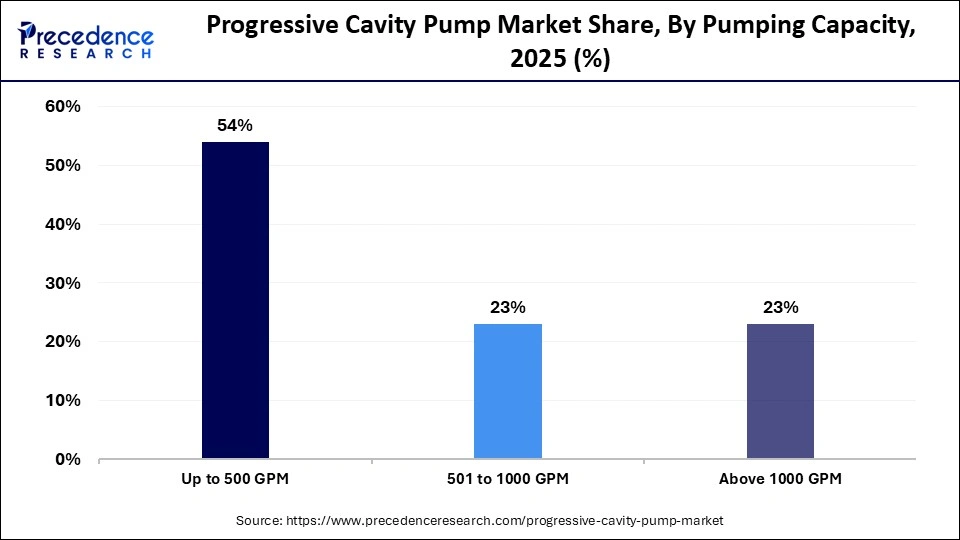
The above 1000 GPM segment is expected to grow at the fastest CAGR over the forecast period because large-scale industries often deal with large amounts of fluid. These high-capacity pumps are increasingly used in oil & gas, mining, chemical processing, and wastewater treatment industries, where efficient handling of large fluid volumes is essential. The growth of this segment is also driven by the need for powerful and energy-efficient pumping solutions capable of maintaining stable flow rates and reliable performance under challenging operating conditions. Technological advancements such as variable-speed drives, real-time monitoring systems, and predictive maintenance capabilities further enhance the performance, efficiency, and lifecycle of high-capacity pumps.
End Use Insights
Why Did the Water & Wastewater Segment Dominate the Progressive Cavity Pump Market?
The water & wastewater segment dominated the market while holding the largest share in 2025, primarily due to the increasing need for efficient fluid handling in municipal and industrial treatment facilities. Progressive cavity pumps are particularly suitable for handling sludge, slurry, and high-viscosity fluids, as they provide a steady and consistent flow, making them ideal for wastewater processing applications. The growth of this segment is also driven by stringent environmental regulations and rising investments in the modernization of water infrastructure aimed at improving water quality and enhancing waste management efficiency. Governments and industries are focusing on upgrading treatment plants to meet regulatory standards and support sustainable water management practices.
The oil & gas segment is expected to grow at the fastest rate in the coming years because of the increasing global energy demand and increased extraction of heavy crude oil and unconventional reserves. Progressive cavity pumps are suitable for oilfield operations because they can deliver a steady flow of viscous, abrasive, and multiphase fluids, which are often difficult to handle with conventional pumping technologies.
The expansion of upstream and midstream activities, especially in regions such as North America, the Middle East, and Asia-Pacific, is a key factor driving the growth of this segment. These operations require high-capacity and durable pumping solutions capable of operating reliably under complex drilling and production conditions. Furthermore, technological advancements such as variable speed drives, high-pressure pump designs, and predictive maintenance systems are improving the efficiency, reliability, and operational lifespan of pumps used in harsh oilfield environments.
Regional Insights
Asia Pacific Progressive Cavity Pump Market Size and Growth 2026 to 2035
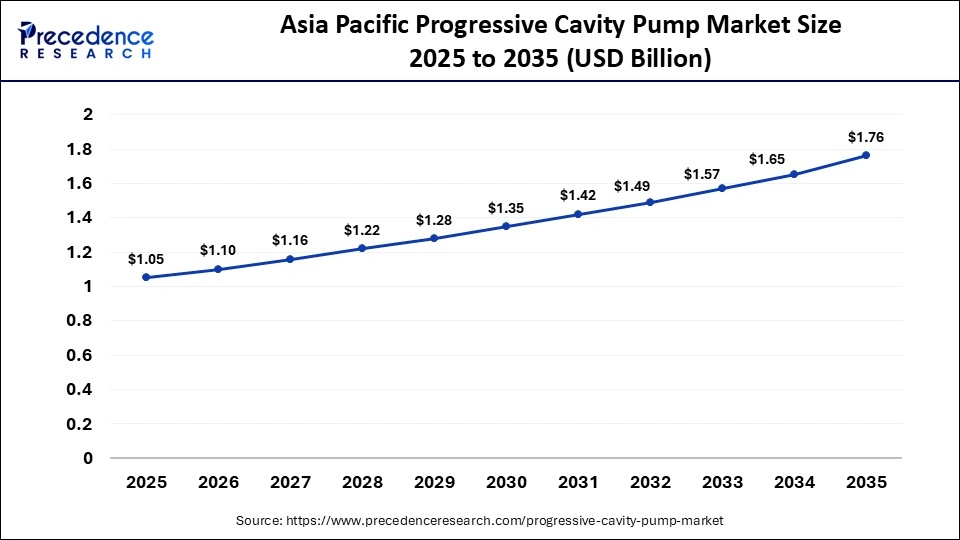
The Asia Pacific progressive cavity pump market size is expected to be worth USD 1.76 billion by 2035, increasing from USD 1.05 billion by 2025, growing at a CAGR of 5.30% from 2026 to 2035.
What Made Asia Pacific the Leading Region in the Global Progressive Cavity Pump Market?
Asia Pacific led the progressive cavity pump market while holding a major share in 2025. This is mainly due to the rapid industrialization, urbanization, and infrastructure development. The market in the region is propelled by increased investments in industries such as oil & gas, chemicals, power generation, and water & wastewater treatment, which heavily depend on reliable and effective pumping systems. Progressive cavity pumps are widely used in these industries due to their ability to handle viscous fluids, slurries, and solids-laden liquids while maintaining a consistent flow rate. Their operational reliability makes them well suited for complex industrial fluid-handling applications.
In addition, the region's growing population and continuous expansion of urban infrastructure are increasing the need for improved water management and wastewater treatment systems. This rising demand for efficient fluid-handling solutions is further supporting the growth of the market across Asia Pacific.
How is the Opportunistic Rise of North America in the Progressive Cavity Pump Market?
North America is expected to grow at the fastest rate in the coming years because of its strong industrial base and the presence of major industries such as oil and gas, wastewater treatment, food processing, and chemicals. These industries require reliable pumping systems capable of handling highly viscous, abrasive, and solids-laden fluids while maintaining consistent flow and minimal pulsation. Increasing regulatory requirements related to wastewater management and environmental protection in countries such as the U.S. and Canada have further increased the demand for advanced pumping technologies. Moreover, the presence of leading pump manufacturers in the region, along with ongoing technological advancements and the integration of smart monitoring systems, is supporting market expansion.
Progressive Cavity Pumps Market Value Chain Analysis
- Raw Material Sourcing
This stage involves sourcing high-quality raw materials, such as corrosion-resistant metals, elastomers, and electronic materials. Durability, performance, and industry standards are ensured by reliable procurement.
Key Players: Seepex GmbH, NETZSCH Technologies, Sulzer, Verder Liquid
- Testing and Certification
Pumps are intensively tested once they are produced, and testing is done by pressure test, flow test, and leak test to meet international safety and quality standards. Performance, reliability, and compliance are approved by the concerned authorities, and this renders pumps acceptable in the industry.
Key Players: Schlumberger, Weatherford, Pumpenfabrik Wangen
- Installation and Commissioning
The installation of pumps is done at customer locations as per the guidelines of the manufacturers. Commissioning involves integrating the system, alignment, and testing of the workflow to make sure it is optimized in terms of flow, pressure, and efficiency, and risks of operational problems or untimely failures are minimal.
Key Players: Xylem Inc., Borets, PCM Group, Nordson
Progressive Cavity Pump Market Companies
- Seepex GmbH (Germany)
- Schlumberger (U.S.)
- NOV (U.S.)
- Xylem Inc. (U.S.)
- CIRCOR (U.S.)
- Weatherford (U.S.)
- Borets (UAE)
- Roto Pumps (India)
- Sulzer (Switzerland)
- Champion X (U.S.)
- PCM Group (Paris)
- NETZSCH Technologies (Germany)
- Verder Liquid (Netherlands)
- Nordson (U.S.)
- Pumpenfabrik Wangen (Germany)
Recent Developments
- In February 2025, Atlas Copper announced a plan to open a new plant in Pune to produce air and gas compressor systems in the local and overseas markets. The plant is set to manufacture the Gv3 oil-injected air compressor and ZH + centrifugal air compressor, which focus on reliability and efficiency.(Source: https://www.atlascopco.com)
- In October 2024, NETZSCH introduced a better, more affordable upgrade of their NEMO progressing cavity pumps in the form of hermetically sealed housing. Hermetic seal helps to make the working environment safer by avoiding the leakage of toxic fluids and gases and minimizing the expenses of maintenance.
(Source: https://pumps-systems.netzsch.com)
Segments Covered in the Report
By Power Rating
- Up to 50 HP
- 51 to 150 HP
- Above 150 HP
By Pumping Capacity
- Up to 500 GPM
- 501 to 1000 GPM
- Above 1000 GPM
By End Use
- Oil & Gas
- Water & Wastewater
- Food & Beverage
- Pulp & Paper
- Chemicals
- Others
By Region
- North America
- Latin America
- Europe
- Asia-pacific
- Middle and East Africa
For inquiries regarding discounts, bulk purchases, or customization requests, please contact us at sales@precedenceresearch.com
Frequently Asked Questions





Ask For Sample
No cookie-cutter, only authentic analysis – take the 1st step to become a Precedence Research client
 Get a Sample




 sales@precedenceresearch.com
 Schedule a Meeting
