






 Request Consultation
Synthetic stem cells represent a breakthrough in cell-free therapy, combining biomaterials and bioactive factors to replicate the healing effects of natural stem cells. With advantages such as enhanced stability, reduced immunogenicity, and customizable treatment design, they are paving the way for advanced, accessible, and efficient regenerative healthcare solutions.
Regenerative medicine promises to repair damaged tissues and organs from within, with stem cells playing a central role due to their ability to self-renew and differentiate into various cell types. For decades, they have been a primary focus in advancing regenerative therapies. However, translating laboratory discoveries into clinical applications has faced significant challenges, including limited long-term cell viability, risks of immune rejection, ethical concerns, and the high cost of producing large quantities of viable cells.
Several researchers are heavily investing and focusing on creating artificial cell-like particles that mimic the regenerative therapeutic benefits of natural stem cells without harming the living tissue. This revolutionary field brings together materials science, synthetic biology, and regenerative medicine to create safer, more controlled, and effective therapeutic solutions. By overcoming many of the limitations associated with traditional stem cell therapies, these innovations hold strong potential for advancing next-generation regenerative treatments.
What Are Synthetic Stem Cells?
Synthetic stem cells or "synthetic artificial stem cells (SASC)” are not living cells; they are engineered and cell-free mimics that replicate the regenerative paracrine effects of natural stem cells like Adipose-derived stem cells (ADSCs) by releasing therapeutic bioactive factors. Synthetic stem cells are non-living biomaterials that specifically mimic the therapeutic, structural, and signaling functions of natural stem cells, particularly mesenchymal stem cells (MSCs). These artificial particles are mainly created using polymers that provide targeted tissue regeneration, excellent stability, and reduced immune response, serving as a cell-free alternative for treating various chronic conditions like osteoarthritis. Synthetic stem cells are a versatile therapy that enables the tailoring of paracrine responses across different cell types and provides a more potent regenerative effect for targeted tissues.
What is the Synthetic Stem Cells Market Size in 2026?
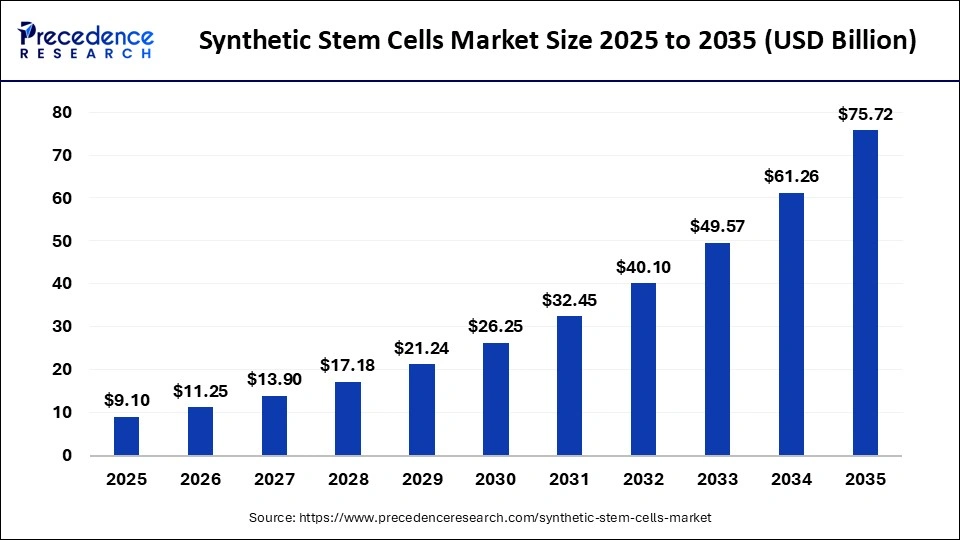
The global synthetic stem cells market was valued at USD 9.10 billion in 2025 and is projected to grow from USD 11.25 billion in 2026 to approximately USD 75.72 billion by 2035, registering a CAGR of 23.60% from 2026 to 2035. This growth is driven by increasing investments in biotechnology and rising awareness of the advantages of synthetic stem cells over natural stem cells.
Get a Free Sample Report with Key Market Trends: https://www.precedenceresearch.com/sample/8222
Key Benefits of Synthetic Stem Cells:
- Mimicking Natural Function: These engineered cells mimic the paracrine activities of natural stem cells, like cell-cell interaction and therapeutic factor secretion, vital for regenerating damaged tissue.
- Reduced Risks: Synthetic stem cells do not generally stimulate significant immune responses and show tumorigenicity, addressing the safety issues (immunogenicity and tumorigenicity) associated with natural stem cell transplantation.
- Therapeutic Potential: Synthetic cells represent promising results in mitigating myocardial infarction by preserving myocardium and treating medical conditions such as osteoarthritis through anti-inflammatory effects.
- Versatility: Synthetic stem cells provide controlled responses for specialized tissue repair.
How do they Mimic Natural Stem Cells?
Synthetic stem cells mimic natural stem cells by replicating their key functional properties, particularly their ability to promote tissue repair and regeneration, without being living cells. Instead of self-renewing and differentiating like biological stem cells, they are engineered using biomaterials and bioactive molecules to release growth factors, cytokines, and signaling proteins that influence surrounding cells. These signals stimulate the body’s own repair mechanisms, encouraging cell proliferation, differentiation, and healing at the target site.
Additionally, synthetic stem cells are often designed to imitate the structural and biochemical environment of natural stem cells, enabling them to interact effectively with tissues. By delivering controlled and targeted therapeutic effects, they overcome limitations such as immune rejection, ethical concerns, and instability, making them a promising alternative in regenerative medicine.
From Lab to Life: Artificial Stem Cells Redefining Regenerative Medicine
Dr. Cato T. Laurencin, University Professor and Albert and Wilda Van Dusen Distinguished Endowed Professor of Orthopaedic Surgery, has successfully developed synthetic artificial stem cells (SASC), a new class of stem cells that may avoid conventional challenges associated with stem cell therapies.
These synthetic cells are typically tailored to specific tissue types and used across systems to deliver immunomodulatory and regenerative benefits. The findings were published in the Proceedings of the National Academy of Sciences.
Using the secretome allows scientists to tailor the therapy to the patient’s needs while offering broader applicability across tissue types. Although the secretome still faces challenges, including time-intensive cell maintenance.
With SASC cells, scientists can choose the type and amount of different biological factors to achieve a specific purpose in a certain tissue type. This mimics the paracrine effect without using secretome or stem cells.
Laurencin and his team developed and tested Synthetic Artificial Stem Cells (SASC) as an injectable, regenerative therapy for osteoarthritis. These engineered cells are programmed to release specialized factors that reduce inflammation and combat cartilage degeneration (joint narrowing). Studies demonstrated that SASC improves cartilage biomechanical properties and provides an effective alternative to natural stem cell therapy. This discovery paves the way for future advances in regenerative therapy.
Synthetic Artificial Stem Cell (SASC) System: A Tailorable, Cell-Free Approach for Cartilage Regeneration in Osteoarthritis
The synthetic artificial stem cell (SASC) system, fabricated using PLGA microspheres to encapsulate chondrogenesis-related growth factors, acts as an injectable therapy with controlled release of the formulated secretome. It can efficiently treat osteoarthritis by providing superior, controlled, and tailored anti-inflammatory and chondroprotective effects compared to natural cells, lowering cartilage degeneration, reducing osteoarthritis-associated genes, and upregulating SOX9 in preclinical models.
- Fabrication and Mechanism: SASC uses poly (lactic-co-glycolic acid) (PLGA) 85:15, encapsulating recombinant growth factors to mimic the natural secretome of ADSCs.
- Osteoarthritis Therapy: It is specifically designed for joint injections. SASC provides controlled release of therapeutic factors that promote cartilage repair.
- In Vitro Efficacy: synthetic artificial stem cell (SASC) showed remarkable anti-inflammatory and chondroprotective effects compared to ADSCs, featuring up-regulation of SOX9 and reduction of ADAMTS5, PRG4, and nitric oxide.
- In Vivo Results: In rodent models, synthetic artificial stem cells (SASCs) lower knee cartilage degeneration and significantly improve biomechanical properties, performing the same as natural stem cells.
- Advantages over Stem Cells: SASC provides enhanced stability, reduces immunogenicity, and offers customized formulation possibilities in comparison with cell-based therapies.
Synthetic vs. Natural Stem Cells: What Makes the Difference?
Natural stem cells, such as mesenchymal stem cells (MSCs), derived from bone marrow, have several limitations. Synthetic alternatives are gaining popularity as they help overcome the related hurdles:
- Enhanced Safety and Minimized Immunogenicity: The major hurdles in transplantation are that the body’s immune system recognizes foreign cells, leading to rejection. Live stem cells can sometimes turn into tumors. As synthetic cells are not living cells, they are minimally immunogenic and cannot turn into tumor cells, which makes them safer.
- Stability and Preservation: Natural stem cells are certainly more fragile, requiring precise, costly cryogenic storage and instant transport, whereas synthetic stem cells can be easily stored in a refrigerator or freeze-dried, offering superior shelf-life stability and several commercial benefits.
Ease of Manufacturing and Standardization
Growing standardized stem cells for every patient often becomes difficult and too expensive. Synthetic cells can be manufactured in mass quantities with controlled and consistent dosages.
From Research to Reality: Applications of Synthetic Stem Cells in Medicine
The versatility of synthetic stem cells means they are being researched for a range of therapeutic areas:
- Cardiac Regeneration: In numerous studies involving mice with myocardial infarction, synthetic cardiac stem cells represent a promising ability to repair heart tissue and preserve cardiac function.
- Osteoarthritis and Cartilage Repair: Researchers have successfully developed synthetic artificial stem cells (SASC) that can deliver anti-inflammatory factors to damaged joints, significantly reducing the depletion of the cartilage extracellular matrix and mitigating inflammation.
- Wound Healing and Tissue Repair: Synthetic mesenchymal stem cells are widely being explored to assist in the healing of skin and soft tissue, promoting regeneration.
Current Obstacles in the Commercialization of Synthetic Stem Cells
Despite the vast potential of synthetic stem cells, they remain in their early stages and continue to face several major roadblocks.
- Replicating Complexity: Natural stem cells are incredibly complex. While synthetic cells can mimic the paracrine factors, they cannot fully simulate the complex and dynamic behavior of a living cell.
- Longevity of Effect: As synthetic cells are not living cells, they cannot multiply on their own. It generally means that, unlike stem cell therapies, which may take root and continue growing. Whereas synthetic cells may require repeated scheduled injections like traditional medications.
- Complex Formulation Processes: Techniques that are used to create synthetic cells require complex emulsification and assembly steps that often become difficult to replicate at high volumes.
- Regulatory Compliance: Scaling up requires ensuring that the production process aligns with clinical-grade Good Manufacturing Practice (GMP) standards for purity, safety, and potency, which often becomes challenging to implement at large-scale.
Expert Opinion
According to our industry experts, synthetic stem cells represent a transformative advancement in regenerative medicine, offering scalable and safer alternatives to natural stem cells. Their development addresses major limitations of traditional stem cell therapies, including immune rejection, ethical concerns, and high production costs. By mimicking the paracrine signaling and regenerative potential of natural stem cells, synthetic variants enable precise, customizable, and reproducible therapies, which are critical for commercialization and large-scale adoption.
The potential for synthetic stem cells is significant, spanning applications in oncology, cardiovascular repair, wound healing, and immunomodulation. Companies investing in synthetic stem cell platforms can leverage shorter development timelines, improved regulatory alignment, and reduced risk profiles, translating into faster market entry and better ROI. Furthermore, integration with digital healthcare and AI-driven analytics can optimize patient-specific therapies, enhance clinical outcomes, and strengthen competitive differentiation in the rapidly growing regenerative medicine sector.
Summary
Synthetic stem cells offer a highly promising alternative to natural stem cells by combining regenerative potential with enhanced safety profiles, serving as an innovative step toward sophisticated, tailored, and safer regenerative therapies. Synthetic stem cells emerge as a game changer, providing the superior regenerative power of stem cell science with the utmost safety and predictability of modern pharmaceuticals. By substantially eliminating the risks of immune rejection and tumor formation while solving the storage and logistics challenges, synthetic cells hold great potential to make regenerative therapies accessible to millions. As research accelerates worldwide, synthetic cells are set to redefine the future of medicine in the coming years, moving us closer to a future where affected or damaged tissues can be easily repaired with the precision of engineered and artificial biology.
About the Authors

Aditi Shivarkar
Aditi, Vice President at Precedence Research, brings over 15 years of expertise at the intersection of technology, innovation, and strategic market intelligence. A visionary leader, she excels in transforming complex data into actionable insights that empower businesses to thrive in dynamic markets. Her leadership combines analytical precision with forward-thinking strategy, driving measurable growth, competitive advantage, and lasting impact across industries.



Aman Singh
Aman Singh with over 13 years of progressive expertise at the intersection of technology, innovation, and strategic market intelligence, Aman Singh stands as a leading authority in global research and consulting. Renowned for his ability to decode complex technological transformations, he provides forward-looking insights that drive strategic decision-making. At Precedence Research, Aman leads a global team of analysts, fostering a culture of research excellence, analytical precision, and visionary thinking.

Piyush Pawar
Piyush Pawar brings over a decade of experience as Senior Manager, Sales & Business Growth, acting as the essential liaison between clients and our research authors. He translates sophisticated insights into practical strategies, ensuring client objectives are met with precision. Piyush’s expertise in market dynamics, relationship management, and strategic execution enables organizations to leverage intelligence effectively, achieving operational excellence, innovation, and sustained growth.