



Intelligent Data Pipelines Market Size, Share, Trends, Companies, and Forecast 2026-2035
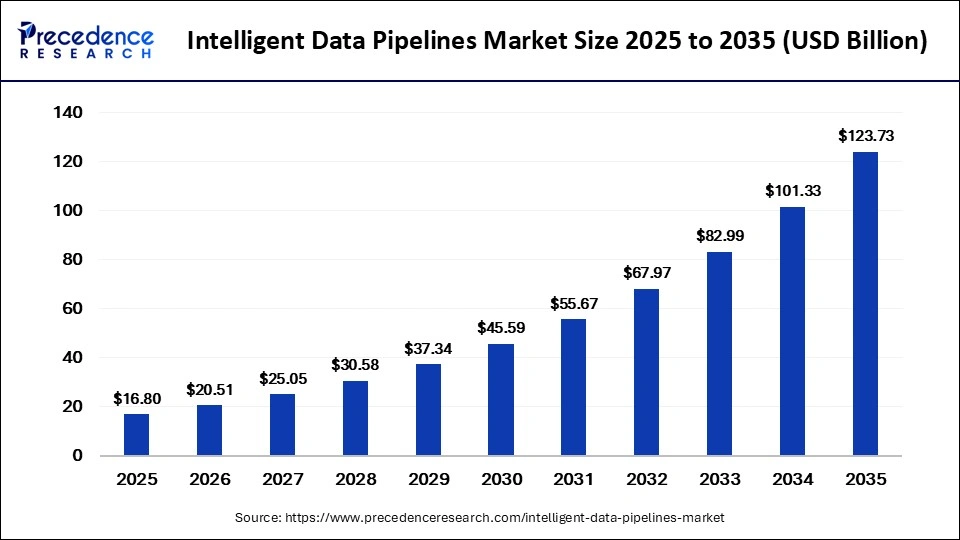
ICT industry specialist Shivani Zoting estimates the intelligent data pipelines market at USD 20.51 billion in 2026, with continued technology adoption expected to take the market to USD 123.73 billion by 2035 at a CAGR of 22.10%. Leading intelligent data pipelines market providers such as Informatica, IBM, Oracle, Microsoft are expanding their capabilities across segments including By Component, By Deployment Mode, By Pipeline Type, By Application, By End-use Industry.
Source: https://www.precedenceresearch.com/intelligent-data-pipelines-market
 Get a Sample
 Table Of Content


What is the Intelligent Data Pipelines Market Size in 2026?
The global intelligent data pipelines market size is predicted to increase from USD 20.51 billion in 2026 to approximately USD 123.73 billion by 2035, expanding at a CAGR of 22.10% from 2026 to 2035. The market is driven by the rapid digital transformation across various industries, rising public and private investment into hyperscale data centers, a surge in the need to process vast amounts of unstructured data, and widespread adoption of cloud native architectures.
Key Takeaways
- North America dominated the intelligent data pipelines market with a share of 39% in 2026.
- Asia Pacific is expected to grow at the fastest CAGR of 26.5% during the forecast period.
- By component, the software segment held a dominant position in the market with a share of 73% in 2026.
- By component, the services segment held a 27% market share and is expected to grow at a CAGR of 23.8% between 2026 and 2035.
- By deployment mode, the cloud-based segment accounted for 58% market share in 2026 and is expected to grow at the fastest CAGR of 25.1% between 2026 and 2035.
- By pipeline type, the real-time data pipelines segment led the global market with a share of 38% in 2026.
- By pipeline type, the streaming data pipelines segment is expected to grow at the fastest CAGR of 27.1% between 2026 and 2035.
- By application, the data integration segment held a major share of 29% in 2026.
- By application, the machine learning & AI workloads segment is expected to grow at the fastest CAGR of 30.4% between 2026 and 2035.
- By end-use industry, the BFSI segment registered its dominance in the global market with a share of 22% in 2026.
- By end-use industry, the healthcare & life sciences segment is expected to expand rapidly in the market with a CAGR of 24.8% in the coming years.
Market Overview
In the era of a rapidly evolving technological landscape, intelligent data pipelines are a transformative solution that allows organizations to remain competitive in a data-driven world. Intelligent data pipelines leverage machine learning (ML), artificial intelligence (AI), and automation to extract, transform, and load data without requiring constant human intervention. They serve as a vital foundation for generative AI and real-time analytics by efficiently managing data quality, adapting to schema changes, and accurately predicting bottlenecks before they occur. Several data engineers often depend on these intelligent systems to autonomously run data pipelines 24/7 without needing to reprocess any datasets. This ensures data integrity and facilitates change across thousands of interconnected pipelines spanning numerous data clouds while maintaining data lineage.
Intelligent Data Pipelines Market Trends
- The growing adoption of LLMs, generative AI, and retrieval-augmented generation (RAG) is driving the need for automated data pipelines to extract, chunk, embed, and load vast, unstructured data into vector databases.
- The surge in data volume is expected to drive growth in the intelligent data pipelines market during the forecast period.
- Stringent regulatory compliance is expected to accelerate the market's growth. Global privacy frameworks such as GDPR and CCPA compel organizations to maintain strong data lineage, effective metadata management, and secure access to control data.
- Several organizations are increasingly shifting from AI assistants to multi-step AI agents. This requires feeding massive volumes of high-quality, preprocessed, structured, and unstructured data into models, driving the market's expansion.
Market Dynamics
Drivers
Growing Demand for Real-Time Business Intelligence
The rising need for real-time business intelligence is anticipated to drive the market's growth during the forecast period. The market is witnessing strong demand for instant and actionable insights to support various use cases, such as dynamic pricing, fraud detection, and personalized customer experiences, which necessitate real-time and low-latency streaming pipelines. Real-time data pipelines allow firms to ingest, process, and act on streaming data with minimal latency, that ensure to make informed decisions instantly.
Restraint
Shortage of Skilled Professionals
The growing shortage of skilled professionals, particularly in underdeveloped countries, hampers the growth of the market. The scarcity of proficient data engineers in both pipeline orchestration and AI model lifecycles often causes operational delays. Additionally, the stringent data privacy laws and rise in integration complexity often result in high interoperability challenges and workflow configuration delays. Such factors may hinder the growth of the global intelligent data pipelines market during the forecast period.
Opportunity
Shift to Cloud and Hybrid Environments
The increasing adoption of cloud and hybrid environments is anticipated to offer lucrative growth opportunities for the intelligent data pipelines market. Several companies are increasingly migrating to complex multi-cloud and hybrid environments. The use of cloud data platforms necessitates the development of highly scalable and cloud-native pipeline architectures that highly connect on-premises infrastructure with multi-cloud environments. Hybrid architecture ensures seamless data sovereignty. Intelligent pipelines enable stringent compliance with regulations by processing and storing sensitive data locally while leveraging public cloud computing resources to analyze large datasets.
Segment Insights
Intelligent Data Pipelines Market by Component 2026 Share & Size
| Segments | 2026 Share | 2026 Market Value (USD Billion) |
| Software | 73% | 14.972 |
| Services | 27% | 5.538 |
Sources: Expert Interview, Secondary Sources, Precedence Research Database, Precedence Research Analysts and Researcher.
Software dominates the market because intelligent data pipelines depend on integration platforms, orchestration tools, data transformation engines, and automated data quality solutions. Services support implementation, customization, managed operations, and integration with enterprise data environments.
Intelligent Data Pipelines Market by Deployment Mode 2026 Share & Size
| Segments | 2026 Share | 2026 Market Value (USD Billion) |
| Cloud-based | 58% | 11.896 |
| On-premises | 24% | 4.922 |
| Hybrid | 18% | 3.692 |
Sources: Expert Interview, Secondary Sources, Precedence Research Database, Precedence Research Analysts and Researcher.
Cloud-based deployment leads because it offers elastic computing capacity, managed infrastructure, and easier integration with cloud-native analytics and AI services. On-premises deployment remains relevant for organizations with strict data residency or security requirements, while hybrid environments support workloads distributed across cloud and internal systems.
Intelligent Data Pipelines Market by Pipeline Type 2026 Share & Size
| Segments | 2026 Share | 2026 Market Value (USD Billion) |
| Batch Data Pipelines | 32% | 6.563 |
| Real-time Data Pipelines | 38% | 7.794 |
| Streaming Data Pipelines | 30% | 6.153 |
Sources: Expert Interview, Secondary Sources, Precedence Research Database, Precedence Research Analysts and Researcher.
Real-time Data Pipelines lead because organizations increasingly require low-latency data for operational monitoring, fraud detection, customer personalization, and time-sensitive analytics. Batch pipelines remain important for scheduled processing and large-scale data transformations, while streaming pipelines support continuous event ingestion and rapidly growing AI workloads.
Intelligent Data Pipelines Market by Application 2026 Share & Size
| Segments | 2026 Share | 2026 Market Value (USD Billion) |
| Data Integration | 29% | 5.948 |
| Data Migration | 15% | 3.077 |
| Data Analytics & Business Intelligence | 22% | 4.512 |
| Machine Learning & AI Workloads | 19% | 3.897 |
| Data Governance & Compliance | 15% | 3.077 |
Sources: Expert Interview, Secondary Sources, Precedence Research Database, Precedence Research Analysts and Researcher.
Data Integration leads because businesses need to unify information from distributed databases, cloud platforms, enterprise applications, and external sources. Machine Learning & AI Workloads are becoming an important growth area as organizations require reliable, continuously refreshed, and well-governed data to develop and operate AI models.
Intelligent Data Pipelines Market by End-use Industry 2026 Share & Size
| Segments | 2026 Share | 2026 Market Value (USD Billion) |
| BFSI | 22% | 4.512 |
| Healthcare & Life Sciences | 15% | 3.077 |
| Retail & E-commerce | 14% | 2.871 |
| IT & Telecommunications | 16% | 3.282 |
| Manufacturing | 12% | 2.461 |
| Government | 9% | 1.846 |
| Others | 12% | 2.461 |
Sources: Expert Interview, Secondary Sources, Precedence Research Database, Precedence Research Analysts and Researcher.
BFSI leads because banks, insurers, and financial institutions rely on integrated data pipelines for fraud monitoring, risk assessment, regulatory reporting, and real-time transaction analytics. Healthcare & Life Sciences is positioned for rapid growth as providers and research organizations integrate electronic health records, clinical data, genomic information, and AI-driven analytical workloads.
Regional Insights
Intelligent Data Pipelines Market by Region 2026 Share & Size
| Segments | 2026 Share | 2026 Market Value (USD Billion) |
| North America | 39% | 7.999 |
| Latin America | 6% | 1.231 |
| Europe | 25% | 5.128 |
| Asia-Pacific | 23% | 4.717 |
| Middle East and Africa | 7% | 1.436 |
Sources: Expert Interview, Secondary Sources, Precedence Research Database, Precedence Research Analysts and Researcher.
North America leads the market with the supplied 39% share, supported by advanced cloud infrastructure, hyperscale data center investment, and widespread enterprise adoption of AI and analytics platforms. Asia-Pacific is estimated to hold a substantial share and is expected to grow fastest, driven by digital transformation, cloud adoption, expanding data center capacity, and increasing demand for data-intensive applications.
North America Intelligent Data Pipelines Market Size and Growth 2026 to 2035
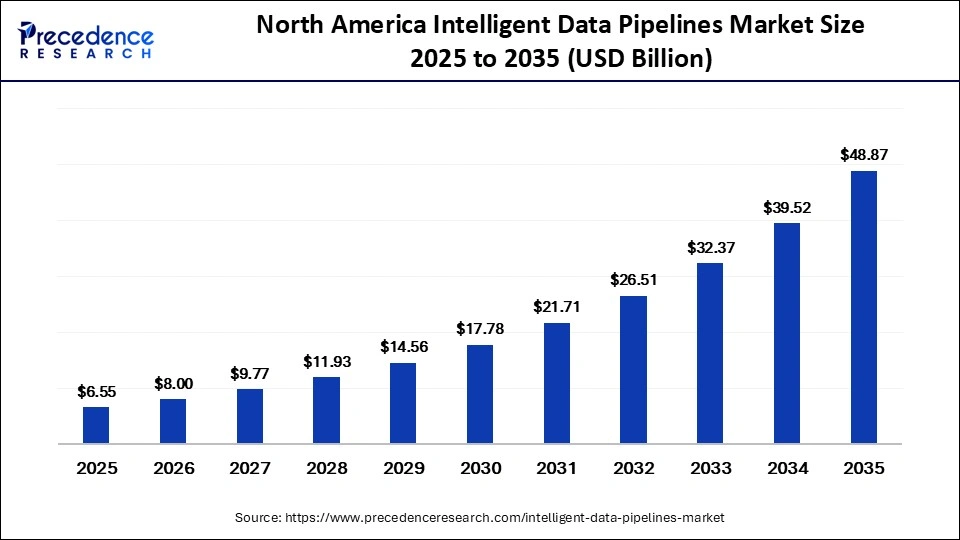
The North America intelligent data pipelines market size was exhibited at USD 8 billion in 2026 and is projected to be worth around USD 48.87 billion by 2035, growing at a CAGR of 22.26% from 2026 to 2035.
What Made North America the Dominant Region in the Market?
North America dominated the intelligent data pipelines market by holding a 39% share in 2026. The region's dominant position in the market is attributed to the combination of factors such as the strong presence of leading data platform vendors, surging investments in data engineering platforms, and strong enterprise AI & ML adoption. Strict regulatory frameworks, widespread adoption of cloud data ecosystems, and growing demand for real-time analytics across various industries also reinforce the region's dominance.
U.S. Intelligent Data Pipelines Market Size and Growth 2026 to 2035
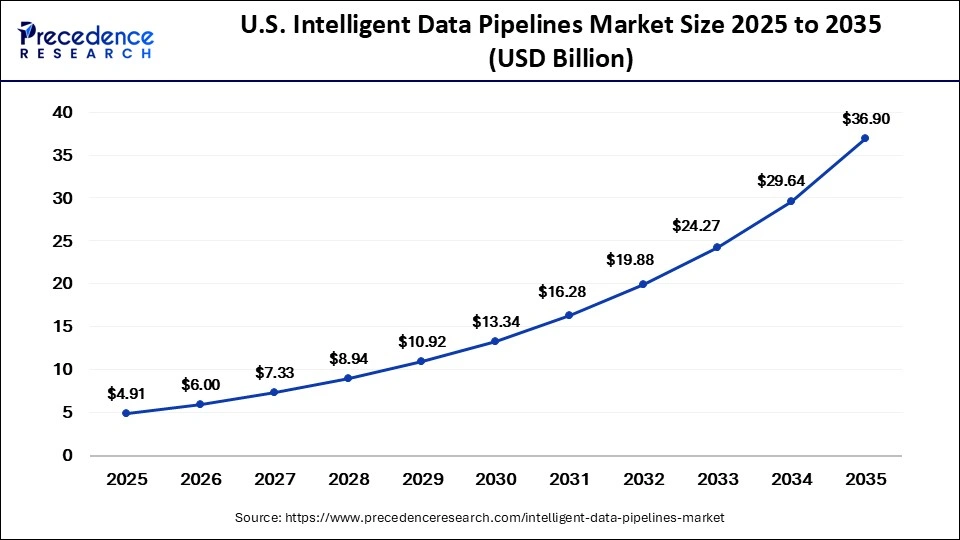
The U.S. intelligent data pipelines market size was evaluated at USD 6 billion in 2026 and is projected to reach around USD 36.90 billion by 2035, growing at a CAGR of 22.35% from 2026 to 2035.
U.S. Intelligent Data Pipelines Market Analysis
The U.S. is the major contributor to the North American intelligent data pipelines market, driven by the presence of leading cloud-tech giants, mature multi-cloud enterprise ecosystems, and rapid Artificial Intelligence (AI) and Machine Learning (ML) integration. The country is home to major companies like IBM, Informatica, Databricks, Confluent, Microsoft, Talend, Cloudera, Denodo, Teradata, Oracle, Qlik, Snowflake, and others. These leading industry players continuously pioneer scalable and real-time streaming data technologies that dictate global market trends. The strict data governance in the country compels businesses to heavily invest in secure and advanced pipeline tools that are capable of automated masking, logging, and data unification.
Asia Pacific: The Fastest-Growing Region
Asia Pacific held the second-largest market share of 27% in 2026 and is expected to grow at the fastest CAGR of 26.5% during the forecast period. This growth is attributed to the rapid digital transformation across enterprises, the expansion of e-commerce and fintech industries, and increasing investments in Generative AI and big data platforms. A surge in cloud transformation initiatives, strict data localization laws, and the growth in enterprise data volumes also drive regional market growth.
China Intelligent Data Pipelines Analysis
The intelligent data pipelines market in China is steadily growing, driven by the strong presence of dominant tech giants, increasing shift toward automated and real-time insights, massive hyperscale data center expansions, growing adoption of cloud native architectures, strict data sovereignty laws, and the booming of AI & ML integration. The government-backed infrastructure investments and the rollout of 5G have significantly spurred hyperscale cloud expansion. The country is also acting as a major hub for high-performance computing capacity.
What Makes Europe a Significant Region in the Intelligent Data Pipelines Market?
Europe held a market share of 26% in 2026 and is expected to grow at a CAGR of 20.4% during the projection period. The region is considered a significant market due to the rapid expansion of digital business operations, surging demand for enterprise analytics, strict data governance regulations, increasing expansion of cloud-based data ecosystems, and escalating adoption of AI-driven data workflows. Moreover, the rising technological advancements, along with a heavy reliance on real-time data processing across major European sectors such as the BFSI, healthcare organizations, IT & Telecommunications, and others, are anticipated to bolster the growth of the market during the forecast period.
Germany Intelligent Data Pipelines Market Analysis
Germany is witnessing remarkable growth, driven by the rising enterprise modernization, increasing push for real-time insights, exponential data growth, and rapid hyperscale cloud expansion centered in Frankfurt. The strict data sovereignty requirements force organizations to adopt localized and intelligent data governance frameworks. Additionally, the market is witnessing strong growth driven by the rapid adoption of generative AI and machine learning requires vast volumes of structured and unstructured data to flow smoothly and securely between cloud and on-premises environments.
What Drives the Intelligent Data Pipelines Market Within Latin America?
Latin America held a market share of 4% in 2026 and is expected to grow at a CAGR of 20% between 2026 and 2035. The region's growth is characterized by the rising digitalization across various industries, rising enterprise focus on cloud adoption, surging investment in AI technologies, increasing expansion of data analytics applications, and growing need for automated data integration.
Brazil Intelligent Data Pipelines Market Analysis
The country is expected to experience considerable growth, which is mainly fueled by the rise in digital infrastructure initiatives, massive investment in cloud-based platforms, stringent local data regulations, and rising explosion of AI and Machine Learning. The increasing expansion of fintech and e-commerce sectors in the country requires robust and scalable pipelines for fraud prevention, real-time reporting, and strict regulatory compliance.
How is the Opportunistic Rise of the Middle East & Africa in the Market?
The Middle East & Africa held a market share of 4% in 2026 and is expected to experience an opportunistic rise with a CAGR of 20.8% in the coming years. The region's growth is mainly driven by the rising hyperscale data center expansions, growing demand for real-time data ingestion and processing, wide adoption of enterprise analytics solutions, surging expenditure in cloud-based infrastructure, and the rise of digital government-led projects.
UAE Intelligent Data Pipelines Market Analysis
The country is experiencing notable growth in the market, driven by the rapid expansion of the AI-driven data center ecosystem. massive public and private partnerships investment in digital infrastructure development, increasing shift toward cloud adoption, strict data privacy & localization regulations, and rising into hyperscale data centers and sovereign-cloud projects. The rapid digital transformation is significantly driving immense data consumption, which requires advanced intelligent pipelines to extract real-time insight. Such factors are supporting the expansion of the intelligent data pipelines market in the country.
Competitive Landscape
The intelligent data pipelines market is characterized by intense competition between established cloud providers, data management leaders, and specialized data integration vendors that are engaged in expanding their AI-driven capabilities in different areas. Leading players, including Microsoft, Google, Amazon Web Services, Cloud, IBM, Snowflake, Databricks, and Talend, are actively investing and launching new platforms. These platforms are designed to enhance intelligent automation, real-time data processing, and enhanced governance features to increase their utility.
The competition is dependent on the ability of the software to automate complex data workflows using artificial intelligence and machine learning, which enables organizations to reduce manual intervention, enhance data quality, and accelerate analytics initiatives. Well-established companies are also focusing on seamless integration across hybrid and multi-cloud environments, recognizing that enterprises require flexible data architectures capable of supporting diverse workloads and regulatory requirements. Strategic acquisitions, ecosystem partnerships, and continuous product innovation have become key growth strategies among the market players
Intelligent Data Pipelines Market Companies
- Informatica
- IBM
- Oracle
- Microsoft
- SAP
- Snowflake
- Databricks
- Confluent
- Talend
- Cloudera
- Qlik
- Fivetran
- StreamSets
- Denodo
- Teradata
Recent Developments
- In March 2026, DataBahn.ai, the AI-native security data fabric company, announced Autonomous In-Stream Data Intelligence (AIDI), a new operating model for security data pipelines, where data is continuously interpreted, validated, and acted on in real time as it flows. Building on its AI-native foundation, DataBahn significantly advances the pipeline from intelligent data preparation to an active system of in-stream decision-making, allowing organizations to identify issues earlier, adapt dynamically, and ensure data gains trust before it reaches downstream systems. (Source: https://finance.yahoo.com)
- In March 2026, Precisely, the pioneer in data integrity, announced a new OEM partnership with Matillion, the intelligent data integration platform, bringing cloud-native Extract Transform Load (ETL) capabilities to the Precisely Data Integrity Suite. This offering allows organizations to move, transform, and prepare data within a single suite of interoperable services, reducing reliance on fragmented tools and manual ETL processes. (Source: https://www.eqs-news.com)
Segments Covered in the Report
By Component
- Software
- Services
By Deployment Mode
- Cloud-based
- On-premises
- Hybrid
By Pipeline Type
- Batch Data Pipelines
- Real-time Data Pipelines
- Streaming Data Pipelines
By Application
- Data Integration
Data Migration - Data Analytics & Business Intelligence
- Machine Learning & AI Workloads
- Data Governance & Compliance
By End-use Industry
- BFSI
- Healthcare & Life Sciences
- Retail & E-commerce
- IT & Telecommunications
- Manufacturing
- Government
- Others
By Region
- North America
- Latin America
- Europe
- Asia-Pacific
- Middle East and Africa
For inquiries regarding discounts, bulk purchases, or customization requests, please contact us at sales@precedenceresearch.com
Frequently Asked Questions





Ask For Sample
No cookie-cutter, only authentic analysis – take the 1st step to become a Precedence Research client
 Get a Sample




 sales@precedenceresearch.com
 Schedule a Meeting
