List of Contents
What is the IR Spectroscopy Market Size?
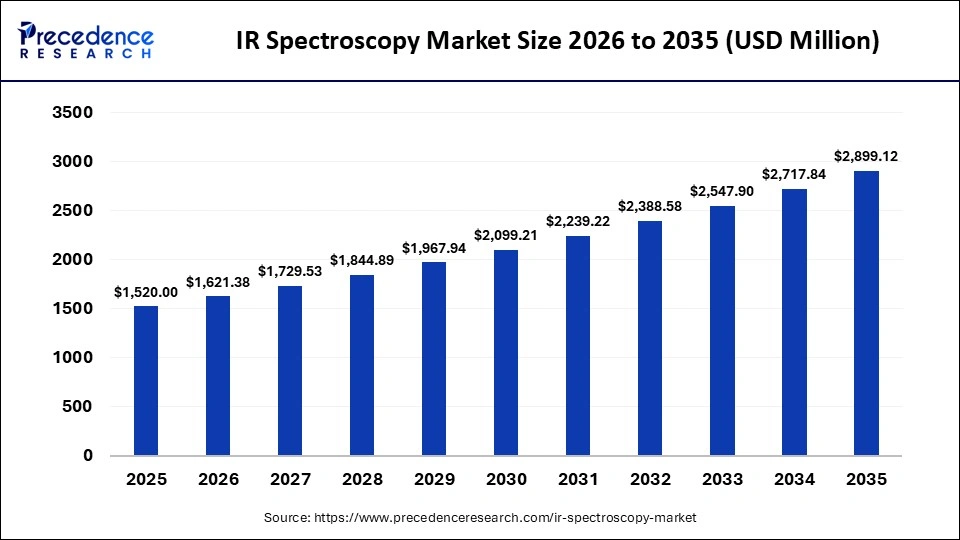
The global IR spectroscopy market size accounted for USD 1,520.00 million in 2025 and is predicted to increase from USD 1,621.38 million in 2026 to approximately USD 2,899.12 million by 2035, expanding at a CAGR of 6.67% from 2026 to 2035. The market is witnessing robust growth driven by increasing demand for quality products across sectors such as pharma, healthcare, and food and beverages, the integration of AI and automation, and the development of portable spectrometers, all of which are fueling global expansion.
Market Highlights
- North America accounted for the largest market share of 35% in 2025.
- Asia Pacific is expected to grow at the fastest CAGR from 2026 to 2035.
- By product type, the fourier transform infrared spectrometers segment held the major market share of 35% in 2025.
- By product type, the near-infrared spectrometers segment is expected to grow at a strong CAGR from 2026 to 2035.
- By application, the pharmaceutical and life sciences segment contributed the biggest market share of 30% in 2025.
- By application, the food & beverages segment is growing at a solid CAGR from 2026 to 2035.
- By end user industry, the pharmaceutical companies segment captured more than 32% of market share in 2025.
- By end user industry, the food & beverage manufacturers segment is growing at a healthy CAGR from 2026 to 2035.
- By technology type, the fourier transform IR segment generated the highest market share of 40% in 2025.
- By technology type, the near IR segment is growing at the notable CAGR from 2026 to 2035.
- By product form/configuration, the benchtop/laboratory instruments segment accounted for the highest market share of 45% in 2025.
- By product form/configuration, the portable/handheld segment is expected to grow the fastest CAGR from 2026 to 2035.
IR Spectroscopy: Principles and Applications
Infrared spectroscopy is an analytical technique that uses the infrared region of the electromagnetic spectrum to probe molecular vibrations and chemical bond information, enabling qualitative and quantitative analysis of solids, liquids and gases for applications such as material characterization, quality control, process monitoring and research across industries like pharmaceuticals, chemicals, food and beverage and environmental science. The technique measures how molecules absorb IR light at specific wavelengths, producing characteristic spectra that reveal functional groups, molecular structures and interactions.
Modern IR spectroscopy instruments, including Fourier Transform Infrared (FTIR) systems, benchtop units and portable handheld devices, allow rapid, non-destructive testing with minimal sample preparation. The method is widely used to authenticate raw materials, detect contaminants, verify chemical composition and monitor reaction progress in real time. In pharmaceuticals, IR spectroscopy supports drug formulation, API identification and regulatory compliance. In environmental applications, it helps detect pollutants and monitor emissions. Advances in microsampling accessories, ATR (attenuated total reflectance) technology, and integrated software analytics have further expanded the capabilities of IR spectroscopy, making it one of the most versatile and essential tools in analytical science.
AI Shifts in the IR Spectroscopy Market
Artificial intelligence integration with IR spectroscopy is a transformative move for market growth by automating complex data analysis, improving data accuracy, and enabling advanced lab settings rather than traditional ones. This AI-based evolution is highly beneficial for the biopharma, food safety, and environmental monitoring sectors, where rapid and real-time data analysis is becoming mandatory.
AI and machine learning (ML) algorithms can rapidly and precisely analyze huge datasets, even with unstructured information and derive insights that might be missed with a manual extraction method. Interpretation is a key driver of AI integration with IR spectroscopy, bolstering global market progress on a large scale.
IR Spectroscopy Market Outlook
The IR spectroscopy market is experiencing a robust growth rate due to the combination of factors like the Growing demand for advanced analytical instrumentation across pharmaceuticals, food safety, environmental testing, increasing adoption of portable/handheld IR spectrometers, and inline/online process monitoring. Additionally, the growing and evolving regulatory and quality control requirements in chemicals, materials and manufacturing industries are fuelling the markets growth, along with Technological innovation in IR spectroscopy (miniaturization, hyphenation, AI/ML in spectral data analysis)
The sustainability trends for the IR spectroscopy market include green analytical methods, environmental monitoring, energy efficiency, and resource minimization while supporting material innovation and product longevity. A major driving factor for the market is the growing need for environmental monitoring applications to detect and quantify pollutants, GHGs, and other harmful substances in air, water, and soil, fueling market growth.
The startup ecosystem of the IR spectroscopy market is highly evolving, focusing more on technological innovation to attain refined outcomes in less time and niche applications. Many startups, such as Quantune Technologies, Maramba Labs, and Lightigo, are adopting quantuminduced spectroscopy.
Market Scope
| Report Coverage | Details |
| Market Size in 2025 | USD 1,520.00 Million |
| Market Size in 2026 | USD 1,621.38 Million |
| Market Size by 2035 | USD 2,899.12 Million |
| Market Growth Rate from 2026 to 2035 | CAGR of 6.67% |
| Dominating Region | North America |
| Fastest Growing Region | Asia Pacific |
| Base Year | 2025 |
| Forecast Period | 2026 to 2035 |
| Segments Covered | Product Type, Application, End-Use Industry, Technology Type, Product Form/Configuration, and Region |
| Regions Covered | North America, Europe, Asia-Pacific, Latin America, and Middle East & Africa |
IR Spectroscopy Market Segmental Insights
Product Type Insights
Fourier Transform Infrared (FTIR) Spectrometers: The segment held the largest market share, at 35%, in 2025. The segment is dominating due to its benefits, such as speed, versatility, and efficiency, which enable simultaneous capture of the complete infrared spectrum and deliver high-quality data with unmatched signal-to-noise ratios. It can perform rapid, non-destructive analysis, which is crucial for the pharma, environmental, and chemical sectors.
Near-Infrared (NIR) Spectrometers: The near-infrared spectrometers segment is expected to witness the fastest CAGR during the foreseeable period. The segment is growing due to high demand across sectors such as food safety, pharmaceuticals, quality control, and clinical diagnostics. The increasing need for real-time, on-site analysis and AI integration with precise results is are key driver of the segment.
Dispersive IR Spectrometers: The segment is notably growing, as dispersive spectrometers have historically been invaluable owing to their low cost and simple use for identifying compounds through wavelength separation. It is highly useful for an application where the budget is constraint, while speed is not necessarily faster.
Mid-Infrared (MIR) Spectrometers: The segment is growing moderately due to offerings such as high specificity and sensitivity in the molecular fingerprint region, enabling non-destructive, precise analysis of the chemical composition and structure of the given sample. They are most often used for gas sensing, food quality analysis, and environmental monitoring.
Application Insights
Pharmaceutical & Life Sciences: The pharmaceutical and life sciences segment held the largest market share of 30% in 2025. The segment is dominating due to stringent quality-control regulations, the method providing detailed molecular-structure data without destructive methods, and its widespread adoption across the entire drug development and manufacturing lifecycle. Regulatory bodies like the U.S. FDA mandate rigorous quality control across pharma and life science products is a key driver.
Food & Beverages: The segment is expected to post the highest CAGR over the foreseeable period. The segment is growing due to increasing demand for food quality and safety, the widespread adoption of the functional foods sector, and the need for non-destructive yet accurate analysis. IR spectroscopy enables rapid testing of raw materials, fueling the segments growth.
Environmental and Water Testing: The segment is growing moderately due to heightened public awareness of the fatal conditions resulting from the depletion of the protective environmental layer around the earths surface, driven by uncontrolled industrialization and GHG emissions. IR spectroscopy offers unmatched environmental monitoring, enabling rapid and detailed analysis of various pollutants.
Polymers & Materials: The segment is growing due to the essential role of IR spectroscopy in the characterization, identification, and quality control of polymers and materials across several critical industries, including automotive, medical, and packaging. IR spectroscopy allows analysts to detect polymer degradation, verify copolymer composition, and assess additives, fillers or plasticizers with high precision. Manufacturers rely on IR techniques to ensure batch consistency, confirm the authenticity of raw materials, and troubleshoot production issues such as contamination or incomplete curing.
End-User Industry Insights
Pharmaceutical Companies: The pharmaceutical companies segment held the largest market share of 32% in 2025. The segment is dominating, as pharmaceutical companies must comply with stringent quality regulations for drug development and commercialization.IR spectroscopy is the most widely used method for confirming the chemical structure, purity, and stability of drug compounds, driving the segments market growth.
Food & Beverage Manufacturers: The food & beverage manufacturers segment is expected to grow at the highest rate over the foreseeable period. The segment is expanding due to increasing demand for high-quality, safe food and greater compliance with food safety standards. The technology provides detailed insights into foods nutritional content and quality.
Chemical Manufacturers: The segment is moderately expanding due to this method ability to quickly analyse various chemical samples without interfering with their internal chemical bonds, which aligns with strict mandates set for the chemical manufacturing industry.
Technology Type Insights
Fourier Transform IR (FTIR): The Fourier transform IR segment held the largest market share, at 40%, in 2025. The segment is dominating due to the technology ability to deliver high-speed, high-resolution, and precise spectral data in a single measurement, mitigating the need for oversampling and frequent testing, and it also provides a better signal-to-noise ratio with wavenumber precision. Also, this is a versatile and non-destructive technology, which is a major driving factor.
Near-IR (NIR): The near-IR segment is expected to witness the fastest CAGR of 15% during the foreseeable period. The segment is expanding due to its ability to perform detailed analysis and a its wide range of applications across industries such as pharma, food, and healthcare. Innovations such as highly developed software further enhance its usability.
Raman-Integrated IR: The segment is growing due to its comprehensive, complementary material analysis, which mitigates the limitations of other methods. This synergy provides a versatile, powerful tool for complex applications, particularly for researchers and industry professionals.
Product Form/Configuration Insights
Benchtop/Laboratory Instruments: The benchtop/laboratory instruments segment held the largest market share, at 45%, in 2025. The segment is dominant owing to its excellent analytical capabilities, higher precision, and authenticity, which are crucial for complying with stringent regulations in laboratory and industrial applications. Benchtop configurations typically have a longer lifespan and offer greater ROI for leading companies.
Portable/Handheld Instruments: The portable/handheld segment is expected to post the fastest CAGR of 25% over the foreseeable period. The segment is growing due to increasing demand for on-site, real-time analysis that saves time and costs. This configuration is designed to be user-friendly, durable, yet capable of offering precise performance, making it a highly desirable instrument. Handheld IR devices are widely adopted in field inspections, supply chain verification, raw material screening and environmental monitoring, where laboratory access is limited.
Online/Inline Instruments: The segment is proliferating as the shift towards instant data analysis directly within the production line increases, allowing operators to make immediate adjustments to optimize conditions and processing, and to correct any deviations for precise analysis. Inline IR spectroscopy systems are integrated into manufacturing equipment to monitor chemical reactions, polymer curing, blending uniformity and contamination in real time.
IR Spectroscopy Market Regional Insights
The North America IR spectroscopy market size is estimated at USD 532.00 million in 2025 and is projected to reach approximately USD 1,029.19 million by 2035, with a 6.82% CAGR from 2026 to 2035.
Which Factors Made North America a Leading Force in the IR Spectroscopy Market?
North America held the largest market share of 35% in 2025. The regions dominance can be attributed to major factors such as a strong research and development sector, leading pharmaceutical andbiotechnology companies, highly advanced technological adoption, growing demand for regulatory and quality control standards, widespread automation and robust healthcare infrastructure. Laboratories across the region rely heavily on IR spectroscopy for material verification, impurity profiling and conformity testing to comply with strict FDA and EPA requirements. Continuous investments in analytical instrumentation, digital laboratories and high-throughput testing systems also support the strong adoption of IR-based platforms.
In North America, IR spectroscopy is widely adopted by leading sectors, including industrial automation, manufacturing, and quality control units across petrochemicals, agriculture, and food safety, driving sustained market growth. The technique is used extensively for real-time monitoring of chemical processes, rapid contamination detection and verification of raw material authenticity in high-volume production environments.
The U.S. IR spectroscopy market size is calculated at USD 399.00 million in 2025 and is expected to reach nearly USD 777.04 million in 2035, accelerating at a strong CAGR of 6.89% between 2026 and 2035.
U.S. IR Spectroscopy Market Trends
The U.S. is a hub of technological innovation, with substantial investment in research and development across sectors like pharmaceuticals and life sciences, driving the development of IR spectroscopy in the region. Many U.S. laboratories and biotech companies use IR spectroscopy for active ingredient verification, formulation analysis and structural confirmation as part of their routine analytical workflows. Advanced FTIR systems, portable IR devices and automated sampling accessories are widely adopted in academic institutions and industrial labs, strengthening the countrys leadership in spectroscopy innovation.
A stringent regulatory landscape, especially in sectors like food and pharma, mandates the use of advanced analytical tools such as IR spectroscopy for compliance and quality control. The U.S. Food and Drug Administration and the Environmental Protection Agency require strict monitoring of chemical identity, purity and contaminants, which increases reliance on IR-based methods.
The Asia Pacific IR spectroscopy market size is expected to be worth USD 884.23 million by 2035, increasing from USD 456.00 million by 2025, growing at a CAGR of 6.85% from 2026 to 2035.
Why is the Asia Pacific IR Spectroscopy Market Expanding Largely?
Asia Pacific is expected to witness the fastest CAGR of 30% during the foreseeable period of 2026-2035. The region is growing rapidly due to factors such as industrial expansion, rapid economic growth, technological advancements, and an increasing focus on food quality and safety amid expanding safety mandates across the region. Many countries are implementing stricter standards for ingredient verification, contamination control, and chemical analysis, which is increasing the use of IR spectroscopy in routine testing laboratories.
The region has stable and evolving economies that support investments in new infrastructure and innovative technologies such as IR spectroscopy, fueling global growth. Countries like China, Japan, South Korea and India are expanding pharmaceutical manufacturing, chemical processing and materials research, creating high demand for FTIR instruments, handheld IR devices and automated sampling systems. Growth in semiconductor fabrication, polymer production and environmental monitoring further strengthens the adoption of IR techniques across industrial, academic and government laboratories.
China IR spectroscopy Market Trends
The country is expanding its market due to several factors, including rapid industrialization, a large and growing pharmaceutical sector, and substantial government investments in R&D across key sectors. The high adoption rate of spectroscopy in Chinas manufacturing base, across sectors likesemiconductors, polymers, and chemicals, requires high-quality tools to analyze its efficiency and quality, further supporting the markets growth in China.
The Europe IR spectroscopy market size has grown strongly in recent years. It will grow from USD 304.00 million in 2025 to USD 594.32 million in 2035, expanding at a compound annual growth rate (CAGR) of 6.93% between 2026 and 2035.
Why Is Europe Showing Strong Growth in the Market for IR Spectroscopy?
The Europe IR spectroscopy market is experiencing strong growth owing to stringent government regulations, especially for air and water quality, a well-developed pharma sector, and the increasing demand for real-time analysis across sectors such as food safety and manufacturing. The European Unions strict environmental protection and safety regulations in the manufacturing sector support IR spectroscopy in the region.
Additionally, Europes established chemical and materials science industries increasingly rely on IR spectroscopy for compliance testing, raw material verification and advanced process monitoring. National metrology institutes and accredited labs across Germany, France, and the UK continue to expand their analytical capabilities, encouraging broader adoption of high-performance FTIR systems and portable IR analyzers. The regions strong emphasis on sustainability, product traceability, and automation further accelerates the deployment of IR spectroscopy in research facilities and industrial production lines.
UK IR Spectroscopy Market Analysis
The UK IR spectroscopy market is bolstering owing to the robust biopharma sector, along with active leading players like GSK and AstraZeneca that are heavily investing to adopt IR spectroscopy for drug discovery, quality assurance, and significant R&D.Government initiatives and ongoing investment in research for nanotechnology and the bioanalytical field a key drivers for the markets progress in the UK.
The Middle East and Africa IR spectroscopy market is notably growing as oil-dependent economies in the region are making strong efforts to diversify by investing in emerging sectors such as biopharma, food testing, specialty chemicals, and water treatment, all of which rely on IR spectroscopy for quality assurance and compliance with tightening safety regulations. Also, GCC countries are increasingly adopting strict product quality, traceability, and environmental safety standards, which has accelerated the adoption of advanced analytical technologies.
Growth is further supported by rising investments in modern laboratory infrastructure across the UAE, Saudi Arabia, and South Africa, where government-backed programs encourage the use of high-precision analytical tools in industrial manufacturing and environmental monitoring. Expanding petrochemical activities continue to use IR spectroscopy for process control and emission analysis, while new healthcare and research facilities across the region increase demand for spectroscopy systems for pharmaceutical validation and clinical research. This combination of diversification, regulatory tightening, and infrastructure development contributes to the regions notable growth.
UAE IR Spectroscopy Market Trends
The countrys growth can be attributed to the couple of major factors like rapid industrial expansion, growing research and collaboration between private and government institutions along with healthcare products offerors and strategic moves to promote innovation while supporting R&D for food and beverages, pharma and chemical sectors, facilitating the IR spectroscopy markets growth in the UAE of Middle east & Africa region on a large scale.
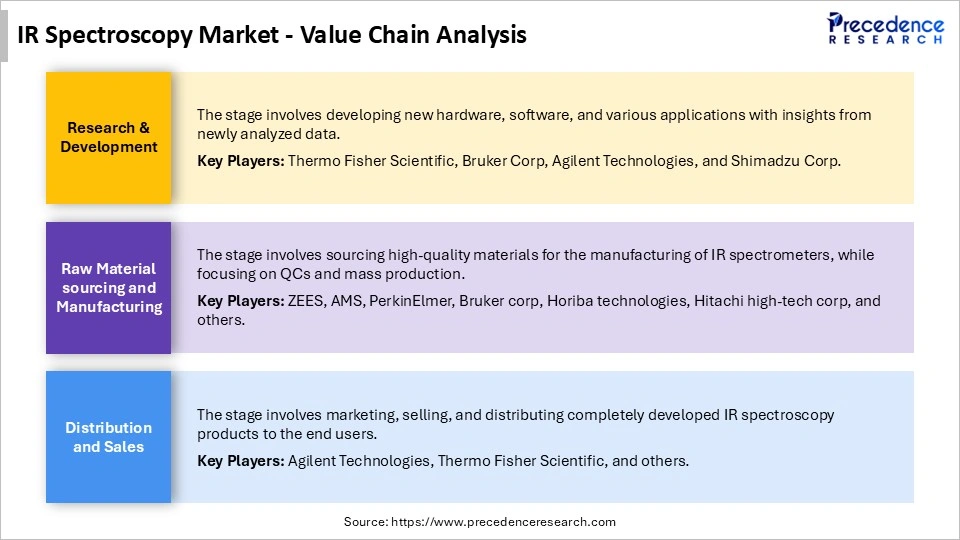
IR Spectroscopy Market Value Chain
IR Spectroscopy Market Companies
Offers a full range of high-performance FTIR and NIR solutions, along with compact, easy-to-use spectrometers like the Nicolet iS50.
Offers flexible handheld solutions and portable FTIR systems for routine testing, and advanced research.
Offers a wide range of spectrometers, including entry-level spectrometers for general use and a flexible spectrum 3 FT-IR for research in the mid-, near-, and far-infrared ranges.
Other Players in the IR Spectroscopy Sector
- Bruker Corporation
- Shimadzu Corporation
- HORIBA Ltd.
- Hitachi High Tech Corporation
- Oxford Instruments
- JASCO Corporation
- Metrohm
- Teledyne Technologies
- ABB
- Buhler Leybold Optics
- BaySpec
- Infrared Analysis Instrumentation
- Ametek (Spectro Scientific)
- Isben Photonics
- Microâ€Optik Instruments
- Galaxy Scientific
- Skyray Instrument Co.
Recent Developments
- In November 2025, a leading player, BrukerCorpp, introduced VERTEX NEO Ultra, the most advanced and versatile benchtop vacuum FT-IR spectrometer with a full automation mode and high spectral performance.(Source: https://www.bruker.com)
- In November 2025, Wiley unveiled extra IR, Raman, LC-MS, and SmartSpectra Data to its spectral libraries, aiming to strengthen new data techniques used for analytical verification.(Source: https://www.knowledgespeak.com)
IR Spectroscopy MarketSegments Covered in the Report
By Product Type
- Fourier Transform Infrared (FTIR) Spectrometers
- Bench-top FTIR
- Portable/Handheld FTIR
- Dispersive IR Spectrometers
- Single-beam dispersive
- Double-beam dispersive
- Near-Infrared (NIR) Spectrometers
- Portable NIR
- Benchtop NIR
- Mid-Infrared (MIR) Spectrometers
- Raman-Integrated IR Systems
- Accessories & Consumables
- Sampling accessories
- Detectors & sources
By Application
- Pharmaceutical & Life Sciences
- Chemical & Petrochemical Analysis
- Food & Beverages
- Environmental & Water Testing
- Polymers & Materials
- Academic & Research Institutes
- Others
By End-Use Industry
- Pharmaceutical Companies
- Chemical Manufacturers
- Food & Beverage Manufacturers
- Environmental Laboratories
- Oil & Gas Companies
- Academic & Research Institutions
- Others
By Technology Type
- Dispersive IR
- Fourier Transform IR (FTIR)
- Near-IR (NIR)
- Raman-Integrated IR
- Others
By Product Form/Configuration
- Benchtop/Laboratory Instruments
- Portable/Handheld Instruments
- Online/Inline Instruments
- Others/Accessories
By Region
- North America
- Europe
- Asia-Pacific
- Latin America
- Middle East and Africa
For inquiries regarding discounts, bulk purchases, or customization requests, please contact us at sales@precedenceresearch.com
Frequently Asked Questions

Ask For Sample
No cookie-cutter, only authentic analysis – take the 1st step to become a Precedence Research client