



Legal AI Market Trends, Leading Companies, Company Revenue / Sales Performance, Subscriber Growth, Pricing Strategies, Cloud Adoption, Infrastructure Expansion, Competitive Landscape, and Industry Outlook
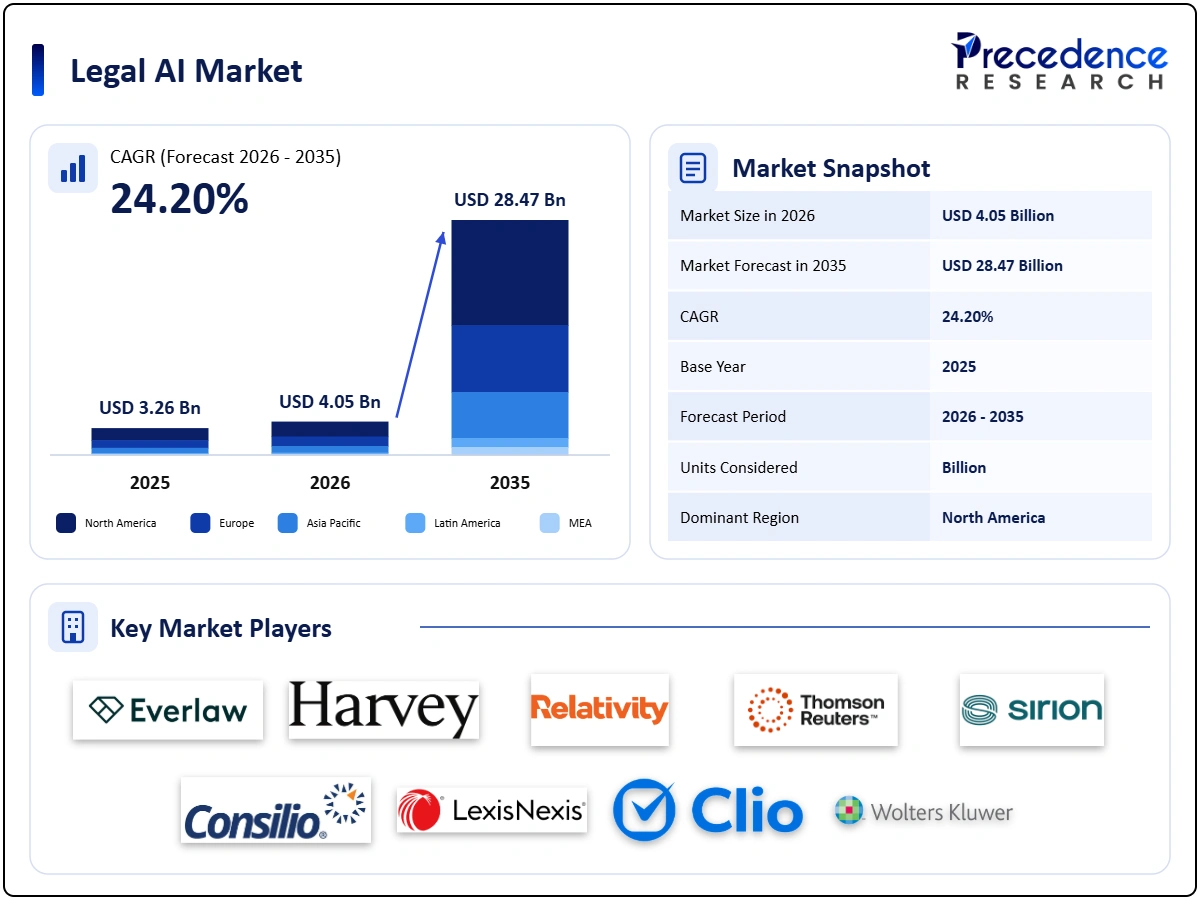
ICT industry specialist Gautam Mahajan estimates the legal AI market at USD 3.26 billion in 2026, with continued technology adoption expected to take the market to USD 28.47 billion by 2035 at a CAGR of 24.20%. Leading legal AI market providers such as Thomson Reuters, LexisNexis, Harvey, Wolters Kluwer are expanding their capabilities across segments including application, deployment, end user and region.
Source: https://www.precedenceresearch.com/legal-ai-market
 Get a Sample
 Report Description


Legal AI Market Growth, Innovations, and Market Size Forecast 2035
The legal AI market is forecasted to expand from USD 4.05 billion in 2026 to USD 28.47 billion by 2035, growing at a CAGR of 24.2% from 2026 to 2035.
Key Takeaways
Market Size & Growth Outlook
- Market size in 2025: USD 3.26 billion
- Estimated market size in 2026: USD 4.05 billion
- Projected market size by 2035: USD 28.47 billion
- CAGR (2026-2035): 24.2%
Regional Market Spotlight
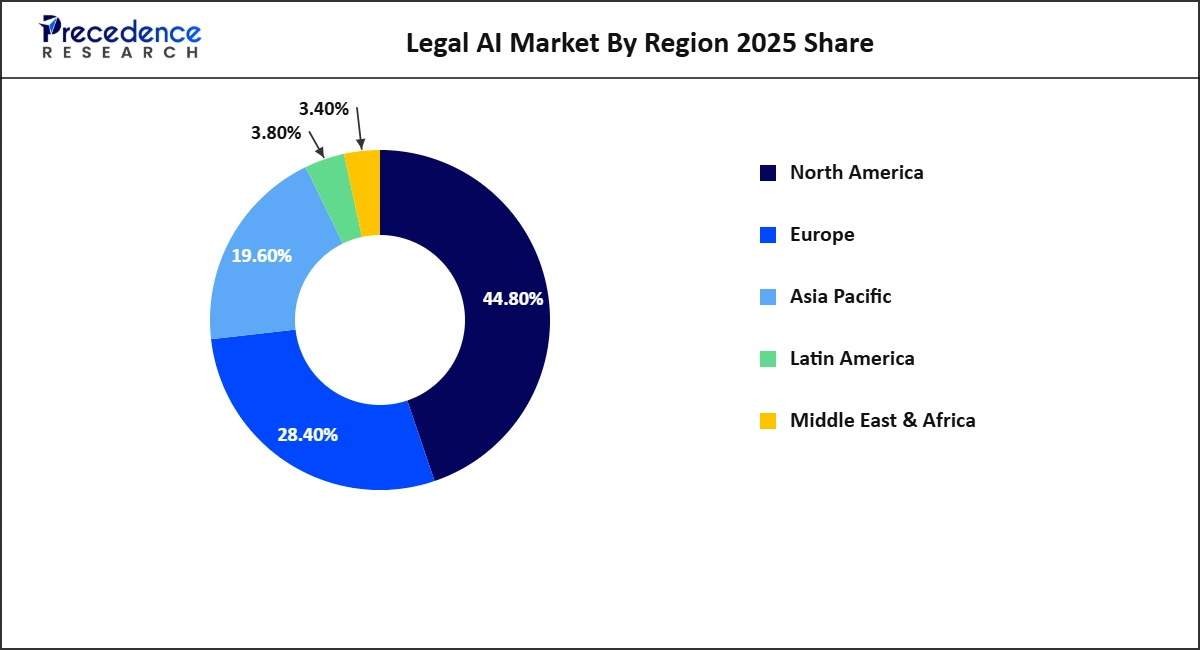
- North America's share of the market stood at 44.8% in 2025, corresponding to USD 1.46 billion.
- The market in Europe reached USD 0.93 billion in 2025, accounting for 28.4% of the global total.
- In 2025, Asia Pacific accounted for 19.6% of the market, valued at USD 0.64 billion. The region is projected to report a CAGR of 25.96% from 2025 to 2035.
Segmental Spotlight
- In 2025, legal research & case law analysis accounted for 27.4%, valued at USD 0.89 billion.
- Cloud deployment accounted for 78.6% of the legal AI market in 2025, equivalent to USD 2.56 billion.
- By end user, law firms accounted for 52.4%, valued at USD 1.71 billion in 2025.
Legal AI Market Size and Forecast, 2025-2035 (USD Billion)
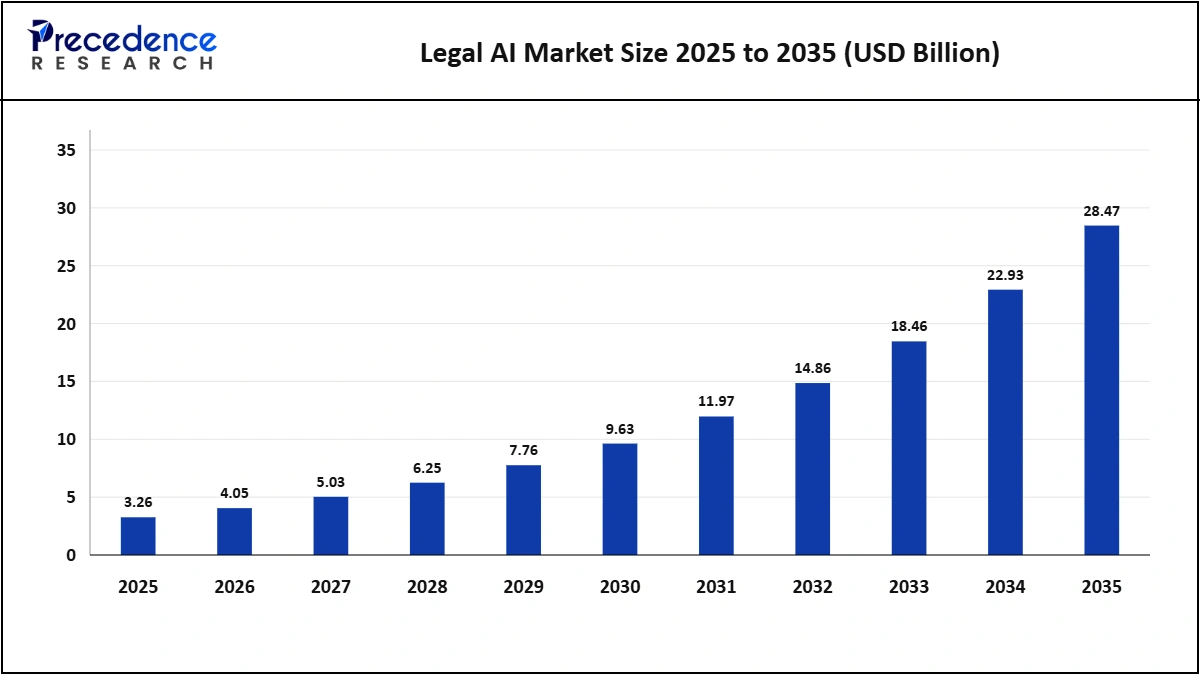
Note: 2025 is the base year; 2026-2035 values are forecasts.
Sources: Expert interviews, secondary sources, Precedence Research database, and Precedence Research analysts.
The legal AI market was valued at USD 3.26 billion in 2025 and is estimated to reach USD 4.05 billion in 2026. The market is projected to grow at a CAGR of 24.2% through 2035, reaching USD 28.47 billion. Growth is driven by law firms and legal departments adopting generative AI assistants and tools for AI research and contract management, alongside rising client expectations for AI-enhanced efficiency. Agentic AI is enhancing multi-step legal workflows, with adoption by mid-sized and small firms. Investments in AI-driven eDiscovery and compliance are projected to elevate the market in the forecast period.
- Analyst View: As generative and agentic AI adoption expands globally, law firms of different sizes, corporate legal departments, and government agencies are investing in AI tools for research, drafting, and reviews. The market estimate is cross-checked against attributable AI-specific revenue from legal technology providers, specialist vendors, and identifiable AI-enabled product portfolios. Broader legal information, practice-management, and eDiscovery revenues are excluded unless they can be reliably allocated to AI-related offerings. The growth rate of the market reflects rapid adoption of generative AI for legal work, moderated over the ten-year period by accuracy concerns and professional responsibility rules.
Market Trends
- Agentic AI is extending legal automation beyond individual prompts by coordinating multi-step workflows, retrieving information, using connected digital tools, and executing defined tasks. Human review remains essential for validating outputs and controlling consequential legal decisions.
- Legal information providers and publishers are integrating AI into research platforms to improve case-law discovery, statutory interpretation, legal analysis, document summarization, and drafting workflows.
- Corporate legal departments are increasingly using AI-enabled tools to manage selected research, contract review, compliance, and routine legal workflows internally, potentially reducing reliance on external counsel for certain activities.
- Generative AI enables legal professionals to review contracts and case documents through natural-language instructions, document-grounded analysis, and automated summarization.
- Citation verification and authority-checking tools help detect fabricated or inaccurate references and assess whether cited legal authorities support the associated legal arguments. Final validation by qualified legal professionals remains necessary.
- Legal AI tools are expected to improve efficiency across various tasks, but they may reduce revenue for service providers under hourly billing due to fewer billable hours.
Drivers, Restraints, and Opportunities
Driver
With the help of generative AI tools, users can draft, summarize, and analyze legal documents in less time. These tools can reduce the time required for selected research, drafting, summarization, and document-review tasks, making more workforce available for urgent and important cases. As volumes of litigation and investigation documents grow, users are opting for legal AI tools to strategize and study the cases. Growing regulatory complexity and rising document volumes are encouraging legal departments to explore AI-enabled compliance monitoring, document analysis, and risk-management workflows. The use of AI in these workflows can reduce processing time and operating costs, although realized savings depend on implementation costs, output accuracy, review requirements, and workflow integration. By reducing the time required for selected research, drafting, summarization, and document-review tasks, legal AI tools can improve professional capacity and support higher-value legal work. Growing document volumes and regulatory complexity further strengthen demand for AI-enabled legal workflows.
Restraint
Circumstances such as AI hallucinations and citation errors create professional risks when studying cases. Adoption remains uneven as firms evaluate accuracy, confidentiality, cybersecurity, and professional-responsibility risks. Therefore, professional responsibility rules require oversight of the results provided by AI. AI-driven productivity gains may challenge traditional hourly billing models by reducing the time required for research, drafting, and document review. Law firms may respond by expanding fixed-fee, subscription-based, and value-based pricing models, while retaining human expertise for complex advisory and litigation work. These risks are contributing to uneven adoption across the legal sector, particularly among organizations with stringent confidentiality, data-governance, and professional-responsibility requirements.
Opportunity
Agentic AI tools can automate complete legal workflows. A significant opportunity exists for vendors to develop jurisdiction-specific legal AI platforms with localized case-law databases, multilingual capabilities, data-residency controls, audit trails, and human-review mechanisms. These features can improve suitability for regulated legal environments and cross-border legal work. Even though corporate legal departments are a fast-growing buyer group for efficient AI tools, cloud-based legal AI and practice-management platforms may lower initial infrastructure requirements for small and mid-sized law firms, although adoption will depend on affordability, usability, data protection, and the reliability of AI-generated outputs. AI-assisted document classification, transcription, summarization, and case administration may support court efficiency, subject to judicial oversight, procedural safeguards, and public-sector procurement requirements. Legal AI is developing as a distinct revenue category within the broader legal technology market, as providers increasingly monetize AI-specific research, drafting, contract intelligence, document review, and agentic workflow capabilities.
Legal AI Market Segmentation: 2025 Share and Value
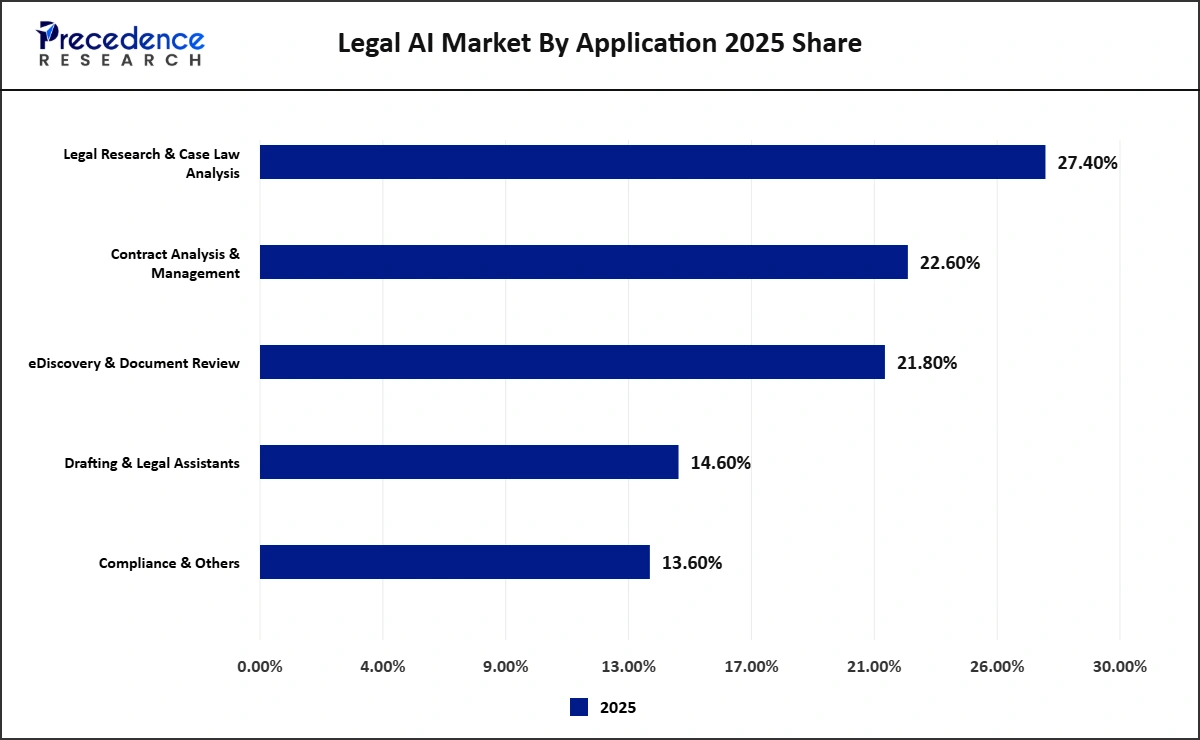
Legal AI Market By Application 2025 Share
Note: 2025 is the base year.
Sources: Expert interviews, secondary sources, Precedence Research database and Precedence Research analysts.
In 2025, legal research and case law analysis represented the largest application segment, accounting for 27.4% of the global legal AI market. Contract intelligence tools and Discovery also represented substantial revenue pools, reflecting demand for automation across research, contract management, and document-intensive legal workflows.
Legal research and case law analysis covered 27.4% of the market, equating to USD 0.89 billion, due to the daily use of AI-enhanced research tools by legal professionals. Contract analysis and management follows at 22.6%, which translates to USD 0.74 billion. The eDiscovery and document review segment accounted for 21.8% of the market, representing USD 0.71 billion. Drafting and legal assistants accounted for 14.6% of the market in 2025, valued at USD 0.48 billion, attributed to the rapid growth of generative AI capabilities in document drafting and review. Compliance and other legal services contributed the remaining 13.6% of the market, amounting to USD 0.44 billion. This data indicates a robust trend toward automation and AI integration in various facets of legal practice.
Legal AI Market By Deployment 2025 Share & Size
| Segments | 2025 Share | 2025 Market Value |
| Cloud | 78.6% | USD 2.56 billion |
| On-Premises | 21.4% | USD 0.70 billion |
Note: 2025 is the base year.
Sources: Expert interviews, secondary sources, Precedence Research database and Precedence Research analysts.
Cloud deployment accounted for 78.6% of the market in 2025, valued at USD 2.56 billion. Cloud deployment offers scalability, centralized updates, and lower infrastructure-management requirements, while security and confidentiality depend on vendor controls and customer configuration. In contrast, on-premises deployment accounted for 21.4% of the market. On-premises and private deployment models may appeal to organizations with stringent data-residency, confidentiality, or infrastructure-control requirements.
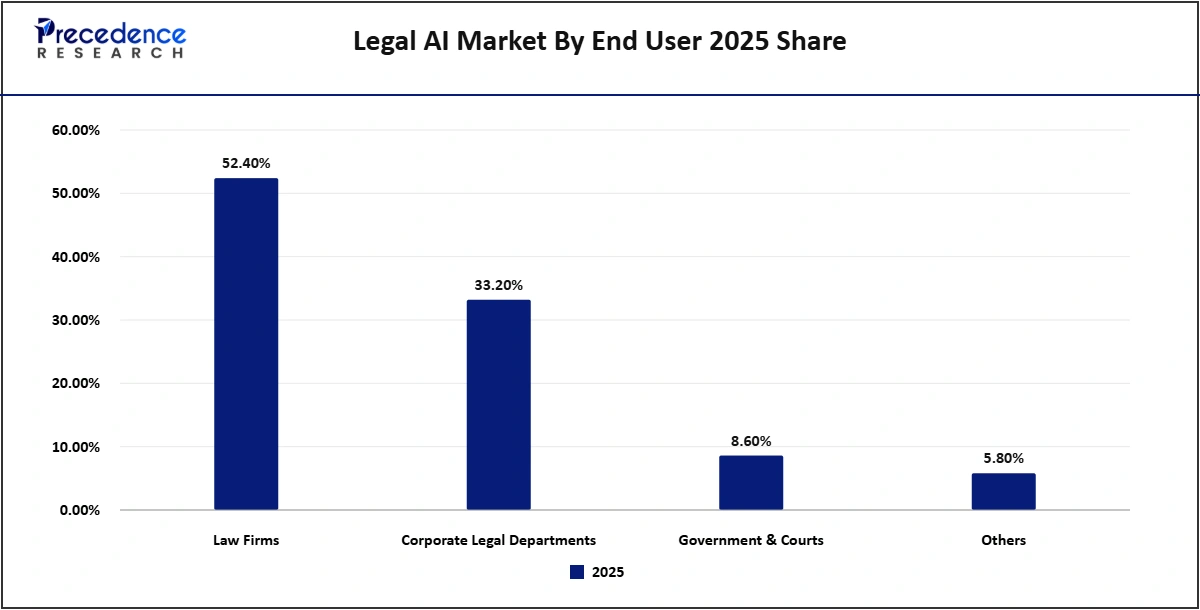
Legal AI Market By End User 2025 Share
Note: 2025 is the base year.
Sources: Expert interviews, secondary sources, Precedence Research database and Precedence Research analysts.
In 2025, law firms dominated the legal sector's adoption of AI, with 52.4% of the market, valued at USD 1.71 billion. This substantial share is attributed to large firms leveraging AI tools to enhance productivity across various functions, including research, drafting, and review processes. Corporate legal departments accounted for 33.2% of the market in 2025, valued at USD 1.08 billion. Their adoption is supported by growing demand for in-house contract analysis, compliance monitoring, legal research, and document-review capabilities as they increasingly shift workloads in-house through AI implementation. Additionally, government entities and courts represented 8.6% of the market, translating to USD 0.28 billion, while other users contributed 5.8%, with a total of USD 0.19 billion.
- Analyst View: As more law firms adopt AI for legal research, the market is expected to contribute to AI growth. We expect demand to expand across generative drafting assistants, contract intelligence, and enterprise legal workflows. Corporate legal departments are likely to represent an important source of incremental demand as organizations seek to improve in-house legal productivity and manage external counsel expenditure.
Regional Analysis
Legal AI Market By Region 2025 Share & Size
Note: 2025 is the base year.
Sources: Expert interviews, secondary sources, Precedence Research database and Precedence Research analysts.
North America captured 44.8% of the legal AI market in 2025, supported by the scale of the U.S. legal services industry, high litigation activity, substantial legal technology spending, and established adoption of enterprise software. Influential vendors include Thomson Reuters, Harvey, Relativity, and Clio in the region, boosting the market. Europe held 28.4% of the market, underpinned by sizable law firms in the UK and across continental Europe, as well as prominent legal publishers like LexisNexis and Wolters Kluwer, along with innovative startups such as Legora. Asia Pacific accounted for 19.6% of the market, driven largely by advancements in legal digitalization in key countries including India, China, Japan, Australia, and Singapore. Conversely, Latin America and the Middle East and Africa captured smaller shares of the market at 3.8% and 3.4%, respectively, yet witnessed growth through increasing adoption by law firms and the government sector.
North America accounted for 44.8%, valued at USD 1.46 billion in 2025. Most large law firms and numerous corporate legal departments in the United States have implemented generative AI tools.
Europe reached USD 0.93 billion in 2025, accounting for 28.4% of the global market. Law firms in the UK are early adopters of AI, offering growth opportunities for several AI start-ups. Legora, an AI start-up from Sweden, is one of the examples of the development of legal AI tools across Europe.
Asia Pacific accounted for 19.6%, valued at USD 0.64 billion in 2025, and is the fastest-growing region. In India, the expansion of legal process outsourcing and ongoing court digitalization initiatives may create opportunities for legal AI adoption.
Latin America contributed 3.8% of the global market in 2025, equivalent to USD 0.12 billion. Brazil's substantial legal services market and document-intensive litigation environment may support demand for AI-enabled legal tools.
The Middle East and Africa accounted for 3.4% (USD 0.11 billion) in 2025. Demand opportunities in the Gulf region are supported by cross-border commercial activity, multilingual legal requirements, and government digitalization initiatives. Arabic and English-language legal AI capabilities may be relevant to international trade, regulatory compliance, and contract workflows.
Analyst View: North America leads the market, supported by its large legal services industry and established legal technology ecosystem. In terms of forecast CAGR, we expect Asia Pacific to outperform other regions through the forecast period because legal outsourcing is expanding fastest there.
Competitive Landscape
Top 10 Companies in the Legal AI Market, 2025
| Rank | Company Name | Market-Specific Revenue (USD Billion) | 2025 Share | Key Products / Business | Headquarters |
| 1 | Thomson Reuters | 0.42 | 12.88% | CoCounsel and Westlaw AI | Canada |
| 2 | LexisNexis | 0.40 | 12.27% | Lexis+ AI and Protégé | United States |
| 3 | Harvey | 0.13 | 3.99% | Generative AI legal platform | United States |
| 4 | Wolters Kluwer | 0.12 | 3.68% | Legal AI and compliance tools | Netherlands |
| 5 | Relativity | 0.11 | 3.37% | RelativityOne with aiR review | United States |
| 6 | Clio | 0.10 | 3.07% | Legal practice-management, legal research, and Vincent AI capabilities | Canada |
| 7 | Consilio | 0.09 | 2.76% | AI document review services | United States |
| 8 | Everlaw | 0.08 | 2.45% | eDiscovery with generative AI | United States |
| 9 | Sirion | 0.06 | 1.84% | AI contract lifecycle management | United States |
| 10 | Legora | 0.05 | 1.53% | Collaborative legal AI platform | Sweden |
Note: Company revenues and shares are 2025 estimates.
Sources: Company press releases, expert interviews, secondary sources, Precedence Research database and Precedence Research analysts.
The top 10 companies collectively accounted for approximately 47.85% of the estimated global legal AI market in 2025, while the remaining share was distributed across other specialist vendors, legal technology providers, regional platforms, and AI-enabled legal service providers.
Thomson Reuters ranked first in our estimates, with an estimated market share of 12.88% in 2025, closely followed by LexisNexis at 12.27% and Harvey at 3.99%. Thomson Reuters excels in CoCounsel and AI features in Westlaw and Practical Law, used by law firms and legal departments worldwide. LexisNexis offers Lexis+ AI and its Protégé assistant built on its legal content, and Harvey has grown rapidly as a generative AI platform for large law firms and corporate legal teams.
Key players such as Wolters Kluwer, Relativity, Clio, Consilio, Everlaw, Sirion, and Legora compete through compliance and legal tools, eDiscovery and review, practice management with AI research, managed review, contract lifecycle management, and collaborative AI. The legal AI market features a mix of established legal technology providers and specialist AI vendors. Specialist vendors compete through model performance, legal-domain accuracy, proprietary data access, workflow integration, information security, deployment flexibility, and pricing. Key competitive factors include accuracy, citation reliability, proprietary content, security, workflow integration, and pricing.
Companies Ecosystem
The legal AI ecosystem links foundation model providers and legal content owners with legal AI platforms, practice and document management systems, service providers and legal professionals.
| Ecosystem Stage | Role in the Market | Key Companies |
| Foundation Models | Provide language models used in legal tools | OpenAI, Anthropic, Google, Mistral AI |
| Legal Content Providers | Own case law, statutes and practice content | Thomson Reuters, LexisNexis, Wolters Kluwer, vLex |
| Legal AI Platforms | Offer research, drafting, review and contract AI | Harvey, Legora, CoCounsel, Lexis+ AI, Sirion |
| Practice & Document Systems | Manage matters, documents and eDiscovery | Clio, iManage, NetDocuments, Relativity, Everlaw |
| Users & Service Providers | Use and deliver AI-enabled legal work | Law firms, corporate legal teams, courts, Consilio, legal process outsourcers |
Sources: Company press releases, expert interviews, secondary sources, Precedence Research database and Precedence Research analysts.
Precedence Research Companies Quadrant
The Precedence Research Companies Quadrant positions key participants in the legal AI market by market strength, reflecting revenue scale, market share, and geographic reach, and by innovation and growth strategy, reflecting product portfolio breadth, R&D intensity, and partnerships. Positions reflect each company's estimated 2025 legal AI revenue and our assessment of its AI capabilities, legal content, and partnerships.
Sources: Company press releases, expert interviews, secondary sources, Precedence Research database and Precedence Research analysts.
Leaders: Thomson Reuters and LexisNexis benefit from established legal content portfolios and integrated AI research platforms. Harvey has gained traction as a specialist generative AI provider, while Relativity has a strong position in AI-enabled eDiscovery and document review.
Challengers: Wolters Kluwer combines established legal information, compliance, and workflow software capabilities with AI-enabled product development.
Innovators: Clio integrates AI into legal practice-management workflows, Everlaw applies generative AI to eDiscovery, and Legora focuses on collaborative legal AI workflows.
Niche Players: Consilio focuses on AI-enabled legal services and document-review workflows, while Sirion specializes in AI-enabled contract lifecycle management. Their positioning reflects their more focused application areas within the broader legal AI ecosystem.
Recent Developments
- September 2026: Harvey raised USD 550 million at a company-announced valuation of USD 15.5 billion, supporting the expansion of its legal AI platform and agentic capabilities.
- March 2026: Harvey raised USD 200 million at an USD 11 billion valuation to expand its AI agent capabilities for law firms and corporate legal teams.
- August 2025: Thomson Reuters launched CoCounsel Legal, incorporating agentic workflows and Deep Research capabilities grounded in Westlaw and Practical Law content.
- November 2025: Clio completed its USD 1 billion acquisition of vLex, combining legal practice-management capabilities with vLex's legal research database and Vincent AI.
Legal AI Market Segments
By Application
- Legal Research & Case Law Analysis
- Contract Analysis & Management
- eDiscovery & Document Review
- Drafting & Legal Assistants
- Compliance & Others
By Deployment
- Cloud
- On-Premises
By End User
- Law Firms
- Corporate Legal Departments
- Government & Courts
- Others
By Region
- North America (U.S., Canada, Mexico)
- Europe (Germany, U.K., France, Italy, Spain, Rest of Europe)
- Asia Pacific (China, Japan, India, South Korea, Taiwan, Rest of Asia Pacific)
- Latin America (Brazil, Argentina, Rest of Latin America)
- Middle East & Africa (GCC, South Africa, Rest of MEA)
Research Methodology
The legal AI market is defined as AI software and separately identifiable services supporting legal research, contract analysis, eDiscovery, document review, drafting, litigation analytics, and compliance. The 2025 base-year estimate is developed bottom-up using paid users and seats, enterprise licences, subscription pricing, usage-based fees, and attributable AI-specific services revenue. Estimates are segmented by application, deployment, end user, and region. Company-level estimates isolate revenue attributable to legal AI products and services from broader legal information, practice-management, and eDiscovery portfolios. The resulting estimates are cross-checked against company disclosures, industry information, expert interviews, and published market assessments. The 2026–2035 forecast is developed from the base-year estimate using the stated growth assumptions, with regional, application, deployment, and end-user values reconciled to the global market total.
Analyst View: Overall Market
The legal AI market is transitioning from standalone research and document-assistance tools toward integrated, workflow-oriented platforms. Our assessment is that long-term growth will depend on vendors' ability to combine reliable legal content, accurate outputs, secure data handling, and measurable productivity improvements. Agentic workflows and enterprise adoption represent important growth opportunities, while professional accountability and confidentiality requirements will shape commercialization.
Sources and References
For inquiries regarding discounts, bulk purchases, or customization requests, please contact us at sales@precedenceresearch.com
Frequently Asked Questions





Ask For Sample
No cookie-cutter, only authentic analysis – take the 1st step to become a Precedence Research client
 Get a Sample




 sales@precedenceresearch.com
 Schedule a Meeting
