



Low Light Imaging Market Trends, Companies, Revenue / Sales Performance, Manufacturing Yield, Fab Capacity, Export & Import Dynamics, Supply Chain Analysis, Competitive Landscape, and Growth Forecast
Low Light Imaging Market (By Technology:CMOS Sensors,CCD Sensors,Infrared/Thermal Imaging,Image Intensifiers; By Application:Defense & Security,Automotive & Transportation, Medical & Life Sciences, Surveillance & Monitoring, Scientific Research; By End User:Government & Military, Commercial Enterprises, Healthcare & Research Institutes, Others) - Global Industry Analysis, Size, Trends, Leading Companies, Regional Outlook, and Forecast 2026 to 2035
Source: https://www.precedenceresearch.com/low-light-imaging-market
 Get a Sample
 Table Of Content


What is the Low Light Imaging Market Size in 2026?
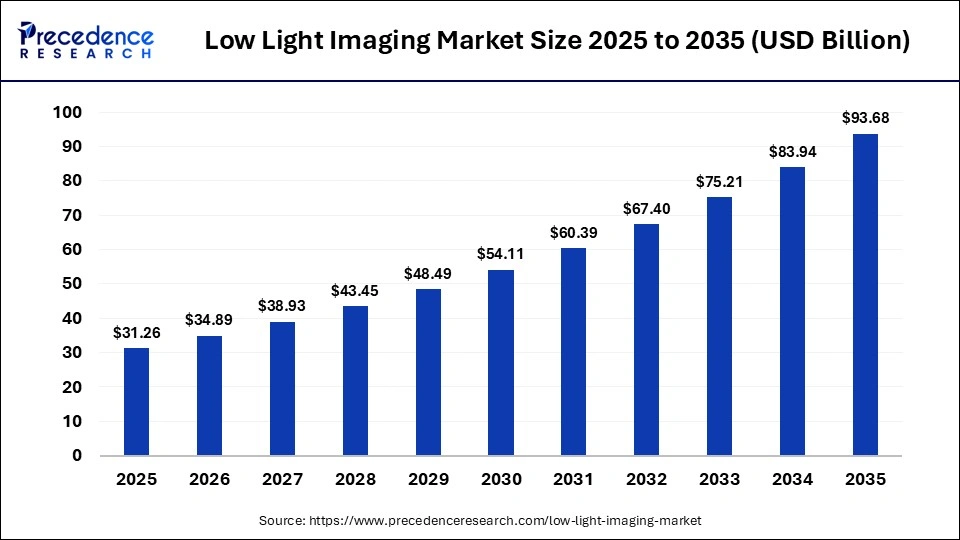
The low light imaging market size was estimated at USD 31.26 billion in 2025 and is predicted to increase from USD 34.89 billion in 2026 to approximately USD 93.68 billion by 2035, expanding at a CAGR of 11.6% from 2026 to 2035. This market is growing due to increasing demand for enhanced surveillance, security systems, and advanced imaging technologies that perform effectively in low-visibility environments.
Key Takeaways
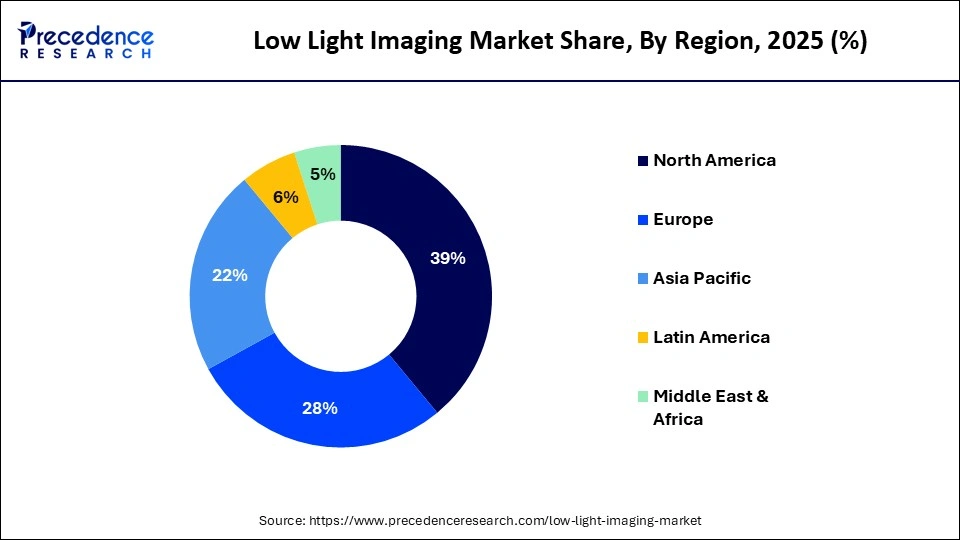
- North America dominated the low light imaging market with a 39% share in 2025.
- Asia Pacific is expected to grow at the fastest CAGR of 12.0% between 2026 and 2035.
- By technology, the CDMO sensors segment held the biggest market share of 38% in 2025.
- By technology, the infrared/thermal imaging segment is expected to expand at the fastest CAGR of 10.1% between 2026 and 2035.
- By application, the defense & security segment contributed to the highest market share of 34% in 2025.
- By application, the automotive & transportation segment is expected to grow at a strong CAGR of 10.3% between 2026 and 2035.
- By end user, the government & military segment held a major market share of 36% in 2025.
By end user, the commercial enterprises segment is expected to expand at the fastest CAGR of 10.5% from 2026 to 2035.
Market Overview
The market encompasses imaging systems and sensors designed to capture high-quality images in minimal light conditions. These systems use technologies such as CMOS, CCD, thermal imaging, and infrared sensors to enhance visibility in near-dark environments. Applications include defense & security, automotive (night vision), surveillance, medical diagnostics, and scientific research.
The low light imaging market is witnessing significant growth because of the growing need for sophisticated security, defense, and surveillance systems that can take crisp pictures in low light. The market is growing as low-light cameras are increasingly used in automotive applications such as autonomous cars and advanced driver assistance systems. Technological developments in infrared imaging, image processing, and sensors are also improving image quality and performance in low-light conditions. The increasing application of low-light imaging in consumer electronics, medical imaging, and industrial inspection also drives the market. Furthermore, growing security concerns and investments in smart city infrastructure are boosting the demand for low-light imaging technologies.
How is Artificial Intelligence Transforming the Low Light Imaging Market?
By enhancing image clarity, noise reduction, and real-time processing in extremely dark environments, artificial intelligence is greatly improving the performance of low-light imaging technologies. AI-driven algorithms can improve brightness, reduce distortions, and reconstruct images, allowing cameras to record crisper images even in low light. Applications in defense systems, autonomous car surveillance, and smart security are all being supported by the integration of AI with sophisticated sensors. Low-light imaging systems are becoming more widely used in a variety of industries as AI-based image recognition and analytics make it possible to detect and monitor objects more quickly.
Low Light Imaging Market Trends
- Rising Adoption in Surveillance and Security Systems: The increasing need for advanced surveillance systems in public safety, border security, and smart cities is driving the demand for low-light imaging technologies capable of capturing clear visuals in dark environments.
- Integration with Artificial Intelligence (AI): AI-powered image enhancement and noise reduction technologies improve image clarity and enable accurate object detection even in extremely low lighting conditions.Growing Use in Automotive Safety Systems: Low-light imaging is increasingly being integrated into advanced driver assistance systems (ADAS) and autonomous vehicles to enhance night vision and improve road safety.
- Advancements in Sensor Technology: Continuous innovations in CMOS and infrared sensor technologies are improving the sensitivity, resolution, and performance of cameras in low-light environments.
- Expansion of Smart City Infrastructure: Governments worldwide are investing in smart city projects that rely heavily on advanced surveillance systems, boosting the adoption of low-light imaging solutions.
- Increasing Application in Consumer Electronics: Smartphones and digital cameras are incorporating enhanced night photography features, contributing to the growth of low-light imaging technologies.
- Growing Demand in Defense and Military Operations: Defense organizations are adopting low-light imaging devices such as night vision systems and thermal cameras for improved monitoring and tactical operations.
- Rising Use in Industrial and Medical Imaging: Low-light imaging technologies are being utilized in industrial inspection and medical diagnostics where high image accuracy is required under limited lighting conditions.
Future Market Outlook
- Increasing Demand for Autonomous and Night Vision Vehicles: The development of autonomous vehicles and advanced night driving assistance systems is creating strong demand for high-performance low-light imaging sensors.
- Expansion of Smart Surveillance in Emerging Economies: Rapid urbanization and growing investments in smart infrastructure in developing countries present significant growth opportunities for low-light imaging solutions.
- Growing Adoption in Healthcare Imaging Applications: Low-light imaging is increasingly used in medical diagnostics, surgical imaging, and biological research, offering new opportunities in the healthcare sector.
- Rising Demand for High-Performance Smartphone Cameras: Smartphone manufacturers are focusing on advanced night photography capabilities, creating opportunities for low-light imaging sensor providers.
- Increasing Use in Industrial Automation and Inspection: Industries are adopting low-light cameras for quality inspection, robotics, and automation processes where visibility may be limited.
- Advancements in Infrared and Thermal Imaging Technologies: Continuous research and development in infrared and thermal imaging are expected to open new opportunities for applications in defense, aerospace, and security sectors.
Market Scope
| Report Coverage | Details |
| Market Size in 2025 | USD 31.26 Billion |
| Market Size in 2026 | USD 34.89 Billion |
| Market Size by 2035 | USD 93.68 Billion |
| Market Growth Rate from 2026 to 2035 | CAGR of 11.6% |
| Dominating Region | Asia Pacific |
| Fastest Growing Region | North America |
| Base Year | 2025 |
| Forecast Period | 2026 to 2035 |
| Segments Covered | Technology, Application, End User, and region |
| Regions Covered | North America, Europe, Asia-Pacific, Latin America, and Middle East & Africa |
Government Initiatives Supporting the Market
|
Region/Country |
Year |
Initiative |
Description |
|
Asia Pacific |
2025 |
Smart City Surveillance Programs |
Governments are expanding smart city projects with AI-based surveillance and traffic monitoring systems, increasing the use of low-light imaging cameras for urban safety. |
|
India |
2025 |
Safe City Initiative |
The government is deploying AI-enabled CCTV networks and intelligent monitoring systems in major cities to improve public safety and night-time surveillance. |
|
North America |
2025 |
Smart Infrastructure Development |
Governments are investing in intelligent transportation systems and public safety infrastructure that utilize advanced night-vision and infrared imaging technologies. |
|
United States |
2026 |
Border & Homeland Security Programs |
Federal agencies are deploying thermal cameras and night-vision systems for border monitoring and critical infrastructure protection. |
|
Europe |
2025 |
Digital Security & Smart Mobility |
European countries are implementing smart surveillance and digital security programs in transportation hubs and public areas. |
|
Germany |
2025 |
Industry 4.0 & Smart City Projects |
Germany is promoting intelligent monitoring systems in industrial facilities and urban infrastructure, supporting advanced imaging technologies. |
|
UAE |
2025 |
Smart Policing Initiative |
The UAE government is deploying AI-powered surveillance systems and smart police stations to enhance city security and monitoring. |
Segment Insights
Technology Insights
What Made CDMO Sensors the Dominant Segment in the Low Light Imaging Market?
The CDMO sensors segment dominated the market with the largest share of 38% in 2025, driven by their capacity to provide enhanced image quality and high sensitivity in extremely low light conditions. Because of their superior signal processing performance and sophisticated noise reduction capabilities, CDMO sensors are widely used in defense imaging systems, night vision devices, and surveillance cameras. Detection accuracy and image clarity have been further enhanced by ongoing developments in semiconductor fabrication and sensor architecture.
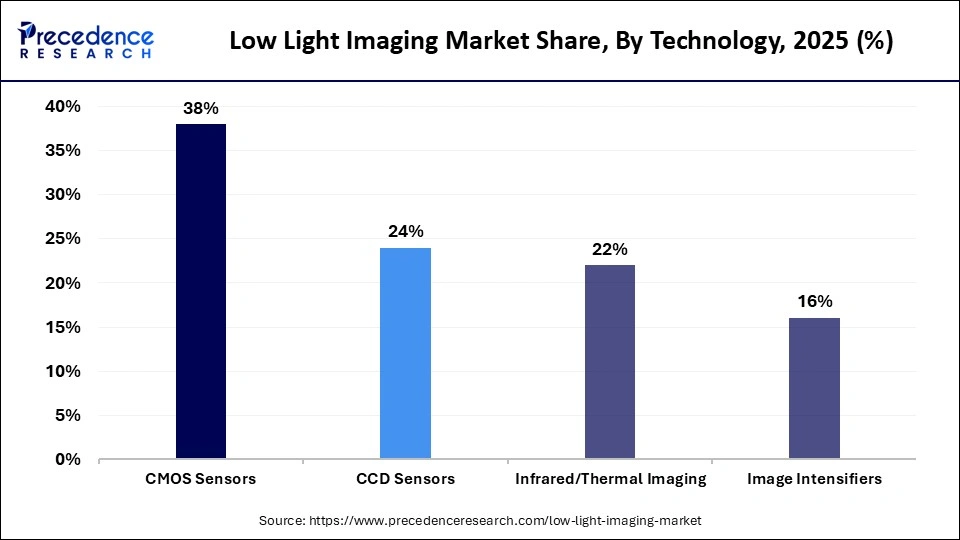
The infrared/thermal imaging segment is expected to grow at the fastest CAGR of 10.1% in the coming years. This is because of its ability to identify heat signatures even in complete darkness. These systems are being utilized more in industrial inspection applications, automotive night vision systems, military surveillance, and border monitoring. The adoption of infrared imaging technologies is increasing due to increased investments in security infrastructure and defense modernization.
Application Insights
Why Did the Defense & Security Segment Dominate the Low Light Imaging Market?
The defense & security segment dominated the market with a 34% market share in 2025 because surveillance cameras, thermal imaging equipment, and night vision systems are widely used in homeland security and military operations. For intelligence operations, border surveillance, and reconnaissance carried out in low-visibility, low-light imaging technologies are essential. Globally, governments are investing more in cutting-edge defense technologies to improve operational effectiveness and situational awareness. The segment's strong market position is further supported by the growing demand for threat detection and national security monitoring.
The automotive & transportation segment is expected to grow at the fastest CAGR of 10.3% in the coming years because automobiles are increasingly equipped with advanced driver assistance systems and night vision. By identifying obstacles, animals, and pedestrians in dimly lit areas, automakers are implementing low-light imaging technologies to increase road safety. High-performance imaging systems are becoming increasingly in demand as autonomous and semi-autonomous vehicles continue to advance.
Low Light Imaging Market Share,By Application, 2025 (%)
| Application | 2025 (%) |
| Defense & Security | 34% |
| Automotive & Transportation | 21% |
| Medical & Life Sciences | 18% |
| Surveillance & Monitoring | 16% |
| Scientific Research | 11% |
End User Insights
What Made Government & Military the Leading Segment in the Low Light Imaging Market?
The government & military segment dominated the market with a major share of 36% in 2025, backed by a high demand for sophisticated thermal imaging systems, surveillance cameras, and night vision equipment used in defense operations. For tactical missions, border monitoring, and nighttime reconnaissance operations, military forces mainly rely on low-light imaging technologies. The purchase of cutting-edge imaging systems is being boosted by rising defense budgets and modernization initiatives in a number of nations. The segment's leadership is further reinforced by the increasing demand for improved situational awareness and national security monitoring.
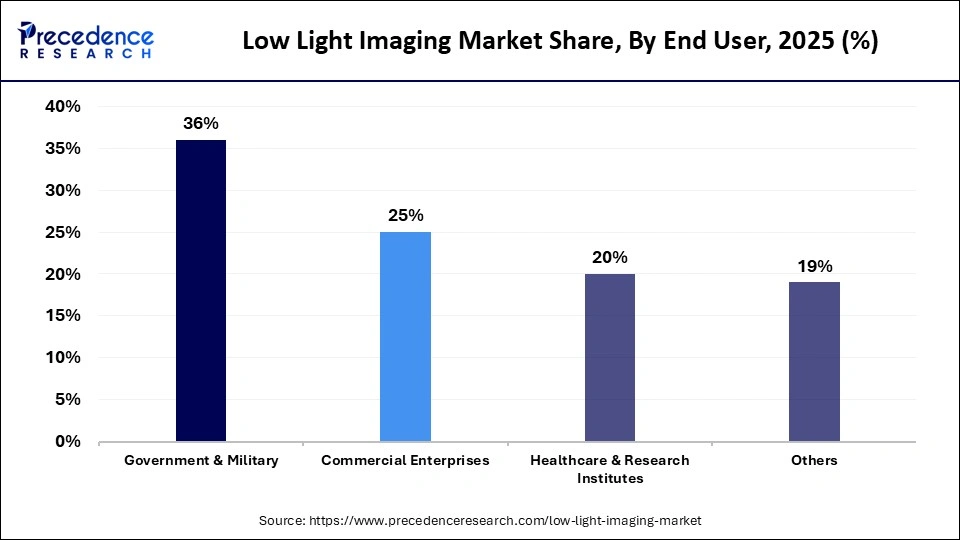
The commercial enterprises segment is expected to grow at the fastest CAGR of 10.5% in the coming years because advanced surveillance and monitoring systems are increasingly being used in a variety of industries. To enhance security and operational monitoring at night, businesses like retail establishments, warehouses, manufacturing facilities, and logistics centers are increasingly installing low-light cameras. Intelligent surveillance infrastructure is being installed more frequently as a result of smart city initiatives and rapid urbanization. Additionally, increased camera performance and falling imaging technology costs are encouraging broader commercial user adoption.
Regional Inights
North America Low Light Imaging Market Size and Growth 2026 to 2035
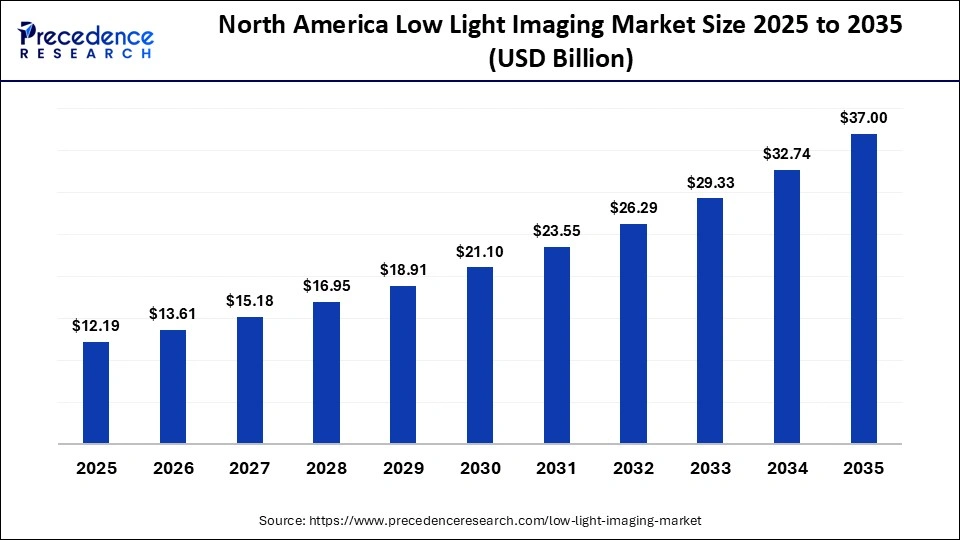
The North America low light imaging market size is exhibited at USD 12.19 billion in 2025 and is projected to be worth around USD 37.00 billion by 2035, growing at a CAGR of 11.74% from 2026 to 2035.
What Made North America the Dominant Region in the Low Light Imaging Market?
North America dominated the low light imaging market by holding the largest share of 39% in 2025. The region's dominance is propelled by early adoption of imaging technologies, high defense spending, and cutting-edge technological infrastructure. For use in homeland security, law enforcement, and military operations, the area has a high demand for thermal imaging devices, night vision systems, and surveillance equipment. Regional market expansion is also being aided by the growing adoption of cutting-edge security and driver assistance technologies.
U.S. Low Light Imaging Market Size and Growth 2026 to 2035
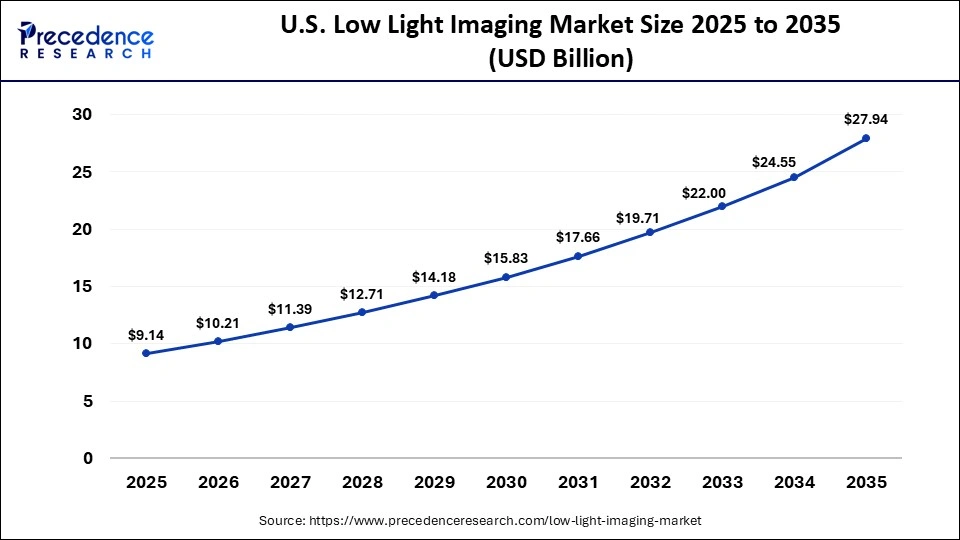
The U.S. low light imaging market size is evaluated at USD 9.14 billion in 2025 and is projected to be worth around USD 27.94 billion by 2035, growing at a CAGR of 11.82% from 2026 to 2035.
U.S. Low Light Imaging Market Trends
The U.S. is the major contributor to the market within North America. This is mainly due to ongoing investments in surveillance infrastructure and defense modernization. The nation's leadership in the market is further reinforced by the presence of significant imaging technology developers and defense contractors.
How is the Opportunistic Rise of Asia Pacific in the Market?
Asia Pacific is expected to grow at the fastest CAGR of 12.0% in the coming years because of increased expenditure on smart city development and defense capabilities. Governments are being encouraged to implement sophisticated monitoring systems with low-light imaging technologies due to growing urbanization and security concerns. Regional market expansion is also being aided by rising automobile production and the expanding electronics manufacturing industry.
India Low Light Imaging Market Trends
India is emerging as a key market due to growing defense modernization initiatives and the growing use of cutting-edge surveillance technologies for homeland and border security. The need for low-light imaging systems is also being driven by government initiatives to boost domestic electronics manufacturing and the development of smart cities.
Low Light Imaging Market Companies
- FLIR Systems (Teledyne)
- Sony Corporation
- Canon Inc.
- Panasonic Corporation
- ON Semiconductor
- Samsung Electronics
- Hamamatsu Photonics
- STMicroelectronics
- Teledyne e2v
- L3Harris Technologies
- BAE Systems
- Hikvision
- Axis Communications
- OmniVision Technologies
- Raytheon Technologies
Recent Developments
- In October 2025, Sony Semiconductor Solutions Corporation announced the development of the IMX775 RGB-IR image sensor, designed for automotive in-cabin monitoring cameras. The sensor delivers high image quality in both visible light and near-infrared conditions, enabling improved performance in low-light environments for driver monitoring and safety systems.(Source: https://www.sony-semicon.com)
- In November 2025, Iris Innovations launched the Photon 4K ultra-low-light marine night-vision camera designed to enhance navigation safety during nighttime operations. The camera provides high-resolution imaging in extremely dark environments and integrates with marine navigation systems.(Source: https://marineindustrynews.co.uk)
- In July 2025, Hikvision launched the DeepinViewX-Series AI-powered bullet cameras designed for advanced surveillance and perimeter protection. These cameras incorporate AI models to improve video analysis and monitoring performance, including in low-light environments.(Source: https://www.hikvision.com)
Segments Covered in the Report
By Technology
- CMOS Sensors
- CCD Sensors
- Infrared/Thermal Imaging
- Image Intensifiers
By Application
- Defense & Security
- Automotive & Transportation
- Medical & Life Sciences
- Surveillance & Monitoring
- Scientific Research
By End User
- Government & Military
- Commercial Enterprises
- Healthcare & Research Institutes
- Others
By Region
- North America
- Latin America
- Europe
- Asia-pacific
- Middle and East Africa
For inquiries regarding discounts, bulk purchases, or customization requests, please contact us at sales@precedenceresearch.com
Frequently Asked Questions
Tags





Ask For Sample
No cookie-cutter, only authentic analysis – take the 1st step to become a Precedence Research client
 Get a Sample




 sales@precedenceresearch.com
 Schedule a Meeting
