



Infrared and Thermal Imaging Systems Market Size, Share, Trends, Companies, and Forecast 2026-2035
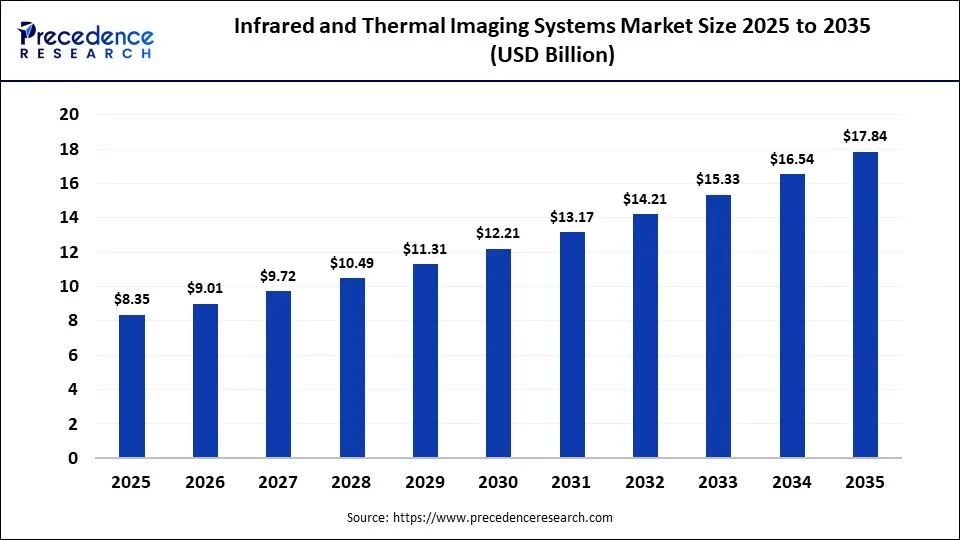
Gautam Mahajan is an ICT market research analyst. He researched infrared detection, thermal cameras, cooled and uncooled imaging systems, wavelength technologies, and their demand in defense, security, industrial, automotive, and commercial sectors. His research assists thermal imaging manufacturers, defense contractors, system integrators, and technology investors in developing competitive benchmarking and strategic planning. The infrared and thermal imaging systems market was valued at USD 9.01 billion in 2026.
Source: https://www.precedenceresearch.com/infrared-and-thermal-imaging-systems-market
 Get a Sample
 Table Of Content


Infrared and Thermal Imaging Systems Market Size and Forecast 2026 to 2035
Gautam has more than five years' experience in electronics, sensing, and defense technology analysis. He mentions that infrared and thermal imaging systems are transitioning into an increasingly integrated and intelligent era. As defense modernization continues, persistent surveillance needs grow, and industrial predictive maintenance needs expand. The use of infrared imaging with AI-based thermal analytics continues to spread to more commercial and industrial uses. The global value of infrared and thermal imaging systems is expected to grow at a CAGR of 7.89% throughout the forecast period.
Key Takeaways
- By technology, the uncooled infrared imaging segment led the market with a share of 34.65% in 2026.
- By product type, the thermal camera segment led the market with a 30.85% share in 2026.
- By component, the infrared detectors segment captured a major revenue share of 25.6% in 2026.
- By wavelength, the long-wave infrared segment captured the largest market share of 31.2% in 2026.
- By mobility, the fixed system segment led the market with a 31.40% share in 2026.
- In 2026, Teledyne Technology, a parent company, recorded net sales of USD 6.12 billion, the majority of which came from the digital imaging segment.
- To thrive in the global market, Exosens is strongly emerging in the infrared and photonics modern technology field and is applied in defense, industrial, and scientific applications.
- Both HIKMICRO and InfiRay have entered the market recently, while Lynred is an independent detector specialist and has a long-term commitment.
- Cooled InfraRed defense sensing products are a very high-barrier specialty due to performance requirements, and Leonardo and Leonardo DRS are very specialized in providing those products.
- Two vendors, Teledyne FLIR and a Teledyne HIKMICRO amalgamation (HIKMICRO/InfiRay), have high-growth momentum grades, with the former being propelled by a fast expansion of its product portfolio.
Market Overview
In 2026, the global infrared and thermal imaging systems market was valued at USD 9.01 billion. This will continue to grow at a CAGR of 7.89% from 2026 to 2035. The competitive mix includes diversified, market-incumbent thermal imaging companies, companies serving defense-related applications (electro-optical/infrared (EO/IR) integrators), specialized infrared detector suppliers, industrial thermography companies, and rapidly emerging, increasingly cost-competitive manufacturers in Asia.
Top Companies in the Infrared and Thermal Imaging Systems Market
Teledyne FLIR
| Company Indicator | Data |
| Parent Company 2025 Net Sales | USD 6.12 Billion |
| Key Position | Global thermal imaging leader |
| Major Applications | Industrial, defense, security, automotive |
| Core Technologies | LWIR, MWIR, thermal cameras, camera cores |
| Strategic Strength | Broadest diversified thermal imaging portfolio |
Source: Precedence Research Database
Competitive Score
| Factor | Position |
| Technology | Very Strong |
| Global Presence | Very Strong |
| Product Portfolio | Very Strong |
| Industrial Exposure | Very Strong |
| Defense Exposure | Very Strong |
| Overall Position | Market Leader |
No one else in this market comes close to Teledyne FLIR's market share. They operate from industrial inspection and defense security to automotive sensing and industrial thermography. In 2025, parent company Teledyne Technologies' total net sales reached USD 6.12 billion, with the digital imaging segment, which includes TMS, generating USD 850.5 million for the company in the fourth quarter. This kind of scale funds a portfolio breadth that few rivals can match on both LWIR and MWIR technologies, as well as camera cores and thermal cameras. Evaluating it by technology, global, product portfolio, and industrial or defense exposure makes Teledyne FLIR the biggest leader in this market.
Key Insight: With the broadest thermal imaging footprint in the market, FLIR was rated very strong across all competitive factors measured, and its 2025 expected net sales of USD 6.12 billion outpaced those of any other vendor included in the market.
Source: Precedence Research Database
L3Harris Technologies
| Company Focus | Position |
| Primary Market | Defense and aerospace |
| Core Technology | EO/IR systems |
| Major Applications | Surveillance, targeting, intelligence |
| Key Strength | Integrated military platforms |
| Competitive Position | Defense technology leader |
L3Harris doesn't go over-the-top on consumer thermal cameras. They hold a very different market presence and are embedded in the country's defense and aerospace applications. Further integrating electro-optical and infrared systems into surveillance, targeting, and intelligence systems for the whole team. L3Harris shows up again and again in any serious list of EO/IR competitors, and its position as a defense technology leader is becoming stronger.
Key Insight: L3Harris differs in its competitive offering when it comes to either a standalone camera or integrated defense EO/IR systems, which always puts the company in a leadership role in defense tech.
Source: Precedence Research Database
Leonardo and Leonardo DRS
| Competitive Indicator | Position |
| Primary Focus | Defense EO/IR |
| Technology | MWIR and LWIR |
| Key Applications | Targeting and navigation |
| Major Customers | Defense and aerospace |
| Strategic Position | High-performance specialist |
Cooled infrared imaging is no easy way to make a million bucks in business, and it is in that area where Leonardo and its DRS arm excel. Customers who believe in reliability, especially those requiring MWIR technology, targeting and navigation systems, and defense and aerospace customers. The walls are also higher here than most in the industry, as the buyer is a military program. Performance and dependability become more important than cost. Hence, the fact of being a high-performance player, and not a volume player.
Key Insight: Leonardo and Leonardo DRS have a strong specialist focus in cooled defense infrared sensing products, which have been a very high barrier specialty to entry due to performance requirements.
Source: Precedence Research Database
RTX
| Company Focus | Competitive Strength |
| Defense | Very Strong |
| EO/IR Systems | Very Strong |
| Missile Applications | Very Strong |
| Surveillance | Strong |
| Commercial Thermal Imaging | Moderate |
RTX is at the high-stakes, high-price end of this business. The best prospects for it are in defense, EO/IR systems, and missile applications, where large government programs, strict qualification standards, and procurement relationships mean it is difficult for a new company to be successful. The gradual shift left to the left endocrinian thermotomy is evidence of intentional preoccupation with its strategy. Instead of going after all market segments, RTX wins by developing deep technology prowess and program experience in markets where the technology, program, and defense relationship is more competitive.
Key Insight: RTX's strengths are in defense, EO/IR systems, and missile applications, rated very strong. Commercial thermal imagery is a market that is depth-oriented, depending on a core size of around moderate.
Source: Precedence Research Database
BAE Systems
| Indicator | Position |
| Core Focus | Defense imaging |
| Thermal Technology | Advanced |
| Key Application | Military surveillance |
| Barrier to Entry | High |
| Competitive Position | Major defense competitor |
In the business of best serving its customers, BAE focuses on five elements of defense imaging: long-range detection, military qualification, high reliability, advanced sensor performance, and integrated surveillance. The barrier to entry is high, as much of BAE's advantage is based on electro-optical technology. That is defense-oriented and has taken years to qualify. It shows up consistently among the major names in broader infrared and thermal imaging coverage.
Key Insight: BAE Systems plays in an area where the margin for error is low, defense-enabling imaging, and a high barrier-to-entry sector to help maintain its position as a major-market competitor.
Source: Precedence Research Database
Lynred
| Company Indicator | Position |
| Headquarters | France |
| Core Business | Infrared detectors |
| Major Technologies | Thermal detectors |
| Competitive Advantage | Sensor technology |
| Market Position | Technology leader |
It is a company that's one notch more advanced than most of its competitors. Teledyne FLIR, or Fluke build complete cameras, but it is in the technology of the detector that these cameras come into existence. Lynred, headquartered in France, works in detector technology. Low-cost, differentiated sensor technology is at its core, targeting customers in defense, aerospace, industrial, and scientific applications. Proprietary detector design, fabrication capability, specialized engineering talent- none of it can be bought off the shelf quickly, which is exactly why Lynred's position as a technology leader has held.
Key Insight: Lynred plays in the value chain further than most, providing basic detector technology, and not just finished cameras, a niche that's quite protected by a combination of fairly high fabrication and engineering barriers.
Source: Precedence Research Database
Fluke Corporation
| Company Indicator | Position |
| Primary Market | Industrial |
| Key Products | Thermal cameras |
| Major Application | Predictive maintenance |
| Customer Base | Industrial technicians |
| Competitive Position | Industrial imaging leader |
According to industrial technicians, Fluke will likely be a prominent provider of thermal cameras. Across electrical inspections, equipment maintenance, manufacturing diagnostics, building inspections, and energy monitoring, Fluke's thermal cameras are used. The real saleability of this business is the ecosystem it operates within; that is, additional measurements and diagnostics that technicians already trust and already own. That bundling is Fluke's real moat, and it's why the company holds its place as an industrial imaging leader.
Key Insight: Fluke leads industrial thermography by embedding thermal cameras inside a broader trusted measurement-and-diagnostic ecosystem, not by selling cameras in isolation.
Source: Precedence Research Database
Axis Communications
| Indicator | Position |
| Parent Ecosystem | Network surveillance |
| Core Product Area | Thermal network cameras |
| Main Application | Security |
| Competitive Advantage | Video analytics |
| Strategic Position | Surveillance specialist |
More security customers are looking for a single system, a single camera, not a thermal camera mounted next to a different video system and connected to a different analytics system. By failing to sell those parts separately, Axis Communications carved out its niche market space. Under one roof, they offer thermal cameras, network video, video analytics, security infrastructure, and remote monitoring. This essentially is the Axis selling point in markets where surveillance is the key element. It's a major reason the company remains a true specialist as opposed to a generalist who is going to do everything.
Key Insight: Axis Communications differentiates itself in the security markets by providing its system as a whole package of thermal camera, network video, and analytics, all sold in one.
Source: Precedence Research Database
Exosens
| Competitive Indicator | Position |
| Core Market | Advanced imaging |
| Technology | Infrared and photonics |
| Primary Applications | Defense and industrial |
| Strategic Strength | Sensor technology |
| Competitive Position | European technology specialist |
Exosens is not as big or imposing as the behemoths above, nor does it appear as loudly as its competitors. This company is continuing to be driven by demand from its defense, scientific, and industrial customers to produce detection technology. That can perform more than merely what a conventional thermal camera can do. It doesn't need to be, not when its strength lies specifically in the technical corners of the market where few competitors can follow.
Key Insight: Exosens reinforces its position by offering modern infrared and photonics technology that is applied to defense, scientific, and industrial applications, as well as detection needs well beyond the capabilities of traditional thermal imaging solutions.
Source: Precedence Research Database
HIKMICRO
| Company Indicator | Position |
| Headquarters | China |
| Main Products | Thermal cameras |
| Key Markets | Industrial and security |
| Strategic Strength | Cost competitiveness |
| Growth Position | High-growth competitor |
China-based HIKMICRO represents the type of price pressure that the rest of this list doesn't offer. It has thermal cameras for industrial, security applications, and outdoor market applications at price points that can sometimes be less expensive than those offered by the Western incumbents. As a more budget-friendly thermal imaging player enters the market under pressure to do so, it's the manufacturers in Asia who are rapidly moving the competition underfoot of every other entry in this list. HIKMICRO is firmly in the lead, gaining market momentum and thus becoming a true high-growth leader.
Key Insight: One of the emerging trends at no cost is HIKMICRO's growth with cost competitiveness, which fits into the trend of the fast-growing number of Asian manufacturers who are putting pressure on their prices in each commercial thermal imaging application.
Source: Precedence Research Database
Company Competitive Ranking
| Company | Primary Strength | Market Position |
| Teledyne FLIR | Broad thermal imaging portfolio | Market Leader |
| L3Harris Technologies | Defense EO/IR | Market Leader |
| Leonardo/Leonardo DRS | Advanced military imaging | Market Leader |
| RTX | Defense infrared systems | Market Leader |
| BAE Systems | Defense sensing | Major Leader |
| Fluke | Industrial thermography | Market Leader |
| Lynred | Infrared detectors | Technology Leader |
| Axis Communications | Security thermal imaging | Segment Leader |
| Exosens | Advanced imaging | Technology Leader |
| HIKMICRO | Commercial thermal imaging | High-Growth Challenger |
| Guide Infrared | Integrated IR manufacturing | Major Asian Player |
| InfiRay | Thermal modules and detectors | High-Growth Challenger |
| Lockheed Martin | Defense systems integration | Strategic Leader |
| Elbit Systems | Military electro-optics | Major Competitor |
| Opgal | Specialized thermal imaging | Niche Leader |
| Testo | Industrial measurement | Segment Specialist |
| InfraTec | Precision thermography | Technology Specialist |
| Thermoteknix | Defense thermal imaging | Specialist |
| Seek Thermal | Commercial affordability | Challenger |
| Hamamatsu Photonics | Photonics and sensors | Technology Specialist |
The top 4 are each market leaders on different grounds, with Teledyne FLIR the leader by broad portfolio, L3Harris by defense EO/IR, Leonardo and Leonardo DRS by advanced military imaging and defense infrared systems. The top ten are rounded off by BAE Systems, Fluke, Lynred, Axis Communications, Exosens, and HIKMICRO, all either major or technology and segment leaders from the defense sensing, industrial thermography, detectors, security, and commercial affordability areas. Testo, InfraTec, Thermoteknix, Seek Thermal, and Hamamatsu Photonics complete the list as experts, not necessarily competitors, in industrial measurement, precision thermography, defense thermal imaging, commercial affordability, and photonics technology.
Key Insight: There are four distinct clusters of the 20 companies shown here, namely broad market leaders, defense and industrial specialists, mid-tier challengers, or narrow technology specialists, rather than a continuous spectrum from weakest to strongest.
Source: Precedence Research Database
Company Revenue and Scale Indicators
| Company | Available Scale Indicator | Relevance to Market |
| Teledyne Technologies | USD 6.12B 2025 total sales | Major parent company of FLIR |
| Teledyne FLIR | Global thermal imaging leader | Direct market participant |
| L3Harris | Large global defense company | EO/IR systems |
| Leonardo | Major aerospace and defense company | Advanced thermal systems |
| RTX | Major global defense contractor | Advanced infrared technology |
| BAE Systems | Major defense company | EO/IR and imaging |
| Fluke | Global industrial measurement brand | Thermal cameras |
| Lynred | Specialized infrared detector supplier | Critical technology provider |
| HIKMICRO | Rapidly expanding thermal imaging company | Commercial and industrial |
| InfiRay | Growing detector and imaging supplier | Cost-competitive challenger |
Aditi believes that the large defense contractors that get involved in infrared, such as L3Harris, Leonardo, RTX, and BAE Systems, are incorporated into bigger companies, with FLIR, which is currently being marketed under Teledyne Technologies, bringing in USD 6.12 billion in total sales for 2025. Fluke is behind the thermal imaging field with its own brand name. Lynred is a dedicated, independent detector specialist, and both HIKMICRO and InfiRay are cheap and fast newcomers.
Key Insight: Parent-company revenue figures, such as Teledyne's USD 6.12 billion, should not be confused with thermal-imaging company revenue because they are typically only part of a much larger business.
Source: Precedence Research Database
Competitive Benchmarking: Who Leads Where?
| Competitive Segment | Leading Companies |
| Overall Thermal Imaging | Teledyne FLIR, Fluke |
| Defense EO/IR | L3Harris, Leonardo, RTX, BAE Systems |
| Infrared Detectors | Lynred, Exosens, Hamamatsu |
| Industrial Thermography | Fluke, Teledyne FLIR, Testo |
| Security Surveillance | Axis Communications, Teledyne FLIR |
| Low-Cost Thermal Cameras | HIKMICRO, InfiRay, Guide Infrared |
| Scientific Applications | InfraTec, Hamamatsu |
| Gas Detection | Opgal |
| Aerospace Integration | Leonardo, RTX, L3Harris |
| Military Systems | BAE Systems, Lockheed Martin, Elbit Systems |
This market says that no single company manages to be a winner in every market, and this is no exception. There's a thermal imaging leader for each category, including Teledyne FLIR and Fluke Thermal Imaging. Defense EO/IR is a member of L3Harris, Leonardo, RTX, and BAE Systems. Infrared detectors are a domain of Lynred, Exosens, and Hamamatsu. Industrial thermography is divided into two groups, including Fluke vs. Teledyne FLIR, and security surveillance falls largely between Axis Communications and Teledyne FLIR. Low-cost thermal cameras are the toughest challenge areas for HIKMICRO, InfiRay, and Guide Infrared, and for scientific applications, it's Infra Tec vs. Hamamatsu. Gas detection is Opgal's specialty, aerospace integration is Leonardo's combination, and RTX's and L3Harris'. Military systems enter the scene in everyday conversation with Elbit Systems.
Key Insight: There is more segment market leadership than universal market leadership, as there are ten different competitive segments each dominated by 2-4 different company clusters in their respective markets.
Source: Precedence Research Database
Company Technology Benchmarking
| Technology | Leading Company Types | Main Advantage |
| Cooled Infrared | Leonardo, L3Harris, RTX, BAE Systems | High sensitivity and long-range performance |
| Uncooled Infrared | Teledyne FLIR, HIKMICRO, InfiRay, Guide | Lower cost and wider commercial adoption |
| Advanced Detectors | Lynred, Exosens, Hamamatsu | Technology differentiation |
| Network Thermal Cameras | Axis Communications | Integrated surveillance |
| Industrial Thermal Cameras | Fluke, Testo, FLIR | Maintenance and diagnostics |
The split between cooled and uncooled is simply a reflection of the overall industry performance/price tradeoff. Cooled infrared is led by Leonardo, L3Harris, RTX, and BAE Systems due to their detection sensitivity and long-range performance desired by defense customers and available at a price.
The movement of uncooled infrared is led by the likes of Teledyne FLIR, HIKMICRO, InfiRay, and Guide. This is driven by lower cost and therefore a much wider commercial market. Lynred, Exosens, and Hamamatsu stand out because of their advanced detector technology. Additionally, Axis Communications offers network-integrated thermal cameras, and Fluke, Testo, and FLIR offer industrial cameras built specifically for maintenance and diagnostics work.
Key Insight: Cooled infrared technology establishes its competitive edge when it comes to the sensitivity of defense-related missions. Uncooled infrared technology has its competitive strength when it comes to costs and commercial market penetration. The two technologies trade off based on fundamentally different value propositions.
Source: Precedence Research Database
Which Companies Are Likely to Gain Market Share?
Teledyne FLIR
Four groups may benefit from distinct growth drivers: diversified thermal imaging suppliers, cost-competitive commercial manufacturers, advanced detector suppliers, and defense-focused imaging companies. Teledyne FLIR lists very high growth potential due to the wide product portfolio, AI-empowered imaging, defence modernization, industrial automation, and autonomous systems.
HIKMICRO and InfiRay
On the other hand, the low-cost products area, the expansion of manufacturing in Asia, increased consumer uptake, industrial thermal imaging, and increased outdoor application interfaces are extending into these categories with ratings of very high from HIKMICRO and InfiRay. Chinese companies in particular are putting real price pressure on uncooled thermal modules and commercial products doing it.
Lynred and Advanced Detector Suppliers
Advanced detector suppliers, such as Lynred, are rated highly due to detector innovation, high-resolution sensors, defence, autonomous systems and advanced scientific imaging.
Defense Companies
Similarly, defense companies like L3Harris, Leonardo, RTX and BAE Systems are likely to keep up their premium segment strength. Due to the intoxicating factors of defense, such as government procurement relationships, long qualification cycles, factors of technology and national security, and high switching costs that exist in the market.
Key points: Both Teledyne FLIR and the combination of HIKMICRO/InfiRay rate very high for growth potential, with the former being driven by a rapid expansion of its product portfolio.
Source: Precedence Research Database
Competitive Landscape by Business Model
| Business Model | Leading Companies |
| Complete Thermal Imaging Systems | Teledyne FLIR, Fluke |
| Infrared Detector Manufacturing | Lynred, Exosens |
| Defense System Integration | RTX, L3Harris, BAE Systems |
| Industrial Measurement | Fluke, Testo |
| Security Solutions | Axis Communications |
| Cost-Focused Imaging | HIKMICRO, InfiRay |
| Specialized Applications | Opgal, InfraTec |
| Photonics Technology | Hamamatsu |
Aman interpreted that, in this market, there are eight business models, and only a few businesses will attempt to cover more than one or two of the models. Teledyne FLIR and Fluke create full systems utilizing thermal imaging. The main product of Lynred and Exosens is infrared detectors. RTX, L3Harris, and BAE Systems' defense systems are integrated and not sold separately. Fluke and Testo specialize in industrial measurement, while Axis Communications' specialty is security solutions, and HIKMICRO/Testo in imaging for cost-conscious customers who prioritize budget over other factors. They cover some of the more niche applications in the photonics technology world. Also, Hamamatsu is an unusually singular title on the photonics-technology side of the corner.
Key Insight: This market is strategically split into eight different business models, and most of the firms adopt only one or two, rather than compete all over the value chain.
Source: Precedence Research Database
Strategic Analysis: What Will Determine Company Leadership?
Detector Technology
Companies with leading key IR detector technology and fundamental sensing ability have the greatest capacity for long-term differentiation. Due to the direct relationship between the performance of the detectors and the overall image quality, sensitivity, range, reliability, and performance of the system.
AI Integration
AI integration is second only to thermal imaging as imaging technology becomes more than just capturing images, as it's making decisions, predicting failures, self-monitoring, and then recognizing objects using AI.
Cost Reduction
Cost reduction is also important in that lower-cost uncooled thermal sensors help new markets open. They are cheap enough to defend old markets.
Defense Relationships
Another healthy moat is in the defense relationship, which has been enforced through qualification cycles, but may also be reinforced with the build of the customer relationship and cannot be rushed.
Software Integration
Software integration rounds it up, as the market continues to move towards off-the-shelf packages that are layered upon hardware solutions, thermal solutions, AI analytic tools, cloud platforms, and monitoring software.
Key Insight: The outcomes of the competitive leadership will be determined by the combination of the technologies of detectors, AI, cost, defense relationships, and software integration.
Segmentation Analysis
Technology Insights
| Segment | 2026 Share (%) | 2035 Share (%) | CAGR | Growth Factor |
| Uncooled Infrared Imaging | 34.65 | 36.9 | 8.55% | Lower cost, compact design, and expanding commercial applications support widespread adoption. |
| Cooled Infrared Imaging | 22.4 | 20.85 | 7.10% | High-performance defense and scientific applications sustain demand. |
| Short-Wave Infrared (SWIR) | 13.25 | 15.4 | 9.55% | Semiconductor inspection, machine vision, and industrial applications drive growth. |
| Mid-Wave Infrared (MWIR) | 12.1 | 11.65 | 7.45% | Long-range surveillance and defense applications maintain demand. |
| Long-Wave Infrared (LWIR) | 14.85 | 13.95 | 7.20% | Building inspection and thermal security applications support utilization. |
| Near-Infrared (NIR) | 2.75 | 1.25 | 2.85% | Mature imaging applications experience comparatively slower growth. |
Uncooled infrared imaging dominates the market at 34.65% in 2026 and will gain market share to 36.90% by 2035 with 8.55% CAGR, due to its low cost, small size, and commercial applications that continue to facilitate future opportunities.
Short-wave infrared increased from 13.25% to 15.40% market share with the highest 9.55% CAGR, because of semiconductor inspection, machine vision, and industrial use, which only took off a year ago for this wavelength. Mid-wave infrared has increased its market share, from 12.10% to 11.65% at 7.45% CAGR, primarily due to long-range surveillance/defense applications.
Key Insight: Short-wave infrared is outperforming uncooled infrared as its share of the market increases at a fast pace.
Source: Precedence Research Database
Product Type Insights
| Segment | 2026 Share (%) | 2035 Share (%) | CAGR | Growth Factor |
| Thermal Cameras | 30.85 | 29.2 | 7.35% | Broad industrial, security and commercial deployment supports market leadership. |
| Infrared Cameras | 18.4 | 17.15 | 7.10% | Machine vision, surveillance and specialized imaging applications sustain demand. |
| Thermal Imaging Modules | 16.25 | 19.85 | 10.15% | Integration into drones, vehicles and smart devices accelerates growth. |
| Thermal Scopes | 9.3 | 8.8 | 7.45% | Defense and security applications remain key demand drivers. |
| Thermal Sensors | 8.85 | 9.35 | 8.45% | IoT and smart monitoring systems support increasing integration. |
| Infrared Detectors | 6.7 | 6.15 | 7.00% | Detector demand tracks growth in advanced imaging systems. |
| Thermal Monoculars | 4.2 | 3.75 | 6.75% | Portable surveillance applications support steady demand. |
| Thermal Binoculars | 3.35 | 2.75 | 5.90% | Defense and specialized security uses maintain demand. |
| Other Systems | 2.1 | 3 | 11.55% | Emerging specialized imaging systems expand into new applications. |
Thermal cameras are the largest product segment, accounting for 30.85% market share in 2026, and are expected to grow at 29.20% CAGR on account of their widespread usage in industrial, security, and commercial applications. Machine vision and special imaging work kept the market for infrared cameras at 17.15% market share in 2035 at a 7.10% CAGR. This evened out from the 18.40% market share consistently maintained in the past year of 2026. Thermal imaging modules grew from 16.25% to 19.85% of the overall market share at a 10.15% CAGR. They continue to be integrated with drones, vehicles, and smart devices.
Key Insight: Thermal imaging modules' impressive 10.15% CAGR proves that truly new and still limited use cases are outperforming the categories.
Source: Precedence Research Database
Component Insights
| Segment | 2026 Share (%) | 2035 Share (%) | CAGR | Growth Factor |
| Infrared Detectors | 25.6 | 24.85 | 7.55% | Core sensing functionality makes detectors a high-value component. |
| Infrared Lenses | 18.25 | 16.9 | 7.10% | Demand increases with imaging-system production. |
| Image Sensors | 17.4 | 19.55 | 9.10% | Higher resolution and smart imaging systems accelerate demand. |
| Processing Electronics | 15.35 | 16.45 | 8.60% | Real-time image processing and AI analytics increase system complexity. |
| Displays | 8.2 | 7.1 | 6.45% | Mature display technologies experience moderate growth. |
| Software & Analytics | 10.75 | 12.85 | 9.85% | AI-enabled thermal analytics and automated anomaly detection drive expansion. |
| Other Components | 4.45 | 2.3 | 3.10% | Specialized supporting components represent a smaller market. |
In 2026, infrared detectors lead with 25.60% of the market, but by 2035, it has fallen to 24.85% and is growing at 7.55% CAGR. That remains the highest-valued of any thermal system, as core sensing has to be somewhere. The infrared lenses segment is seeing a reduction in its market share from 18.25% to 16.90%, driven mainly by the decline in production volume at 7.10% CAGR. At 9.85% CAGR, the fastest growth in the market, the software and analytics market share grows from 10.7 to 12.85 in the forecast period.
Key Insight: Non-sigma swings across the board, with software and analytics rising by almost a point to 12.85% market share with a 9.85% CAGR, showing that in many aspects, intelligence is becoming as important as the sensor itself.
Source: Precedence Research Database
Wavelength Insights
| Segment | 2026 Share (%) | 2035 Share (%) | CAGR | Growth Factor |
| Long-Wave Infrared | 31.2 | 29.15 | 7.15% | Broad thermal imaging and commercial applications support leadership. |
| Mid-Wave Infrared | 25.45 | 24.6 | 7.60% | Long-range sensing and defense applications sustain demand. |
| Short-Wave Infrared | 18.3 | 22.45 | 10.05% | Semiconductor inspection and industrial machine vision drive rapid expansion. |
| Near-Wave Infrared | 14.15 | 13.2 | 7.25% | Scientific and industrial applications support stable demand. |
| Far Infrared | 10.9 | 10.6 | 7.55% | Specialized sensing and research applications maintain demand. |
Long-wave infrared is the dominant technology at 31.20% market share in 2026, and will maintain dominance at 29.15% market share by 2035 with a 7.15% CAGR, wide enough to spread the majority of commercial thermal imaging practice. Short-wave infrared is the dominant choice, rising to 22.45% market share at 10.05% CAGR. This is the fastest of the segment, driven by semiconductor inspection/industrial machine vision.
Key Insight: As takeover drives semiconductor and machine vision, short-wave infrared is at the leading edge in terms of a CAGR of 10.05% by wavelength segment.
Source: Precedence Research Database
Mobility Insights
| Segment | 2026 Share (%) | 2035 Share (%) | CAGR | Growth Factor |
| Fixed Systems | 34.4 | 31.65 | 7.15% | Perimeter security and industrial monitoring sustain significant installations. |
| Handheld Systems | 25.85 | 23.9 | 7.05% | Maintenance, inspection, and emergency-response applications maintain demand. |
| Vehicle-Mounted Systems | 16.3 | 17.55 | 8.65% | Automotive safety and military vehicle modernization support growth. |
| Portable Systems | 12.15 | 11.2 | 7.20% | Field inspection and commercial applications support utilization. |
| Drone-Mounted Systems | 11.3 | 15.7 | 11.55% | Infrastructure inspection, surveillance, and emergency response drive rapid adoption. |
In 2026, fixed systems will have the biggest share (34.40%), declining to 31.65% with a CAGR of 7.15%, but still relying heavily on perimeter security and industrial monitoring. Topping the table and surging ahead at 15.70% market share and growing at 11.55% CAGR is drone-mounted systems with a runaway share, with infrastructure inspection and surveillance and emergency response becoming increasingly reliant on drones every year.
Key Insight: Of all mobility categories, the fastest CAGR is for Drones - 11.55%, due to the increasing movement of use cases for inspection and emergency response to the air. Vehicle-Mounted Systems prepare a high 8.65%.
Source: Precedence Research Database
Application Insights
| Segment | 2026 Share (%) | 2035 Share (%) | CAGR | Growth Factor |
| Security & Surveillance | 24.65 | 22.85 | 7.05% | Border security, critical infrastructure, and perimeter monitoring support demand. |
| Industrial Inspection | 19.85 | 20.15 | 8.05% | Predictive maintenance and non-contact inspection drive adoption. |
| Defense & Military | 18.4 | 17.2 | 7.30% | Modernization of surveillance and night-vision capabilities supports spending. |
| Automotive | 10.75 | 13.85 | 10.55% | ADAS, autonomous driving and enhanced night vision create growth opportunities. |
| Healthcare & Medical | 7.6 | 8.3 | 8.85% | Non-invasive diagnostics and medical monitoring support adoption. |
| Building Inspection | 6.25 | 5.85 | 7.15% | Energy-efficiency and building diagnostics maintain demand. |
| Firefighting & Rescue | 4.75 | 4.5 | 7.35% | Emergency response agencies increasingly adopt thermal imaging equipment. |
| Research & Development | 4.2 | 3.6 | 6.35% | Scientific applications remain important but comparatively specialized. |
| Other Applications | 3.55 | 3.7 | 8.30% | Emerging smart-city and environmental applications support expansion. |
The security and surveillance segment held 24.65% market share in 2026. That will decrease slightly to 22.85% by 2035 at 7.05% CAGR, with border security, critical infrastructure, and perimeter monitoring remaining paramount. The biggest increase in market share in larger applications, with thermal imaging coming to rely more heavily on an increasing number of ADAS, autonomous driving, and improved night vision technologies, was in automotive. This segment's market share grew from 10.75% to 13.85% with a 10.55% CAGR during the forecasting period.
Key Insight: Automotive is the fastest-growing segment in the market, based on the rate of growth of ADAS and autonomous driving, and thermal imaging is now an application moving into the driver's seat, growing at a 10.55% CAGR to capture 13.85% market share.
Source: Precedence Research Database
End User Insights
| Segment | 2026 Share (%) | 2035 Share (%) | CAGR | Growth Factor |
| Defense & Government | 27.4 | 25.55 | 7.10% | Defense modernization and public-security investments maintain high demand. |
| Industrial & Manufacturing | 21.35 | 21.85 | 8.15% | Predictive maintenance and automation increase thermal inspection deployment. |
| Commercial | 15.25 | 14.1 | 7.10% | Security and facility-management applications support demand. |
| Automotive & Transportation | 11.45 | 14.6 | 10.45% | Vehicle safety and autonomous mobility technologies drive rapid growth. |
| Healthcare | 8.3 | 8.95 | 8.55% | Expanding medical and diagnostic applications support growth. |
| Energy & Utilities | 7.2 | 7.4 | 8.20% | Electrical inspection and infrastructure monitoring create recurring demand. |
| Aerospace | 4.85 | 4.55 | 7.20% | Specialized surveillance and testing applications support the market. |
| Research Institutions | 4.2 | 3 | 4.10% | Commercial adoption increasingly outpaces research-specific demand. |
Defense and government are projected to remain the largest end-user segment, with market share declining from 27.40% in 2026 to 25.55% in 2035. The reported segment CAGR is 7.10%, subject to confirmation that it represents revenue growth. Automotive & transportation has also seen the share rise from 11.45% to 14.60% and is growing at 10.45% CAGR mainly due to the rapid growth of vehicle safety technology and autonomous mobility solutions.
Key Insight: Key end users are automotive and transportation, which are expected to grow at 10.45% CAGR over the period.
Source: Precedence Research Database
Regional Insights
| Region | 2026 Share (%) | 2035 Share (%) | CAGR | Growth Factor |
| North America | 33.25 | 30.85 | 7.05% | Strong defense spending, advanced industrial infrastructure, and technology adoption support leadership. |
| Europe | 25.4 | 23.85 | 7.25% | Automotive, industrial inspection, and security applications drive demand. |
| Asia Pacific | 27.15 | 31.9 | 9.35% | Manufacturing expansion, smart infrastructure, and automotive adoption accelerate growth. |
| Latin America | 7.45 | 7.3 | 7.65% | Security and industrial modernization support gradual expansion. |
| Middle East & Africa | 6.75 | 6.1 | 6.85% | Defense and infrastructure security remain key application areas. |
North America's dominance has been in the global market, as the region will hold a 33.25% market share in 2026 and 30.85% in 2035 at 7.05% CAGR. Facilitated by advanced infrastructure and defense spending is expected to drive the region's growth in the coming years. Amid the growth of manufacturing, smart infrastructure, and automotive consumption, Asia Pacific is the only region to make progress, with the share increasing from 27.15% to 31.90% at a CAGR of 9.35%, the fastest of all the regions.
Key Insight: Asia Pacific is the only region to be gaining share, at 9.35% CAGR, with the market projected to surpass the North American market lead with major market share in the forecast period.
Source: Precedence Research Database
Expert Insights
The market for infrared and thermal imaging systems is evolving from dedicated imaging applications to intelligent, connected, and more self-contained imaging platforms. The combination of high-performance infrared detectors, small uncooled thermal sensors, image analysis via AI, and networked surveillance systems offers me very appealing prospects. I believe the opportunities of persistent situational awareness and reliable detection in low-visibility environments will be huge areas of focus for market competitiveness to be helped by in the coming decade. Enterprises that have the capacity to create extensible sensor designs and integrate AI-powered analytics into their thermal solutions will be well equipped to reap the benefits of growing demand.
Our Experts
Primary market analysis was prepared by Gautam Mahajan, who was closely involved in the report preparation right from the inception of research, development of methodology, industry development analysis, technology segmentation, application trends, region-wise developments, competition study, and technology forecasts.
Aman leveraged his expertise in collecting and validating regulatory information, company financial data, product developments, technology investments, and other quantitative datasets independently from the marketplace, thereby strengthening and enhancing the evidence base behind the market.
Aditi checked the entire research document, did quality checks, validated some results, fine-tuned the document, corrected the inconsistencies, and produced the final report, making it accurate and clear.
Infrared and Thermal Imaging Systems Market Segmentation
By Technology
- Uncooled Infrared Imaging
- Cooled Infrared Imaging
- Short-Wave Infrared (SWIR)
- Mid-Wave Infrared (MWIR)
- Long-Wave Infrared (LWIR)
- Near-Infrared (NIR)
By Product Type
- Thermal Cameras
- Infrared Cameras
- Thermal Imaging Modules
- Thermal Scopes
- Thermal Sensors
- Infrared Detectors
- Thermal Monoculars
- Thermal Binoculars
- Other Systems
By Component
- Infrared Detectors
- Infrared Lenses
- Image Sensors
- Processing Electronics
- Displays
- Software & Analytics
- Other Components
By Wavelength
- Long-Wave Infrared
- Mid-Wave Infrared
- Short-Wave Infrared
- Near-Wave Infrared
- Far Infrared
By Mobility
- Fixed Systems
- Handheld Systems
- Vehicle-Mounted Systems
- Portable Systems
- Drone-Mounted Systems
By Application
- Security & Surveillance
- Industrial Inspection
- Defense & Military
- Automotive
- Healthcare & Medical
- Building Inspection
- Firefighting & Rescue
- Research & Development
- Other Applications
By End User
- Defense & Government
- Industrial & Manufacturing
- Commerical
- Automotive & Transportation
- Healthcare
- Energy & Utilities
- Aerospace
- Research Institutions
By Region
- North America (U.S., Canada, Mexico)
- Europe (Germany, U.K., France, Italy, Spain, Netherlands, Switzerland, Rest of Europe)
- Asia-Pacific (China, Japan, India, South Korea, Australia, Singapore, Rest of Asia-Pacific)
- Latin America (Brazil, Argentina, Mexico, Rest of Latin America)
- Middle East & Africa (UAE, Saudi Arabia, Israel, South Africa, Rest of Middle East & Africa)
Questions This Report Deliberately Leaves Open
- What market size is projected for the global infrared and thermal imaging systems market in 2030 and 2035?
- Given the superior performance of cooled technologies, how is it that Uncooled Infrared Imaging is expanding at an 8.55% CAGR when compared to Cooled Infrared Imaging, which is growing at 7.10% CAGR?
- Is Teledyne FLIR's market leader status determined because of its $6.12 billion parent company size or its competitors' (L3Harris and Leonardo, both defense/EO/IR-focused companies) size and scope?
- The fastest-growing wavelength category is SWIR, as it expanded at 10.05% CAGR, so what does this say about emerging applications, such as semiconductor inspection, machine vision, and advanced sensing?
- How will the lower cost of HIKMICRO and InfiRay's manufacturing in Asia threaten the commercial & industrial thermal imaging business from Teledyne FLIR in the next 10 years?
- Which company commands the largest market share, but is projected to be the next best ride on the back of 11.55% CAGR growth of mobility's hottest demand segment, Drone-Mounted Systems?
- How significant are defense procurement relationships, qualification requirements, and program-specific certifications as genuine competitive moats for L3Harris, Leonardo, RTX, and BAE Systems, rather than simply indicators of established market incumbency?
- What is the realistic timeline for automotive applications, growing at a 10.55% CAGR, to become one of the market's top-three application categories as ADAS and autonomous driving technologies advance?
- How significant are defense procurement relationships and qualification cycles as a genuine moat versus a description of incumbency for L3Harris, Leonardo, RTX, and BAE Systems?
- Which segment - Software & Analytics (9.85% CAGR, fastest-growing component) or Image Sensors (9.10% CAGR) - represents the stronger long-term margin opportunity?
- Asia-Pacific is expected to grow by a 9.35% CAGR and account for the highest share of the thermal imaging manufacturing market (27.15% to 31.90%) and demand during the forecast period; how will it change the global center of gravity?
- Where does this leave industrial thermography professionals like Fluke and Testo as more extensive solutions like Teledyne FLIR become part of today's ever-growing field of industrial diagnostics, inspection, and predictive maintenance?
- What competitive risk does Axis Communications face as thermal imaging capabilities increasingly become integrated features within broader security and surveillance platforms rather than remaining a standalone source of differentiation?
- How much of the AI-integration narrative (automated anomaly detection, predictive maintenance, autonomous surveillance) is currently monetized versus still aspirational across the top 20 companies?
- Which of the 5 strategic leadership factors (detector technology, AI integration, cost reduction, defense relationships, software integration) will be the biggest contributor to competitive results until 2035?
References
- Precedence Research Database
"Infrared and Thermal Imaging Systems Market - Company Landscape, Competitive Analysis, and Segmentation Data"
Data used: Market size, CAGR, all company competitive-analysis content, and all segment share/CAGR tables presented throughout this report. - Teledyne Technologies Incorporated
"Teledyne Technologies Reports Fourth Quarter Results" - January 21, 2026
https://www.teledyne.com/en-us/investors/Documents/2025%20Q4%20-%20Teledyne%20Earnings%20Release.pdf
Data used: Verification of Teledyne's full-year 2025 net sales ($6,115.4M) and Digital Imaging segment Q4 2025 net sales ($850.5M)
For inquiries regarding discounts, bulk purchases, or customization requests, please contact us at sales@precedenceresearch.com
Frequently Asked Questions





Ask For Sample
No cookie-cutter, only authentic analysis – take the 1st step to become a Precedence Research client
 Get a Sample




 sales@precedenceresearch.com
 Schedule a Meeting
