



Master Data Management Market Trends, Companies, Revenue / Sales Performance, Subscriber Growth, Pricing Strategies, Cloud Adoption, Infrastructure Expansion, Competitive Landscape, and Industry Outlook
Master Data Management Market (By Component: Software, Services; By Deployment Mode: On-Premise, Cloud-based, Hybrid; By Data Type: Customer Data, Product Data, Supplier Data, Financial Data, Asset & Location Data; By End Use: Operational MDM, Analytical MDM, Collaborative MDM) - Global Industry Analysis, Size, Trends, Leading Companies, Regional Outlook, and Forecast 2026 to 2035
Source: https://www.precedenceresearch.com/master-data-management-market
 Get a Sample
 Table Of Content


What is the Master Data Management Market Size?
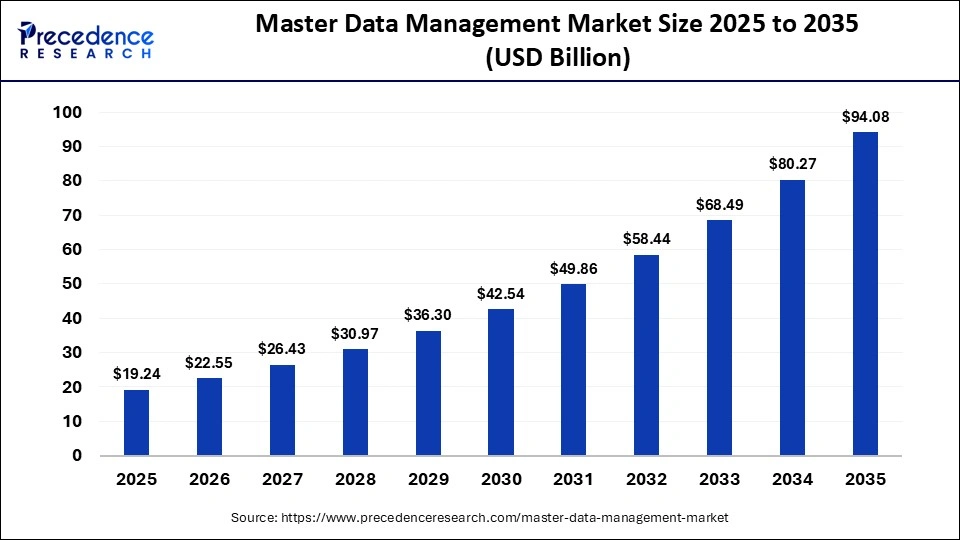
The global master data management market size accounted for USD 19.24 billion in 2025 and is predicted to increase from USD 22.55 billion in 2026 to approximately USD 94.08 billion by 2035, expanding at a CAGR of 17.20% from 2026 to 2035. The region is significantly growing due to the expansion of data-driven strategies into several leading sectors like BFSI, healthcare, manufacturing, and IT& telecom, along with smart city initiatives that require robust data management solutions.
Market Highlights
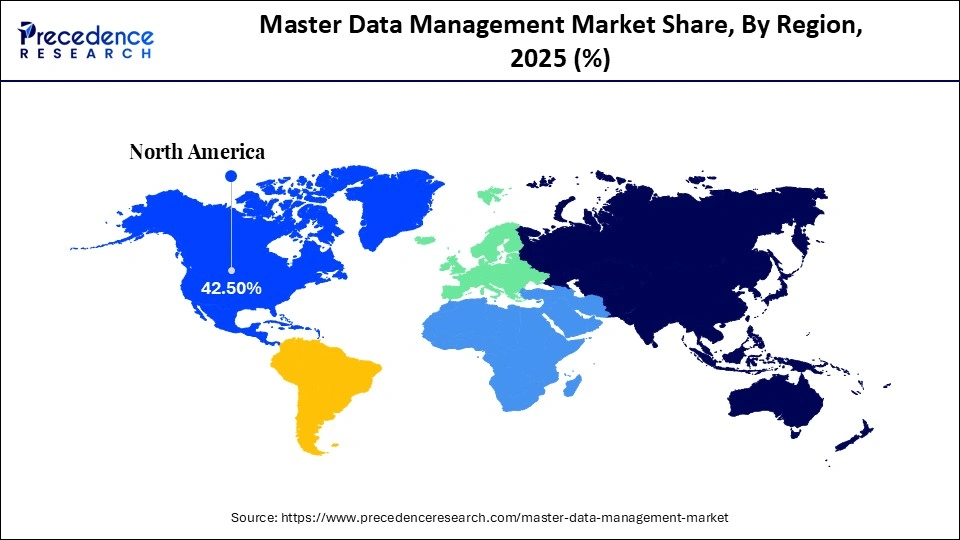
- North America accounted for the biggest market share of 42.5% in 2025.
- The Asia Pacific is projected to grow at the fastest CAGR of 15.5% between 2026 and 2035.
- By component, the software segment contributed the highest market share of 70.2% in 2025.
- By component, the services segment is expanding at the fastest CAGR of 14% from 2026 to 2035.
- By deployment mode, the on-premises segment captured the largest market share of 56.7% in 2025.
- By deployment mode, the hybrid segment is poised to grow at a notable CAGR of 13.7% from 2026 to 2035.
- By data type, the customer data segment generated the biggest market share of 37.6% in 2025.
- By data type, the asset & location data segment is expected to grow at the fastest CAGR of 13.8% between 2026 and 2035.
- By end use, the operational MDM segment contributed the highest market share of 48.6% in 2025.
- By end use, the collaborative MDM segment is projected to expand at a strong CAGR of 14.3% from 2026 to 2035.
What is Master Data Management?
The master data management market comprises software platforms and associated services that enable organizations to create, manage, govern, and maintain a single, consistent, and trusted view of critical business data. This core data typically includes customer, product, supplier, asset, and location information that is shared across multiple business systems and operational functions.
Master data management solutions integrate master data from disparate internal and external systems, resolving inconsistencies, duplicates, and quality issues to establish a unified source of truth. Through data standardization, validation, and enrichment, master data management platforms improve data accuracy, completeness, and reliability across enterprise applications such as ERP, CRM, supply chain management, and analytics platforms.
Data governance and regulatory compliance are central to master data management adoption. Master data management systems support data stewardship workflows, access controls, audit trails, and policy enforcement, helping organizations comply with data protection, privacy, and industry-specific regulatory requirements. By ensuring consistent data definitions and ownership, master data management reduces operational risk and improves accountability across business units.
AI Shifts in Master Data Management Market
The integration of artificial intelligence with master data management systems is transforming MDM from largely manual, rules-based data handling into automated and adaptive platforms that deliver real-time insights and higher data accuracy. AI-enabled master data management systems apply machine learning models to continuously analyze data patterns, detect inconsistencies, and improve data precision across large and complex datasets without constant human intervention.
Capabilities such as automated data cleansing, intelligent matching and deduplication, predictive analytics, and scalable data integration are increasingly embedded within modern master data management platforms. These AI-driven functions significantly reduce the time and effort required to manage master data, lower operational costs, and accelerate data availability compared with conventional, manual data management approaches. As a result, organizations can respond faster to business needs while maintaining a trusted and consistent data foundation.
According to research published by Gartner, nearly 80% of organizations are expected to use AI by the end of 2026 to support business operations and better leverage data assets. This trend underscores the growing reliance on AI to manage data complexity and enable more intelligent, data-driven decision-making at scale.
Master Data Management Market Outlook
- Industry growth overview: The market is observing a substantial growth rate due to the heavy digital transformation across leading sectors like healthcare, finance, manufacturing, retail, and IT & telecom, where managing data is a crucial part of the system. The increasing demand for consistent and reliable data and the growing need for regulatory compliance are key reasons for the market's growth.
- Sustainability Trends: The sustainability trends include technological integration and innovative data strategies to stay competitive in the global market. A significant inclination towards the adoption of cloud-native solutions has seen a surge in demand owing to their higher flexibility, scalability, and cost-effective nature, while AI/ML are used to automate data quality processes and assist in MDM workflows.
- Startup Ecosystem: Venture capital funding has become a highly dedicated way to expand the master data management market. The funding is majorly concentrated in AI-focused companies in recent years. Much of the data management space is captured by AI companies and data platform enterprises like Databricks.
Market Scope
| Report Coverage | Details |
| Market Size in 2025 | USD 19.24 Billion |
| Market Size in 2026 | USD 22.55 Billion |
| Market Size by 2035 | USD 94.08 Billion |
| Market Growth Rate from 2026 to 2035 | CAGR of 17.20% |
| Dominating Region | North America |
| Fastest Growing Region | Asia Pacific |
| Base Year | 2025 |
| Forecast Period | 2026 to 2035 |
| Segments Covered | Component, Deployment Mode, Data Type, End Use, and Region |
| Regions Covered | North America, Europe, Asia-Pacific, Latin America, and Middle East & Africa |
Drivers
Rapid Digitization
The digital transformation has been the primary factor that has brought about the change in data management. Several businesses are becoming more reliant on digital channels, which are making it increasingly important to possess a good data management system. Data mistakes may lead to marketing campaigns that will be fruitless, operational, and misleading.
The MDM system gathers data in an organized manner across all platforms, verifies, and collects data. The chances of mistakes are reduced, and, therefore, the expenses of mistakes and inefficiency of working processes become much lower.
Risk Management and Compliance.
Regulations such as GDPR force business organisations to manage and access information in a highly efficient way. Failure to organize the information appropriately can lead to fines, sluggishness, and a tarnished reputation of the firm. MDM stores valuable information in a single location and therefore reduces the chances of non-conformance of the companies by a significant margin.
Restraints
Data Silos
The dispersal of data in various systems would result in inconsistencies and reporting challenges. The data silos are a cause of decision delays, redundancies, and data analysis complexities. The implementation of MDM involves careful system coordination and planning. Failure to do this will mean that it will be difficult to have a single source of data that businesses can rely on. The lack of consolidated and reliable master data management will increase the number of operational inefficiencies.
Integration Complexity
Old systems do not allow the incorporation of the new MDM because of compatibility problems. Platforms created using a cloud-native, API-first approach are easily connected and can be updated in real-time. Organizations should plan migrations carefully to prevent any disruption of the workflow. The effective integration will ensure that there is synchronisation in the systems and that data operations are reliable.
Market Opportunities
Adoption of Cloud-Native MDM Tool
Cloud-native MDM is a solution that attracts organizations because of its speed of deployment and flexibility. These platforms liberate the IT resources and reduce the initial implementation cost. Business and operational needs evolve, and teams can be adjusted quickly.
The benefits of upgrading the legacy on-premise systems will enable them to have more control of the data and have real-time access. Cloud MDM is very scalable, simple to adopt, and more adept at the range of data management throughout the entire enterprise.
Data Fabric Adoption
Data fabrics combine fragmented sources into a layer of data in real time. They eradicate the issues that were caused by single legacy systems and scattered data. Firms benefit by enjoying increased publicity, availability, and analytics. A combination of different sources makes the decision-making process faster, smarter, and more data-driven. The implementation of data fabrics will make the company more agile in its operations and support the strategic growth initiatives its companies undertake.
Segmental Insights
Component Insights
Why Did the Software Segment Dominate in the Master Data Management Market During 2025?
Software: The segment held the largest market share of 70.2% in 2025. The segment is dominating, as it offers benefits like a single source of truth, enhances operational efficiency with higher data quality, and helps eliminate silos by improving decision-making in less time than conventional methods of analysis. It further helps in data cleaning and ensures consistency across various systems without delay, which is highly anticipated in the digital systems for better experience and compliance.
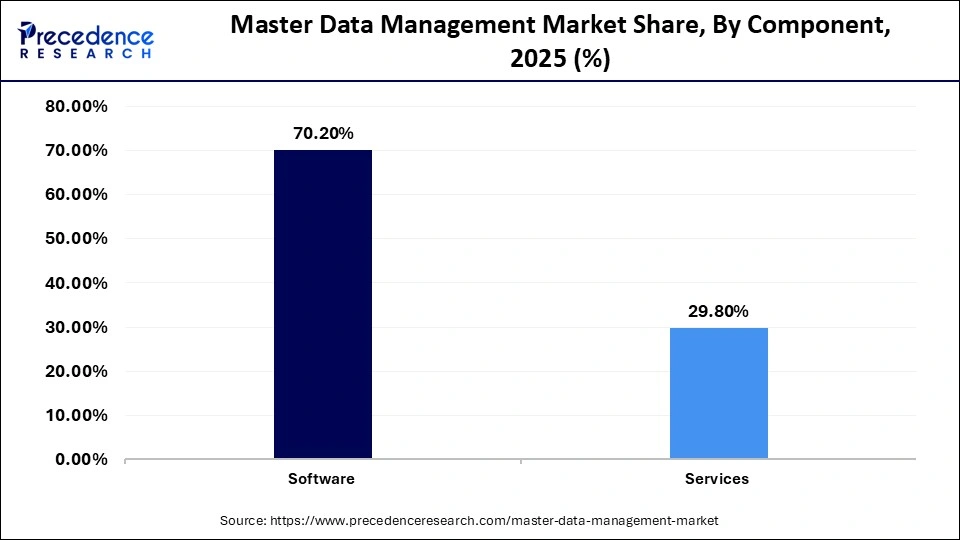
Services: This segment is projected to grow at the fastest CAGR of 14% during the foreseeable period. The segment is growing due to the ability of services offered in terms of scaling up or down as per business needs without the need for substantial investments in infrastructure and specialized staff. Master data management services ensure regulatory compliance and support business growth with fewer challenges.
Deployment Mode Insights
Why Is On-Premises Deployment Preferred in the Master Data Management Market?
On-Premises: This segment held the largest market share of 56.7% in 2025. The segment is dominating due to the maximum control offered by on-premises deployment for data privacy and mitigating risks of data breaches by unauthorized persons, enhanced security measures, and easy regulatory compliance, which is a crucial factor for data-intensive sectors like healthcare and finance. Businesses are looking for the best solutions to customize their workflow, easy integration with legacy systems, and management of data sovereignty.
Hybrid: The segment is projected to grow at the fastest CAGR during the foreseeable period. The segment is expanding as it offers benefits of both on-premises deployment and cloud deployment as per the company's needs to resolve data security issues and scalability as well as cost-effective solutions and data handling tools.
Data Type Insights
Why Is Customer Data Type Largely Influencing the Growth of the Master Data Management Market?
Customer Data: This segment held the largest market share of 37.6% in 2025. The segment is dominating because the modern businesses are collecting vast amounts of customer data from various sources such as CRM systems, e-commerce platforms, and social media, along with customer support that needs sophisticated MDM solutions to prevent data silos and inconsistencies. Master data management provides a uniform and precise golden record of every customer, providing streamlined processes, enhanced data quality at entry, and ensuring every team member can access the same verified data.
Asset & Location Data: This segment is projected to grow at the fastest CAGR of 13.8% during the foreseeable period, driven by the increasing complexity of asset-intensive operations across industries such as manufacturing, utilities, transportation, energy, and infrastructure. Organizations manage large volumes of asset and location data distributed across multiple databases, operational systems, and departments, which creates data silos, inconsistencies, and governance challenges. Master data management solutions address these issues by providing a centralized and authoritative view of assets and locations, improving data accuracy, consistency, and traceability.
End-Use Insights
Why Does Operational MDM Lead the Master Data Management Market Globally?
Operational MDM: This segment held the largest market share of 48.6% in 2025. The segment is dominating due to the daily business processes with trusted and consistent data that is highly essential to enhance consumer experiences and enable real-time actions across leading systems like ERP and CRM. It transcends beyond basic data centralization and actively handles massive data efficiently.
Collaborative MDM: The collaborative MDM segment is projected to grow at the fastest CAGR during the foreseeable period. The segment is growing due to the benefits like seamless collaboration between IT and business users, which directly affects enhanced decision-making and operational efficiency. This approach affects the automated workflows and ensures data quality rules and governance policies of compliance.
Regional Insights
How Big is the North America Master Data Management Market Size?
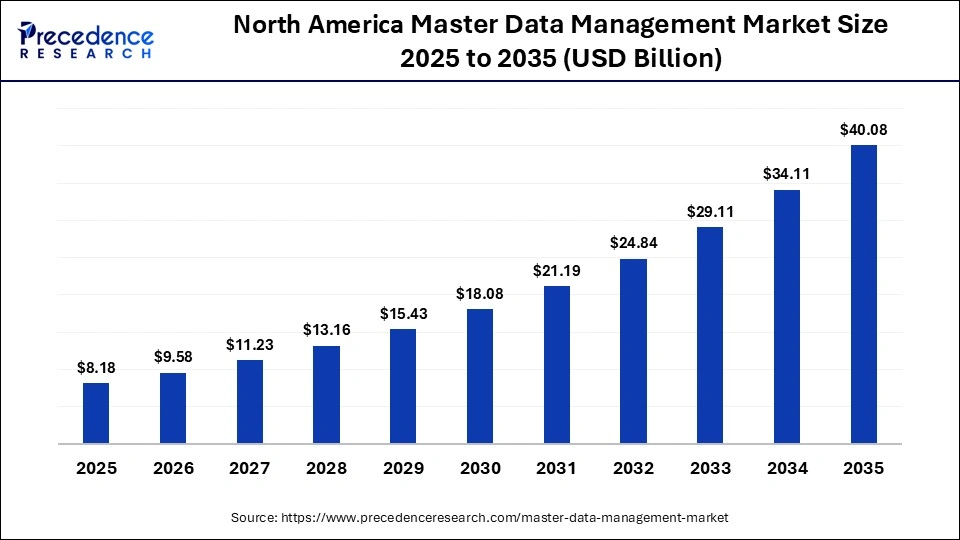
The North America master data management market size is estimated at USD 8.18 billion in 2025 and is projected to reach approximately USD 40.08 billion by 2035, with a 17.22% CAGR from 2026 to 2035.
What Made North America a Dominant Player in the Master Data Management Market?
North America held the largest market share of 42.5% in 2025, supported by strong adoption of cloud computing and artificial intelligence, along with highly advanced digital infrastructure capable of handling large-scale enterprise data operations. Organizations across the region increasingly rely on master data management platforms to support complex data environments, ensure data consistency, and enable real-time analytics across business functions.
The region's dominance is also reinforced by strict data privacy, security, and governance requirements. As data becomes a critical asset in North America's digitally driven economy, enterprises are investing heavily in MDM solutions to maintain data accuracy, meet regulatory obligations, and reduce operational and compliance risks. These requirements are particularly pronounced in sectors such as BFSI, healthcare, retail, and government, where data integrity and traceability are essential.
The strong presence of major technology providers such as IBM, Oracle, and Amazon plays a central role in shaping the regional master data management landscape. These companies continue to invest in cloud-native data platforms, AI-enabled data governance, and scalable integration frameworks, accelerating enterprise adoption of advanced master data management solutions.
What is the Size of the U.S. Master Data Management Market?
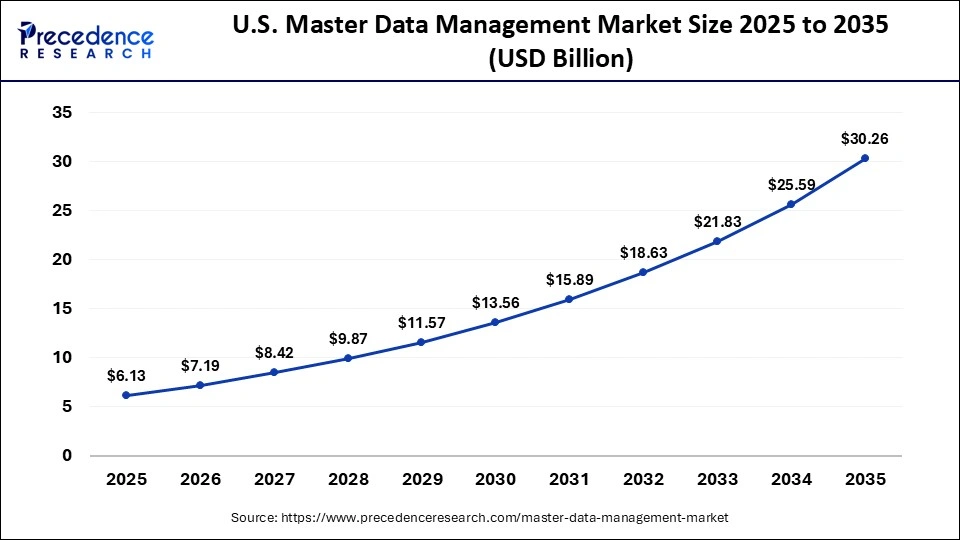
The U.S. master data management market size is calculated at USD 6.13 billion in 2025 and is expected to reach nearly USD 30.26 billion in 2035, accelerating at a strong CAGR of 17.31% between 2026 and 2035.
U.S. Master Data Management Market Analysis
The region is expanding due to the leading tech companies like IBM, Oracle, and Informatica that provide highly scalable and comprehensive data management platforms. U.S. companies are heavily investing in the cutting-edge technologies like cloud AI, analytics and digitalization across many sectors, pushing the advanced data management further.
- For instance, in October 2025, a leader in tech, Oracle introduced the ‘Oracle Fusion Applications AI Agent Marketplace'. It is an innovative solution that enables cloud application consumers to find and deploy partner-built AI agents within their environment.
Why is Asia Pacific Largely Growing in the Master Data Management Market?
Asia Pacific is projected to grow at the fastest CAGR of 15.5% during the period 2026-2035, driven by rapid digitalization and a sharp increase in enterprise data volumes across the region. The continued expansion of e-commerce platforms, digital payments, and online services is generating large and complex datasets, increasing the need for structured and governed master data across organizations.
Rising cloud adoption across key industries such as BFSI, IT and telecom, and manufacturing is another major growth driver. As enterprises migrate core operations to cloud environments, the need for centralized, consistent, and high-quality master data becomes critical to ensure interoperability between systems, accurate reporting, and reliable analytics. Master data management platforms help address fragmentation caused by multi-cloud and hybrid IT architectures.
Rapid internet penetration and widespread smartphone adoption are further accelerating data creation and consumption. Mobile-first business models and digital customer engagement strategies are increasing the volume of customer, product, and transactional data that must be synchronized across multiple platforms in real time. This places growing pressure on organizations to adopt master data management solutions that can scale with data growth while maintaining governance and accuracy.
China Master Data Management Market Analysis
The China master data management market is heavily influenced by the huge data growth from smart manufacturing like the Industry 4.0 revolution and the booming e-commerce sector with strict data policies like PIPL and strong demand from the IT/telecom sector that inclined majorly towards cloud-based solutions. Significant investments from leading tech players into emerging start-ups further fuel the region's growth rate.
Why Is Europe Significantly Expanding in the Master Data Management Market?
Europe's master data management market is strongly driven by accelerated digital transformation combined with strict data protection and governance requirements. Regulatory frameworks governing data privacy and compliance are compelling organizations to maintain accurate, consistent, and well-governed master data across all business systems. As a result, enterprises are increasingly investing in structured MDM platforms to reduce data risk, improve audit readiness, and ensure end-to-end data traceability.
Adoption is further reinforced by Europe's strong momentum toward Industry 4.0, which relies heavily on cloud-based architectures, interconnected systems, and real-time data exchange. Manufacturing, utilities, and industrial enterprises require reliable master data to support automation, predictive maintenance, supply chain coordination, and operational analytics, making master data management a foundational component of digital industrial strategies.
The widespread need for data accuracy in sectors such as finance, healthcare, and BFSI is a key growth driver. These industries operate in highly regulated environments where inconsistent or poor-quality data can lead to compliance failures, operational disruptions, and financial penalties. Master data management enables standardized definitions, controlled data ownership, and consistent use of customer, product, and reference data across enterprise applications.
Germany Master Data Management Market Trends
The Germany master data management market is increasingly shaped by the integration of advanced technologies such as artificial intelligence and machine learning within MDM platforms. Organizations are adopting AI- and ML-enabled capabilities to automate data cleansing, standardization, matching, and enrichment processes, reducing manual effort while improving data accuracy and consistency.
These technologies also support intelligent data governance by continuously monitoring data quality, detecting anomalies, and enforcing governance rules across complex enterprise data environments. Another key trend driving market growth is the shift in consumer behavior toward omnichannel engagement. German enterprises across sectors such as retail, manufacturing, BFSI, and healthcare are required to manage customer, product, and supplier data consistently across physical channels, digital platforms, and partner ecosystems.
How Are the Middle East and Africa Expanding the Master Data Management Market?
The master data management market in the Middle East and Africa is expanding steadily due to the rapid adoption of data-driven strategies across both public and private sectors. Organizations are increasingly relying on structured data foundations to support operational efficiency, digital service delivery, and informed decision-making as part of broader digital transformation initiatives.
Market growth is primarily driven by rising requirements for data governance and regulatory compliance, particularly in sensitive and highly regulated sectors such as retail, banking, and healthcare. These industries manage large volumes of customer, transactional, and reference data, where accuracy, consistency, and traceability are critical to meeting compliance obligations and reducing operational risk. Master data management platforms help establish controlled data ownership, standardization, and auditability across fragmented systems.
The accelerating shift toward cloud-based platforms and software-as-a-service deployment models is further strengthening adoption across the region. Cloud-native master data management solutions enable organizations to centralize master data, improve data integrity, and support real-time data processing without heavy upfront infrastructure investment. This is especially important for enterprises operating across multiple locations and jurisdictions with varying data requirements.
UAE Master Data Management Market Analysis
The United Arab Emirates master data management market is growing rapidly, driven by a strong national push toward e-governance and large-scale smart city programs. Initiatives such as Smart Dubai require integrated and interoperable data management frameworks to ensure accuracy, consistency, and reliability of master data across multiple public services, digital platforms, and government entities. Unified master data is critical for enabling seamless citizen services, real-time analytics, and cross-departmental coordination. Market growth is further reinforced by the introduction of data protection regulations and national cybersecurity strategies aimed at strengthening data security, privacy, and governance.
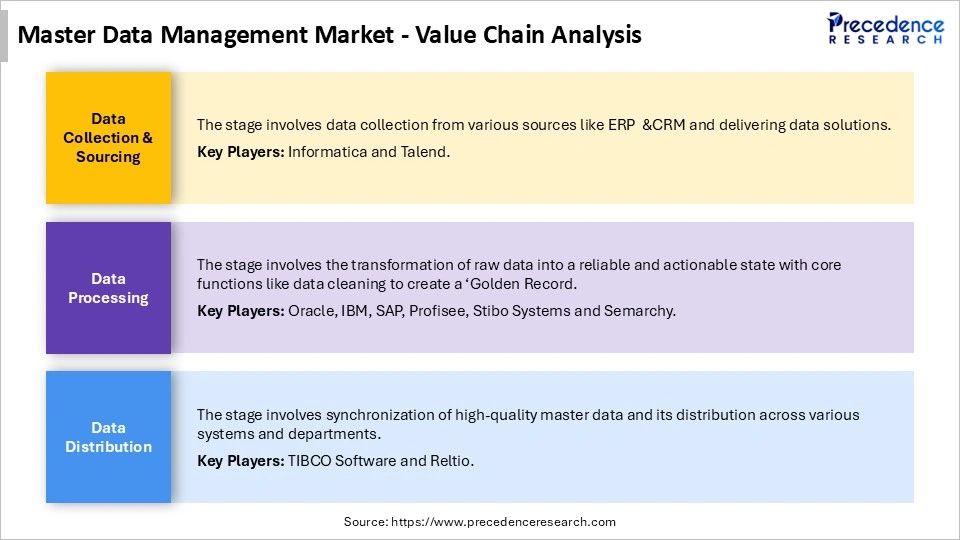
Master Data Management Market Value Chain
Top Master Data Management Market Companies and their Offerings
- IBM: IBM MDM is a cloud-based AI solution that gathers data from several domains and forms a single reliable 360-degree view very fast.
- Oracle: Oracle provides MD cloud applications that help to unify, manage, and make master data accessible through standard models.
- SAP: SAP Master Data Governance provides the company with powerful and integrated workflows and prebuilt models to guarantee that its data is consistent and of top quality.
Top Companies in Master Data Management Market
- IBM
- Oracle
- SAP
- Informatica
- TIBCO Software
- SAS Institute
- Microsoft
- Stibo Systems
- Talend
- Ataccama
- Riversand (Syndigo)
- Precisely
- Semarchy
- Profisee
- EnterWorks
Recent Developments
- In September 2025, the world leader in data integrity, ‘Precisely,' announced new updates regarding its EnterWorks software that integrates master data management and data governance service by using a suite called Data Integrity Suite. This update is highly valuable for enterprises, as it allows them to link master data to policies, goals, and metrics, ensuring more accountability.(Source: https://www.prnewswire.com)
- In December 2025, AWS introduces the Amazon Relational Database Service with its improved capabilities, aiming to optimize their costs and enhance scalability for their two databases, called Amazon RDS for Oracle and Amazon RDS SQL Server.(Source: https://www.dbta.com)
Segments Covered in the Report
By Component
- Software
- Services
By Deployment Mode
- On-Premise
- Cloud-based
- Hybrid
By Data Type
- Customer Data
- Product Data
- Supplier Data
- Financial Data
- Asset & Location Data
By End Use
- Operational MDM
- Analytical MDM
- Collaborative MDM
By Region
- North America
- Europe
- Asia-Pacific
- Latin America
- Middle East and Africa
For inquiries regarding discounts, bulk purchases, or customization requests, please contact us at sales@precedenceresearch.com
Frequently Asked Questions





Ask For Sample
No cookie-cutter, only authentic analysis – take the 1st step to become a Precedence Research client
 Get a Sample




 sales@precedenceresearch.com
 Schedule a Meeting
