



MEA Albumin Market Revenue, Leading Companies, Company Technology / Innovation, Diagnostic Testing Volume, Adoption Rates, Pricing Metrics, Supply Chain Performance, Competitive Positioning, and Industry Trends
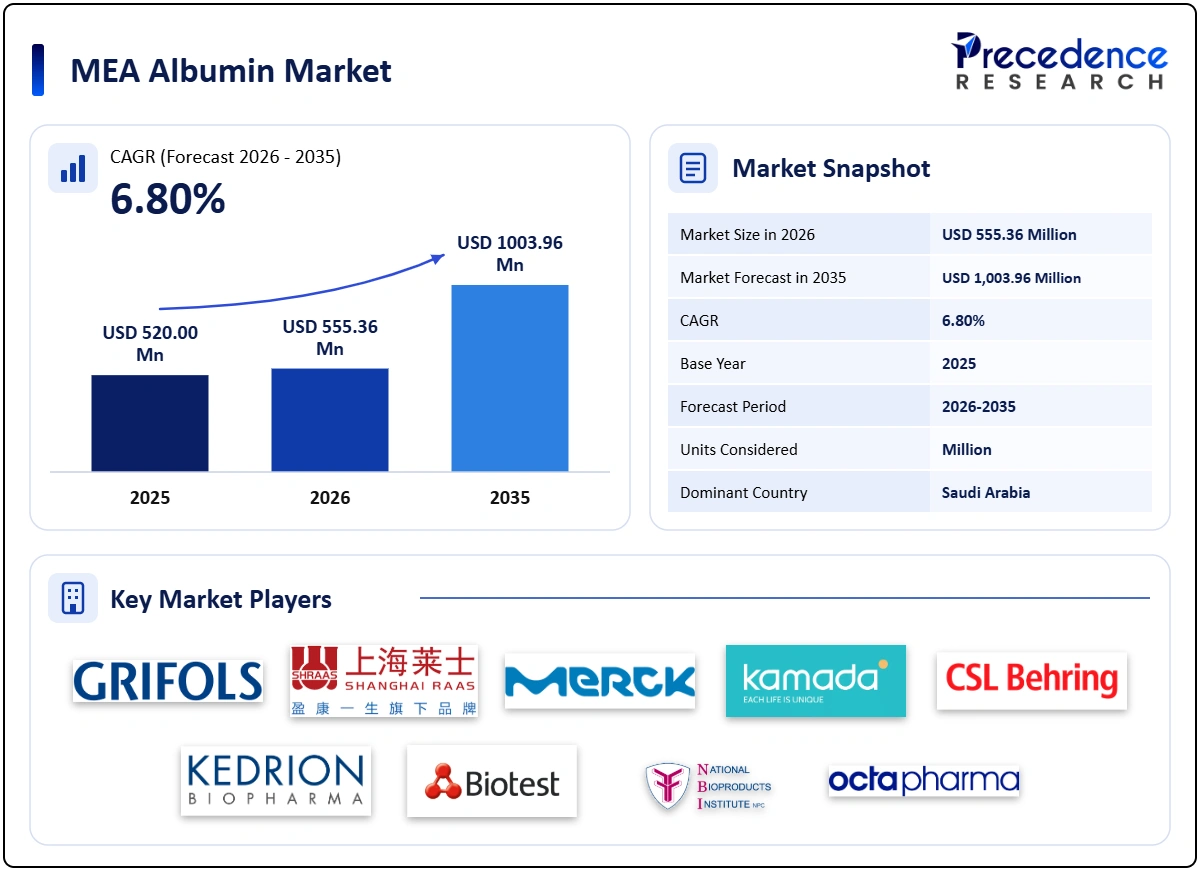
Payal Rabde, a Healthcare Industry Expert, highlights that the MEA albumin market has reached USD 555.36 million in 2026 and is on track to reach USD 1,003.96 million by 2035, advancing at a CAGR of 6.80%. Key MEA albumin market companies shaping the market include Universal Grifols, CSL Behring, Octapharma, Takeda Medical while major growth segments span product, application, end user.
Source: https://www.precedenceresearch.com/mea-albumin-market
 Get a Sample
 Table Of Content
Key Takeaways
Market Size & Growth Outlook
- Market size in 2025: USD 520.00 million
- Estimated market size in 2026: USD 555.36 million
- Projected market size by 2035: USD 1,003.96 million
- CAGR (2026-2035): 6.80%
Regional Market Insights
- In 2025, Saudi Arabia dominated with 31.00% of the market share.
- Egypt held 19.00% share in 2025 and is projected to be the fastest-growing country, at a CAGR of 7.88% from 2026 to 2035.
- The UAE accounted for 14.00% of the market share in 2025.
Segmental Spotlight
- By product, Human Serum Albumin accounted for the largest share of 82.00% in 2025.
- Hypovolemia & Shock contributed 33.00% to the market in 2025, positioning it as the leading application area.
- In 2025, Hospitals & Clinics represented the leading end user category, with 81.00% market share.
MEA Albumin Market Size, 2025-2035 (USD Million)
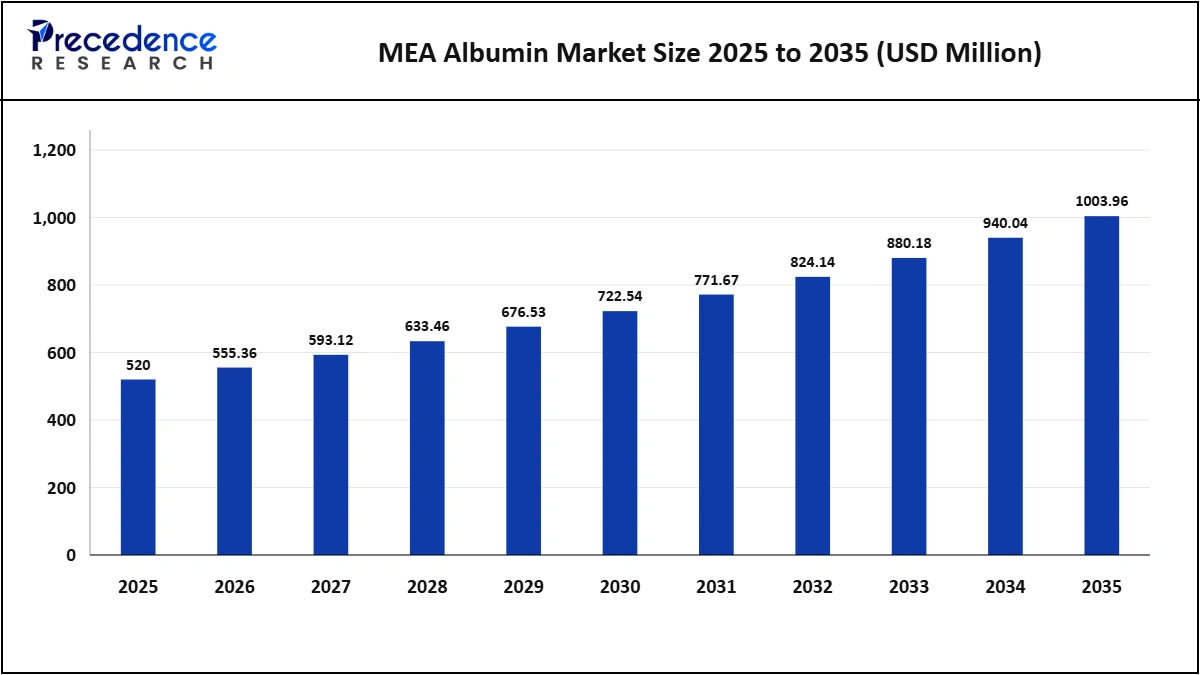
Note: 2025 is the base year; 2026-2035 values are forecasts.
Sources: Expert interviews, secondary sources, Precedence Research database, and Precedence Research analysts.
The MEA albumin market is expected to expand steadily, supported by increasing hospital capacity across the Gulf and Egypt, rising demand from critical care, liver disease management, and surgical procedures, and the development of local manufacturing capabilities. The market is projected to grow from USD 520.00 million in 2025 to USD 722.54 million by 2030, reaching USD 1,003.96 million by 2035 at a CAGR of 6.80% during 2026-2035.
Analyst View: We expect the market to grow steadily, driven by expanding hospital infrastructure, rising demand for critical care and surgical procedures, and increasing prevalence of liver diseases. Local manufacturing investments will further strengthen supply availability and support market expansion.
MEA Albumin Market Trends
- Plasma self-sufficiency: Countries are investing in local plasma collection and fractionation capabilities.
- Recombinant excipients: Biologics manufacturers are increasingly adopting animal-free recombinant albumin.
- Centralized tenders: NUPCO in Saudi Arabia and Egypt's UPA are consolidating procurement to improve purchasing efficiency.
- Critical care growth: Expanding ICU capacity is increasing demand for albumin in critical care settings.
- Patient blood management: Hospitals are reviewing albumin utilization guidelines to promote appropriate use and improve treatment cost efficiency.
Market Dynamics
The MEA albumin market depends on imported plasma-derived products bought through large government tenders. Saudi Arabia and Egypt are pursuing plasma self-sufficiency, and Grifols Egypt is building the region's first large fractionation plant.
Drivers
Hospital and ICU expansion
Investment under Saudi Vision 2030, UAE health plans, and Egypt's universal health insurance program are expanding hospital infrastructure and ICU capacity, supporting demand for albumin in critical care.
Liver disease burden
The high burden of cirrhosis, including cases linked to historical hepatitis C infections in Egypt, and rising fatty liver disease prevalence across the Gulf are driving albumin demand.
Surgery and trauma
Increasing volumes of cardiac surgeries, organ transplants, and trauma cases are supporting albumin demand for volume replacement and perioperative fluid management.
Local manufacturing
Investments in plasma fractionation and albumin production, including Grifols' operations in Egypt and emerging plasma infrastructure in Saudi Arabia, are expected to strengthen regional supply security.
Market Drivers - Impact & CAGR Contribution (2026-2035)
| Driver | Impact | ≈ CAGR Contribution | Time Horizon | Key Regions |
| Hospital and ICU expansion | High | +2.65 pp | Short to long term | Middle East & Africa-wide, strongest in Saudi Arabia |
| Liver disease burden | Medium | +2.24 pp | Medium to long term | Middle East & Africa-wide, fastest uptake in Egypt |
| Surgery and trauma | Medium | +1.91 pp | Short to medium term | Middle East & Africa-wide |
| Local manufacturing | Low | +1.49 pp | Long term | Saudi Arabia and Egypt |
Note: Contributions are indicative estimates of each factor's effect on annual growth.
Sources: Expert interviews, secondary sources, Precedence Research database, and Precedence Research analysts.
Hospital and ICU expansion, liver disease burden, and surgery and trauma drive most growth in the MEA albumin market, supported by local manufacturing plans.
Restraints
Dependence on imported plasma
High reliance on imported albumin and plasma-derived products exposes regional markets to fluctuations in global plasma supply, international logistics costs, and foreign exchange rates.
Tender price pressure
Centralized government procurement and competitive tendering prioritize cost efficiency, putting downward pressure on albumin prices and limiting supplier profit margins.
Clinical substitution
The availability of alternative volume expanders, including crystalloids and synthetic colloids, limits albumin uses in certain clinical settings.
Market Restraints - Impact & Negative CAGR Contribution (2026-2035)
| Restraint | Impact | ≈ Negative CAGR Contribution | Time Horizon | Key Regions |
| Dependence on imported plasma | High | -0.67 pp | Short to medium term | Middle East & Africa-wide |
| Tender price pressure | High | -0.49 pp | Medium term | Smaller and price-sensitive markets |
| Clinical substitution | Medium | -0.33 pp | Short term | Saudi Arabia and other mature markets |
Note: Contributions are indicative estimates of each factor's effect on annual growth.
Sources: Expert interviews, secondary sources, Precedence Research database and Precedence Research analysts.
Dependence on imported plasma is the main restraint, followed by tender pricing pressure and clinical substitution in the MEA albumin market.
Opportunities
Regional fractionation
Investments in local plasma collection and fractionation facilities present opportunities to strengthen regional albumin production.
Recombinant albumin for biologics
The expansion of vaccine and biologics manufacturing facilities across the region is creating opportunities for recombinant human albumin as an animal-free excipient and cell culture supplement.
Private hospital growth
Growing private healthcare infrastructure across the Gulf is creating opportunities for suppliers to serve hospitals with higher-value procurement requirements and potentially better pricing flexibility than public tenders.
MEA Albumin Market Segmentation: 2025 Share and Size
MEA Albumin Market by Product, 2025-2035 Share (%)
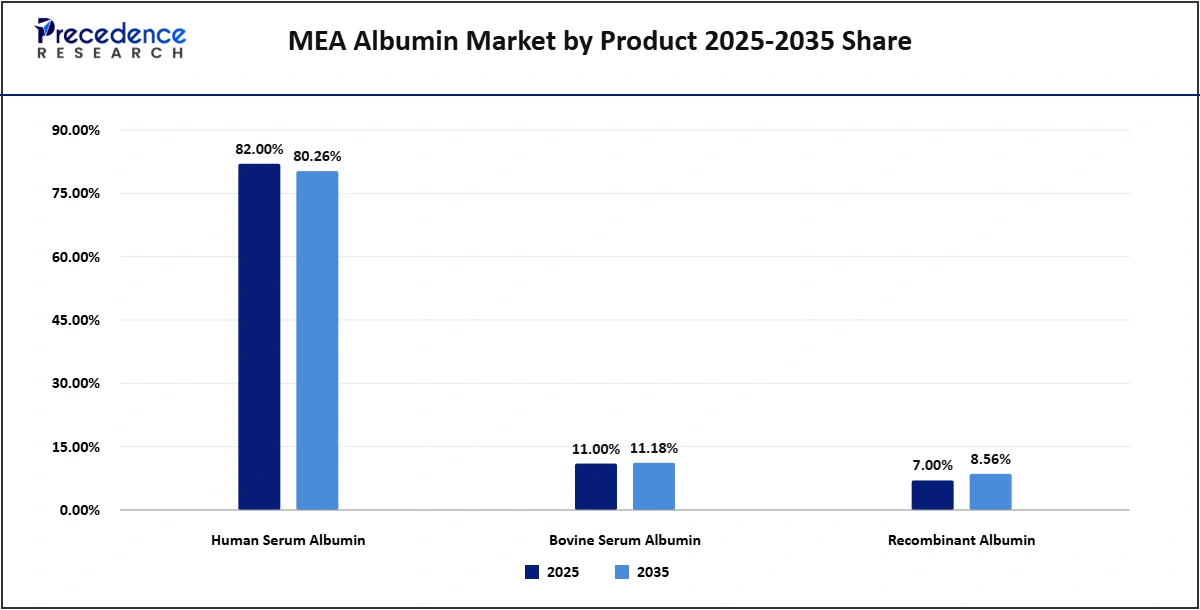
Note: 2025 is the base year; 2035 shares and CAGRs are forecasts.
Sources: Expert interviews, secondary sources, Precedence Research database, and Precedence Research analysts.
Human serum albumin dominates because nearly all clinical use in hospitals is plasma-derived HSA imported from developed regions. Recombinant albumin grows fastest as regional biologics and vaccine manufacturers need animal-free, consistent excipients.
Human Serum Albumin: The segment captured 82.00% of the total market in 2025 and is anticipated to register a CAGR of 6.57% between 2026 and 2035. Human Serum Albumin leads due to its established clinical use across critical care and surgical procedures, supported by strong demand for plasma-derived HSA in government hospital procurement.
Bovine Serum Albumin: With a market contribution of 11.00% in 2025, bovine serum albumin is expected to sustain expansion at a CAGR of 6.97% from 2026 to 2035. Demand for bovine serum albumin is rising in diagnostic testing, cell culture applications, and biomedical research across universities, laboratories, and biotechnology centers.
Recombinant Albumin: Representing 7.00% of the market in 2025, recombinant albumin is forecast to maintain the fastest growth at a CAGR of 8.97% over the forecast period. Recombinant Albumin is growing rapidly due to increasing adoption of animal-free, highly consistent albumin in vaccine, biologics, and cell therapy manufacturing.
MEA Albumin Market by Application, 2025-2035 Share (%)
| Segments | 2025 Share | 2035 Share | CAGR 2026-2035 |
| Hypovolemia & Shock | 33.00% | 31.46% | 6.29% |
| Liver Disease | 27.00% | 26.72% | 6.69% |
| Surgery & Burns | 18.00% | 17.82% | 6.69% |
| Drug Formulation & Bioprocessing | 14.00% | 16.08% | 8.29% |
| Others | 8.00% | 7.92% | 6.69% |
Note: 2025 is the base year; 2035 shares and CAGRs are forecasts.
Sources: Expert interviews, secondary sources, Precedence Research database, and Precedence Research analysts.
Hypovolemia & Shock leads because albumin is used daily in ICUs, liver units, and operating theatres. Drug formulation and bioprocessing grow fastest as Saudi Arabia, the UAE, and Egypt localize biologics and vaccine production.
Hypovolemia & Shock: The segment held a substantial 33.00% share of the market in 2025, with growth projected at a 6.29% CAGR through 2035. Hypovolemia and shock lead to the widespread use of albumin for intravascular volume expansion and fluid resuscitation in emergency, trauma, and intensive care settings.
Liver Disease: In 2025, the segment represented 27.00% of the market and is expected to achieve a CAGR of 6.69% over the 2026-2035 period. The segment's growth is driven by the high burden of cirrhosis and increasing use of albumin for paracentesis and the management of liver-related complications.
Surgery & Burns: The segment's market share stood at 18.00% in 2025, while its growth trajectory is expected to reflect a CAGR of 6.69% during 2026-2035. Demand is supported by rising cardiac surgeries, organ transplants, and burn cases requiring fluid resuscitation and volume replacement.
Drug Formulation & Bioprocessing: Holding a 14.00% market share in 2025, this segment is expected to expand at a CAGR of 8.29% during the forecast period. Drug formulation & bioprocessing is the fastest-growing application segment due to expanding biologics, vaccine, and cell culture production, which is driving demand for albumin as a stabilizer.
Others: This segment accounted for 8.00% of the market in 2025 and is projected to grow at a CAGR of 6.69% through 2035. Growth is driven by increasing albumin use in nephrotic syndrome, neonatal care, and other specialized clinical applications.
MEA Albumin Market by End User, 2025-2035 Share (%)
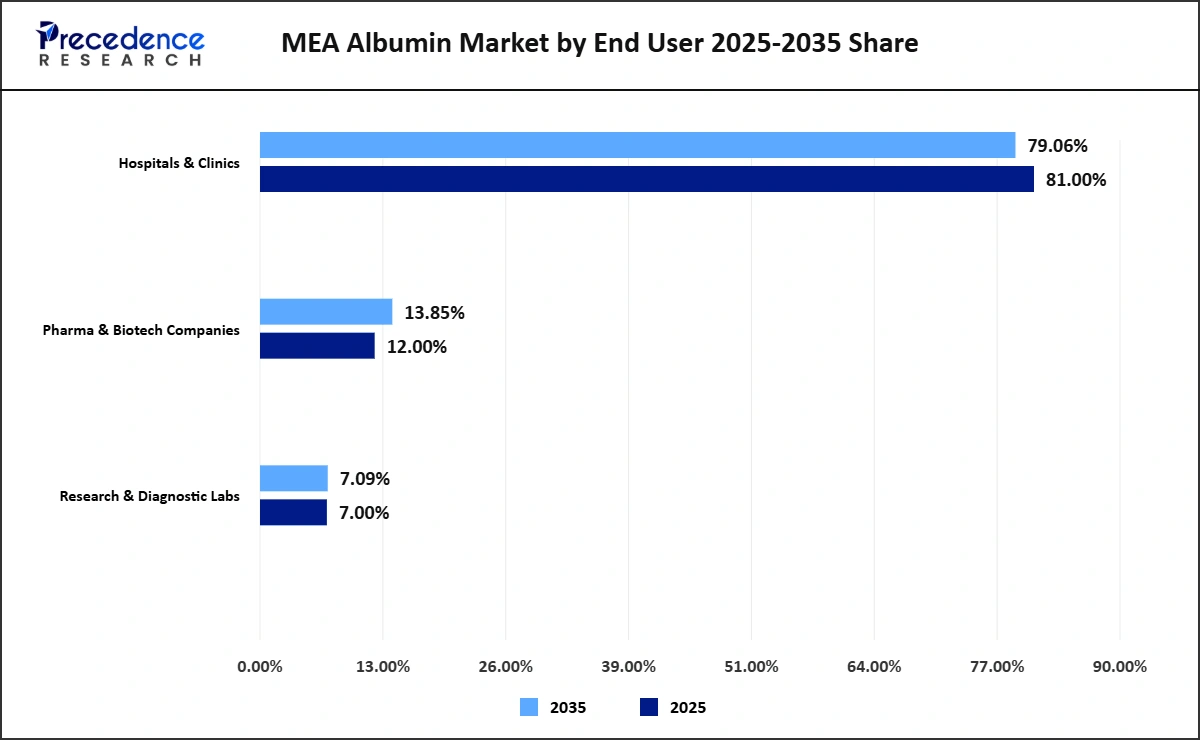
Note: 2025 is the base year; 2035 shares and CAGRs are forecasts.
Sources: Expert interviews, secondary sources, Precedence Research database, and Precedence Research analysts.
Hospitals and clinics dominate because albumin is an injectable given under specialist supervision. Pharma and biotech companies grow fastest with new local manufacturing projects.
Hospitals & Clinics: In 2025, the segment represented 81.00% of the overall market and is expected to achieve a CAGR of 6.54% over the 2026-2035 period. Hospitals and clinics are growing due to high albumin utilization in hospital-based critical care, emergency, surgical, and liver disease treatments.
Pharma & Biotech Companies: The segment held a substantial 12.00% share of the market in 2025, with growth projected at 8.34% CAGR through 2035. The Pharma & Biotech Companies segment is growing fastest due to expanding biologics, vaccine, and cell therapy manufacturing, which is increasing demand for albumin as an excipient and cell culture supplement.
Research & Diagnostic Labs: With a market contribution of 7.00% in 2025, research & diagnostic labs are expected to witness sustained expansion at a CAGR of 6.94% from 2026 to 2035. It is growing due to increasing investments in biomedical research, diagnostic testing, and laboratory activities.
Analyst View: We expect the market to grow steadily, driven by sustained demand for human serum albumin across hospital-based critical care. However, recombinant albumin and bioprocessing applications are likely to record faster growth as biologics, vaccines, and cell therapy manufacturing expand. Long-term growth will be supported by growing use of animal-free albumin, while hospitals & clinics will continue to anchor market demand.
Country Analysis
MEA Albumin Market by Country, 2025 Share (%)
| Country | 2025 Share | 2035 Share | CAGR 2026-2035 |
| Saudi Arabia | 31.00% | 29.53% | 6.28% |
| Egypt | 19.00% | 21.02% | 7.88% |
| UAE | 14.00% | 13.85% | 6.68% |
| South Africa | 11.00% | 10.88% | 6.68% |
| Israel | 8.00% | 7.91% | 6.68% |
| Rest of MEA | 17.00% | 16.81% | 6.68% |
Note: 2025 is the base year; 2035 shares and CAGRs are forecasts.
Sources: Expert interviews, secondary sources, Precedence Research database, and Precedence Research analysts.
Saudi Arabia leads because of its large hospital base and centralized purchasing, while Egypt is the fastest-growing country as Grifols Egypt builds local plasma collection and fractionation.
Country Insights
Saudi Arabia: Representing 31.00% of the market in 2025, Saudi Arabia is forecast to maintain steady growth at a CAGR of 6.28% over the forecast period. Saudi Arabia dominates due to its extensive hospital infrastructure, high albumin procurement through NUPCO, and investments in domestic plasma collection.
Egypt: The country captured 19.00% of the total market in 2025 and is anticipated to register a CAGR of 7.88% between 2026 and 2035. Egypt is growing fastest due to its high burden of liver disease, expanding healthcare demand, and investments in local plasma fractionation.
UAE: Holding a 14.00% market share in 2025, the UAE is expected to expand at a CAGR of 6.68% during the forecast period. Rising healthcare investments, high per-capita healthcare spending, and expanding private hospital networks are supporting greater albumin utilization.
South Africa: This country accounted for 11.00% of the market in 2025 and is projected to grow at a CAGR of 6.68% through 2035. Established plasma fractionation infrastructure and domestic albumin production through the National Bioproducts Institute are strengthening market growth.
Israel: This country represented 8% of revenue in 2025 and is expected to grow at a CAGR of 6.68% through 2035. Local manufacturing capabilities, advanced healthcare infrastructure, and demand from therapeutic and research applications are driving market expansion.
Rest of MEA: The region's market share stood at 17.00% in 2025, and its growth trajectory is expected to reflect a CAGR of 6.68% during 2026-2035. Increasing critical care requirements and rising surgical volumes are creating additional demand across import-dependent countries.
Analyst View: We expect Saudi Arabia to remain the largest market, supported by centralized procurement, while Egypt will record faster growth through rising liver disease burden and local manufacturing investments. The UAE will continue to grow steadily due to the increase in private hospitals. South Africa and Israel will benefit from established domestic manufacturing capabilities and advanced healthcare infrastructure, while the Rest of MEA will see demand growth driven by expanding healthcare access.
Competitive Landscape
Top 10 Companies in the MEA Albumin Market, 2025
| Rank | Company Name | 2025 Share (%) | Key Products / Business | Headquarters |
| 1 | Grifols | 21.00% | Albutein and Human Albumin Grifols, plus Grifols Egypt | Spain |
| 2 | CSL Behring | 19.00% | AlbuRx and Albuminar | Australia |
| 3 | Octapharma | 14.00% | Albunorm | Switzerland |
| 4 | Takeda | 10.00% | Flexbumin and Buminate | Japan |
| 5 | Kedrion | 7.00% | Plasbumin and Kedbumin | Italy |
| 6 | Biotest | 5.00% | Albumin and plasma products | Germany |
| 7 | National Bioproducts Institute | 4.00% | South African plasma products | South Africa |
| 8 | Shanghai RAAS | 3.00% | Albumin exports | China |
| 9 | Merck KGaA | 3.00% | Bovine and recombinant albumin for bioprocessing | Germany |
| 10 | Kamada | 2.00% | Plasma-derived products | Israel |
Note: Company shares are 2025 estimates.
Sources: Company press releases, expert interviews, secondary sources, Precedence Research database, and Precedence Research analysts.
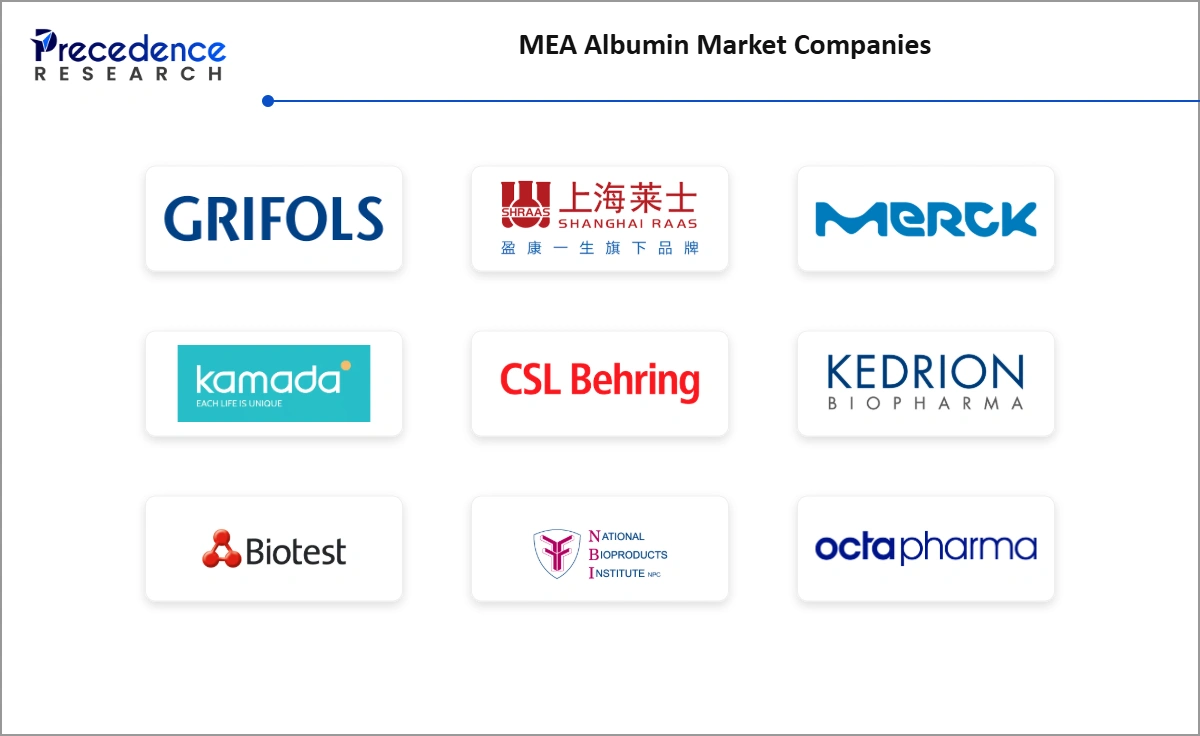
Grifols led the MEA albumin market with 21.00% share of 2025 revenue, followed by CSL Behring at 19.00% share and Octapharma at 14.00% share. Grifols leads with Albutein and Human Albumin Grifols, plus Grifols Egypt; CSL Behring competes with albuRx and Albuminar; and Octapharma offers Albunorm. Takeda, Kedrion, Biotest, National Bioproducts Institute, Shanghai RAAS, Merck KGaA, and Kamada compete through flexbumin and Buminate, plasbumin and Kedbumin, albumin and plasma products, South African plasma products, albumin exports, bovine and recombinant albumin for bioprocessing, and plasma-derived products.
The top 10 market players accounted for 88.00% of 2025 revenue, while the remaining 12.00% was shared among regional distributors and smaller fractionators. The MEA albumin market is concentrated among global fractionators, and competition centers on ministry tender pricing, registration in each country, supply reliability, local partnerships, and plans for regional fractionation.
Company Snapshots
Grifols: Headquartered in Spain, Grifols held 21.00% of the MEA albumin market in 2025, built largely on Albutein and Human Albumin Grifols, plus Grifols Egypt. The Precedence Research Companies Quadrant places it as a Leader.
CSL Behring: CSL Behring competes mainly through AlbuRx and Albuminar. From its base in Australia, it captured 19.00% of 2025 revenue and is rated a Leader in the Precedence Research Companies Quadrant.
Octapharma: With 14.00% of the market in 2025, Octapharma draws on Albunorm. The company is based in Switzerland and appears as a Leader in the Precedence Research Companies Quadrant.
Takeda: Based in Japan, it accounted for a 10.00% share in 2025. Its Flexbumin and Buminate keep it in the Leader group of the Precedence Research Companies Quadrant.
Kedrion: Accounted for 7.00% of the market share in 2025, making Kedrion a notable participant. It is headquartered in Italy, focuses on Plasbumin and Kedbumin, and is classed as a Leader in the Precedence Research Companies Quadrant.
Biotest: This company held a 5.00% share in the market for albumin and plasma products. Headquartered in Germany, it is shown as a Leader in the Precedence Research Companies Quadrant.
National Bioproducts Institute: Most of National Bioproducts Institute's presence in this market comes from South African plasma products. The company is headquartered in South Africa, contributed 4.00% of 2025 revenue, and is rated an Innovator in the Precedence Research Companies Quadrant.
Shanghai RAAS: In 2025, the company contributed a 3.00% share. Its range is built around albumin exports, and the company, based in China, is placed as an Innovator in the Precedence Research Companies Quadrant.
Merck KGaA: Operating from Germany, Merck KGaA offers bovine and recombinant albumin for bioprocessing. That portfolio gave it 3.00% of the MEA albumin market share in 2025 and a position as an Innovator in the Precedence Research Companies Quadrant.
Kamada: About 2.00% of 2025 revenue in the MEA albumin market went to Kamada, whose business here centers on plasma-derived products. The company is headquartered in Israel, and the Precedence Research Companies Quadrant rates it as an Innovator.
Companies Ecosystem
The MEA albumin ecosystem links plasma collection, fractionators, distributors & local partners, hospitals & procurement bodies, and regulators, with each stage adding value before products reach end users. Albumin is also used in parenteral nutrition protocols and as an excipient in clinical trials of new biologics.
MEA Albumin Market Ecosystem
| Ecosystem Stage | Role in the Market | Key Companies |
| Plasma Collection | Collect donor plasma | Grifols Egypt centers, national blood services |
| Fractionators | Make albumin | Grifols, CSL, Octapharma, Takeda |
| Distributors & Local Partners | Register and distribute | Tamer, local agents |
| Hospitals & Procurement Bodies | Buy and use albumin | NUPCO, Egypt UPA, DoH Abu Dhabi |
| Regulators | Approve products | SFDA, EDA, SAHPRA |
Sources: Company press releases, expert interviews, secondary sources, Precedence Research database, and Precedence Research analysts.
Plasma Collection: Most regional plasma is still not fractionated locally.
Fractionators: Global plants supply most of the region.
Distributors & Local Partners: Agents handle registration and tenders.
Hospitals & Procurement Bodies: Tenders decide prices and suppliers.
Regulators: Plasma safety and origin rules shape supply.
Value in the MEA albumin market flows from upstream material and technology suppliers to manufacturers and service providers, then through distribution partners to end users. Companies that integrate several stages or build long-term relationships with end users capture a larger share of this value.
Precedence Research Companies Quadrant
The Precedence Research Companies Quadrant positions key participants in the MEA albumin market by market strength, reflecting revenue scale, market share and geographic reach, and by innovation and growth strategy, reflecting product portfolio breadth, R&D intensity and partnerships. Positions reflect each company's estimated 2025 share of the MEA albumin market and our assessment of its product innovation, portfolio breadth and partnerships.
Sources: Company press releases, expert interviews, secondary sources, Precedence Research database and Precedence Research analysts.
Leaders: Grifols, CSL Behring, Octapharma, Takeda, Kedrion, and Biotest combine high market share with broad portfolios and strong innovation.
Innovators: National Bioproducts Institute, Shanghai RAAS, Merck, and Kamada bring newer technologies and specialized products.
Recent Development
- June 2026: Grifols raised its investment in Grifols Egypt to about EUR 460 million. The fractionation plant is expected to be completed in 2027 and reach full operating capacity in 2028, strengthening regional production capabilities for plasma-derived medicines.
MEA Albumin Market Segments
By Product
- Human Serum Albumin
- Bovine Serum Albumin
- Recombinant Albumin
By Application
- Hypovolemia & Shock
- Liver Disease
- Surgery & Burns
- Drug Formulation & Bioprocessing
- Others
By End User
- Hospitals & Clinics
- Pharma & Biotech Companies
- Research & Diagnostic Labs
By Country
- Saudi Arabia
- Egypt
- UAE
- South Africa
- Israel
- Rest of MEA
Research Methodology: The market was defined as albumin products sold, including plasma-derived human serum albumin, recombinant human albumin and bovine serum albumin, used in therapeutic indications, cirrhosis and paracentesis, burns, cardiac surgery and hypoalbuminemia, and as excipients and cell culture supplements in drug manufacturing. The 2025 base year was built bottom-up from demand volumes and average prices by product, application and end user and country, and checked top-down against the market-specific revenues of leading companies and public industry data. Segment, country and company values were allocated from product, application and end user and country demand. Key estimates were verified by cross-checking company disclosures, regulatory and industry data, and published third-party estimates, and inputs that could not be reconciled were excluded. All segment, regional, and company figures were reconciled to the same 2025 base year, and the 2026-2035 forecast, which applies a constant CAGR from the 2025 base, was recalculated and validated.
Analyst View: We expect the MEA albumin market to expand steadily, driven by rising demand from critical care, liver disease management, and surgical procedures. Investments in local plasma fractionation in Egypt and Saudi Arabia will gradually strengthen regional supply security, while import dependence and competitive government tenders will continue to pressure pricing and supplier margins.
Sources and References
- "Grifols Egypt raises investment in the project to €460M". June 2026. Press Releases. https://www.grifols.com/en/view-news/-/news/grifols-egypt-continues-its-growth-plan-through-2029-with-an-additional-investment-of-euros-180-million
For inquiries regarding discounts, bulk purchases, or customization requests, please contact us at sales@precedenceresearch.com
Frequently Asked Questions





Ask For Sample
No cookie-cutter, only authentic analysis – take the 1st step to become a Precedence Research client
 Get a Sample



 sales@precedenceresearch.com
 Schedule a Meeting
