



Microdisplays Market Size, Key Companies, Trends, Segments, and Forecast 2026-2034
Microdisplays Market (By Product: Near-To-Eye, Projection, Others; By Technology: Liquid Crystal Display, Organic Light-Emitting Diode, Digital Light Processing, Liquid Crystal On Silicon; By Application: Consumer Electronics, Military and Defense, Medical Applications, Industrial Systems, Automotive, Others) - Global Industry Analysis, Size, Trends, Leading Companies, Regional Outlook, and Forecast 2026 to 2034
Source: https://www.precedenceresearch.com/microdisplays-market
 Get a Sample
 Table Of Content


What is Microdisplays Market Size?
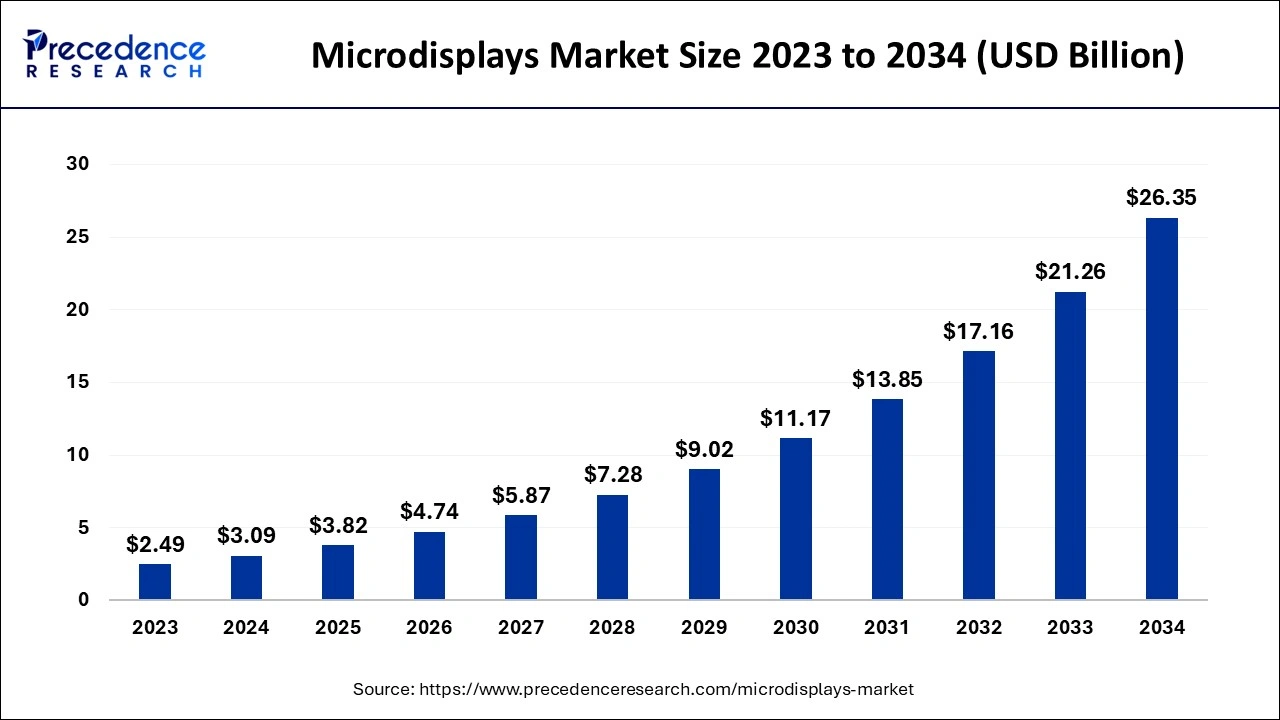
The global microdisplays market size was estimated at USD 4.74 billion in 2026 and is projected to reach approximately USD 26.35 billion by 2034, representing a CAGR of 23.92% from 2026 to 2034. Growing advancements in microdisplay technology are the key factor driving the market growth. Also, the increasing adoption of next-generation display technology coupled with the rising utilization of head-mounted displays (HMDs) can fuel the microdisplays market growth further.
Market Highlights
- Asia Pacific dominated the global market with the largest market share of 36% in 2026.
- North America is expected to grow at the fastest rate in the market over the studied period.
- The U.S. dominated the North America microdisplays market and recorded more than 73% of the market share in 2026.
- By product, the near-to-eye segment led the global market in 2026.
- By product, the projection segment is anticipated to grow at the fastest CAGR over the forecast period.
- By technology, the liquid crystal display (LCD) segment generated the highest market share in 2026.
- By technology, the liquid crystal on silicon (LCoS) segment is estimated to grow at a significant CAGR during the forecast period.
- By application, the consumer electronics segment has held the largest market share in 2026.
- By application, the automotive application segment is projected to grow at the fastest CAGR over the forecast period.
Microdisplays- Compact Powerhouses Revolutionizing Visual Technology
A microdisplay is a small electronic display panel. Microdisplays are compact display panels, typically characterized by a small diagonal screen size and viewed directly or through an optical system. Microdisplays have been utilized in many applications, such as near-eye applications, rear-projection TVs, data projectors, head-mounted displays (HMDs), etc. The microdisplays market offers Super Extended Graphics Array (SXGA) resolution, resolution for improved brightness. Some common types of microdisplays are OLED microdisplays and AMOLED microdisplays.
How is AI enhancing advancements in the Microdisplays Market?
AI can support user interaction, content generation, and personalized recommendations in devices that incorporate microdisplays. AI can personalize displayed information and adapt visual interfaces to user context in compatible AR and VR devices. Furthermore, In compatible AR and VR devices, AI can adapt displayed information and user interfaces to individual preferences and operating contexts.
Microdisplays Market Growth Factors
- Growing adoption of microdisplays in military and defense applications is expected to support market growth during the 2026-2034 forecast period.
- Increasing consumer's inclination” with “Increasing consumer demand.
- The rising demand for fitness trackers and smartwatches for lifestyle support and entertainment will likely contribute to the market expansion further.
Market Outlook
- Industry Growth Overview- The microdisplays market is experiencing strong growth driven by rising adoption in AR/VR devices, automotive displays, and smart wearables. Advancements in OLED and micro-LED technologies, along with increasing demand for compact, high-resolution displays, are fueling market expansion.
- Startup Ecosystem- The startup ecosystem in the microdisplays market is gaining momentum, with niche firms like MicroOLED securing venture funding to commercialize compact OLED microdisplays and innovation hubs emerging around AR/VR hardware development.
Market Dynamics
Drivers
Increasing demand for consumer electronics
The ongoing growth of augmented reality and virtual reality technologies in healthcare, training, and gaming is fuelling the demand for the microdisplays market to give immersive experiences. In addition, Consumer electronics manufacturers incorporate microdisplays into electronic viewfinders for cameras and camcorders, supporting demand for compact, high-resolution display components. Also, there is a growing demand for consumer electronics in developing countries like China and India.
- In September 2024, Kopin Corporation announced a USD 1.3 million follow-on order for its Emerald microdisplay module for a weapon-sight application. The order illustrates demand in defense-related display applications but does not independently establish an industry-wide growth trend.
Restraint
Limited content availability
Content availability and compatibility with specific AR and VR platforms may limit adoption in some consumer applications. This can impact negatively on customer interest, particularly for applications related to entertainment and gaming. Moreover, in some applications, power efficiency is important, mainly for portable equipment. This can limit the adoption of microdisplays if they use a lot of power.
Opportunity
Increase in demand for power-efficient micro-LED display panels.
In the microdisplays market, micro LED displays present an innovative technology in the realm of display technology, distinguished by the utilization of microscopic LEDs as central pixel elements. These advancements provide improved contrast as compared to conventional LCD and OLED displays, along with minimal power consumption. Furthermore, the increasing need for consumer electronics with brighter displays and higher pixel density is fuelling the adoption of power-efficient micro-LED displays.
Regional Insights
Product Insights
The near-to-eye segment led the global microdisplays market in 2026. The dominance of the segment can be attributed to the growing adoption of these displays and near-eye displays used in head-mounted displays and electronic viewfinders, alongside other optical-display applications. Also, these displays have greater pixel density which leads to higher clarity and resolution.
The projection segment is anticipated to grow at the fastest rate in the microdisplays market over the forecast period. The growth of the segment can be credited to the expanding innovation of technologies like Liquid Crystal on Silicon (LCOS) which has an advantage t in high-end projection. The ability to offer larger size images distinguished by small size display units with higher quality. And power efficiency. Moreover, there are rapid advancements in display technology and the increasing use of AR technologies.
Technology Insights
The liquid crystal display (LCD) segment dominated the microdisplays market in 2026. The dominance of the segment can be linked to the increasing use of LCD in head-up displays, low costs, and minimal energy consumption. The proliferation of smart devices is a key factor that impacts market growth positively. Furthermore, the escalating adoption of digital teaching practices in education can lead to a substantial surge in LCD display demand.
The liquid crystal on silicon (LCoS) segment is estimated to grow at a significant rate in the microdisplays market over the projected period. The growth of the segment is driven by the increasing utilization of LCoS in laser projections coupled with technological advancements. Furthermore, LCoS technology is essential for designing AR applications in the automotive industry. Also, the increase in learn by fun" trend in the education field is anticipated to raise the demand for LCoS.
The consumer electronics segment held the largest share of the microdisplays market. The dominance of the segment is due to a growing preference for convenient and portable devices and the increasing adoption of smartwatches and smartphones. Microdisplays play an important role in the functionality of products like wearable devices, VR headsets, and AR glasses in the electronics industry.
The automotive application segment is projected to grow at the fastest rate in the microdisplays market over the forecast period. The growth of the segment is linked to the ongoing advancements in microdisplays and the integration of cutting-edge features by key market players in the automotive sector which enable car drivers to respond to calls and control music without distracting attention. Mainly microdisplayes use in automotive technologies like AR dashboards and heads-up displays (HUDs).
Regional Insights
Asia Pacific Microdisplays Market Size and Growth 2026 to 2034
The Asia Pacific microdisplays market size is exhibited at USD 1.71 billion in 2026 and is projected to be worth around USD 9.62 billion by 2034, growing at a CAGR of 24.03% from 2026 to 2034.
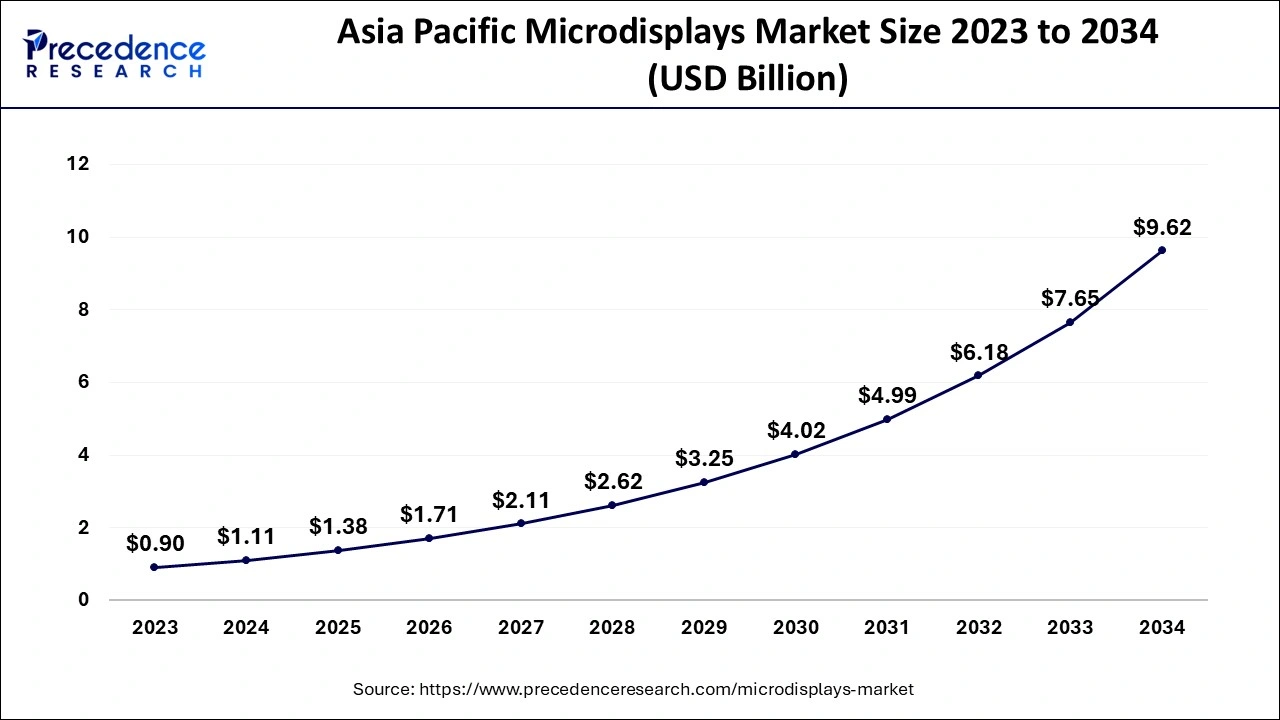
Asia Pacific dominated the global microdisplays market in 2026. The dominance of the region can be attributed to the increasing demand for consumer electronics in developing nations like China and India. Furthermore, in the region, Japan shows remarkable growth owing to the rising utilization of high-resolution display devices and growing demand for innovative consumer electronics like smart glasses and smartphones.
Rising Demand and Innovation Fuel Growth of China's Market
China's market is growing rapidly due to increasing demand for AR/VR devices, smart wearables, and advanced automotive displays. Strong government support for semiconductor and display technologies, along with rising investments in consumer electronics and defense applications, further drives growth. Additionally, the presence of key manufacturers and expanding production capabilities is boosting innovation and reducing costs, strengthening China's position in the global microdisplay market.
Digital Transformations Spark Rapid Growth in Europe's Market
Europe's market is expanding due to the increasing adoption of AR/VR technologies across automotive, healthcare, and industrial sectors. Growing demand for advanced driver-assistance systems (ADAS) and smart glasses is driving innovation. Additionally, strong government support for digital transformation, investments in microelectronics, and collaborations between research institutions and tech companies are fostering technological advancements, boosting the region's competitiveness in the global microdisplays market.
Rising Investments Accelerate the Growth of the UK
The UK market is increasing due to the rising adoption of AR/VR technologies in defense, healthcare, and education sectors. Growing demand for high-resolution displays in smart glasses, simulation systems, and wearable devices is driving innovation. Additionally, strong government support for digital technologies, expanding R&D investments, and collaborations between tech firms and research institutions are boosting the country's role in advancing microdisplay applications and manufacturing capabilities.
Automotive Electronics and Immersive Technologies Drive Microdisplays Growth in North America
North America is expected to grow at the fastest rate in the microdisplays market over the studied period. The growth of the segment can be credited to the strong presence of major market players that utilize microdisplays in their product designs. Moreover, the growing adoption of AR/VR technologies in countries like the U.S. further boosts the market expansion in the region. Microdisplays are also widely utilized in the electronics and automotive industry due to their exceptional picture quality and high resolution.
Technological Advancements Drive the Growth of the Market
The U.S. market is growing due to the rising adoption of AR/VR technologies in defense, healthcare, and entertainment sectors. Increased demand for high-resolution, compact displays in head-mounted and wearable devices is driving innovation. Strong R&D investments, advanced manufacturing capabilities, and government support for defense and aerospace applications further contribute to market expansion, positioning the U.S. as a key leader in microdisplay technology development.
Value Chain Analysis
- Product Conceptualization and Design The design and conceptualization of microdisplays require a specialized process combining product design and advanced small-scale display technology.
The final design often integrates optics, a drive chip, and a backplane into a compact system-on-module.
The development approach varies based on the selected microdisplay technology, intended application, and specific market requirements.
Key Players- Sony Corporation, eMargin Corporation, Kopin Corporation, Himax Technologies - Raw Material Procurement Procuring raw materials for microdisplays requires a specialized global supply chain tailored to the specific technology, such as OLEDoS or micro-LED.
The process is complex, facing challenges related to high costs, maintaining quality standards, and managing supply chain instability.
Key Players- Seiko Epson Corporation, BOE Technology Group
Key Players in Microdisplays Market and Their Offerings
- LG Display: Offers OLED and micro-LED microdisplays for AR/VR devices, smart glasses, and automotive applications.
- eMagin Corporation: Specializes in OLED microdisplays for defense, medical imaging, and industrial use.
- Sony Corporation: Provides high-resolution OLED microdisplays for cameras, EVFs, and AR/VR headsets.
- Kopin Corporation: Develops LCD and OLED microdisplays for AR/VR, military optics, and wearable devices.
- AUO Corporation: Produces micro-LED and TFT-LCD microdisplays for smart wearables, automotive, and industrial applications.
Recent Developments
- On 10 January 2025, VueReal announced the introduction of its advanced ColourFusion Microdisplay, setting a new benchmark in visual sharpness and color accuracy for AR applications. This development caters to both consumer electronics and automotive sectors, enhancing user experience in smart glasses and HUDs.
- On 21 February 2025, Sony Semiconductor Solutions Corporation released the ECX344A, a 1.3-inch OLED Microdisplay with 4K resolution, designed for VR and AR applications. This product leverages Sony's expertise in miniaturization and pixel drive circuits to deliver high-definition visuals in compact form factors.
- On 25 March 2025, Raontech entered a strategic partnership with a European automotive supplier to develop next-generation automotive displays utilizing its LCD-on-Silicon (LCoS) Microdisplay technology. This collaboration aims to advance Microdisplay applications in automotive HUDs, enhancing driver safety and information accessibility.
Segments Covered in the Report
By Product
- Near-To-Eye
- Projection
- Others
By Technology
- Liquid Crystal Display (LCD)
- Organic Light-Emitting Diode (OLED)
- Digital Light Processing (DLP)
- Liquid Crystal On Silicon (Lcos)
By Application
- Consumer Electronics
- Military and Defense
- Medical Applications
- Industrial Systems
- Automotive
- Others
By Region
- North America
- Asia Pacific
- Europe
- Latin America
- Middle East and Africa
For inquiries regarding discounts, bulk purchases, or customization requests, please contact us at sales@precedenceresearch.com
Frequently Asked Questions
Tags





Ask For Sample
No cookie-cutter, only authentic analysis – take the 1st step to become a Precedence Research client
 Get a Sample




 sales@precedenceresearch.com
 Schedule a Meeting
