



Microencapsulated Omega 3 Powder Market Size, Companies, Share, Patient Volume, Treatment Adoption Rates, Pricing Analysis, Regulatory Landscape, Competitive Positioning, and Demand Forecast
Microencapsulated Omega 3 Powder Market (By Nature: Organic, Conventional; By Distribution Channel: Direct, Indirect, Store-based, Supermarket/Hypermarket, Convenience Stores, Discount Stores, Food and Drink Health Stores, Online; By Type: Alpha-linolenic Acid (ALA), Eicosapentaenoic Acid (EPA), Docosahexaenoic Acid (DHA)) - Global Industry Analysis, Size, Trends, Leading Companies, Regional Outlook, and Forecast 2026 to 2035
Source: https://www.precedenceresearch.com/microencapsulated-omega-3-powder-market
 Get a Sample
 Table Of Content


What is Microencapsulated Omega 3 Powder Market Size in 2026?
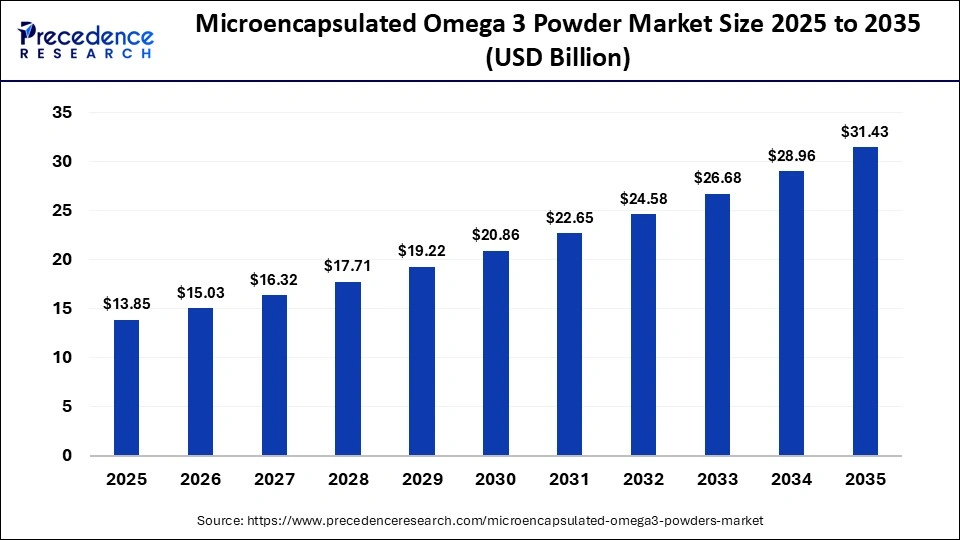
The global microencapsulated omega 3 powder market size was calculated at USD 13.85 billion in 2025 and is predicted to increase from USD 15.03 billion in 2026 to approximately USD 31.43 billion by 2035, expanding at a CAGR of 8.54% from 2026 to 2035. The market is expanding steadily, driven by rising demand for fortified functional foods, dietary supplements, infant nutrition, and clinical formulations. Microencapsulation enhances stability, masks odor and taste, and improves shelf life, supporting wider application across food and beverage categories. Growing health awareness, clean-label preferences, and advancements in encapsulation technologies further support global market growth.
Key Takeaways
- North America led the microencapsulated omega 3 powder market in 2025.
- Asia-Pacific is expected to expand at the highest CAGR in the market between 2026 and 2035.
- By nature, the organic segment held a dominant market share in 2025.
- By nature, the conventional segment is expected to grow at the highest CAGR between 2026 and 2035.
- By distribution channel, the direct segment led the market in 2025.
- By distribution channel, the online segment is expected to expand at a notable CAGR from 2026 to 2035.
- By type, the alpha-linolenic acid (ALA) segment held the largest market share in 2025.
- By type, the docosahexaenoic acid (DHA) segment is expected to grow at a solid CAGR between 2026 and 2035.
Why is the Microencapsulated Omega 3 Powder Market Gaining Strategic Importance?
The market is growing rapidly as consumers and industries seek stable, odor-free, and easily incorporated sources of essential fatty acids for supplements, functional foods, infant nutrition, and clinical products. Microencapsulation enhances oxidative stability, masks taste, improves bioavailability, and extends shelf life, enabling omega-3 integration across beverages, nutrition mixes, and fortified foods.
The market is gaining strategic importance due to the rising health awareness, especially for cardiovascular and brain health, coupled with advancements in encapsulation technologies and clean-label formulations. Innovation in delivery systems and expanding applications also make this market strategically important for nutraceutical, food, and pharmaceutical sectors, supporting product differentiation and long-term consumer demand.
How Can AI Integration Transform the Microencapsulated Omega 3 Powder Market?
Artificial Intelligence integration can significantly transform the microencapsulated omega-3 powder industry by enhancing formulation precision, production efficiency, and market responsiveness. Advanced algorithms can optimize encapsulation parameters, such as temperature, drying rate, and wall material selection, to improve oxidative stability, bioavailability, and shelf life. Predictive analytics supports better raw material sourcing by forecasting fish oil and algae oil availability, reducing supply risks.
AI-driven quality control systems can monitor particle size, moisture levels, and product consistency in real time, minimizing waste and downtime. Additionally, consumer data analysis enables the development of targeted, condition-specific omega-3 formulations, accelerating innovation and strengthening competitive positioning in functional nutrition markets.
Primary Trends Influencing the Microencapsulated Omega 3 Powder Market
- Functional Food & Beverage Fortification
Manufacturers are increasingly incorporating microencapsulated omega-3 powders into dairy products, bakery items, beverages, and nutrition bars. The encapsulation process prevents oxidation and eliminates fishy taste, enabling seamless fortification while maintaining product stability, sensory quality, and extended shelf life across diverse food applications. - Advancements in Encapsulation Technologies
Continuous innovation in spray drying, coacervation, and lipid-based delivery systems is improving oxidative stability, controlled release, and bioavailability of omega-3 fatty acids. These technological improvements enhance formulation flexibility, allowing companies to develop high-performance powders suitable for supplements, clinical nutrition, and pharmaceutical applications. - Rising Demand for Plant-Based & Sustainable Sources
Growing consumer preference for vegetarian and sustainable nutrition has accelerated the adoption of algae-derived omega-3 powders. Plant-based sourcing reduces dependency on marine fisheries, supports environmental sustainability goals, and aligns with clean-label positioning, strengthening product appeal in premium health and wellness segments. - Expansion in Emerging Economies
Increasing health awareness, rising disposable incomes, and expanding nutraceutical distribution networks in Asia-Pacific and Latin America are driving demand. Manufacturers are targeting these regions through localized production, strategic partnerships, and cost-effective formulations to capture growing opportunities in infant nutrition and dietary supplements.
Market Scope
| Report Coverage | Details |
| Market Size in 2025 | USD 13.85 Billion |
| Market Size in 2026 | USD 15.03 Billion |
| Market Size by 2035 | USD 31.43 Billion |
| Market Growth Rate from 2026 to 2035 | CAGR of 8.54% |
| Dominating Region | North America |
| Fastest Growing Region | Asia Pacific |
| Base Year | 2025 |
| Forecast Period | 2026 to 2035 |
| Segments Covered | Interface Type, Security Feature , Type, Application, End-user and Region |
| Regions Covered | North America, Europe, Asia-Pacific, Latin America, and Middle East & Africa |
Segmental Insights
Nature Insights
Why Was the Organic Segment Dominant in the Microencapsulated Omega 3 Powders Market?
The organic segment held the largest revenue share of the market in 2025, due to consumer demand for clean-label, non-GMO, and sustainably sourced ingredients that align with health and environmental values. Organic omega-3 sources, especially algae-derived options, reduce concerns about contaminants and promote perceived purity.
Strong retailer and regulatory emphasis on transparency and certification further boost trust and preference. Additionally, organic positioning supports premium pricing and differentiation, while aligning with broader shifts toward plant-based nutrition, preventive health, and environmental sustainability in functional food and supplement markets.
The conventional segment is expected to be the fastest-growing segment in the coming years because it leverages established, cost-effective marine oil sources that are widely available and easier to process at scale. Conventional omega-3 oils from fish provide high EPA/DHA concentrations that meet broad nutritional needs, making them attractive for mass-market supplements and fortified foods. Established supply chains, technological familiarity, and lower production costs compared to specialty organic or plant-based options help drive rapid adoption.
Distribution Channel Insights
What Made Direct the Dominant Segment in the Microencapsulated Omega 3 Powder Market?
The direct segment contributed the biggest market share in 2025 because manufacturers preferentially supply encapsulated powders directly to formulators, food processors, and supplement producers, bypassing intermediaries. This direct link ensures consistent quality control, closer collaboration on customized specifications, and faster integration into high-value applications like functional foods, nutraceuticals, and clinical nutrition products.
Direct engagement also reduces distribution layers and cost markups, enabling stronger long-term partnerships, streamlined logistics, and better alignment with regulatory and formulation requirements, propelling the segment's growth.
The online segment is expected to grow with the highest CAGR in the market during the studied years, due to increased digital adoption, convenience, and broader product access. Consumers are using e-commerce platforms to research formulations, compare purity levels, and read reviews before purchasing. Online channels enable brands to offer direct-to-consumer shipping, personalized bundles, and subscription models that improve repeat sales.
Lower distribution costs allow competitive pricing and niche product launches, while targeted digital marketing (social media and health influencers) raises awareness of omega-3 benefits. These factors together drive the rapid expansion of the online segment compared to traditional retail.
Type Insights
Which Type Segment Led the Microencapsulated Omega 3 Powder Market?
The alpha-linolenic acid (ALA) segment led the market in 2025 primarily because ALA is widely available from plant sources (e.g., flaxseed, chia, perilla), making it easier and more cost-effective to source at scale. ALA's vegetarian/vegan appeal aligns with growing plant-based nutrition trends and broader consumer health preferences.
Additionally, regulatory frameworks in many regions more readily allow general health claims for ALA compared to EPA/DHA, and its oxidative stability is higher, simplifying encapsulation and formulation. These factors collectively support broader adoption and formulation into functional foods and supplements.
The docosahexaenoic acid (DHA) segment is expected to expand rapidly in the market in the coming years because DHA has strong clinical support for brain, eye, and maternal health, driving demand in infant nutrition, cognitive care, and prenatal products. Its targeted health benefits motivate formulators to incorporate encapsulated DHA into high-value functional foods and supplements.
Additionally, advancements in algae-based DHA sourcing and encapsulation technologies improve stability and palatability, expanding applications. Growing consumer awareness of DHA's unique physiological roles further accelerates adoption compared with other omega-3 types.
Regional Insights
Why North America Dominated the Microencapsulated Omega 3 Powder Market?
North America held a major revenue share of the market in 2025, due to strong consumer awareness of cardiovascular and cognitive health, driving consistent demand for fortified foods and dietary supplements. The region benefits from a well-established functional food industry, advanced encapsulation technologies, and clear regulatory frameworks that support product claims. High healthcare spending, innovation capacity, and widespread e-commerce penetration further strengthen regional leadership and sustained product adoption.
U.S. Market Trends
In the U.S., the market is driven by rising demand for fortified functional foods, dietary supplements, and infant nutrition products. Strong consumer awareness of heart, brain, and prenatal health supports consistent product adoption. Manufacturers are investing in advanced encapsulation technologies to enhance stability and bioavailability. Growing interest in algae-based, plant-derived DHA and expanding e-commerce distribution channels further accelerate market penetration and product innovation nationwide.
Why is Asia-Pacific Experiencing the Fastest Growth in the Microencapsulated Omega 3 Powder Market?
Asia-Pacific is expected to host the fastest growing market in the coming years, due to increasing health awareness and rising disposable incomes that boost the demand for functional food and supplements. Rapid urbanization and expanding middle class populations are leading to greater consumption of fortified nutrition products. Growing manufacturing capacity, improvements in cold chain logistics, and expanding modern retail and e commerce channels make omega 3 powders more accessible. Additionally, greater focus on preventive health care and government initiatives encouraging nutritional improvement support accelerated regional market growth.
China Market Trends
In China, the market is driven by strong demand for infant formula and prenatal nutrition, where DHA-enriched powders are increasingly integrated to meet regulatory health standards. Leading domestic manufacturers like Zhejiang NHU Co., Ltd. and Shandong Haisheng Nutrition Co., Ltd. are adopting advanced spray drying and coacervation encapsulation technologies to enhance stability and mask fishy taste. Rapid urbanization, rising disposable income, and the expansion of modern retail and e commerce channels are facilitating direct consumer access, making China one of the fastest-growing markets globally.
Will Europe Grow in the Microencapsulated Omega 3 Powder Market?
Europe is expected to grow at a notable CAGR in the foreseeable future, supported by strong demand from the region's functional dairy, infant nutrition, and dietary supplement sectors. Countries such as Germany, the UK, and France are driving uptake due to increasing preference for clean-label, plant-based, and sustainably sourced omega-3 ingredients. Advanced food processing capabilities and strict EFSA compliance standards further encourage the adoption of high-stability, odor-masked encapsulated formulations across mainstream food and beverage applications.
Microencapsulated Omega 3 Powders Market Value Chain Analysis
- Research & Development
Formulation scientists first analyze EPA/DHA profiles and oxidative stability of marine or algal oils, then design encapsulation matrices using spray drying or coacervation with pilot-scale validation of particle size and release performance.
Key Players: BASF SE, Koninklijke DSM N.V., Croda International Plc, and Glanbia Nutritionals. - Clinical Research & Approval
Companies conduct controlled human studies measuring omega-3 index improvements and bioavailability of encapsulated powders, followed by regulatory dossier submission for health claim substantiation and safety clearance.
Key Players: ADM, BASF, IQVIA, U.S. Food and Drug Administration, and European Food Safety Authority. - Patient Support & Services
Manufacturers implement dosage guidance programs and digital adherence tools to monitor intake consistency and track lipid biomarker outcomes in target populations.
Key Players: Aker BioMarine and GC Rieber Oils support clinician engagement, pharmacovigilance reporting, and structured consumer education initiatives.
Microencapsulated Omega 3 Powder Market Companies
- Clover Corporation
- Venketesh Biosciences LLP
- Novotech Nutrition
- KD Pharma Group
- BASF SE
- Wincobel
- Skuny Bioscience Co., Ltd.
- Stepan Company
- Glanbia Nutritionals
- Benexia
- DSM Nutritional Products (Koninklijke DSM N.V.)
- Cargill, Incorporated
- Omega Protein Corporation
- Croda International Plc
- NutraScience Labs
- Ginkgo BioWorks Inc.
- FMC Corporation
- Cohere Capital
- BioCare Copenhagen
- Aker BioMarine
- Lonza Group
Recent Developments
- In January 2026, Aker BioMarine announced to present its sustainable marine-based nutrition at the Vitafoods India trade show in February 2026, highlighting its growing presence in the nation as a "new chapter of growth". Aker BioMarine aims to highlight its new distribution agreement with G.C. Chemie Pharmie to increase nationwide access to its DHA ingredients made from algae and krill oil.(Source: https://www.nutritioninsight.com)
- In April 2025, AlgiSys Biosciences developed a proprietary strain of microalgae that is rich in EPA omega-3 and an alternative protein for aquafeeds. The company announced plans to raise $5 million to enable commercial-scale production by opening its Centre for Process Innovation (CPI) in Middlesbrough. (Source: https://thefishsite.com)
- In March 2024, FrieslandCampina Ingredients launched two new DHA ingredients, Biotis DHA FlexP15 and Biotis DHA FlexP20, for adult nutrition. The company's brain health portfolio enables the creation of multifunctional vegan and vegetarian omega-3 products with superior sensory properties.(Source: https://nutraceuticalbusinessreview.com)
Segments Covered in the Report
By Nature
- Organic
- Conventional
By Distribution Channel
- Direct
- Indirect
- Store-based
- Supermarket/Hypermarket
- Convenience Stores
- Discount Stores
- Food and Drink Health Stores
- Online
By Type
- Alpha-linolenic Acid (ALA)
- Eicosapentaenoic Acid (EPA)
- Docosahexaenoic Acid (DHA)
By Region
- North America
- Europe
- Asia-Pacific
- Latin America
- Middle East & Africa
For inquiries regarding discounts, bulk purchases, or customization requests, please contact us at sales@precedenceresearch.com
Frequently Asked Questions





Ask For Sample
No cookie-cutter, only authentic analysis – take the 1st step to become a Precedence Research client
 Get a Sample
.webp)



 sales@precedenceresearch.com
 Schedule a Meeting
