



Microplate Systems Market Size, Key Companies, Company Product Portfolio, Detection Technology Adoption, Laboratory Automation Trends, Application Analysis, Competitive Landscape, and Growth Forecast
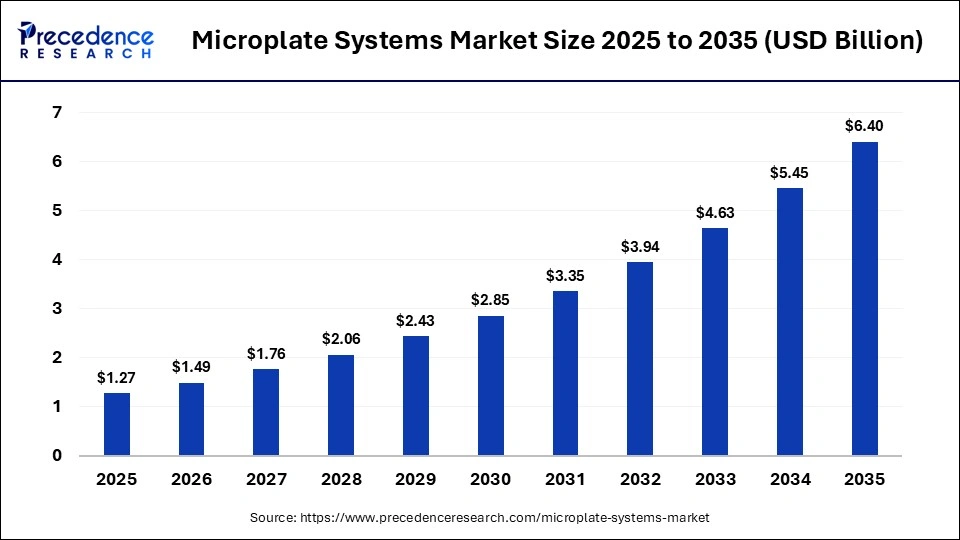
Deepa Pandey, a Healthcare Industry Expert, highlights that the microplate systems market has reached USD 1.49 billion in 2026 and is on track to reach USD 6.40 billion by 2035, advancing at a CAGR of 17.56%. Key microplate systems market companies shaping the market include Danaher Corporation, Tecan Group Ltd, Promega Corporation, while major growth segments span by product type, by detection technology, by end-user, by application.
Source: https://www.precedenceresearch.com/microplate-systems-market
 Get a Sample
 Table Of Content


What is Microplate Systems Market Size?
The global microplate systems market size accounted for USD 1.27 billion in 2025 and is predicted to increase from USD 1.49 billion in 2026 to approximately USD 6.40 billion by 2035, expanding at a CAGR of 17.56% from 2026 to 2035. The global microplate systems market is witnessing robust growth, driven by the rising adoption of microplates in various life science fields, the increasing burden of chronic diseases, and rising R&D investment.
Market Highlights
- North America dominated the global market, holding the largest market share of 40% in 2025.
- The Asia Pacific is expected to grow at the fastest CAGR of 18% between 2026 and 2035.
- By product type, the microplate readers segment held the largest market share of 38% in 2025.
- By product type, the software & data analysis tools segment is growing at a remarkable CAGR of 18.30% between 2026 and 2035.
- By detection technology, the absorbance segment contributed the major market share of 50% in 2025.
- By detection technology, the time-resolved fluorescence (TRF) / TR-FRET segment is expanding at a significant CAGR of 18.20% between 2026 and 2035.
- By end-user, the pharmaceutical & biotechnology companies segment captured the major market share of 40% in 2025.
- By end-user, the contract research organizations (CROs) segment is expected to expand at a remarkable CAGR of 17.50% between 2026 and 2035.
- By application, the drug discovery & development segment accounted for the largest share of 42% in 2025.
- By application, the cell-based assays segment is poised to grow at a solid CAGR of 18.40% between 2026 and 2035.
Market Overview
The global microplate systems market comprises instruments, microplates (assay plates), readers, washers, dispensers, software, and services used in life sciences, pharmaceuticals, biotechnology, clinical diagnostics, and academic research. These systems enable high-throughput screening, quantitative assays, ELISA, cell assays, biomarker analysis, drug discovery, genotyping, and other biological and biochemical assays leveraging standardized microplate formats (such as 96-, 384-, and 1536-well plates).
The market is expanding due to growing demand for high-throughput and automation-ready laboratory workflows. Increasing adoption of microplate-based assays in drug discovery and toxicity screening is driving equipment upgrades. Integration of advanced detection technologies such as fluorescence, luminescence, and absorbance is improving assay sensitivity and reproducibility. Software-enabled data analysis and laboratory information system compatibility are enhancing workflow efficiency. Rising investment in genomics, proteomics, and translational research is further strengthening demand for scalable microplate systems.
How are AI-Driven Innovations Reshaping the Microplate Systems Market?
As technology continues to advance, the integration of Artificial Intelligence (AI) is driving innovation and accelerating the growth of the microplate systems market by streamlining data analysis, enhancing automation, and enabling predictive maintenance. AI algorithms allow for real-time analysis of complex datasets generated by microplate assays, which assists researchers in making data-driven decisions. AI can efficiently handle more complex experimental designs and supports the ongoing demand for multiplexed assays used in personalized medicine.
AI-driven predictive maintenance can forecast instrument failures before they occur by analyzing usage patterns and sensor data, which minimizes downtime, increases instrument lifetime, and lowers operational costs. AI seamless integration reduces manual intervention, lowers human error, and increases experimental throughput for high-volume operations such as clinical diagnostics and drug discovery.
AI is also improving assay quality by identifying anomalous wells, edge effects, and signal drift during runs. Machine learning models are being used to optimize assay conditions, reagent volumes, and incubation times automatically. Integration with robotics is enabling fully autonomous screening workflows in high-throughput laboratories. AI-powered image analysis is enhancing cell-based and phenotypic assay interpretation. Together, these advancements are positioning AI-enabled microplate systems as core infrastructure in next-generation laboratory automation.
Microplate Systems Market Outlook
- Industry Growth Overview: Between 2026 and 2035, the industry is expected to experience accelerated growth. The growth of the market is primarily driven by expanding drug discovery and development pipelines, increasing adoption of high-throughput screening techniques, growing emphasis on personalized medicine, rising research funding, and integration of automated laboratory workflows.
- Global Expansion: Several leading players in the microplate systems market, including Thermo Fisher Scientific, Agilent Technologies, Beckman Coulter, Danaher Corporation, PerkinElmer, HORIBA, and Mindray. These players are actively expanding their global reach through various strategic initiatives such as acquisitions, key partnerships/collaborations, and new product launches. For instance, in March 2025, HORIBA, a global leader in analytical and measurement technologies, announced the launch of the PoliSpectra Rapid Raman Plate Reader (RPR) for Raman High-Throughput Screening (HTS). RPR technology enables efficient monitoring of bioprocesses and drug discovery workflows with rapid, non-destructive analysis of 96 wells within one minute.
- Major Investors: Major investors and key players in the microplate systems industry primarily include large life sciences and diagnostics companies. These major players are investing heavily in research and development (R&D) to develop advanced microplate systems, such as multi-mode readers with improved sensitivity, speed, and automation capabilities.
Market Scope
| Report Coverage | Details |
| Market Size in 2025 | USD 1.27 Billion |
| Market Size in 2026 | USD 1.49 Billion |
| Market Size by 2035 | USD 6.40 Billion |
| Market Growth Rate from 2026 to 2035 | CAGR of 17.56% |
| Dominating Region | North America |
| Fastest Growing Region | Asia Pacific |
| Base Year | 2025 |
| Forecast Period | 2026 to 2035 |
| Segments Covered | Product Type, Detection Technology,End-user, Application, and Region |
| Regions Covered | North America, Europe, Asia-Pacific, Latin America, and Middle East & Africa |
Segments Insights
Product Type Insights
What Causes the Microplate Readers Segment to Dominate the Microplate Systems Market?
The microplate readers segment held the largest market share of 38% in 2025. Microplate readers play a critical role in high-throughput screening (HTS) for rapid drug discovery, improved diagnostics, and personalized medicine. Microplate readers enable continuous screening of thousands of compounds, which accelerates drug discovery and reduces errors in data collection.
On the other hand, the software & data analysis tools segment is expected to grow at a remarkable CAGR of 18.30% between 2026 to 2035. The software and data analysis tools capabilities play a crucial role in extracting valuable insights. Research and drug discovery generate huge datasets, which create a need for powerful software for analysis. Manufacturers are embedding data analysis software directly into instruments to improve user experience and optimize the data handling process. Moreover, the rise in R&D investment in biotechnology and life sciences propels the demand for advanced software & analysis tools.
Detection Technology Insights
Which Segment is Dominated by the Detection Technology in the Microplate Systems Sector?
The absorbance segment dominates the microplate systems sector, holding a 50% share. Absorbance technology holds a significant position in the market, particularly for specific and high-volume applications. Absorbance offers versatility, simplicity, reliability, and cost-effectiveness. They have widespread adoption in clinical diagnostics and academic research, as it is a well-established method that often does not require specialized labels, which helps to lower assay complexity and cost.
On the other hand, the time-resolved fluorescence (TRF) segment is the fastest-growing in the microplate systems industry, with a CAGR of 18.20%. The time-resolved fluorescence (TRF) offers significantly higher sensitivity than absorbance and reduced background interference. Its high speed and accuracy significantly increased its adoption in clinical diagnostics for chronic & infectious diseases and cancer biomarkers. Several pharma companies are increasingly investing in TRF to identify new drug candidates quickly.
End-user Insights
What Causes the Pharmaceutical & Biotechnology Companies Segment to Dominate the Microplate Systems Market?
The pharmaceutical & biotechnology companies segment dominates the microplate systems market, holding a 40% share. Pharmaceutical and biotechnology companies are the major end-users in the market, using these microplate systems extensively for high-throughput screening (HTS), drug discovery, genomic/proteomic research, and personalized medicine. Additionally, pharmaceutical and biotechnology companies are investing heavily in R&D, which increases demand for advanced laboratory equipment like microplate systems.
On the other hand, the contract research organizations (CROs) segment is the fastest-growing in the market, with a CAGR of 17.50%. CROs provide specialized expertise and infrastructure for advanced microplate systems that many pharma & biotechnology companies lack in-house, facilitating cost-effective drug development and regulatory compliance. Contract Research Organizations (CROs) are significant users in the microplate systems market, using advanced microplate systems for drug discovery, high-throughput screening, and clinical trials.
Application Insights
Why is Drug Discovery & Development Dominating the Microplate Systems Industry?
The drug discovery & development segment dominates the microplate systems industry, holding a 42% share. Microplate systems assist researchers in rapidly screening thousands of potential drug compounds for biological activity, crucial for modern drug discovery. Microplate systems with automation and robotic/AI handling systems significantly reduce manual errors, streamline workflows, and increase efficiency in the research process. Pharmaceutical and biotechnology companies, along with Contract Research Organizations (CROs), are increasingly focusing on increasing their R&D investments to discover novel therapeutics.
On the other hand, the cell-based assays segment is expected to show the fastest growth of 18.40% CAGR over the forecast period. The increasing prevalence of chronic diseases such as cancer, diabetes, neurodegenerative diseases, and cardiovascular diseases drives the need for effective therapies, which further creates significant demand for cell-based assays in drug discovery and development. Cell-based assays play a vital role in developing therapies that are mainly tailored to individual patient profiles. The surge in R&D funding and investment by the government and private sector investments, particularly in biotechnology and pharmaceutical research, fuels the development and adoption of cell-based assay technologies. These factors are expected to boost the growth of the cell-based assays segment in the market.
Regional Insights
What is the Size of the North America Microplate Systems Market Size?
The North America microplate systems market size is exhibited at USD 520.70 million in 2025 and is projected to be worth around USD 2,656.00 million by 2035, growing at a CAGR of 17.7% from 2026 to 2035

Why did North America Dominate the Microplate Systems Market in 2025?
North America dominates the microplate systems market, holding a 40% share. The region has an advanced healthcare infrastructure and an increasing prevalence of chronic diseases. The growth of the region is characterized by the strong presence of key market players, a significant rise in R&D expenditure, and expanding applications in genomics and proteomics research. Rapid adoption of advanced technologies, including innovations in microplate reader design such as enhanced optics, automation features, and multi-mode detection capabilities, is further supporting market leadership. Moreover, strong government support and increasing investments in life sciences research, particularly for complex diseases and personalized medicine, are fueling demand for microplate systems.
This dominance is reinforced by the high concentration of pharmaceutical and biotechnology companies conducting large-scale screening and assay development. Academic and clinical research institutions are heavily reliant on microplate platforms for translational research and biomarker validation. Strong funding support from agencies such as the National Institutes of Health is accelerating assay throughput requirements. Early adoption of laboratory automation and AI-enabled data analysis is improving productivity in high-volume labs. Together, these factors are sustaining North America's leadership in both installed base and technology advancement.
What is the Size of the U.S. Microplate Systems Market?
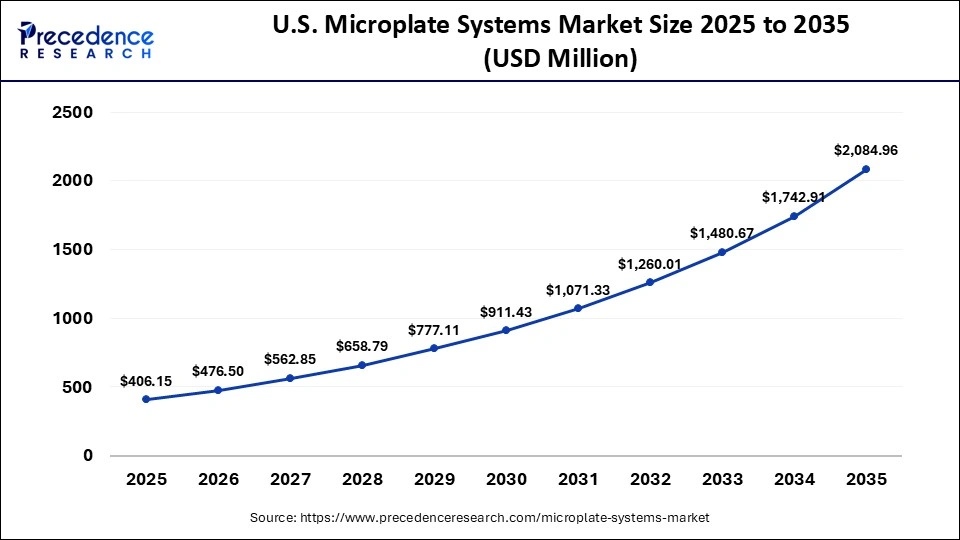
The U.S. microplate systems market size is calculated at USD 406.15 million in 2025 and is expected to reach nearly USD 2,084.96 million in 2035, accelerating at a strong CAGR of 17.77% between 2026 and 2035.
United States Microplate Systems Market Trends
The United States leads the microplate systems market as a major contributor to global demand. The country is home to leading market players such as Danaher Corporation, Agilent Technologies, Thermo Fisher Scientific, PerkinElmer, Bio-Rad Laboratories, BMG LABTECH, Promega Corporation, and Lonza Group. Growth is driven by a well-established healthcare and research infrastructure, high biotechnology and pharmaceutical R&D spending, rapid laboratory digitalization, and strong government support for cell-based and molecular research.
Large-scale drug discovery programs rely heavily on microplate platforms for high-throughput screening and assay miniaturization. Federal research funding, including sustained support from the National Institutes of Health, is increasing assay volumes and automation requirements. Clinical laboratories are expanding microplate-based diagnostics for immunoassays and biomarker testing. Integration of microplate systems with robotic liquid handlers is improving laboratory throughput and reproducibility. Together, these factors are reinforcing the United States' leadership in both innovation and the installed base of microplate systems.
Why is Asia Pacific Set to Be the Fastest-Growing Region in the Microplate Systems Market?
Asia Pacific is set to be the fastest-growing region in the microplate systems market, with a CAGR of 18%. The region's growth is driven by the increasing presence of pharmaceutical and biotechnology companies, rising government-backed funding, and the growing burden of chronic diseases such as cancer, cardiovascular diseases, and rare diseases. Several companies are focusing on launching advanced microplate systems with higher sensitivity and faster read times to meet diverse needs in drug discovery, clinical diagnostics, and genomics research. The region is also seeing rising adoption of automated laboratory solutions that integrate robotics with analytical instrumentation and AI-enhanced data analysis to improve efficiency and throughput.

This momentum is reinforced by large-scale expansion of contract research organizations supporting global drug development programs. Public research institutes are increasing use of microplate platforms for population-scale screening and translational studies. Investments in new laboratory infrastructure are accelerating the replacement of legacy readers with multi-mode systems. Together, these factors are translating automation and disease research demand into sustained microplate system adoption across Asia Pacific.
In June 2025, Mitsui Chemicals, Inc. announced that it is beginning sales for InnoCell cell culture microplates, which offer excellent oxygen permeability. The novel microplates were created by synergizing Mitsui Chemicals' unique materials with the company's precision cutting technologies.
India Microplate Systems Market Trends
India's microplate systems market is experiencing growth. The country's growth is supported by the developing healthcare infrastructure, increasing adoption of advanced technology like AI integration and automation, rising R&D investment, increasing emphasis on data-driven decision-making, increasing cases of infectious & chronic diseases, and increasing partnerships between governments, research institutions, and tech providers. Additionally, the investments in life sciences research and the growing demand for automation and miniaturization are pushing its adoption of microplate systems in the country. Such a combination of factors is expected to drive the growth of the market in the coming years.
Why is Europe Seeing Notable Growth in the Microplate Systems Industry?
The Europe market is experiencing notable growth driven by a strong healthcare system, heavy R&D investment by pharmaceutical and biotechnology companies, a rising burden of chronic diseases, and increasing high-throughput screening demand for drug discovery and diagnostics. The region is rapidly embracing advanced technologies such as AI and machine learning for predictive analytics, automated insights, and personalized care. Moreover, supportive government initiatives for scientific research and an expanding base of diagnostic and medical laboratories are anticipated to propel regional growth during the forecast period.
This growth is further supported by stringent regulatory standards that favor validated, reproducible assay platforms in clinical and research settings. Academic–industry collaborations are expanding the use of microplate-based assays in translational research and biomarker validation. Increasing adoption of multi-mode readers is enabling laboratories to consolidate workflows across fluorescence, luminescence, and absorbance assays. Investments in laboratory automation are reducing manual handling and improving throughput consistency. Together, these factors are strengthening Europe's position as a stable and innovation-driven market for microplate systems.
Germany Microplate Systems Market Trends
Germany is experiencing significant growth, largely driven by the increasing focus on personalized medicine, surging demand for diagnostic tools, rising burden of chronic diseases, increased R&D spending, expanding integration of AI and automated laboratory solutions, and a growing base of domestic biotech startups. Several pharmaceutical and biotechnology companies in Germany are actively expanding their product portfolios and distribution networks to meet demand for efficient, high-throughput screening and advanced diagnostic platforms. These factors collectively are anticipated to boost the market's growth during the forecast period.
This momentum is reinforced by strong collaboration between academic research institutes and industry for translational research. National funding programs are supporting modernization of laboratory infrastructure and automation upgrades. Increased use of microplate-based assays in genomics, proteomics, and biomarker discovery is raising system utilization rates. Together, these developments are strengthening Germany's role as a core growth engine within the European microplate systems market.
Why is the Middle East & Africa Microplate Systems Sector Showing Promise?
The microplate systems market is showing strong growth potential in the Middle East and Africa, driven by sustained investment in healthcare infrastructure and expanding pharmaceutical and biopharmaceutical R&D activities focused on drug discovery, genomics, and proteomics. Rising incidence of chronic and infectious diseases, along with a growing aging population, is increasing demand for laboratory diagnostics and high-throughput analytical tools.
Countries such as the United Arab Emirates and Saudi Arabia are upgrading hospital laboratories and research centers as part of broader healthcare modernization programs. Regional laboratories are increasingly adopting automated microplate readers to support immunoassays, molecular diagnostics, and biomarker testing. Multinational suppliers are strengthening local distribution and service networks to improve instrument uptime and technical support. Together, these developments are positioning the Middle East and Africa as an emerging but structurally strengthening market for microplate systems.
South African Microplate Systems Market Trends
The country is experiencing notable growth, supported by South Africa's focus on modernizing healthcare infrastructure and improving treatment quality. Market expansion is attributed to the rising burden of chronic and rare diseases, increasing diagnostic requirements, growing demand for high-throughput screening, and rapid technological innovation. In addition, rising government funding, policy support for scientific research, and sustained investment in biotechnology and life sciences are driving demand for advanced analytical tools. These factors are fueling steady growth of the microplate systems market in South Africa.
This growth is further supported by expansion of reference laboratories serving both public and private healthcare sectors. Academic research institutions are increasing use of microplate-based assays for translational and infectious disease research. Adoption of automated readers is improving throughput in centralized diagnostic laboratories. Strengthening ties with global suppliers is enhancing access to multi-mode and automation-ready microplate platforms.
Top Companies and Their Offerings
- Danaher Corporation: Danaher Corporation provides a comprehensive portfolio including automated washers, SpectraMax multi-mode readers, high-throughput screening systems, and even specialized software for ELISA, cell-based assays, and molecular diagnostics.
- PerkinElmer Inc.: PerkinElmer Inc.'s offerings aim to accelerate drug discovery and diagnostics via extensive cell line portfolios, optimized reagents, and automated liquid handling.
- Bio-Rad Laboratories Inc.: Bio-Rad Laboratories Inc. provides a comprehensive portfolio for the microplate systems market, thus specializing in instrumentation, software, and reagents programmed for research, food safety, and even clinical diagnostics, which includes high-throughput ELISA applications.
- Tecan Group Ltd.: Tecan Group Ltd. focuses on automation, detection, and liquid handling for drug discovery, life sciences, and diagnostics. Their offerings involve multimode microplate readers, automation handling systems, washers, software, and consumables, designed to improve high-throughput and routine laboratory workflows.
- Promega Corporation: Promega Corporation mainly focuses on high-sensitivity luminescence and fluorescence detection instruments, automated liquid handling, and integrated assay chemistries programmed for drug discovery and life science research.
- Corning Incorporated: Corning Incorporated provides a comprehensive portfolio of high-performance microplates and accessories programmed for life sciences research, drug discovery, and diagnostics. Their offerings aim to enhance assay performance via surface treatments, specialized materials, and automation compatibility.
- Beckman Coulter: Beckman Coulter provides a robust portfolio for the microplate systems industry, focusing on automated solutions for microbiology, blood banking, and lab automation.
Who are the major Players in the Microplate Systems Market?
The major players in the microplate systems market include Agilent Technologies Inc., Danaher Corporation, PerkinElmer Inc., Bio-Rad Laboratories Inc., Tecan Group Ltd., BMG LABTECH GmbH, Promega Corporation, Corning Incorporated, Lonza Group AG Biochrom, Beckman Coulter, Berthold Technologies, Thermo Fisher Scientific, and Mindray
Recent Developments
- In September 2025, Cerillo, a pioneer in compact microplate reader technology, is proud to announce the launch of Rayo, its newest multiwavelength platform for ELISA assays, protein quantification, and kinetic growth curves for plant, algae, and microbial cells. Rayo will make its debut at Analytica USA, September 10–12, in Columbus, Ohio. Cerillo will exhibit at Booth 952, showcasing Rayo as the future of compact, automation-compatible microplate readers for high-performance assays. (Source: https://www.prnewswire.com)
- In June 2025, Emulate, Inc., the world leader in Organ-on-a-Chip technology, launched AVA Emulation System, a self-contained instrument that cultures, incubates, and images up to 96 independent Organ-Chip samples in a single run. These transformative capabilities give the pharmaceutical industry the practical means to pivot beyond animal testing and into truly human-relevant territory. (Source: https://www.businesswire.com)
Segments Covered in the Report
By Product Type
- Microplate Readers
- Microplate Washers
- Microplate Dispensers
- Microplates/Assay Plates
- Microplate Accessories (seals, lids, adapters)
- Software & Data Analysis Tools
- Services (Installation, Maintenance, Calibration)
By Detection Technology
- Absorbance
- Fluorescence
- Luminescence
- Time-Resolved Fluorescence (TRF) / TR-FRET
- Alpha Technology
- Other Detection Modalities (e.g., BRET, chemiluminescence)
By End-User
- Pharmaceutical & Biotechnology Companies
- Academic & Research Institutions
- Clinical & Diagnostic Laboratories
- Contract Research Organizations (CROs)
- Government & Public Research Centers
- Industrial & Environmental Labs
By Application
- Drug Discovery & Development
- Genomics & Proteomics
- Biomarker Analysis
- ELISA & Immunoassays
- Cell-Based Assays
- Environmental Monitoring
- Others (food safety, industrial QC)
By Region
- North America
- Europe
- Asia-Pacific
- Latin America
- Middle East & Africa
For inquiries regarding discounts, bulk purchases, or customization requests, please contact us at sales@precedenceresearch.com
Frequently Asked Questions
Tags





Ask For Sample
No cookie-cutter, only authentic analysis – take the 1st step to become a Precedence Research client
 Get a Sample
.webp)



 sales@precedenceresearch.com
 Schedule a Meeting
