



Model Evaluation and Benchmarking Tools Market Trends, Companies, Revenue / Sales Performance, Subscriber Growth, Pricing Strategies, Cloud Adoption, Infrastructure Expansion, Competitive Landscape, and Industry Outlook
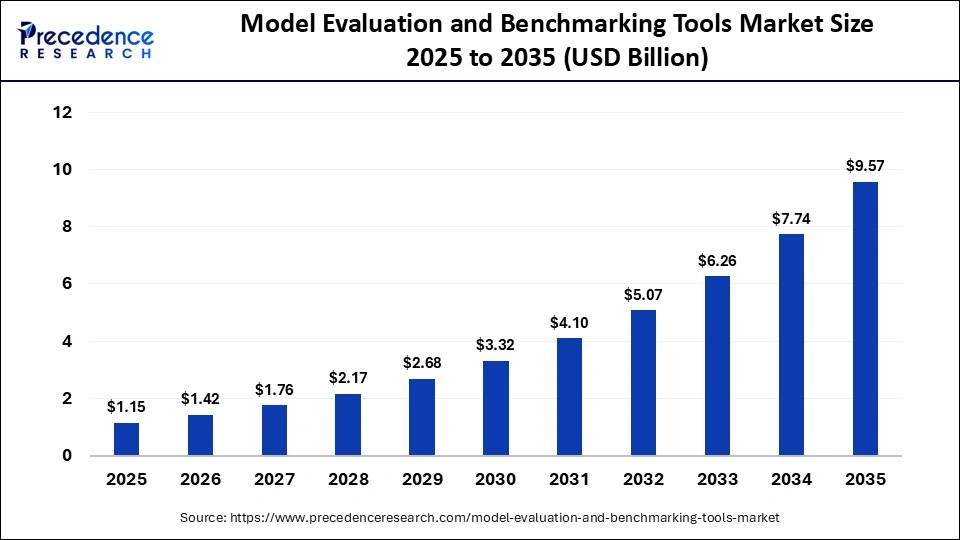
ICT industry specialist Shivani Zoting estimates the model evaluation and benchmarking tools market at USD 1.15 billion in 2026, with continued technology adoption expected to take the market to USD 9.57 billion by 2035 at a CAGR of 9.57%. Leading model evaluation and benchmarking tools market providers such as Amazon Web Services, Inc. (AWS), ClearML Ltd., Databricks, Inc., DataRobot, Inc., Domino Data Lab, Inc. are expanding their capabilities across segments including By Tool Type, By Deployment Mode, By Model Type, By Application, By End-Use Industry.
Source: https://www.precedenceresearch.com/model-evaluation-and-benchmarking-tools-market
 Get a Sample
 Table Of Content


What is the Model Evaluation and Benchmarking Tools Market Size in 2026?
The global model evaluation and benchmarking tools market size accounted for USD 1.15 billion in 2025 and is predicted to increase from USD 1.15 billion in 2026 to approximately USD 9.57 billion by 2035, expanding at a CAGR of 9.57% from 2026 to 2035. The market growth is attributed to the rapid expansion of enterprise AI deployments requiring continuous validation and standardized benchmarking across complex ecosystems.
Key Takeaways
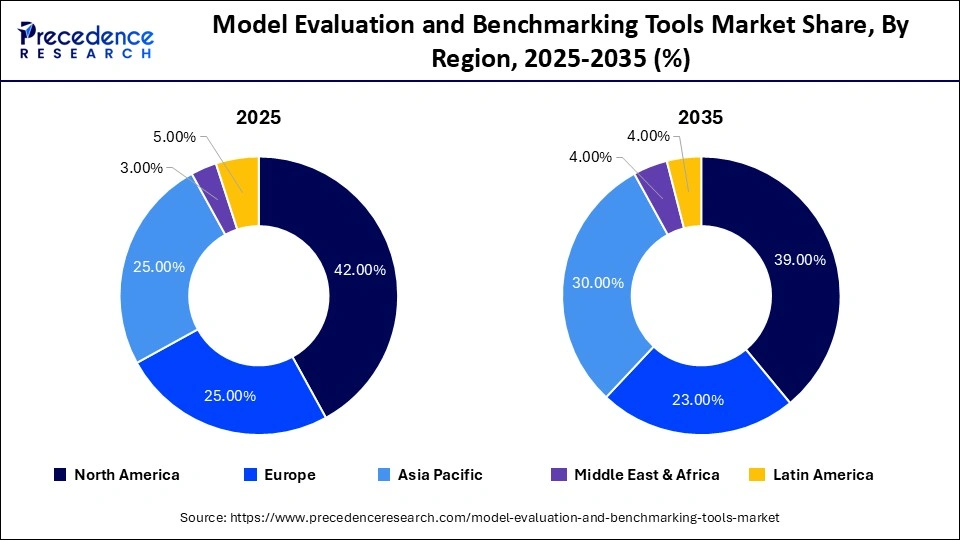
- North America dominated the market with a 42% share of the market in 2025.
- Asia Pacific is expected to grow at the fastest CAGR of 27.5% in the market between 2026 and 2035.
- By tool type, the model validation & testing platforms segment held a market share of 28% in 2025.
- By tool type, the performance monitoring & drift detection tools segment held the second-largest market share of 22% in 2025 and is expected to grow at a significant CAGR of 23% between 2026 and 2035.
- By deployment mode, the cloud-based evaluation platforms segment held a major market share of 65% in 2025.
- By deployment mode, the on-premises model testing tools segment held the second-largest market share of 20% in 2025 and is expected to grow at a significant CAGR of 14.5% between 2026 and 2035.
- By model type, the large language models (LLMs) segment contributed the highest market share of 35% in 2025.
- By model type, the speech & multimodal models segment contributed a 20% market share in 2025 and is estimated to grow at a strong CAGR of 25% over the projected period.
- By application, the AI model validation & QA segment held a market share of 24% in 2025.
- By application, the regulatory compliance & AI governance segment held a 20% share of the market in 2025 and is expected to grow at the fastest CAGR of 26.5% between 2026 and 2035.
- By end-use industry, the IT & telecommunications segment held a 30% share of the market in 2025.
- By end-use industry, the automotive & mobility segment is expected to grow at the fastest CAGR of 25.5% between 2026 and 2035.
Market Overview
The growing adoption of enterprise AI is a major driver accelerating the growth of the model evaluation and benchmarking tools market. These tools are systematic approaches to test AI models against standardized metrics to assess model accuracy, robustness, bias, and performance in the real world. These tools have become a part of MLOps pipelines, allowing automated testing and real-time monitoring between deployment environments. Moreover, international standardization bodies, universities, and industry players are increasingly collaborating to accelerate the development of standardized benchmarking frameworks.
Impact of Artificial Intelligence on the Model Evaluation and Benchmarking Tools Market
Artificial intelligence is significantly transforming the model evaluation and benchmarking tools market by increasing the need for advanced and intelligent validation systems. Companies are implementing complex AI models, including large language and multimodal systems. This demands more thorough analysis in terms of accuracy, bias, reasoning, and real-world adaptability. Additionally, AI is improving the standardization of evaluation processes by enabling more consistent and data-driven comparison across models, industries, and use cases. It is also accelerating the development of automated benchmarking pipelines that reduce manual effort and improve efficiency in model validation.
Major Market Trends
- Shift from Static Benchmarks to Dynamic Real-World Testing: Conventional norms are increasingly ineffective, with the top models scoring above normal standard examinations with little discrimination. Business organizations are increasingly embracing the dynamic and scenario-based assessment environments that estimate real-world situations and are placing strong pressure on adaptive benchmarking platforms.
- Growing Need for AI Transparency and Explainability: Expanding use of AI in critical sectors is fueling the adoption of tools that measure interpretability and accountability metrics.
- Increasing Adoption of MLOps and AI Lifecycle Management: Organizations are increasingly integrating evaluation tools within pipelines, propelling the need for automated benchmarking systems.
Market Scope
| Report Coverage | Details |
| Market Size in 2025 | USD 1.15 Billion |
| Market Size in 2026 | USD 1.42 Billion |
| Market Size by 2035 | USD 9.57 Billion |
| Market Growth Rate from 2026 to 2035 | CAGR of 23.60% |
| Dominating Region | North America |
| Fastest Growing Region | Asia Pacific |
| Base Year | 2025 |
| Forecast Period | 2026 to 2035 |
| Segments Covered | Tool Type, Deployment Mode, Model Type, Application, End-Use Industry, and Region |
| Regions Covered | North America, Europe, Asia-Pacific, Latin America, and Middle East & Africa |
Market Dynamics
Drivers
Increasing Complexity of AI Models and Architectures
The increasing complexity of AI models and architectures is expected to accelerate the demand for advanced evaluation and benchmarking solutions. This trend toward very complex AI ecosystems is reinforcing the importance of scalable and adaptive benchmarking environments. Additionally, the need to increase AI transparency and explainability is likely to enhance the use of evaluation instruments that emphasize interpretability and accountability.
Restraint
High Implementation and Operational Costs
High initial implementation and operational expenses of these tools are likely to hamper the growth of the market. Enterprise-grade evaluation platforms have licensing fees that add to the cost burdens. Such cost implications make it less accessible and less resistant to its ubiquity in cost-sensitive markets. Furthermore, the integration complexity across AI pipelines is estimated to challenge the seamless deployment of evaluation tools within existing enterprise infrastructures.
Opportunity
Increasing Adoption of MLOps and AI Lifecycle Management Solutions
Increasing adoption of MLOps and AI lifecycle management is estimated to create immense opportunities for the evaluation tools across development pipelines. Evaluation tools are now synchronized with version control systems to trace the behavioral change of a model with each iteration. Additionally, the expansion of generative AI applications across industries is projected to drive demand for continuous evaluation and benchmarking frameworks.
Segment Insights
Tool Type Insights
Model Evaluation and Benchmarking Tools Market Share, By Tool Type, 2025-2035 (%)
| Tool Type | 2025 | 2035 | CAGR (%) |
| Model Validation & Testing Platforms | 28.00% | 30.00% | 24.50% |
| Benchmarking Frameworks | 18.00% | 17.00% | 22.00% |
| Explainability & Interpretability Tools (XAI) | 15.00% | 14.00% | 21.50% |
| Bias, Fairness & Risk Evaluation Tools | 17.00% | 18.50% | 26.50% |
| Performance Monitoring & Drift Detection Tools | 22.00% | 20.50% | 23.00% |
The Model Validation & Testing Platforms Segment Held a 28% Market Share in 2025
The model validation & testing platforms segment dominated the model evaluation and benchmarking tools market by holding a share of 28% in 2025. This is mainly due to the growing need to have structured validation pipelines that guarantee accuracy, reliability, and production readiness of AI models across use cases. Organizations use these platforms to check where failures occur and test the AI model's robustness before release.
The performance monitoring & drift detection tools segment held the second-largest market share of 22% in 2025 and is estimated to grow at a strong CAGR of 23% over the projected period. The growth of this segment is driven by the importance of these tools in maintaining model reliability post-deployment. These tools help in monitoring the performance of models and identifying data or concept drift in real time.
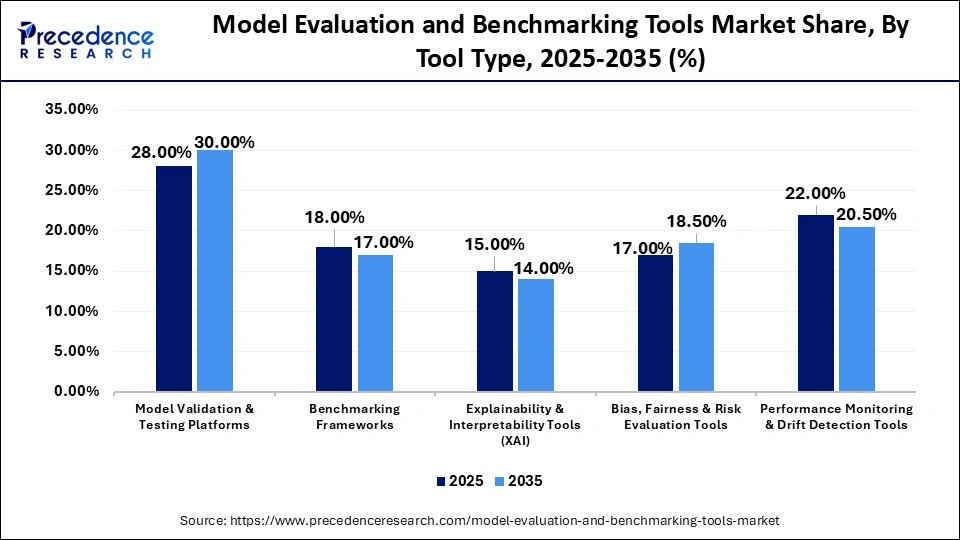
The benchmarking frameworks segment held a 18% share of the market in 2025 and is expected to grow at a 22% CAGR between 2026 and 2035. The growth of this segment is driven by the critical role of these tools in comparing model performance across standardized datasets. Benchmarking tools enable organizations to measure accuracy, latency, and efficiency against the industry standard.
The explainability & interpretability tools (XAI) segment held a 15% share of the market in 2025 and is expected to grow at a significant CAGR of 21.5% in between 2026 and 2035. This is mainly due to the regulatory and ethical demands of getting to know model behavior in any cutting-edge application. These tools offer interpretability and visualization measures, which contribute to confidence and responsibility of AI systems.
The bias, fairness & risk evaluation tools segment held a 17% share of the market in 2025 and is expected to grow at the highest CAGR of 26.5% over the projected period. This is because of the crucial role of risk assessment tools in finding risk areas and preparing against possible operational and reputational risks. Furthermore, the rising demand for these tools from international regulatory bodies is driving segmental growth.
Deployment Type Insights
Model Evaluation and Benchmarking Tools Market Share, By Deployment Mode, 2025-2035 (%)
| Deployment Mode | 2025 | 2035 | CAGR (%) |
| Cloud-based Evaluation Platforms | 65.00% | 70.00% | 26.50% |
| On-premise Model Testing Tools | 20.00% | 15.00% | 14.50% |
| Hybrid Evaluation Environments | 15.00% | 15.00% | 23.00% |
The Cloud-Based Evaluation Platforms Segment Dominated the Market in 2025
The cloud-based evaluation platforms segment dominated the model evaluation and benchmarking tools market with the largest share of 65% in 2025. This is mainly due to the growing need for scalable infrastructure to enable tests of large-scale models and distributed workloads. Interoperability with MLOps pipelines provides an easy overview of deployment, testing, and monitoring of unified, cloud-native workflows
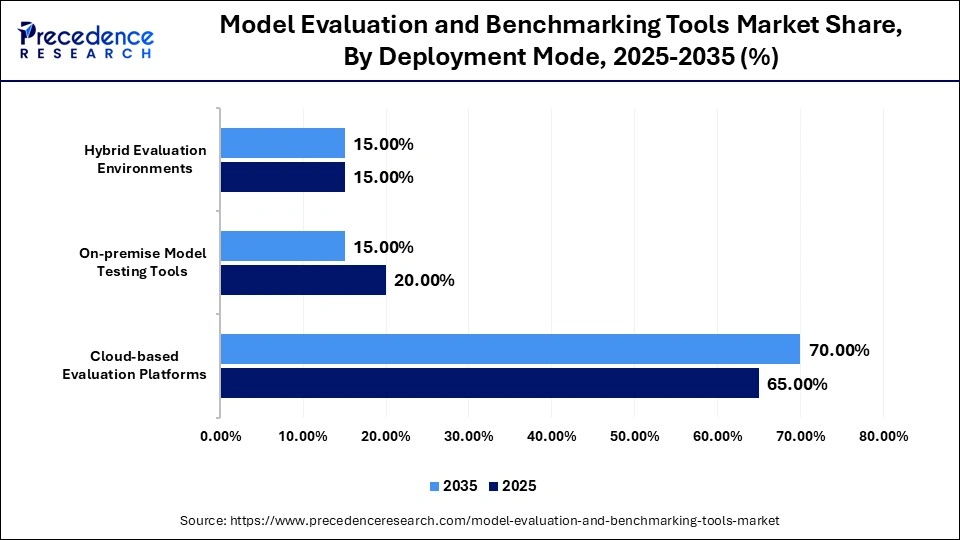
The on-premise model testing tools segment held the second-largest market share of 20% in 2025 and is expected to grow at a 14.5% CAGR during the forecast period. This is mainly due to the demand for data privacy that needs entire control of infrastructure and sensitive data. On-premise tools provide improved data governance with less exposure to external threats and compliance risks.
The hybrid evaluation environments segment held a 15% share of the market in 2025 and is expected to grow at a significant CAGR of 23% in the upcoming period, driven by their increasing adoption by enterprises that need flexibility in operation. Organizations are integrating the cloud scaling feature with the on-premises model to streamline the performance and compliance needs. Hybrid models are gaining traction as enterprises balance flexibility, compliance, and performance across cloud and on-premise setups.
Model Type Insights
Model Evaluation and Benchmarking Tools Market Share, By Model Type, 2025-2035 (%)
| Model Type | 2025 | 2035 | CAGR (%) |
| Large Language Models (LLMs) | 35.00% | 38.00% | 27.50% |
| Computer Vision Models | 20.00% | 18.00% | 21.00% |
| Speech & Multimodal Models | 20.00% | 22.00% | 25.00% |
| Predictive & Classical ML Models | 25.00% | 22.00% | 19.50% |
The Large Language Models (LLMs) Segment Led the Market With a 35% Share in 2025
The large language models (LLMs) segment dominated the model evaluation and benchmarking tools market with a share of 35% in 2025. This is mainly due to the explosive adoption of generative AI applications requiring deep evaluation for reasoning accuracy and hallucination control. The MLCommons research points out that the number of participants in the LLM-specific benchmarks grew tremendously throughout 2025, indicating the increasing industry dependence on standardized assessment. Furthermore, the continuous need for precision and reliability reinforces the strong demand for LLM-focused evaluation frameworks.
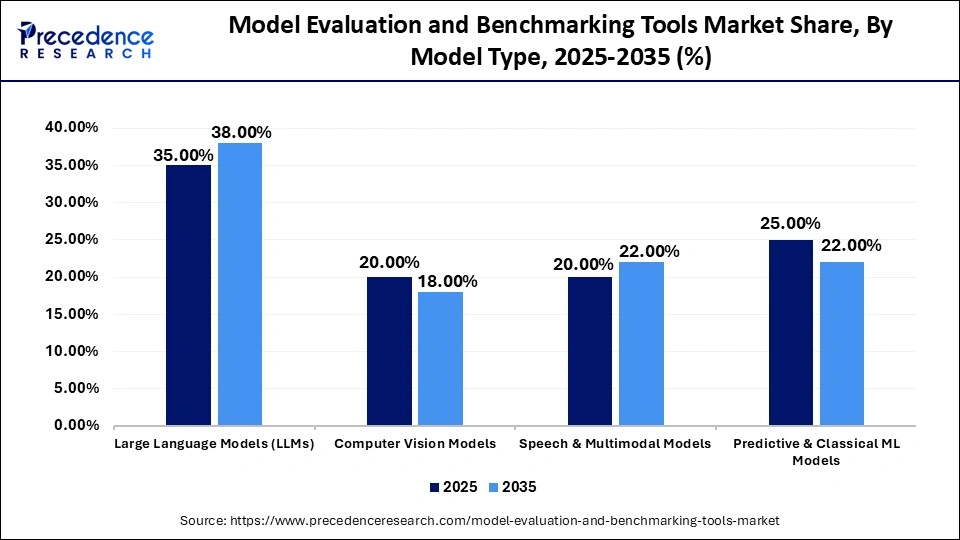
The predictive & classical ML models segment held the second-largest market share of 25% in 2025 and is estimated to grow at a strong CAGR of 19.5% over the projected period, driven by their continued significance in enterprise analytics and decision-making systems. Such models are still popular within fields such as the detection of fraud, the prediction of demand, and recommender systems.
The speech & multimodal models segment held a 20% share of the market in 2025 and is expected to grow at a significant CAGR of 25% between 2026 and 2035. This is mainly due to the increased adoption of integrated AI systems processing different types of data. This segment is growing as companies implement models that process text, audio, and visual data at the same time. Businesses need modern benchmarking engines that emulate real-world situations involving voice assistants, video analytics, and conversation AI.
Application Insights
The AI Model Validation & QA Segment Dominated the Market in 2025
The AI model validation & QA segment dominated the model evaluation and benchmarking tools market with a share of 30% in 2025. The segment's dominance is driven by increasing demand for stricter pre-deployment testing to achieve reliable and consistent results in AI outputs. Companies use QA solutions to mitigate operational risks and retain the quality of the services in large-scale deployments.
The regulatory compliance & AI governance segment held a market share of 20% in 2025 and is estimated to grow at the highest CAGR of 26.5% over the projected period. This is mainly due to the growing requirements for providing transparency, fairness, and explainability of AI systems. Businesses are concerned with governance solutions to make them align with the emerging legal and moral practices. Such regulatory pressure is redefining the process of validation and monitoring of AI systems within industries.
Model Evaluation and Benchmarking Tools Market Share, By Application, 2025-2035 (%)
| Application | 2025 | 2035 | CAGR (%) |
| AI Model Validation & QA | 30.00% | 32.00% | 24.00% |
| Regulatory Compliance & AI Governance | 20.00% | 22.00% | 26.50% |
| Model Performance Optimization | 20.00% | 18.50% | 22.00% |
| Continuous Monitoring & MLOps Integration | 20.00% | 19.50% | 23.50% |
| Benchmarking for Model Selection & Procurement | 10.00% | 8.00% | 21.00% |
The model performance optimization segment held a 20% share of the market in 2025 and is expected to grow at a 22% CAGR during the projection period. This is mainly due to the growing focus on improving model efficiency and accuracy across various AI workloads. Model performance optimization tools optimize performance across workloads, reduce latency, and refine model outputs.
The benchmarking for model selection & procurement segment held a 10% market share in 2025 and is estimated to grow at a strong CAGR rate of 21% over the projected period, driven by the ability to compare models when making an enterprise decision. Benchmarking tools allow organizations to compare the offerings of vendors and pick the models according to the performance measures.
End-Use Industry Insights
The IT & Telecommunications Segment Dominated the Market in 2025
The IT & telecommunications segment dominated the model evaluation and benchmarking tools market with a major share of 30% in 2025 due to its large-scale AI implementation. Telecommunication companies are turning to ongoing benchmarking to keep their services available and minimize downtimes. Additionally, the rapid rollout of 5G networks and increasing data traffic have further intensified the demand for advanced model testing and validation solutions in this sector.
The BFSI segment held the second-largest market share of 15% in 2025 and is estimated to grow at a strong CAGR of 22% over the projected period. This is mainly due to the growing use of AI models in the process of fraud detection, credit scoring, and risk assessment. Banking institutions need powerful assessment systems to ensure model integrity and governance. Evaluation tools facilitate checking predictive models with past financial data and changing patterns of risks.
The healthcare segment held a 15% share of the market in 2025 and is expected to grow at a 24.5% CAGR during the studied period. This is because of the increasing implementation of AI models by healthcare organizations to analyze imaging data, monitor patients, and provide recommendations. Companies need benchmarking models that assess model outputs with medical benchmarks and actual data.
Model Evaluation and Benchmarking Tools Market Share, By End-Use Industry, 2025-2035 (%)
| End-Use Industry | 2025 | 2035 | CAGR (%) |
| IT & Telecommunications | 30.00% | 28.00% | 23.00% |
| BFSI | 15.00% | 14.00% | 22.00% |
| Healthcare | 15.00% | 16.00% | 24.50% |
| Retail & E-commerce | 15.00% | 15.00% | 23.50% |
| Automotive & Mobility | 10.00% | 12.00% | 25.50% |
| Government & Defense | 10.00% | 11.00% | 24.00% |
| Others | 5.00% | 4.00% | 20.00% |
The retail & e-commerce segment held a 15% share of the market in 2025 and is expected to grow at a significant CAGR of 23.5% between 2026 and 2035, supported by the ongoing digitalization of the retail sector and high generation of consumer data. Additionally, rising competition and the need for real-time, data-driven decision-making are pushing retailers to adopt advanced evaluation tools to optimize performance and conversion rates.
The automotive & mobility segment held a 25% share of the market in 2025 and is estimated to grow at the highest CAGR 25.5% over the projected period. This is mainly due to the growing complexity of autonomous vehicles, which is creating pressure to have a robust validation framework. Applications like ADAS require rigorous model testing and benchmarking to ensure safety, accuracy, and real-world reliability under diverse driving conditions.
The government & defense segment held a 35% share of the market in 2025 and is expected to grow at a CAGR of 24% between 2026 and 2035. This is because governments are adopting AI evaluation tools for surveillance, intelligence, and regulatory compliance.
Regional Insights
North America Model Evaluation and Benchmarking Tools Market Size and Growth 2026 to 2035
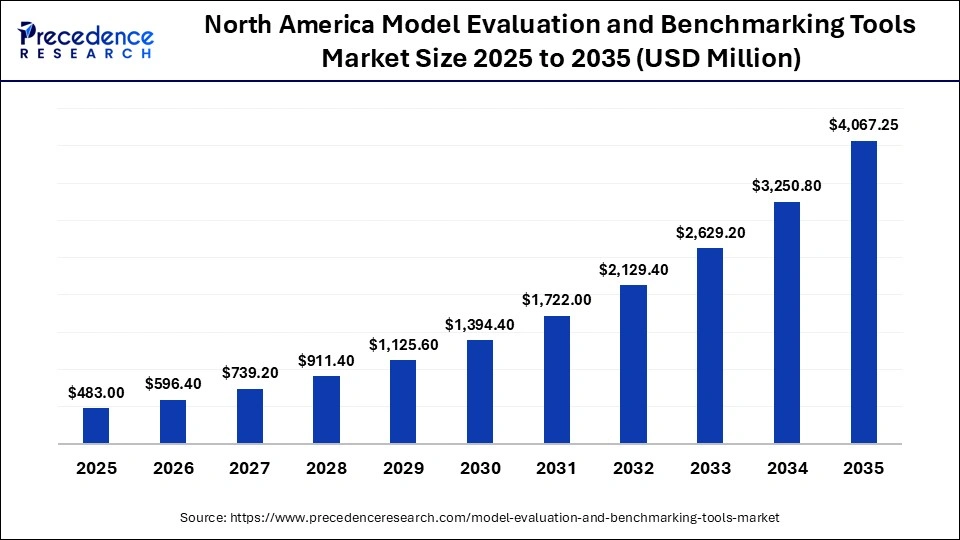
The North America model evaluation and benchmarking tools market size is estimated at USD 483.00 million in 2025 and is projected to reach approximately USD 4,067.25 million by 2035, with a 23.75% CAGR from 2026 to 2035.
North America Dominated the Market With a 42% Share in 2025
North America led the model evaluation and benchmarking tools market, capturing the largest revenue share of 42% in 2025. This is mainly due to the presence of advanced AI ecosystems, leading technology companies, and high enterprise adoption of AI governance frameworks. The growing emphasis on responsible AI and regulatory compliance is further driving demand for sophisticated model validation solutions. In addition, the integration of evaluation tools into cloud-native and MLOps environments is enhancing operational efficiency, thereby supporting regional market growth.
U.S. Model Evaluation and Benchmarking Tools Market Size and Growth 2026 to 2035
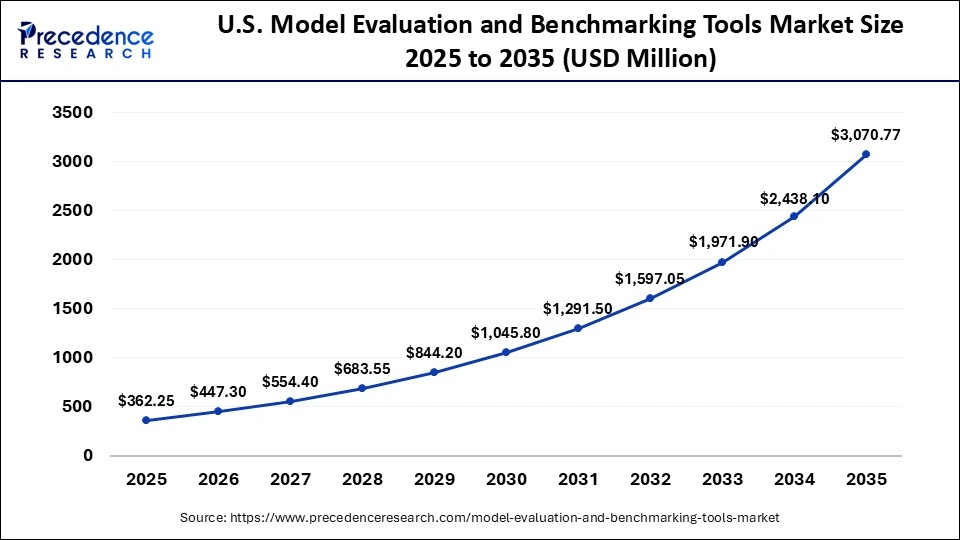
The U.S. model evaluation and benchmarking tools market size is calculated at USD 362.25 million in 2025 and is expected to reach nearly USD 3,070.77 billion in 2035, accelerating at a strong CAGR of 23.83% between 2026 and 2035.
U.S. Model Evaluation and Benchmarking Tools Market Analysis
The U.S. leads the market within North America due to the rapid expansion of large-scale AI deployments across sectors such as cloud computing, defense, and enterprise software. Organizations are increasingly embedding evaluation frameworks into MLOps pipelines to ensure continuous validation of complex AI models. The rising adoption of benchmarking tools is also enabling better measurement of reasoning ability, alignment with safety standards, and real-world performance under diverse conditions.
How is the Opportunistic Rise of Europe in the Market?
Europe held a 25% share of the model evaluation and benchmarking tools market in 2025 and is expected to grow at a strong CAGR of 21.5% over the projected period. This growth is driven by the region's stringent AI regulations and robust data protection frameworks such as the GDPR. As a result, businesses across Europe are increasingly integrating governance-focused evaluation tools into their AI pipelines, creating a compliance-driven ecosystem for model assessment and validation.
Germany Model Evaluation and Benchmarking Tools Market Analysis
Germany is a key contributor to the European market, supported by the adoption of AI evaluation tools across manufacturing, automotive, and enterprise automation sectors. Companies in the country are focusing on benchmarking models to ensure transparency, reliability, and compliance with strict European regulatory standards. This emphasis on accountability and performance validation is strengthening Germany's position in the regional market.
What Makes Asia Pacific the Fastest-Growing Region in the Market?
Asia Pacific held a 25% share of the market in 2025 and is expected to grow at the fastest CAGR of 27.5% between 2026 and 2035. This is primarily due to substantial government and enterprise investments in AI-based innovation and digital transformation initiatives across the region. According to insights from the World Economic Forum, Asia Pacific emerged as a major hub for AI innovation and deployment in 2025. Leading companies such as Alibaba Cloud and Tencent AI Lab are actively advancing the development of large-scale AI evaluation systems.
China Model Evaluation and Benchmarking Tools Market Analysis
In China, the market is driven by the large-scale adoption of AI across sectors such as e-commerce, finance, and smart infrastructure. Companies are increasingly focusing on benchmarking models capable of handling massive datasets and high-throughput environments. As a result, there is growing emphasis on tools that evaluate scalability, latency, and real-time performance of advanced AI systems under operational conditions.
Model Evaluation and Benchmarking Tools Market Companies
- Amazon Web Services, Inc. (AWS)
- ClearML Ltd.
- Databricks, Inc.
- DataRobot, Inc.
- Domino Data Lab, Inc.
- Google LLC (Alphabet Inc.)
- Hugging Face, Inc.
- IBM Corporation
- Microsoft Corporation
- MLCommons Association
- OpenAI, Inc.
- SAS Institute Inc.
- Scale AI, Inc.
- Snowflake Inc.
- Weights & Biases, Inc.
Recent Developments
- In April 2026, Endor Labs launched an agentic code security benchmark extending the SusVibes framework to evaluate AI-generated code security. The company also introduced the Agent Security League, a public leaderboard tracking AI coding agents on accuracy and security performance.(Source: https://www.prnewswire.com)
- In April 2026, the Rapid Evaluation Framework (REF) was introduced at the CMIP 2026 Workshop in Kyoto by scientists from the Coupled Model Intercomparison Project. The framework supports advanced climate model evaluation ahead of CMIP7, contributing to research used by the Intergovernmental Panel on Climate Change.(Source: https://wcrp-cmip.org)
Segments Covered in the Report
By Tool Type
- Model Validation & Testing Platforms
- Benchmarking Frameworks (LLM Benchmarks, Vision Benchmarks)
- Explainability & Interpretability Tools (XAI)
- Bias, Fairness & Risk Evaluation Tools
- Performance Monitoring & Drift Detection Tools
By Deployment Mode
- Cloud-based Evaluation Platforms
- On-premise Model Testing Tools
- Hybrid Evaluation Environments
By Model Type
- Large Language Models (LLMs)
- Computer Vision Models
- Speech & Multimodal Models
- Predictive & Classical ML Models
By Application
- AI Model Validation & QA
- Regulatory Compliance & AI Governance
- Model Performance Optimization
- Continuous Monitoring & MLOps Integration
- Benchmarking for Model Selection & Procurement
By End-Use Industry
- IT & Telecommunications
- BFSI
- Healthcare
- Retail & E-commerce
- Automotive & Mobility
- Government & Defense
- Others
By Region
- North America
- Latin America
- Europe
- Asia-pacific
- Middle and East Africa
For inquiries regarding discounts, bulk purchases, or customization requests, please contact us at sales@precedenceresearch.com
Frequently Asked Questions





Ask For Sample
No cookie-cutter, only authentic analysis – take the 1st step to become a Precedence Research client
 Get a Sample



 sales@precedenceresearch.com
 Schedule a Meeting
