



Acwa Signs Joint Development Agreement with PT GARAM for Indonesia's First Utility-Scale Integrated Seawater Desalination and Industrial Salt Mission
Published: 14 Aug 2026
Author: Vidyesh Swar



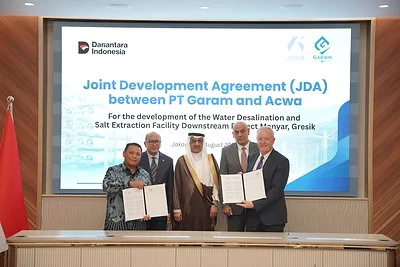
On August 12, 2026, ACWA Power entered into a joint advancement agreement with PT GARAM with a view to setting up Indonesia’s first utility-scale integrated seawater desalination and industrial salt project. This adoption of an integrated approach target to meet Indonesia’s rising demand for water and critical industrial resources. The project is intended to link large-scale freshwater production with the manufacture of industrial salt. The desalination will be linked to salt production, strengthening resource efficiency by producing valuable products from seawater through the integrated process.
The project denotes a momentous move towards strengthening the country’s domestic infrastructure and reducing dependence on imported industrial salt. Water availability and the security of industrial resources are key to economic development in Indonesia. This project may offer long-term advantages for both communities and industrial customers. The partnership combines ACWA Power’s experience in water infrastructure with PT GARAM’s position in Indonesia’s salt industry, laying the preparation for a transformative initiative that might define a new standard for integrated water and mineral resource development.
Impact on the Water & Desalination Industry
he global water and wastewater treatment market size was estimated at USD 369.60 billion in 2025 and is predicted to increase from USD 392.90 billion in 2026 to approximately USD 690.97 billion by 2035, expanding at a CAGR of 6.46% from 2026 to 2035.
According to Precedence Research, the water sector has the potential to see a major advancement as a result of Indonesia's turn towards large-scale seawater desalination. With population growth, industrialization, and the effects of climate change leading to greater demand for a reliable supply of fresh water, desalination can offer an extra source that relies less on rainfall and on traditional fresh water stores. The combined ACWA Power and PT GARAM project could show how large-scale desalination can be connected with the recovery of valuable resources rather than viewing salt as merely a waste product.
This approach might prompt other water developers to investigate integrated solutions that improve the economic viability and resource efficiency of desalination plants. Moreover, if the project is successfully carried out, it could meanwhile enhance Indonesia's desalination capabilities and open up opportunities for technology suppliers, engineering firms and infrastructure investors who are involved in advanced water treatment systems.
Impact on the Industrial Salts Industry
The global industrial salts market size is valued at USD 19.63 billion in 2025 and is predicted to increase from USD 20.89 billion in 2026 to approximately USD 33.06 billion by 2034, expanding at a CAGR of 6.01% from 2025 to 2035.
According to Precedence Research, the development could bring considerable advantages to Indonesia's industrial salt industry since the project is intended to link seawater desalination with large-scale industrial salt production. Industrial salt is a key input in many chemical and manufacturing processes and therefore has strategic value in terms of securing a reliable supply available domestically. Raising local production levels would help lessen dependence on international supply chains, reduce import expenses and avoid the volatility of global salt markets. The integrated method might also lead to greater process effectiveness by combining water treatment and salt recovery in the same project. For chemical manufacturers, industrial processors and other major users of salt, increased domestic availability could improve supply security and aid production planning. The project could also promote greater investment in modern salt-processing technologies, infrastructure and supply chains, thus assisting in the development of Indonesia's wider industrial ecosystem and increasing the resilience of domestic resources.
Impact on the Infrastructure & Energy Industry
The global renewable energy market size accounted for USD 1.74 trillion in 2025 and is predicted to increase from USD 2.04 trillion in 2026 to approximately USD 8.25 trillion by 2035, representing a CAGR of 16.84% from 2026 to 2035.
According to Precedence Research, The infrastructure and energy sectors might benefit from the establishment of Indonesia's first large-scale integrated desalination and industrial salt project. Since large desalination plants involve a great deal of investment in intakes, treatment facilities, pipelines, the supply of electricity and associated facilities, the inclusion of salt production brings an additional element of industrial infrastructure and thus offers opportunities for engineering, construction, equipment and technology suppliers.
The project could also prompt developers to think about how energy efficiency can affect the economics of large-scale desalination, especially since water treatment is energy-demanding. Should the project be developed successfully, it could act as a reference model for other integrated infrastructure projects in Indonesia and in other areas that are under pressure from water shortages. It could at the same time encourage private-sector involvement in vital infrastructure while promoting industrial development and long-term resource security.
Expert Opinion
From expert opinion, the agreement between ACWA Power and PT GARAM is strategically important is that it tackles two resource issues includes the availability of freshwater and the supply of industrial salt by means of a single integrated development. On an infrastructure level, the most noteworthy aspect is the opportunity to generate extra economic value from seawater rather than considering desalination only as a means of producing freshwater. Integrated projects may provide enhanced resilience against supply disruptions. Considering Indonesia's large population, the growth of its industrial sector, and geographical diversity, resource security has gained prominence.
This strategy's long-term success will depend on number of factors, including capital costs, energy consumption, brine handling, environmental management, technology choice, and the competitiveness of industrially produced salt. Lifecycle planning must therefore be careful. This project shows how water infrastructure and industrial resource production can be developed in tandem. Additionally, it might in the end lead to similar integrated desalination and resource-recovery projects in other parts of Southeast Asia and in emerging ecosystems.