



Indian Government Introduces BHAVYA Rasayan Scheme to Enhance Chemical Production
Published: 28 Jul 2026
Author: Vidyesh Swar



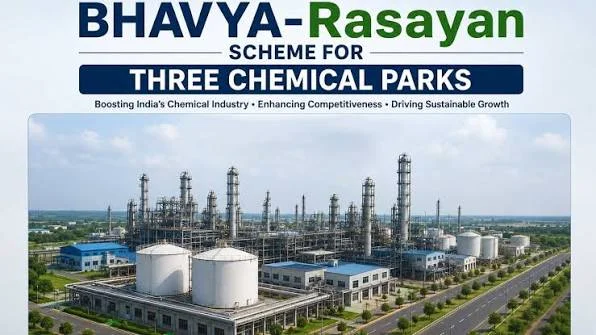
In July 2026, the Union Cabinet of India introduced the Bharat Audyogik Vikas Yojana Rasayan (BHAVYA Rasayan) with a budget of USD 312 million to develop 3 next-generation chemical manufacturing facilities in India. This scheme was announced in the Union Budget 2026-2027 and is intended to boost indigenous chemical production, attract investments, boost the job market, and improve the position of the Indian chemical sector.
The government has declared that it will provide assistance in the development of the 3 chemical manufacturing plants and also help them scale their workflows. Out of USD 312 million, USD 309 million will be used for developing foundational infrastructure and facilities, and USD 3 million will be used for governance and execution. This initiative will follow a shared funding model, as the central government would provide USD 103 million and the state government would have to invest a minimum of USD 51.5 million. This model is expected to promote better participation of the states and result in fast-paced implementation.
The location of the 3 chemical production plants would be decided via the Challenge Route, where the state governments would send their proposals to the central government. The conditions put up for the chemical park location to be considered valid are as follows:
- It must have a minimum area of 8 square kilometers (2000 acres).
- The land should be continuous and free of any impediment.
These conditions have been put up keeping in mind the needs of a comprehensive chemical production facility which would be equipped with next-generation technologies and will support the scaling of operations in the future.
These parks will follow plug-and-play infrastructure, which states that the companies operating in these parks would not need to set up their own facilities from scratch. These parks would have shared roads, power supply, water systems, effluent treatment, and logistics which can be used by all the companies operating in that park. This will help them to optimize operations costs, set up their plant in a relatively shorter amount of time, and scale their workflows quickly.
This initiative is expected to benefit various industries such as agriculture, pharmaceuticals, nutraceuticals, textiles, construction, automobiles, and electronics sectors. These parks are expected to attract both indigenous and foreign investment, and also boost employment opportunities in the country.
Impact on the Chemical Industry
According to Precedence Research, the BHAVYA Rasayan scheme is expected to positively impact the chemical industry as it significantly improves the chemical manufacturing segment in one of the biggest global markets, that is India. These chemical manufacturing parks will attract a lot of domestic as well as foreign investment, which will drive the innovation and adoption of the latest chemical development practices in the country. It will also benefit the downstream industries that depend on the chemicals manufactured by these companies.
Impact on the Specialty Chemicals Market
The global specialty chemicals market size is valued at USD 940.72 billion in 2025 and is predicted to increase from USD 978.79 billion in 2026 to approximately USD 1,377.32 billion by 2035, expanding at a CAGR of 3.54% from 2026 to 2035.
According to Precedence Research, the specialty chemicals market is expected to benefit from the introduction of the BHAVYA Rasayan Scheme, as it will boost the development and manufacturing of specialized chemicals in the country. India is rapidly adopting the use of advanced fuels such as biodiesel and hydrogen, as well as the latest manufacturing practices in various sectors.
Such applications need specialty chemicals that can cater to the specific demands. Indian automobile companies are adopting electric and hybrid vehicles, which demand the use of such chemicals. The Indian government is continuously strengthening carbon footprint and emissions regulations, and thus the companies have to adopt bio-based chemicals, which are more sustainable and eco-friendly as compared to conventional chemicals.
Impact on the Agrochemicals Market
The global agrochemicals market size is calculated at USD 242.49 billion in 2025 and is predicted to reach around USD 322.18 billion by 2035, expanding at a CAGR of 2.90% from 2026 to 2035.
According to Precedence Research, the launch of the BHAVYA Rasayan scheme by the Indian government is expected to positively impact the agrochemicals market. This is because India has a massive agriculture sector that depends on fertilizers, insecticides, pesticides, and herbicides to protect its produce in the tropical weather where germs thrive. The use of the latest chemicals is necessary to combat the growing resistance among pests and germs.
There is also a growing demand for organic produce in the country, which creates a need for bio-based chemicals. Organic fruits, vegetables, meat, as well as dairy demand high-end bio-based chemicals. The preservation of produce in a tropical climate is also necessary to increase drought resilience, as a big chunk of Indian agriculture depends on rains. These requirements drive the demand for modern chemicals.