



China Strengthens Global AI Corporation Vision to Promote Responsible Artificial Intelligence Development
Published: 23 Jul 2026
Author: Gautam Mahajan



In July 2026, China introduced a new global vision for collaboration in artificial intelligence at the World Artificial Intelligence Conference (WAIC) in Shanghai. The declaration emphasized the nation's dedication to fostering global cooperation in AI research, governance, infrastructure development, and innovation while advancing the ethical application of AI technologies. China stressed the significance of creating an inclusive AI ecosystem that benefits both established and emerging nations as AI continues to transform businesses and economies globally.
The effort reflects the growing understanding that artificial intelligence (AI) is one of the most important technologies affecting national development, scientific research, industrial modernization, and economic competitiveness. China suggested enhancing international collaborations that promote information exchange, cooperative research, technical cooperation, and shared governance principles rather than viewing AI as a purely competitive technology. The vision aims to strike a balance between the quick development of technology and long-term sustainability, security, ethics, and transparency.
Artificial intelligence has quickly progressed from experimental technology to a widely used business solution in a variety of industries. Businesses all across the world are incorporating AI into public administration, manufacturing, healthcare, banking, education, transportation, agriculture, cybersecurity, retail, and telecommunications. The need for advanced computer infrastructure, cloud platforms, high-performance semiconductors, and qualified AI specialists has increased due to the expanding use of generative AI, machine learning, robotics, intelligent automation, and predictive analytics. As a result, governments are beginning to acknowledge AI as a major force behind economic expansion and digital transformation.
Chinese authorities emphasized the significance of creating global AI governance frameworks that can foster innovation while reducing possible risks related to sophisticated AI systems during the meeting. Transparency, equity, accountability, data security, and the responsible application of AI were the main topics of discussion. To guarantee that AI benefits society, officials emphasized that cooperation between governments, research institutions, academic institutions, and commercial technology firms will be crucial.
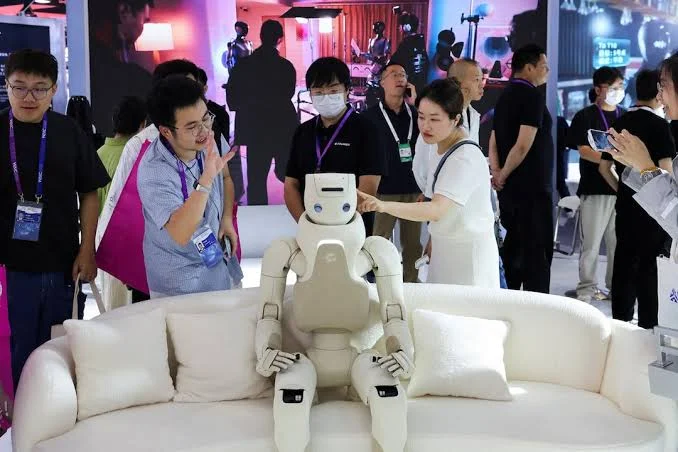
Large language models, intelligent robotics, autonomous manufacturing systems, AI-powered healthcare applications, smart city technologies, industrial automation, and scientific computing were just a few of China's most recent AI innovations that were showcased at the conference. Chinese tech firms have shown how AI is boosting operational effectiveness, increasing productivity, fostering industrial innovation, and hastening digital transformation in a variety of sectors.
The significance of closing the global digital divide was one of the main topics covered at the event. China underlined that a lot of developing nations still struggle with issues including digital infrastructure, processing power, AI know-how, and technological accessibility. By increasing access to AI education, technical training, research collaboration, and computer infrastructure, increased international cooperation may make it possible for emerging economies to take a more active role in the global digital economy.
Additionally, the endeavor is a reflection of the increased interest on a global scale in creating common technical standards for AI. Standardized governance techniques may enhance interoperability, regulatory certainty, and global cooperation as AI technologies are further included in cross-border trade, financial services, healthcare systems, supply chains, and digital communications. While encouraging responsible innovation, harmonized AI standards could also make it easier for global corporations to adopt technology.
Increasing research collaborations between academic institutions, public research organizations, and IT firms is a key component of China's agenda. Innovation in natural language processing and computer vision. Robotics, intelligent manufacturing, biotechnology, autonomous vehicles, climate science, and scientific discovery may be accelerated via collaborative research initiatives. Collaborative research projects can speed up the commercialization of new AI technology while minimizing effort duplication.
The news coincides with a period of substantial worldwide investment in AI infrastructure. Globally, nations are building sophisticated data centers, increasing semiconductor production, building more high-performance computing capacity, and making significant investments in AI workforce development and education. Next-generation computing solutions that can handle expanding industry demand for training increasingly complex AI models are being supported by both public and private initiatives.
China also emphasized how artificial intelligence may be used to address some of the world's most pressing issues, such as access to healthcare, climate change, disaster management, sustainable manufacturing, precision agriculture, energy optimization, environmental monitoring, and scientific research. AI-powered solutions are being used more and more to boost public services, expedite medical research, optimize industrial processes, lower pollution, and increase resource efficiency.
Businesses now have more potential to automate processes, enhance consumer engagement, produce digital content, speed up software development, and assist enterprise decision-making thanks to the quick growth of generative AI. Businesses in almost every sector are investing in AI technologies to save operating costs and increase competitiveness. To promote innovation and safeguard the public interest, governments are concurrently creating regulatory frameworks.
China's proposal acknowledges that ongoing investments in digital infrastructure would be necessary for future AI development. High-capacity cloud computing platforms, dependable data storage, fast networking, energy-efficient data centers, and next-generation semiconductor technologies are all necessary for advanced AI systems. Long-term AI innovation across several areas may be supported by increased investments in these fundamental technologies due to international cooperation.
Impact on the Artificial Intelligence Industry
According to Precedence Research, businesses engage in generative AI, machine learning, automation, and intelligent analytics. The AI sector is growing; it is anticipated that China's emphasis on international cooperation will improve research collaborations, promote technological exchange, and hasten the adoption of AI in public administration, healthcare, manufacturing, finance, education, and logistics. To promote responsible AI deployment globally and increase transparency, the effort may also aid in the creation of universal AI governance standards.
Impact on the Cloud Computing Market
The global cloud computing market size was estimated at USD 912.77 billion in 2025 and is predicted to increase from USD 1,106.28 billion in 2026 to approximately USD 5,946.84 billion by 2035, expanding at a CAGR of 20.61% from 2026 to 2035.
According to Precedence Research, cloud computing offers scalable infrastructure for training and implementing sophisticated AI models; it continues to be crucial for AI development. Investments in high-performance computing. AI cloud platforms, hyperscale data centers, and enterprise AI services are anticipated to rise as international cooperation grows. Businesses and academic institutions will be able to create and implement AI applications more effectively with the expansion of cloud infrastructure.
Impact on the Semiconductor Market
The global semiconductor market size was estimated at USD 627.76 billion in 2025 and is predicted to increase from USD 676.06 billion in 2026 to approximately USD 1,277.45 billion by 2035, expanding at a CAGR of 7.36% from 2026 to 2035.
Continued innovation in advanced semiconductor manufacturing will be supported by rising demand for AI processors, GPUs, AI accelerators, and high-performance memory solutions. Further funding for semiconductor technologies needed for next-generation AI applications may be encouraged by international collaboration in AI research.
About WAIC
One of the top AI conferences in the world, the World Artificial Intelligence Conference (WAIC), brings together researchers, investors, technology businesses, governments, and academic institutions to talk about AI innovation, governance, commercialization, and international cooperation. The conference is a crucial venue for exhibiting technological developments and encouraging global collaboration in artificial intelligence.