



Researchers from University of Adelaide and University of Stuttgart Advance Hair-Thin Optical Fiber Technology for Microprinting Sensors
Published: 27 Mar 2026
Author: Precedence Research



The microprinting market is witnessing revolutionary technological advancements with the help of miniaturized functional sensors and micro-fabrication technology. Both universities made significant contribution to the development of ultra-small optical fiber technology with applications in biomedical imaging and sensors. The research represents a broader trend of utilizing microfabrication, additive manufacturing and materials control to achieve functional, miniaturized devices with unprecedented capabilities. This represents a trend toward increased microprinting technology relevance, which bridges laboratory prototypes and commercial sensor technologies.
Ultra-Thin Optical Fiber Breakthrough
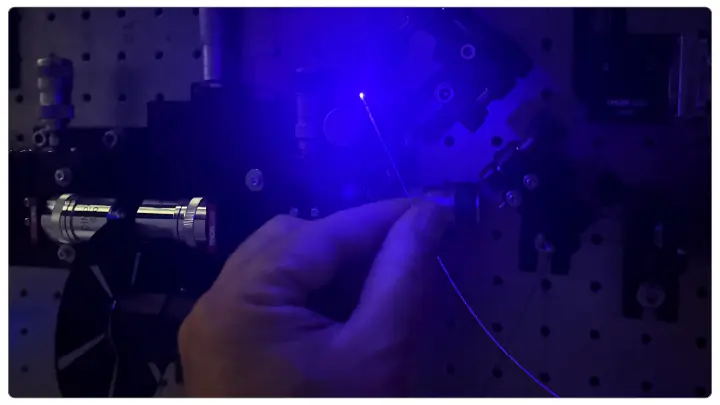
The University of Adelaide’s Institute for Photonics and Advanced Sensing(IPAS) has research activities in quantum nanophotonics, advanced fiber materials, and bio-integrated probes. Under the guidance of Dr. Ralf Mouthaan from the Center of Light for Life at the University of Adelaide, the research has successfully achieved high-resolution microscopy with the help of an optical fiber that is thinner than a human hair. It has diameter of approximately 50 nanometers. The optical fiber capability to transmit complex beam patterns such as Bessel and Airy Beams for high-resolution imaging with minimal damage to the tissues by passing the fiber through a narrow channel.
This innovation represents an example of micro-scale precision fabrication, akin to microprinting, which results in functional devices incorporating sensor and imaging functionality in extremely small form factors. Capabilities to manipulate light within such small fiber sizes suggest microprinted sensor arrays possibilities in diagnostics and wearable electronics.
The microprinting market size was calculated at USD 889.28 million in 2025 and is predicted to increase from USD 949.75 million in 2026 to approximately USD 1,716.92 million by 2035, expanding at a CAGR of 6.80% from 2026 to 2035 as the demand grows for secure documents, anti-counterfeiting solutions, and precise printing in currency, ID cards, and legal documents.
Implications for Microprinting Market
University-level micro-scale precision engineering represents an opportunity for microprinting technology growth, as miniaturized sensors developed via such technologies have a positive effect on market adoption. This technology is beneficial for biomedical, wearable electronics and photonics applications. This research represents an example of next-generation microprinting technology, which extends beyond anti-counterfeiting applications towards functional, high-value microdevices. This innovation demonstrates the potential of precise micro-fabrication technology developed in academia to directly inform commercial microprinting technology.
A recent report by Precedence Research highlights that the microprinting market is benefiting from improvements in high-resolution printing technology and ink development, as well as increasing regulatory demands for document security.