



New 10BASE-T1S PMD Transceivers Launched by NXP for Edge Networking
Published: 10 Mar 2026
Author: Precedence Research



The devices designed for automotive and industrial use focus on affordable multidrop Ethernet featuring CAN-like ease of use.
NXP Semiconductors launched the "first Physical Medium Dependent transceivers in the industry, 10BASE-T1S," which include the TJA1410 designed for automotive use and the TJF1410 intended for industrial and building automation purposes. These devices provide 10-Mb/s single-pair Ethernet connections for multidrop edge nodes, designed to streamline system architecture and lower expenses.
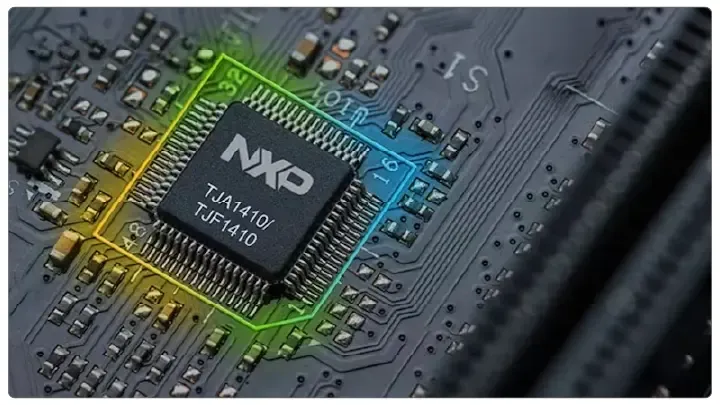
The latest PMD transceivers are created for software-defined automotive and industrial automation systems needing Ethernet connections at the sensor and actuator levels.
According to Precedence Research, the Location-Based Ambient Intelligence Market was valued at USD 327.95 billion in 2025 and is projected to grow from USD 398.52 billion in 2026 to approximately USD 2,302.95 billion by 2035, expanding at a CAGR of 21.52% from 2026 to 2035, driven by increasing IoT adoption and advances in edge connectivity technologies.
10BASE-T1S PMD Transceivers
NXP’s TJA1410 and TJF1410 devices comply with IEEE 802.3cg and the Open Alliance TC14 PMD standards, supporting 10BASE-T1S multidrop Ethernet via a three-pin interface. The TJA1410, tailored for automotive use, adheres to ISO 26262 and ASIL B safety standards, enabling features such as Open Alliance TC14 topology detection and low-power state changes without additional wiring. It also offers excellent EMC performance and works well with cost-effective CAN FD common-mode chokes. The TJF1410 is designed for industrial automation, capable of supporting up to 32 nodes in multidrop setups, optimized for minimal quiescent current in low-power mode, and comes in a compact 3 mm by 3 mm HVSON8 package.
10BASE-T1S and Multidrop Single Pair Ethernet
10BASE-T1S, standardized in IEEE 802.3cg, enables 10-Mb/s Ethernet communication over a single twisted pair, facilitating multidrop topologies where multiple nodes share a common bus segment. This reduces the need for cabling and switch ports in distributed edge networks. The Physical Medium Dependent sublayer manages signaling and collision avoidance with the implementation of Physical Layer Collision Avoidance (PLCA), ensuring predictable latency, which is crucial for automotive and industrial control systems. The Open Alliance TC14 provides a standardized three-pin interface to enhance integration and reduce pin counts, while allowing for topology discovery and remote-wake-up functionalities. Overall, 10BASE-T1S achieves wiring simplicity comparable to legacy field buses while maintaining the benefits of IP-based communication and security.
Extending Ethernet to the Edge
With the transition to zonal and centralized compute architectures, it is essential for designers to have reliable, cost-efficient connections for sensors, actuators, and basic controllers. A multidrop 10 Mb/s Ethernet PHY allows for a cohesive Ethernet backbone without the expense of point-to-point PHYs at each edge device.
The TJA1410 and TJF1410 are currently being produced, with customers already incorporating 10BASE-T1S into future software-defined platforms.
A recent report by Precedence Research highlights that the Location Based Ambient Intelligence Market is benefiting from advancements in edge connectivity technologies.