



Location Based Ambient Intelligence Market Trends, Companies, Revenue / Sales Performance, Subscriber Growth, Pricing Strategies, Cloud Adoption, Infrastructure Expansion, Competitive Landscape, and Industry Outlook
Location Based Ambient Intelligence Market (By Location Technology: GPS And GNSS Positioning, Ultra-Wideband Positioning, Inertial Measurement and Dead Reckoning; By Ambient Intelligence Layer: Context Inference and Reasoning Engine, Digital Twin and Simulation, Personalization and Recommendation Engine, Privacy, Consent, and Governance Layer; By Deployment Mode: Cloud Deployment, Hybrid Deployment, On-Premise Deployment; By Use Case: Indoor Navigation and Wayfinding, Asset Tracking and Utilization, Workforce Productivity and Workflow Automation, Security Monitoring and Anomaly Detection; By End User: Retail and Commercial Venues, Logistics and Warehousing, Transportation Hubs, Public Sector and Smart Cities) - Global Industry Analysis, Size, Trends, Leading Companies, Regional Outlook, and Forecast 2026 to 2035
Source: https://www.precedenceresearch.com/location-based-ambient-intelligence-market
 Get a Sample
 Table Of Content


What is the Location Based Ambient Intelligence Market Size in 2026?
The global location based ambient intelligence market size accounted for USD 327.95 billion in 2025 and is predicted to increase from USD 398.52 billion in 2026 to approximately USD 2,302.95 billion by 2035, expanding at a CAGR of 21.52% from 2026 to 2035. The market growth is attributed to accelerating smart city investments, expanding IoT sensor deployments, and rising demand for real-time, AI-driven spatial intelligence systems.
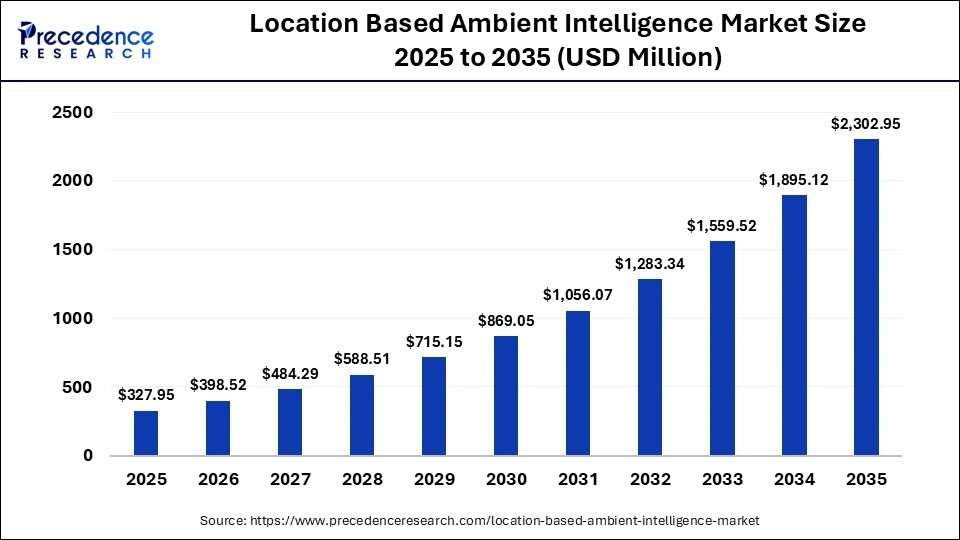
Key Takeaways
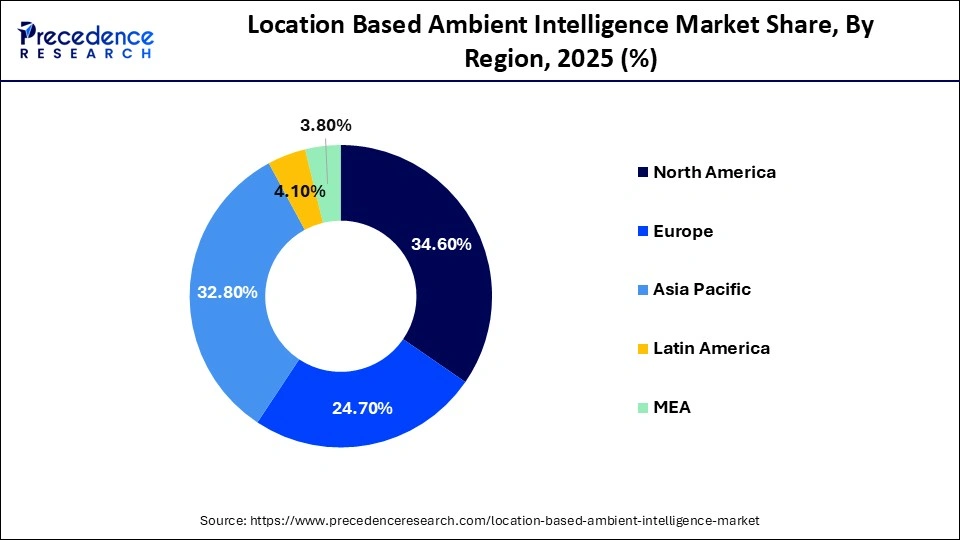
- North America dominated the market with a share of approximately 34.6% in 2025.
- Asia-Pacific is expected to grow at the fastest CAGR between 2026 and 2035.
- By location technology, the GPS and GNSS positioning segment contributed the highest location based ambient intelligence market share of approximately 22.7% in 2025.
- By location technology, the ultra-wideband positioning segment is expected to grow at a strong CAGR between 2026 and 2035.
- By ambient intelligence layer, the context inference and reasoning engine segment held a major market share of approximately 28.6% in 2025.
- By ambient intelligence layer, the predictive analytics and forecasting segment is expected to expand at the highest CAGR from 2026 to 2035.
- By deployment mode, the cloud deployment segment captured the highest market share of approximately 36.7% in 2025.
- By deployment mode, the hybrid deployment segment is poised to grow at a healthy CAGR between 2026 and 2035.
- By use case, the indoor navigation and wayfinding segment generated the biggest market share of approximately 24.8% in 2025.
- By use case, the proximity engagement and contextual messaging segment is expected to expand rapidly between 2026 and 2035.
- By end user, the retail and commercial venues segment accounted for the largest market share of approximately 30.6% in 2025.
- By end-user, the logistics and warehousing segment is expected to grow at a solid CAGR between 2026 and 2035.
Which Factors Influence the Location Based Ambient Intelligence Market?
The location based ambient intelligence industry is expanding rapidly, driven by the global acceleration of smart city programs that integrate IoT and real-time spatial data systems to enhance urban efficiency and public services. Various governments in key economies are integrating interlinked sensors and positioning systems in transport systems, health institutions, and infrastructure.
These deployments establish smart spaces that continuously gather, process, and analyze location information. Furthermore, the continued government-led push for smart, data-driven urban ecosystems remains a primary driver accelerating the adoption of location-based ambient intelligence solutions worldwide.
Impact of Artificial Intelligence on Location Based Ambient Intelligence
Structural change in the location-based ambient intelligence industry occurs as a result of artificial intelligence (AI) transforming real-time spatial signals into predictive challenged intelligence. AI models process data from GNSS satellites, BLE beacons, UWB sensors, cameras, and IoT devices to generate precise indoor and outdoor positioning insights.
These systems recognize patterns of movement, trends in behavior, and changes to the environment to be used to make automated decisions. Furthermore, as demand grows for autonomous, data-driven environments, AI continues to act as a primary catalyst, accelerating innovation and competitive differentiation in the market.
Location Based Ambient Intelligence Market Trends
- Sovereign Geospatial Cloud Frameworks: Governments have begun implementing sovereign geospatial cloud environments to support sensitive location data within the jurisdiction of the nation. This change enhances the institutional adoption of secure, scalable location-based ambient intelligence infrastructure in the ecosystems of the public sector.
- Digital Twin Integration with Live Geospatial Feeds: Real-time sensor feeds are now integrated into functional digital twins by cities and industrial operators. Live spatial data can be used to forecast crowd flows, energy requirements, and transport stress points. This fusion reinforces the business need for AI-based location intelligence systems.
Growth Factors
- Expansion of Indoor Positioning Ecosystems: Growing demand for centimeter-level indoor navigation in hospitals, airports, and industrial facilities is driving large-scale deployment of UWB and hybrid positioning systems.
- Enterprise Asset Digitization Programs: Increasing digital transformation initiatives across logistics and manufacturing are propelling investment in continuous location tracking infrastructures.
Global Infrastructure and Connectivity Developments Driving Intelligent Spatial Systems
- By the end of 2025, 5G subscriptions are projected to approach nearly 2.9 billion worldwide, representing close to one-third of all mobile subscriptions, thereby expanding ultra-reliable network access that improves positioning accuracy, device triangulation, and AI-driven spatial intelligence systems across the market landscape.
- The European Union allocated 151 billion under its 2021-2027 Digital Europe and Horizon Europe programs, with significant 2024-2026 disbursements supporting smart city pilots, urban data spaces, edge computing, and sensor-driven infrastructure across member states, strengthening foundational layers of location-based ambient intelligence.
- India's Smart Cities Mission, extended through 2025, involves investments exceeding ₹2 lakh crore (USD 24 billion) across 100 cities, funding integrated command-and-control centers, urban IoT deployments, surveillance grids, and GIS-based governance systems that directly support ambient intelligence frameworks.
Market Scope
| Report Coverage | Details |
| Market Size in 2025 | USD 327.95 Billion |
| Market Size in 2026 | USD 398.52 Billion |
| Market Size by 2035 | USD 2,302.95 Billion |
| Market Growth Rate from 2026 to 2035 | CAGR of 21.52% |
| Dominating Region | North America |
| Fastest Growing Region | Asia Pacific |
| Base Year | 2025 |
| Forecast Period | 2026 to 2035 |
| Segments Covered | Trailer Type, Communication Technology, Component, Application, Deployment/Distribution Channel, End User, and region |
| Regions Covered | North America, Europe, Asia-Pacific, Latin America, and Middle East & Africa |
Segmental Insights
Location Technology Insights
Which Location Technology Segment Dominated the Market?
The GPS and GNSS positioning segment dominated the location based ambient intelligence market in 2025, accounting for an estimated 22.7% market share, due to their unmatched global coverage and mature infrastructure ecosystem. GNSS receivers are important in smartphones, connected vehicles, fleet management systems, and public safety networks to retrieve precise geospatial signals. Furthermore, the large-scale infrastructure investments also supported the continued expansion of GNSS-enabled spatial intelligence systems in the coming years.
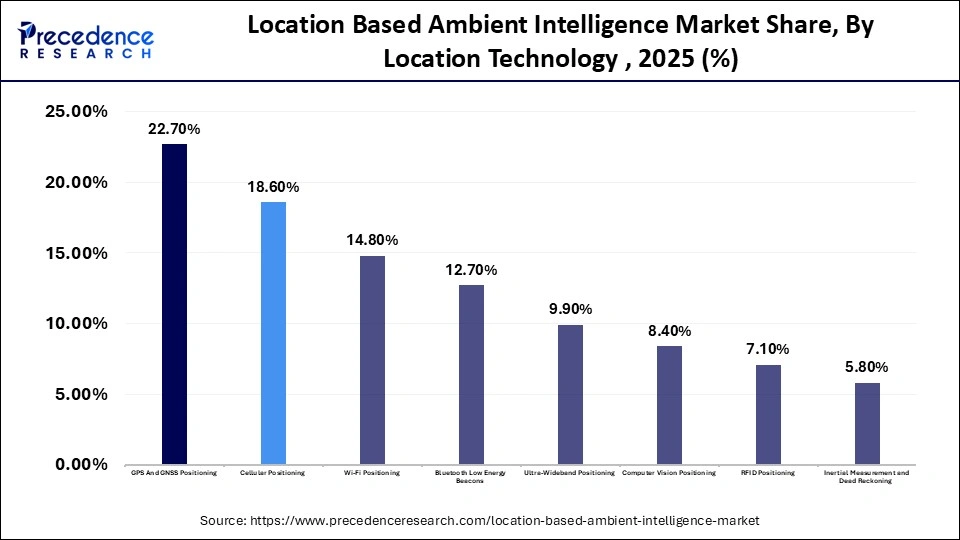
The ultra-wideband positioning segment is expected to grow at the fastest CAGR in the coming years, owing to its accuracy in indoor and dense environments. UWB systems calculate the distance by use of extremely brief radio pulses, which give the ability to calculate positions within a few centimeters. Moreover, the industrial automation and smart building deployments are anticipated to accelerate the adoption of ultra-wideband positioning systems.
Ambient Intelligence Layer Insights
Which Ambient Intelligence Layer Segment Led the Market?
The context inference and reasoning engine segment led the location based ambient intelligence market with a market share of about 28.6% in 2025, due to the need for intelligent systems to have a central processing unit that would interpret real-time data about spatial, behavioral, and environmental information. Furthermore, the increased use of IoT ecosystems in buildings, transport systems, and industry increased the demand for complex contextual process frameworks.
Location Based Ambient Intelligence Market Share, By Ambient Intelligence Layer, 2025 (%)
| Ambient Intelligence Layer | Market Share (%) |
| Context Inference and Reasoning Engine | 28.60% |
| Predictive Analytics and Forecasting | 18.70% |
| Real-time Decisioning and Orchestration | 16.40% |
| Digital Twin and Simulation | 14.60% |
| Personalization and Recommendation Engine | 12.80% |
| Privacy, Consent, and Governance Layer |
8.90% |
The predictive analytics and forecasting segment is expected to show the fastest growth over the forecast period, as organizations increasingly require forward-looking insights from location intelligence data rather than reactive responses. The increased need to take proactive decisions in smart infrastructure setting likely drive the growth of predictive analytics technology in ambient intelligence systems.
Deployment Mode Insights
Why Did the Cloud Deployment Segment Dominate the Market?
The cloud deployment segment held the largest location based ambient intelligence market share of approximately 36.7% in 2025, due to the fact that ambient intelligence platforms demand the use of scalable computing capabilities to handle large amounts of spatial and behavioral information.
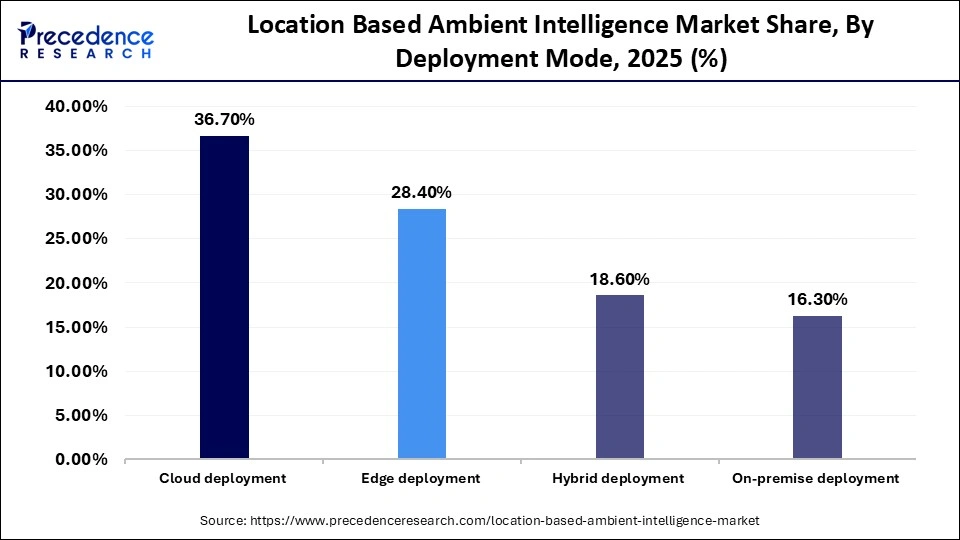
Cloud platforms support central processing of analytics engines that decipher geospatial patterns and user context in a large, distributed environment. The necessity of real-time visibility of traffic sensors and mobility data streams in unified operation dashboards is driving demand for cloud-based architectures.
The hybrid deployment segment is expected to gain the highest market share between 2026 and 2035, as organizations increasingly balance cloud scalability with localized processing requirements. The increasing interest in issues of data privacy, latency control, and regulation is expected to drive the move towards the adoption of hybrid deployment models in intelligent spatial systems.
Use Case Insights
How the Indoor Navigation and Wayfinding Segment Dominated the Market?
The indoor navigation and wayfinding segment held a dominant revenue share of approximately 24.8% in the location based ambient intelligence market in 2025, due to the growing need for complex indoor environments to have smart positioning support for visitors and operational staff. Furthermore, the public infrastructure modernization programs also accelerated the expansion of indoor wayfinding platforms across smart public facilities.
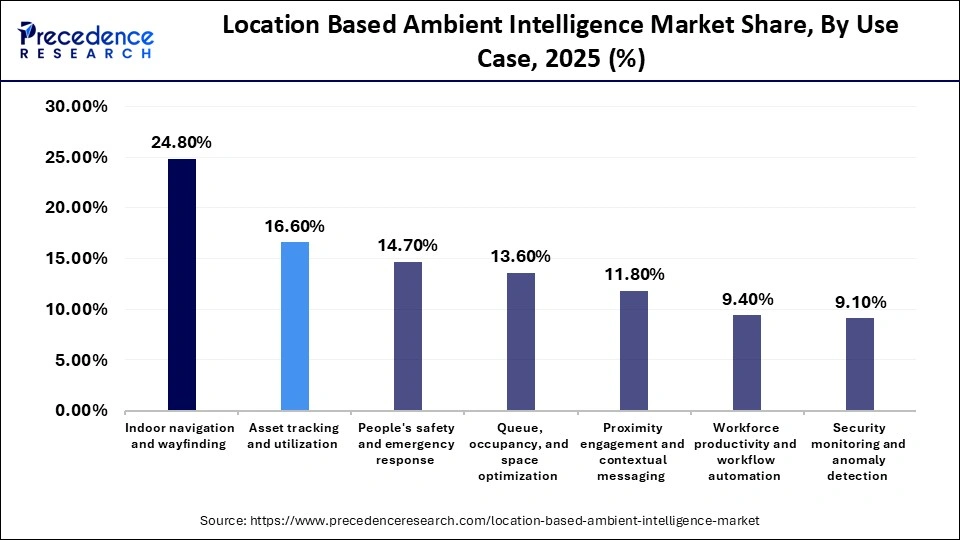
The proximity engagement and contextual messaging segment is expected to witness the fastest growth in the market over the forecast period, as organizations desire real-time interaction with users depending on their exact location. It is expected that the rapid increase in the number of connected mobile devices and IoT sensors boost the use of proximity engagement systems in business premises.
End User Insights
Why Did the Retail and Commercial Venues Segment Dominate the Market?
The retail and commercial venues segment contributed the biggest revenue share of approximately 30.6% in the location based ambient intelligence market in 2025, as businesses increasingly deploy spatial intelligence systems to understand customer movement and optimize store layouts. Furthermore, the commercial sector digitalization initiatives further strengthened the adoption of intelligent spatial analytics across retail environments.
The logistics and warehousing segment is expected to expand rapidly in the market in the coming years, as global supply chains are increasingly relying on precise information about assets within distribution facilities. Additionally, the rapid expansion of automated warehouses and robotics systems is anticipated to accelerate spatial intelligence adoption across the logistics sector.
Regional Insights
North America Location Based Ambient Intelligence Market Size and Growth 2026 to 2035
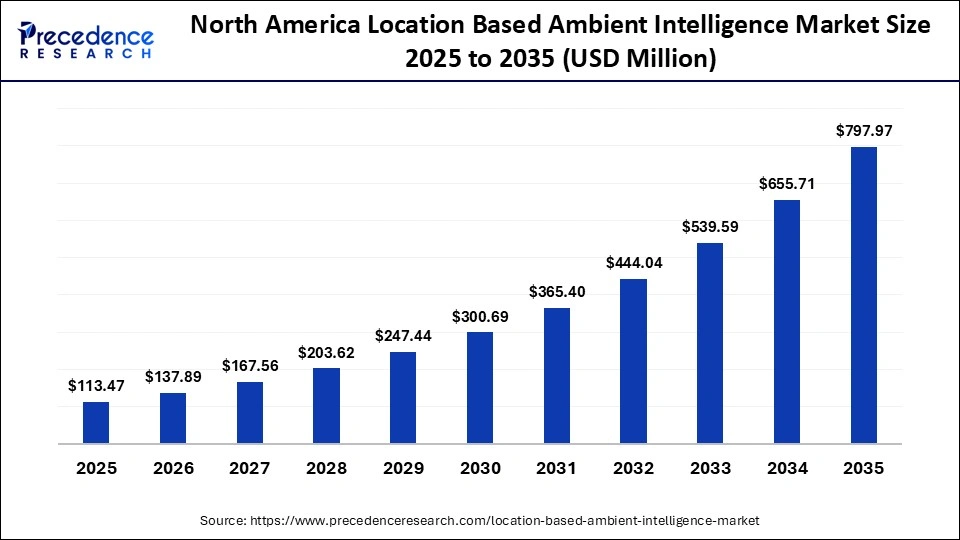
The North America location based ambient intelligence market size is estimated at USD 113.47 billion in 2025 and is projected to reach approximately USD 797.97 billion by 2035, with a 21.54% CAGR from 2026 to 2035.
Why North America Dominated the Location Based Ambient Intelligence Market?
North America held a major revenue share of approximately 34.6% in 2025, due to strong infrastructure investment and early adoption of advanced location-based technologies. It is anticipated that further imbibition of high-speed connectivity, edge AI, and cloud analytics should remain a leader of advanced spatial ecosystems in North America.
U.S. Location Based Ambient Intelligence Market Size and Growth 2026 to 2035
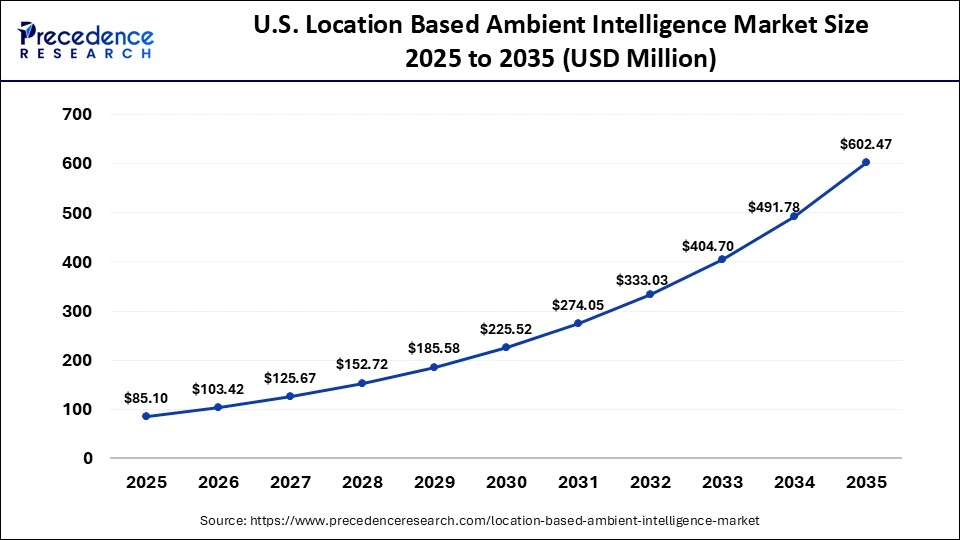
The U.S. location based ambient intelligence market size is calculated at USD 85.10 billion in 2025 and is expected to reach nearly USD 602.47 billion in 2035, accelerating at a strong CAGR of 21.62% between 2026 and 2035.
U.S.: Driving North America's Growth in Intelligent Spatial Systems
U.S. leads the market, driven by its advanced telecom infrastructure and strong institutional support for next-generation networks. The government-industry partnerships also generated new interoperability standards for the IoT and positioning technology that should be deployed across platforms with confidence. Additionally, these combined developments strengthened the position of the U.S. as a primary driver of intelligent spatial system adoption across North America.
How is Asia-Pacific Growing in the Location Based Ambient Intelligence Market?
Asia-Pacific is expected to host the fastest-growing market in the coming years, owing to significant investments in 5G connectivity and digital infrastructure that supports IoT and proximity sensing frameworks. The GSMA reported that 5G adoption in the Asia-Pacific stood at about 18 % of mobile connections in 2024, and industry projections estimate this share could rise significantly through the decade.
Urbanization trends within megacities drive the need to adopt real-time indoor positioning, smart mobility systems, and IoT systems that establish linkages between sensors and analytic engines. Furthermore, the regulatory support for spectrum allocation and IoT frameworks accelerated the rollout of low-latency networks in Australia, Singapore, and South Korea.
China: Leading Growth in Asia-Pacific's Intelligent Spatial Infrastructure
China is leading the charge in Asia-Pacific, facilitated by rapid adopters of digital connectivity and sensor network deployments that enable intelligent ambient systems. The country has also pursued IPv6 rollout initiatives that have led to an estimated 865 million active IPv6 users by mid 2025, providing a scalable internet addressing framework for future connected devices and spatial systems. Moreover, as digital transformation efforts continue across China's economic and industrial hubs, the country is anticipated to drive a substantial portion of the Asia-Pacific's growth in intelligent spatial infrastructure.
What are the Advancements in the Location-Based Ambient Intelligence Market in Europe? 
The European market is expected to experience significant growth during the projected period. This expansion is powered by the rapid roll-out of IoT networks, AI-driven analytics, and advanced infrastructure projects. This, coupled with a strong emphasis on digital transformation in the region – along with compliance with privacy-preserving requirements under the GDPR – promotes the adoption of edge computing and on-device intelligence solutions that reduce data exposure while enhancing real-time responsiveness. Also, European initiatives for interoperable IoT ecosystems and integration of smart devices are advancing both context-aware computing and indoor positioning technologies.
Germany Market Trends 
Germany's leadership is driven by large investments in sectors encompassing Industry 4.0, intelligent infrastructure, industrial IoT applications, and smart mobility systems. Furthermore, privacy frameworks adhering to GDPR have driven innovations in edge AI and secure localization technologies, creating Germany the central hub of privacy-focused ambient intelligence deployments for Europe.
What are the Key Trends in the Location-Based Ambient Intelligence Market in Latin America? 
The Latin American market is expected to witness significant growth, thanks to IoT integration embedded in real-time location analytics across the domains of public transportation, logistics, healthcare, and retail. One major trend is that more and more warehouses, airports, and manufacturing facilities are already equipped with artificial intelligence for indoor navigation and asset-tracking systems, with added support from advancing 5G networks and cloud infrastructure. At the same time, there is increasing cooperation between government entities and tech companies to transform urban spaces through smart mobility solutions, predictive analytics tools, and adaptive environmental monitoring platforms.
Brazil Market Trends
In Brazil, market growth is driven by the installation of real-time sensor networks along with connected surveillance systems; smart mobility innovations; and data-driven public safety initiatives. In this sense, the country's National IoT Plan and its Digital Transformation Strategy accelerate the adoption of location-based solutions across a myriad of sectors, including healthcare, logistics, industrial automation processes, and government.
How is the Middle East and Africa Region Growing in the Location-Based Ambient Intelligence Market? 
The Middle East and Africa are expected to have significant market growth in the upcoming years, due to the increasing deployment of 5G-enabled IoT networks that support high-precision positioning, predictive monitoring, and automated decision-making across airports, logistics hubs, healthcare facilities, and smart buildings. Furthermore, the trends in development of edge AI (a form of intelligent decision support) and sensor fusion for urban safety systems, traffic control, and energy efficiency in densely crowded cities are also taking shape. With the adoption of smart city technologies (such as IoT in place from here on out) Gulf nations; the UAE and Saudi Arabia, leading the way are the leading regional markets.
UAE Market Trends
The country leads the region because of its state-of-the-art smart city development and integration strategies of artificial intelligence with other sectors, and its advanced infrastructure for the Internet of Things. Cities and towns within this country are equipped as intelligent urban frameworks that integrate real-time location analytics with AI-driven surveillance systems, smart mobility solutions, and interconnected public services in an urban environment.
Location Based Ambient Intelligence Market Supply Chain Analysis
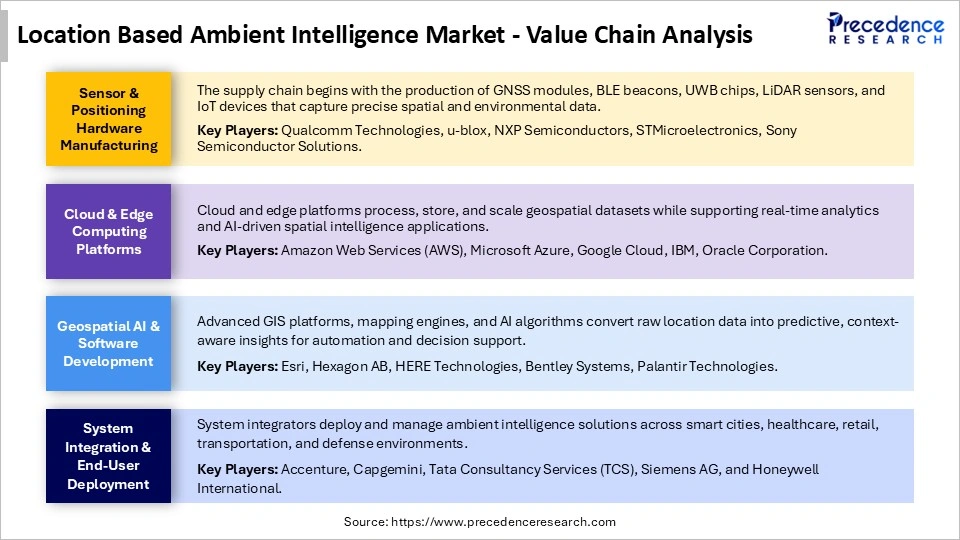
Location Based Ambient Intelligence Market Companies
- Apple
- Bosch
- Cisco
- Esri
- HERE Technologies
- Honeywell
- HPE Aruba Networking
- Juniper Networks (Mist)
- Microsoft
- NEC
- Qualcomm
- Siemens
- Thales
- Zebra Technologies
Recent Developments
- In January 2026, Lenovo introduced Lenovo Qira, a cross-device AI system, also branded as Motorola Qira, that integrates intelligence across apps and devices. Lenovo Qira provides a continuous, collaborative AI experience rather than a traditional assistant, aiming to make device interaction seamless and context-aware.(Source: https://news.lenovo.com)
- In September 2025, OpenSpace announced a Spatial AI breakthrough enabling real-time indoor positioning on smartphones as a part of its Visual Intelligence Platform. The technology addresses the limitations of GPS indoors, improving navigation, asset tracking, and field productivity in industries relying on accurate location data.(Source: https://www.prnewswire.com)
Segments Covered in the Report
By Location Technology
- GPS And GNSS Positioning
- Cellular Positioning
- Wi-Fi Positioning
- Bluetooth Low Energy Beacons
- Ultra-Wideband Positioning
- Computer Vision Positioning
- RFID Positioning
- Inertial Measurement and Dead Reckoning
By Ambient Intelligence Layer
- Context Inference and Reasoning Engine
- Predictive Analytics and Forecasting
- Real Time Decisioning and Orchestration
- Digital Twin and Simulation
- Personalization and Recommendation Engine
- Privacy, Consent, and Governance Layer
By Deployment Mode
- Cloud Deployment
- Edge Deployment
- Hybrid Deployment
- On-Premise Deployment
By Use Case
- Indoor Navigation and Wayfinding
- Asset Tracking and Utilization
- People's Safety and Emergency Response
- Queue, Occupancy, and Space Optimization
- Proximity Engagement and Contextual Messaging
- Workforce Productivity and Workflow Automation
- Security Monitoring and Anomaly Detection
By End User
- Retail and Commercial Venues
- Healthcare Providers
- Logistics and Warehousing
- Manufacturing Plants
- Smart Buildings and Campuses
- Transportation Hubs
- Public Sector and Smart Cities
By Region
- North America
- Asia Pacific
- Europe
- Latin America
- Middle East & Africa
For inquiries regarding discounts, bulk purchases, or customization requests, please contact us at sales@precedenceresearch.com
Frequently Asked Questions





Ask For Sample
No cookie-cutter, only authentic analysis – take the 1st step to become a Precedence Research client
 Get a Sample




 sales@precedenceresearch.com
 Schedule a Meeting
