



Location Analytics Tools Market Trends, Companies, Revenue / Sales Performance, Subscriber Growth, Pricing Strategies, Cloud Adoption, Infrastructure Expansion, Competitive Landscape, and Industry Outlook
Location Analytics Tools Market (By Component Type: Software Platforms, Services; By Deployment Type: Cloud-Based Solutions, On-Premise Solutions; By Technology Type: Geographic Information Systems (GIS), Spatial Data Analytics, Artificial Intelligence & Machine Learning, Big Data Analytics Platforms, Other Spatial Intelligence Technologies; By Application Type: Site Selection & Location Planning, Sales & Marketing Optimization, Supply Chain & Logistics Optimization, Risk & Fraud Detection, Asset Tracking & Monitoring; By Industry Type: Retail & E-commerce, Transportation & Logistics, Telecommunications, Government & Public Sector, Healthcare & Life Sciences, Other Industries) - Global Industry Analysis, Size, Trends, Leading Companies, Regional Outlook, and Forecast 2026 to 2035
Source: https://www.precedenceresearch.com/location-analytics-tools-market
 Get a Sample
 Table Of Content


What is the Location Analytics Tools Market Size in 2026?
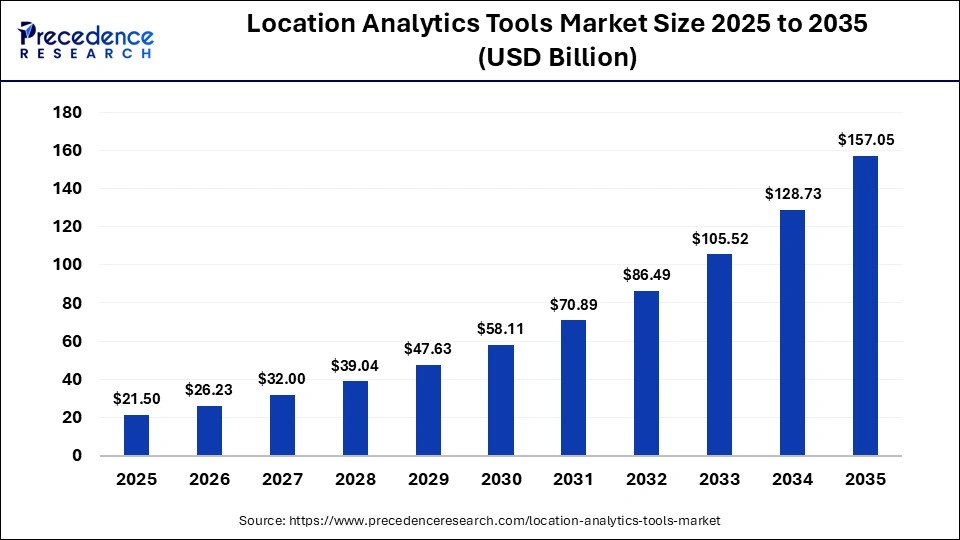
The global location analytics tools market size accounted for USD 21.50 billion in 2025 and is predicted to increase from USD 26.23 billion in 2026 to approximately USD 157.05 billion by 2035, expanding at a CAGR of 22.00% from 2026 to 2035. The market is driven by the growing demand for real-time location information, the adoption of AI and cloud analytics, and the increasing use of spatial data in retail, logistics, and smart cities.
Key Takeaways
- North America led the location analytics tools market with the largest share of approximately 38% in the global market in 2025.
- Asia Pacific is expected to grow at the highest CAGR during the forecast period.
- By component type, the software platforms segment led the market and held approximately 56% share in 2025.
- By component type, the services segment is expected to grow at the highest CAGR during the forecast period.
- By deployment type, the cloud-based solutions segment dominated the market with approximately 58% share in 2025.
- By deployment type, the on-premises solutions segment is expected to grow at a notable CAGR between 2026 and 2035.
- By technology type, the geographic information systems (GIS) platforms segment led the location analytics tools market and captured 33% share in 2025.
- By technology type, the artificial intelligence and machine learning segment is expected to expand at the highest CAGR from 2026 to 2035.
- By application type, the site selection and location planning segment led the market with approximately 26% share in 2025.
- By application type, the asset tracking and monitoring segment is expected to expand at the highest CAGR from 2026 to 2035.
- By industry type, the retail and e-commerce segment led the market and captured approximately 24% share in 2025.
- By industry type, the transportation and logistics segment is expected to expand at the highest CAGR from 2026 to 2035.
What is the Location Analytics Tools Market?
The global market includes software platforms and analytics technologies that analyze spatial and geographic data to generate insights for business decision-making. These tools integrate geographic information systems (GIS), big data analytics, and artificial intelligence to interpret location-based data from sources such as GPS devices, smartphones, satellites, and IoT sensors. Organizations use location analytics tools to optimize site selection, supply chain operations, asset tracking, urban planning, and targeted marketing strategies.
How is AI contributing to the Location Analytics Tools Market?
AI is propelling the market by enabling the conversion of simple mapping solutions into smart decision platforms. It not only provides information about geographical locations, but also uses large amounts of location-related data from GPS, mobile devices, and sensors to identify patterns and trends. AI facilitates predictive capabilities to help businesses predict demand, movement, and risks in a particular location. AI also provides real-time decision support, such as route optimization. AI also provides hyperlocal analysis capabilities, enabling businesses to have in-depth knowledge of a particular neighborhood for effective targeting and planning.
Location Analytics Tools Market Trends
- Collaborations and Partnerships: Location guidance companies are collaborating with technology companies to leverage mapping data, analytics, and cloud infrastructure. This enables them to improve the quality of data and use cases. For instance, Esri partnered with TomTom to integrate detailed traffic and mapping information into their platform, facilitating customers to make better location-based decisions.
- Government Initiatives: Governments are utilizing location analytics for their smart city initiatives, public safety, and infrastructure development. This boosts the adoption of advanced spatial analytics. For instance, in India, Greater Chennai Police launched GIS-based crime mapping to analyze crime patterns and enhance law enforcement planning.
- Business Expansions: Location guidance companies are expanding their businesses through new market entry, new solution offerings, and acquiring other companies. This enables them to enhance technology and reach more customers. Expansions enable them to offer advanced capabilities such as 3D mapping and digital twins. For instance, Bentley Systems acquired Cesium to enhance geospatial and visualization capabilities.
Market Scope
| Report Coverage | Details |
| Market Size in 2025 | USD 21.50 Billion |
| Market Size in 2026 | USD 26.23 Billion |
| Market Size by 2035 | USD 157.05 Billion |
| Market Growth Rate from 2026 to 2035 | CAGR of 22.00% |
| Dominating Region | North America |
| Fastest Growing Region | Asia Pacific |
| Base Year | 2025 |
| Forecast Period | 2026 to 2035 |
| Segments Covered | Component Type, Deployment Type, Technology Type, Application Type, Industry Type, and Region |
| Regions Covered | North America, Europe, Asia-Pacific, Latin America, and Middle East & Africa |
Segmental Insights
Component Type Insights
Why Did the Software Platforms Segment Dominate the Analytics Tools Market?
The software platforms segment dominated the location analytics tools market with approximately 56% share in 2025. The growth of this segment is because it is the core system used for processing and analysis of location data. This segment is capable of handling various sources of data, facilitating a clear and accurate view. The software platforms are highly scalable, especially when using cloud-based systems, and can be easily updated. This segment also provides real-time insights and predictive analytics.
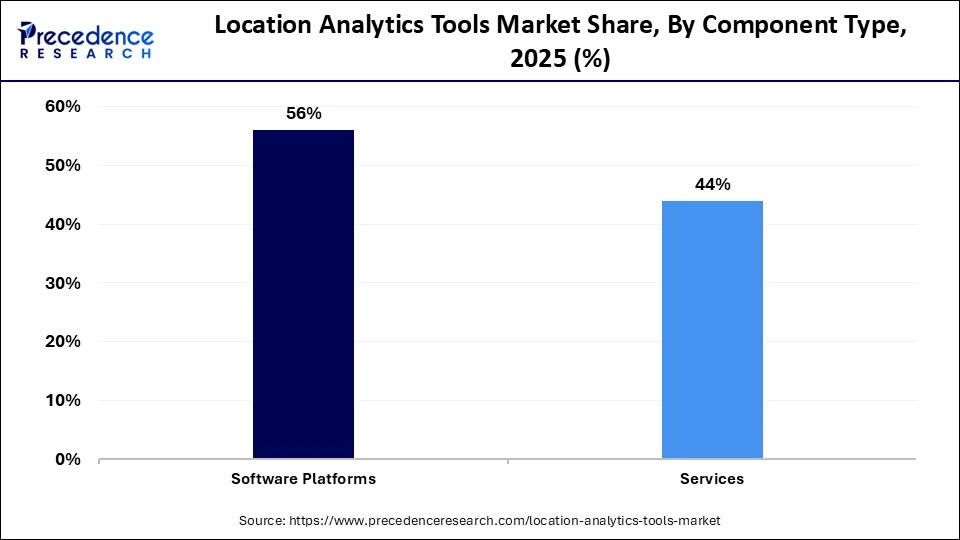
The services segment is expected to grow at the highest CAGR from 2026 to 2035. The market growth of this segment is due to the rising requirement for assistance to implement and leverage location analytics by organizations. The increasing complexity of solutions with AI and real-time analytics is driving the demand for managed services. There is also a continuous need for customization and support due to the rising adoption of location analytics in various industries.
Deployment Type Insights
How did the Cloud-Based Solutions Segment Dominate the Market in 2025?
The cloud-based solutions segment led the location analytics tools market with approximately 58% share in 2025. The market growth of this segment is because of its flexibility and ease of implementation. This is because organizations can use location analytics solutions without requiring much infrastructure upfront. Cloud platforms can be scaled quickly, which means firms can scale their solutions across different locations as needed. This segment provides the ability to process data in real-time and integrate with various data sources.
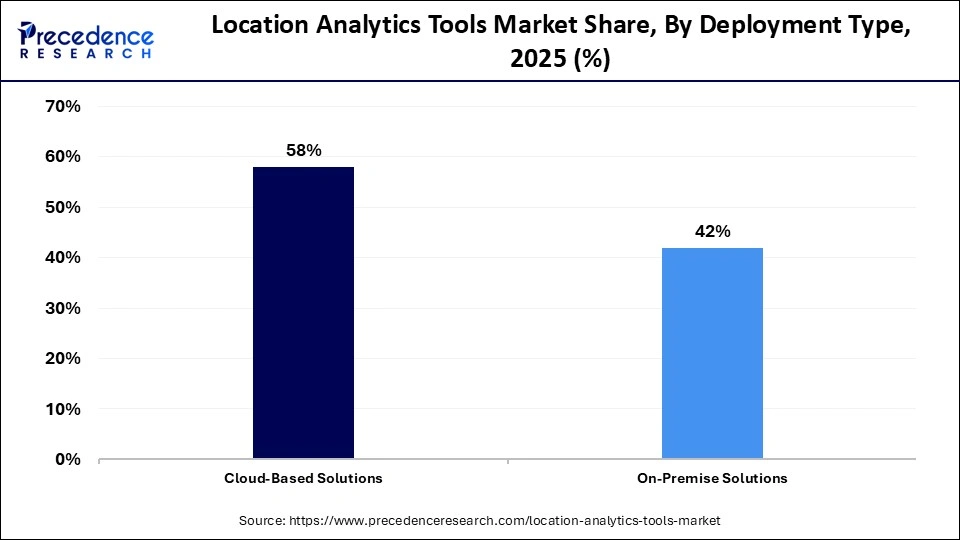
The on-premises solutions segment is expected to grow at a notable CAGR during the forecast period. The market growth of this segment can be attributed to rising concerns about data security and control. Companies dealing with sensitive location data adopt on-premise solutions to satisfy the strict regulatory and privacy norms. On-premise solutions provide better customization and control over the system's performance, which is a significant factor for large-scale organizations and government applications.
Technology Type Insights
Which Technology Segment Dominated the Market in 2025?
The geographic information systems (GIS) platforms segment dominated the location analytics tools market and held approximately 33% share in 2025. The market growth of this segment is because it is the basis of location analytics. GIS is the primary solution for mapping and spatial analysis. Most location intelligence applications begin with GIS solutions. This segment facilitates the integration of various data sets, such as demographics, traffic, and infrastructure. GIS is widely adopted in sectors such as urban planning, retail, utilities, and transportation.
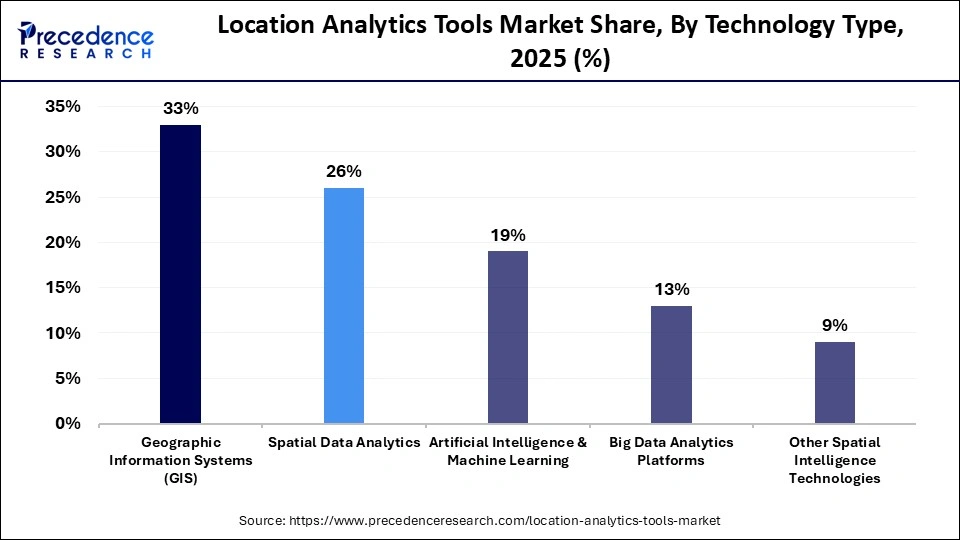
The artificial intelligence and machine learning segment is expected to grow at the highest CAGR during the forecast period. The market growth of this segment is due to a trend shifting from simple mapping to predictive and automated analytics. AI has the capability to analyze patterns, predict demand, and detect risks from a massive amount of location data. The growing adoption of automation, smart city projects, and enhanced customer targeting are fueling the market growth of this segment.
Application Type Insights
Why Did the Site Selection and Location Planning Segment Dominate the Market?
The site selection and location planning segment dominated the location analytics tools market and held approximately 26% share in 2025. The market growth of this segment can be attributed to its adoption in organizations for location analytics to identify the optimal location for their business. Firms consider variables such as customer demographics and foot traffic. This segment is widely adopted in sectors such as retail, property, banking, and logistics, where the selection of optimal locations helps to increase profits and minimize risks.
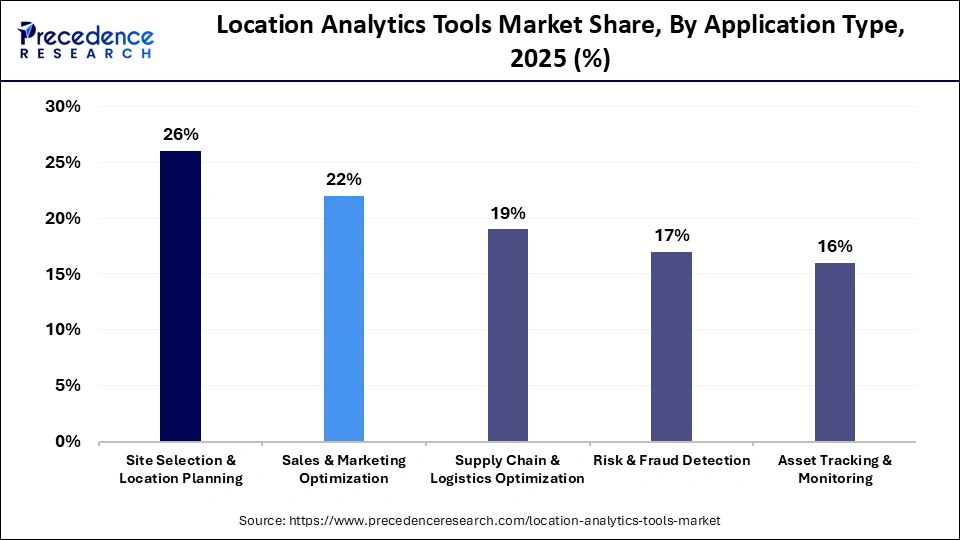
The asset tracking and monitoring segment is expected to grow at the highest CAGR during the forecast period. The market growth of this segment is due to the increasing need for real-time location visibility. Organizations are looking to monitor their vehicles, assets, and shipments on a constant basis to increase efficiency and minimize losses. The development of IoT technology is also contributing to the growth of this segment because it facilitates continuous data collection and tracking.
Industry Type Insights
Why Did the Retail and E-Commerce Segment Dominate the Market in 2025?
The retail and e-commerce segment dominated the location analytics tools market and held approximately 24% share in 2025. The market growth of this segment is because retail and e-commerce businesses depend largely on location insights to boost sales and customer experience. Analytics assist in determining the location of stores, delivery routes, and marketing campaigns based on customer behavior and demographics. The market growth of this segment is further driven by the large customer base, high transaction rates, and data-driven decision-making.
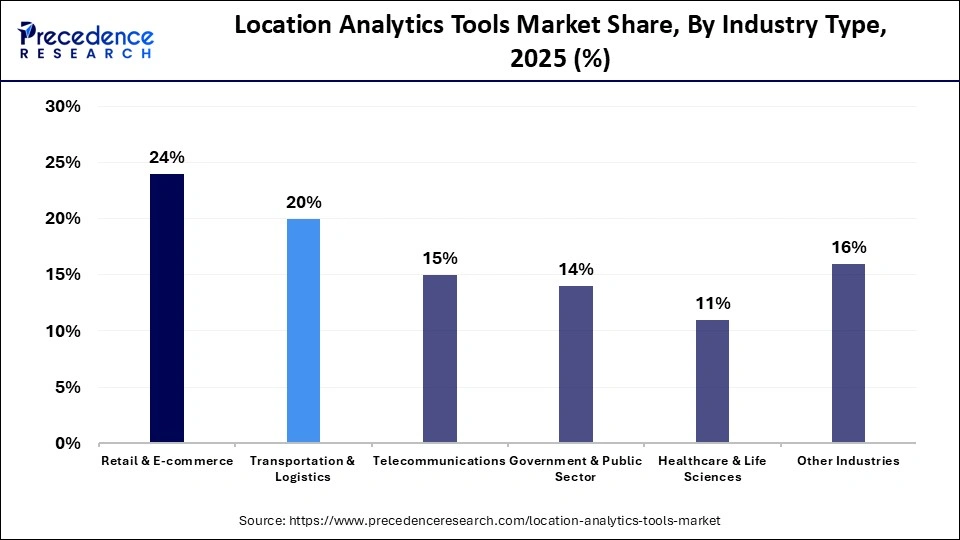
The transportation and logistics segment is expected to grow at the highest CAGR during the forecast period. The market growth of this segment is because organizations require real-time tracking and route optimization to minimize costs and maximize delivery efficiency. Location analytics enables firms to track vehicles, shipments, and fleets, facilitating quicker decision-making and better resource allocation. The growing demand for e-commerce and the development of global supply chains have driven the need for accurate asset tracking and predictive analytics.
Regional Insights
U.S. Location Analytics Tools Market Size and Growth 2026 to 2035
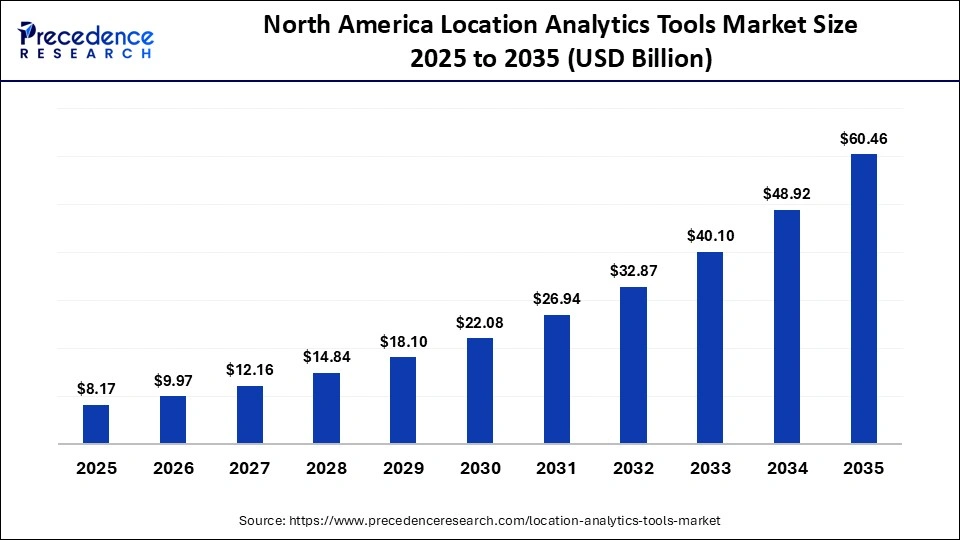
The North America location analytics tools market size is estimated at USD 8.17 billion in 2025 and is projected to reach approximately USD 60.46 billion by 2035, with a 22.16% CAGR from 2026 to 2035.
What Made North America the Leading Region in the Location Analytics Tools Market?
North America dominated the location analytics tools market with the largest share of 38% in the global market in 2025. The market growth in this region can be attributed to the widespread adoption of advanced technologies. Enterprises in this region are largely dependent on data-driven decision-making for retail, logistics, and urban planning. The presence of key market players, significant investment in AI, cloud infrastructure, GIS technology, and early adoption of smart city initiatives accelerate the market growth in North America.
U.S. Location Analytics Tools Market Size and Growth 2026 to 2035
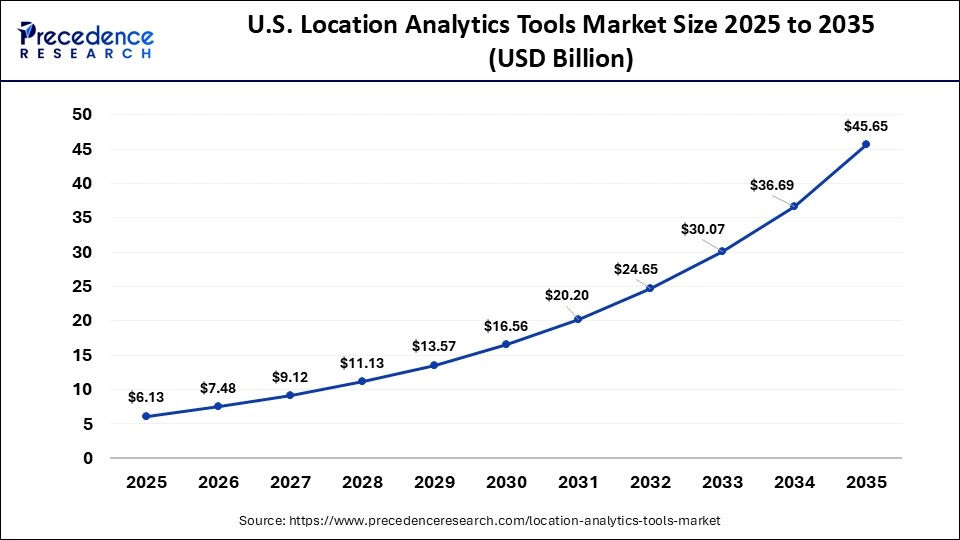
The U.S. location analytics tools market size is calculated at USD 6.13 billion in 2025 and is expected to reach nearly USD 45.65 billion in 2035, accelerating at a strong CAGR of 22.24% between 2026 and 2035.
U.S. Location Analytics Tools Market Analysis
The U.S. leads the market in North America because it is an innovation and adoption hub for cutting-edge location analytics solutions. The strong venture capital investment and vibrant startup community in the region accelerate the development of new software and AI-based solutions. The U.S. has a large number of research and development organizations and qualified talent, which helps in the quick deployment and adaptation of analytics solutions. The partnerships between companies and the government help in the development of large-scale pilot projects.
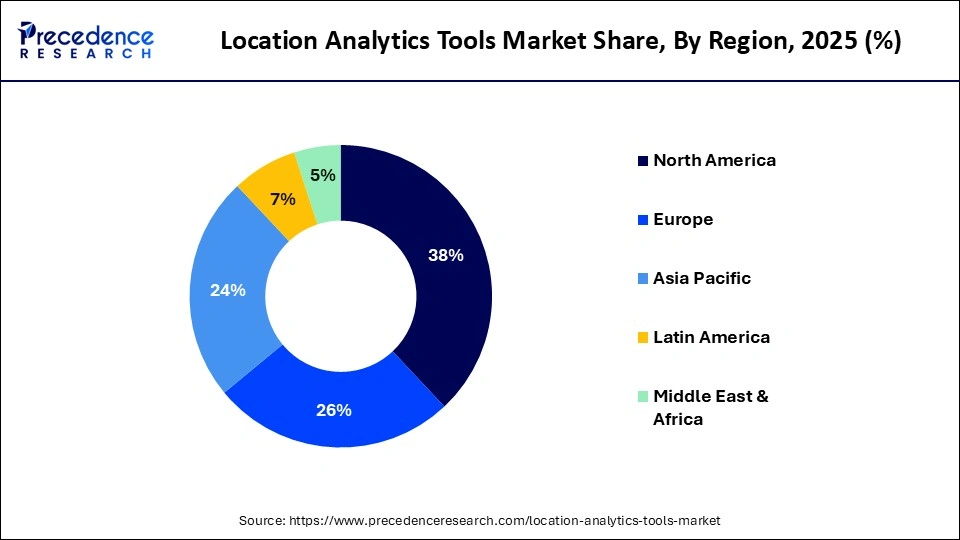
What Made Asia Pacific the Fastest Growing Region in the Location Analytics Tools Market?
Asia Pacific is expected to grow at the highest CAGR from 2026 to 2035. The market growth in this region can be attributed to increasing adoption of smartphones, IoT devices, and cloud-based solutions, which create a conducive environment for analytics. Several countries in this region are investing in the development of their infrastructure and embracing digital transformation, thereby increasing the demand for location-based insights in the transportation, logistics, and government sectors.
China Location Analytics Tools Market Trends
China leads the market in the Asia Pacific due to rapid digitalization and a large population, which results in the generation of a massive amount of location data. This data is utilized by businesses and the government for planning and optimization. The strong emphasis on smart cities, logistics, and AI technology in China drives the demand for advanced analytics platforms. Government initiatives for innovation in technology infrastructure development in sectors such as retail, transportation, and utilities drive the market growth in this country.
Location Analytics Tools Market Top Companies
- Alphabet Inc.
- Alteryx Inc.
- CartoDB Inc.
- Cisco Systems Inc.
- Esri Global Inc.
- Foursquare Labs Inc.
- Galigeo SAS
- GeoMoby Pty. Ltd.
- Infillion
- InMarket Media LLC
- IBM Corp.
- Kinetica DB Inc.
- Microsoft Corp.
- Oracle Corp.
- Pitney Bowes Inc.
Recent Developments
- In March 2025, ClarityX launched Places Pulse, which uses map and search information to provide insights on the movement of people and where they are going. This is very helpful for businesses and governments to understand demand patterns and trends in different areas, facilitating accurate location selection and marketing.(Source: https://smestreet.in)
- In February 2025, Esri released ArcGIS Location Platform with added functionalities such as batch geocoding and optimized routes for deliveries. These features make it simpler for developers and businesses to create location-enabled apps and conduct complex spatial analysis easily. (Source: https://www.esri.com)
Segments Covered in This Report
By Component Type
- Software Platforms
- GIS analytics platforms
- Spatial data visualization tools
- Services
- Consulting & implementation
- Managed analytics services
By Deployment Type
- Cloud-Based Solutions
- On-Premise Solutions
By Technology Type
- Geographic Information Systems (GIS)
- Spatial Data Analytics
- Artificial Intelligence & Machine Learning
- Big Data Analytics Platforms
- Other Spatial Intelligence Technologies
By Application Type
- Site Selection & Location Planning
- Sales & Marketing Optimization
- Supply Chain & Logistics Optimization
- Risk & Fraud Detection
- Asset Tracking & Monitoring
By Industry Type
- Retail & E-commerce
- Transportation & Logistics
- Telecommunications
- Government & Public Sector
- Healthcare & Life Sciences
- Other Industries
By Region
- North America
- Europe
- Asia-Pacific
- Latin America
- Middle East & Africa
For inquiries regarding discounts, bulk purchases, or customization requests, please contact us at sales@precedenceresearch.com
Frequently Asked Questions





Ask For Sample
No cookie-cutter, only authentic analysis – take the 1st step to become a Precedence Research client
 Get a Sample




 sales@precedenceresearch.com
 Schedule a Meeting
