



Next-Generation Firewall (NGFW) Market Trends, Companies, Revenue / Sales Performance, Subscriber Growth, Pricing Strategies, Cloud Adoption, Infrastructure Expansion, Competitive Landscape, and Industry Outlook
Next-Generation Firewall (NGFW) Market (By Product/Type: Hardware NGFW, Virtual NGFW, Cloud-native NGF/FWaaS; By Component: Hardware Appliances, Software/Platform, Professional & Managed Services; By Deployment Mode: On-premises, Cloud-based, Hybrid; By End-user Industry: BFSI, Government & Defense, IT & Telecom, Healthcare, Retail & E-commerce) - Global Industry Analysis, Size, Trends, Leading Companies, Regional Outlook, and Forecast 2026 to 2035
Source: https://www.precedenceresearch.com/next-generation-firewall-market
 Get a Sample
 Table Of Content


What is the Next-Generation Firewall (NGFW) Market Size?
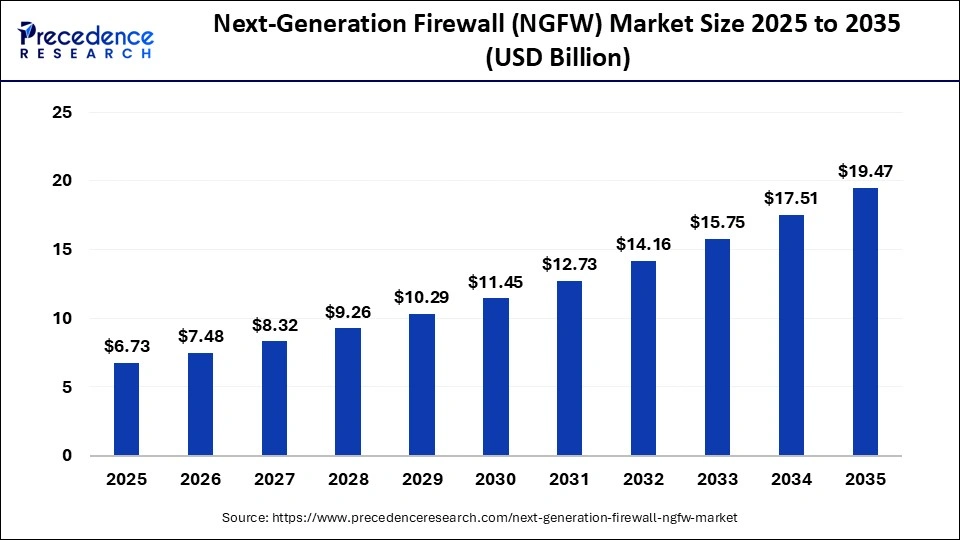
The global next-generation firewall (NGFW) market size is calculated at USD 6.73 billion in 2025 and is predicted to increase from USD 7.48 billion in 2026 to approximately USD 19.47 billion by 2035, expanding at a CAGR of 11.21% from 2026 to 2035. The market is substantially expanding due to the increasing well-organized cyber threats and technological complexities, owing to the rapid adoption of cutting-edge technologies that need high-level security, propelling the next-generation firewall (NGFW) market on a global scale.
Market Highlights
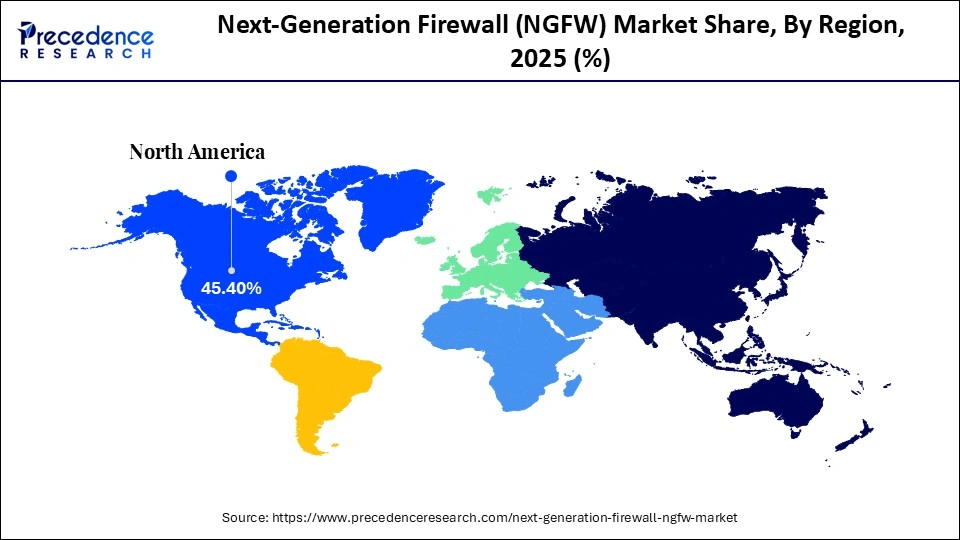
- North America accounted for the largest market share of 45.4% in 2025.
- The Asia Pacific is expected to grow at a solid CAGR of 10.5% from 2026 to 2035.
- By product/type, the hardware NGFW segment held the major market share of 58.5% in 2025.
- By product/type, the cloud-native NGFW/FWaaS segment is growing at anotable CAGR of 9.3% between 2025 and 2035.
- By component, the hardware appliances segment contributed the biggest market share of 58.4% in 2025.
- By component, the professional & managed services segment is poised to grow at a strong CAGR of 9.5% from 2026 to 2035.
- By deployment mode, the on-premises segment captured the highest market share of 56.4% in 2025.
- By deployment mode, the cloud-based segment is growing at a healthy CAGR of 9.8% between 2025 and 2035.
- By end user industry, the BFSI segment held the biggest market share of 42.3% in 2025.
- By end user industry, the healthcare segment is projected to grow at the fastest CAGR of 9.6% from 2026 to 2035.
Next-Generation Firewall (NGFW) Market Means: Deep Packet Inspection, Application Awareness, and Integrated Threat Prevention
Next-Generation Firewalls (NGFWs) are advanced cybersecurity platforms that go beyond the basic traffic filtering functions of traditional firewalls by combining multiple security capabilities into a single, policy-driven system. In addition to controlling network access, NGFWs provide application-level visibility, intrusion prevention, deep packet inspection, and integrated threat intelligence to identify and block sophisticated attacks. Features such as SSL/TLS decryption and user- and identity-based policy enforcement allow organizations to inspect encrypted traffic and apply granular security controls based on users, devices, and applications rather than just IP addresses and ports.
NGFWs are deployed across on-premises data centers, cloud environments, and hybrid architectures to secure east–west and north-south traffic while supporting secure access for remote and mobile users. Their role has expanded as enterprises adopt cloud services, enable hybrid work models, and rely on distributed IT environments that increase the attack surface. Rising cyber threats, stricter regulatory and compliance requirements, and the need for consistent security policy enforcement across locations are driving adoption. In addition, NGFWs are increasingly integrated with Secure Access Service Edge architectures, positioning them as a core control point for unified network security and access management in modern enterprise environments.
AI Shifts in the Next-Generation Firewall (NGFW) Market
The integration of AI with next-generation firewalls is experiencing transformative changes by understanding how neural network works and strengthening the analysis to detect subtle changes and anomalies that may reveal potential cyber-attacks. AI tools can support security teams to analyze data authenticity like fingerprints, typing style, and voice patterns, and they can further analyze user behavior during sessions and trigger additional verification processes when needed.
Automation in cybersecurity is highly advisable due to a lack of skill and expertise to handle highly sophisticated and evolving cyberattacks that cannot be reduced only with human intervention; instead needed extra support with cutting-edge technologies. Automation with AI may help organizations to identify potential threats more quickly and help remove them easily.
Next-Generation Firewall (NGFW) Market Outlook
- Industry Growth Overview: The next-generation firewall (NGFW) market is experiencing a robust growth rate owing to the higher adoption rate of cutting-edge technologies, which, on the other side escalate the sophisticated cyberattacks like ransomware and phishing. Thus, many companies are opting for the next-generation cybersecurity solutions to prevent such attacks and comply with strict data privacy regulations, propelling the market's growth.
- Sustainability Trends: The market is witnessing major sustainability goals by integration of broader ESG goals, circular economy methods to reduce e-waste, and optimization of firewall configuration. Many marketers are incorporating the sustainability and ESG criteria into their business strategies and adding frameworks to follow them as per markets' demand.
- Major Investors: The major investors in the market are leading cybersecurity solution companies themselves, by heavily investing in research and product launch with an innovative approach. Palo Alto Networks, Fortinet, and Cisco are some of the leading companies in the next-generation firewall (NGFW) market. Fortinet launched the FortiGate 700G Series in May 2025 for campus networking and its safety.
Market Scope
| Report Coverage | Details |
| Market Size in 2025 | USD 6.73 Billion |
| Market Size in 2026 | USD 7.48 Billion |
| Market Size by 2035 | USD 19.47 Billion |
| Market Growth Rate from 2026 to 2035 | CAGR of 11.21% |
| Dominating Region | North America |
| Fastest Growing Region | Asia Pacific |
| Base Year | 2025 |
| Forecast Period | 2026 to 2035 |
| Segments Covered | Product/Type, Component, Deployment Mode, End-user Industry, and Region |
| Regions Covered | North America, Europe, Asia-Pacific, Latin America, and Middle East & Africa |
Segmental Insights
Product Insights
What Is the Prominence of Hardware NGFW in the Next-Generation Firewall (NGFW) Market?
Hardware NGFW: This segment held the largest market share of 58.5% in 2025, as it offers essential security with high-performance, along with deep packet inspection, integrated threat prevention, and an application control system. Hardware NGFW is evolving with the modern demands of security features. And they are central to deploying access to zero-trust networks.
Cloud-native NGFW/FWaaS: The segment is projected to grow at the fastest CAGR of 9.3% during the foreseeable period, expected to expand due to superior scalability and easier operations in comparison with conventional hardware systems. The solution can scale with cloud workloads and integrates with DevOps for easy and faster deployment that leads to better performance and cost efficiency.
Component Insights
Why Are Hardware Appliances Play Crucial Role in the Next-Generation Firewall (NGFW) Market?
Hardware Appliances: The segment held the largest market share of 58.4% in 2025, as hardware appliances are built with specific goals like application-specific ICs or NPUs and dedicated memory, which can be optimized for network traffic inspection and security functions only. These devices often come with backups like power supplies to ensure business continuity in case of sudden failure of any critical component.
Professional & Managed Services: The segment is projected to grow at the fastest CAGR of 9.5% during the foreseeable period, largely growing due to the offerings like managing complexity, addressing the loopholes, and a lack of skills to ensure up-to-date precaution, and optimizing performance efficiency. Professional and managed services ensure firewalls can be monitored continuously and updated against new vulnerabilities.
Deployment Mode Insights
Why Does On-Premises Deployment Mode Prevail in the Next-Generation Firewall (NGFW) Market?
On-Premises: The on-premises segment held the largest market share of 56.4% in 2025. The segment is dominating as on-premises firewalls offer unmatched safety for the internal network and defense strategy with multiple layers that allow inspection and traffic control between various internal sites. On-premises deployment further offers tangible benefits like direct control over data security, which is crucial for mission-critical systems.
Cloud-Based: This segment is projected to grow at the fastest CAGR of 9.8% during the foreseeable period, due to the increasing shift to leverage cloud-based deployment by leading industries that are highly required to meet evolving regulatory demands and deliver rapid updates, which is possible through cloud-based deployment.
End User Industry Insights
What Are the Benefits BFSI Industry Finds in the Next-Generation Firewall (NGFW) Market?
BFSI: This segment held the largest market share of 42.3% in 2025, driven by the highly regulated nature of the sector and its exposure to strict data protection and security requirements such as GDPR and PCI DSS. Organizations operating in this segment handle large volumes of sensitive data and are subject to frequent audits, making robust and auditable security controls a necessity rather than an option. Next-generation firewall deployment plays a central role in meeting these compliance obligations by enabling granular traffic inspection, application-level control, and identity-based policy enforcement.
Healthcare: This segment is projected to grow at the fastest CAGR of 9.6% during the foreseeable period, rapidly expanding as next-generation firewalls offer robust capabilities to protect sensitive data about patients, hospital staffs and other administrative details by using IPS and deep packet inspection to detect and block advanced practices of cyberattacks.
Regional Insights
How Big is the North America Next-Generation Firewall (NGFW) Market Size?
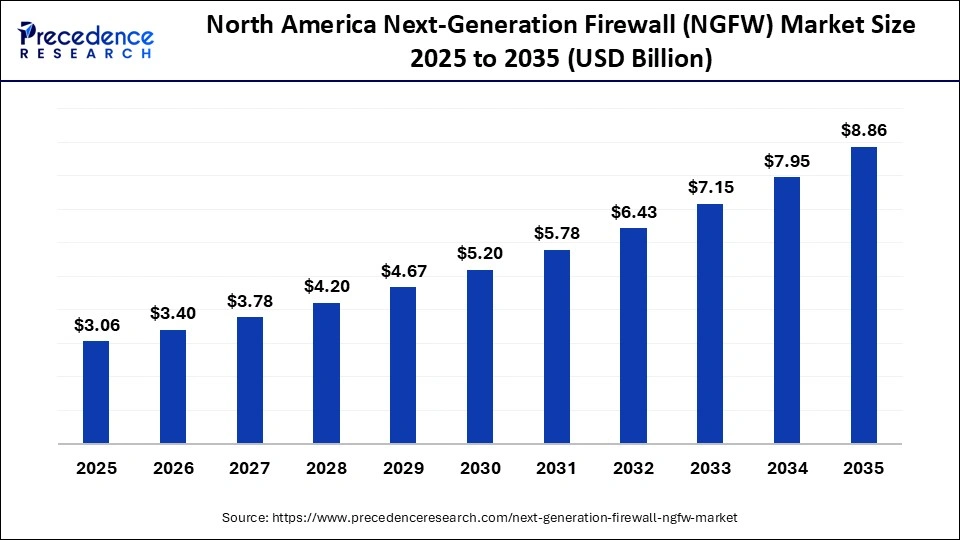
The North America next-generation firewall (NGFW) market size is estimated at USD 3.06 billion in 2025 and is projected to reach approximately USD 8.86 billion by 2035, with a 11.22% CAGR from 2026 to 2035.
What Factors Made North America a Dominant Region in the Next-Generation Firewall (NGFW) Market?
North America held the largest market share of 45.4% in 2025, driven by the region's early and sustained adoption of advanced cybersecurity technologies across enterprises and government institutions. Leading technology companies in the U.S. and Canada prioritize cybersecurity as a foundational component of digital infrastructure, which has accelerated the deployment of next-generation firewalls across data centers, cloud environments, and distributed networks.
The region is home to a large concentration of cybersecurity vendors that are continuously developing and enhancing next-generation firewall solutions in response to evolving threat vectors such as ransomware, zero-day exploits, and encrypted traffic attacks. Federal agencies and public-sector bodies actively promote cybersecurity initiatives through funding programs, regulatory guidance, and public-private partnerships, encouraging wider adoption of advanced network security controls. In parallel, collaboration among technology companies, security vendors, research institutions, and government organizations supports shared threat intelligence, joint R&D efforts, and faster innovation in detection and prevention capabilities. Together, these factors reinforce North America's leadership in the global next-generation firewall (NGFW) market.
What is the Size of the U.S. Next-Generation Firewall (NGFW) Market?
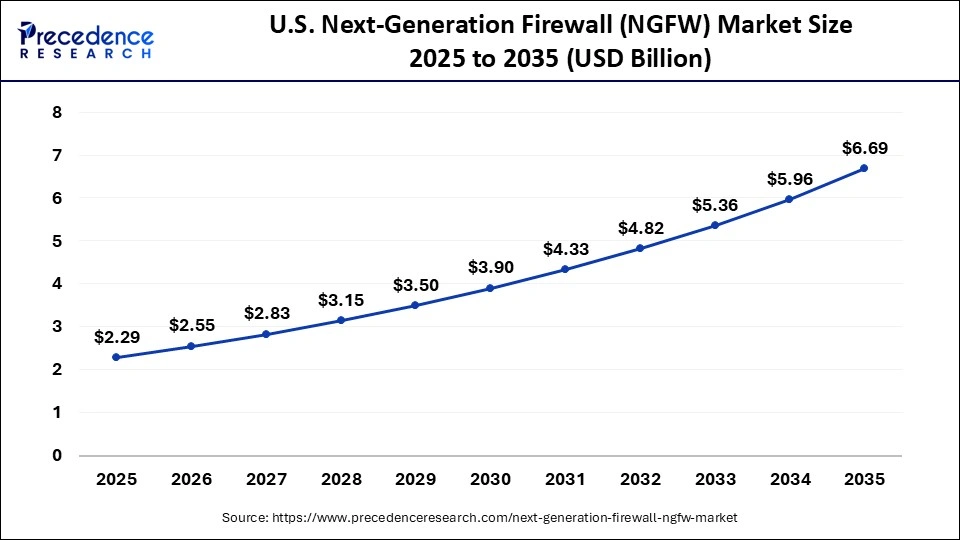
The U.S. next-generation firewall (NGFW) market size is calculated at USD 2.29 billion in 2025 and is expected to reach nearly USD 6.69 billion in 2035, accelerating at a strong CAGR of 11.32% between 2026 and 2035.
U.S. Next-Generation Firewall (NGFW) Market Trends
The region is expanding largely due to a couple of leading trends in the U.S. next-generation firewall (NGFW) market that include sophisticated cyber threats with AI, increasing remote work, growing cloud adoption, and strict regulations like CCPA/HIPAA, and an increasing push for high performance decryption. The increasing shift towards remote work is another crucial factor, supporting the market's growth.
- In 2024, the U.S. government implemented the cybersecurity maturity model certification framework, which states that defense contractors should meet specific cybersecurity standards aiming to secure confidential data.
Why Is Asia Pacific Rapidly Growing in the Next-Generation Firewall (NGFW) Market?
Asia Pacific is projected to grow at the fastest CAGR of 10.5% during the foreseeable period, driven by the widespread adoption of hybrid and remote work models across enterprises. As organizations shift to distributed work environments, demand is rising for advanced network security solutions that provide deep packet inspection, intrusion prevention, and application-level visibility to secure access across corporate networks, cloud platforms, and remote endpoints. This shift is particularly evident among technology, BFSI, and e-commerce enterprises that rely heavily on cloud-based applications and remote connectivity.
Growth is further supported by stricter data protection and localization requirements implemented across major economies such as China, India, Japan, and South Korea, which are pushing organizations to strengthen network-level security controls. Increasing integration of cloud computing, IoT devices, and edge infrastructure is expanding the attack surface, reinforcing the need for next-generation security solutions capable of granular traffic control and threat detection. In parallel, the rapid expansion of e-commerce and digital service platforms across the region is increasing demand for secure handling of customer data, real-time traffic analysis, and application-aware security policies, further accelerating market adoption.
China Next-Generation Firewall (NGFW) Market Trends
China is a major contributor to the expansion of the Asia Pacific next-generation firewall (NGFW) market, supported by large-scale digitization across industrial, commercial, and public-sector environments. The country is seeing rapid integration of Industrial IoT across manufacturing facilities, expansion of the fintech ecosystem, and continued digitization of government and enterprise infrastructure, all of which significantly increase network complexity and exposure to cyber threats. These trends are driving demand for next-generation firewall solutions that provide application-level visibility, intrusion prevention, and encrypted traffic inspection across both on-premises and cloud environments.
Growth is further reinforced by China's transition toward greener and more energy-efficient data centers, where NGFWs are deployed to secure high-density workloads while maintaining performance and scalability. Expansion of telecommunications infrastructure, particularly 5G networks, is increasing data traffic volumes and edge connectivity, creating additional requirements for advanced network security controls.
Why Is the European Next-Generation Firewall (NGFW) Market Experiencing a Rapid Growth Rate?
The market is witnessing strong growth across Europe, driven primarily by the rising frequency and sophistication of cyber threats, increasing complexity of enterprise IT environments, and stringent regulatory compliance requirements. As organizations expand their digital footprints across on-premises infrastructure, cloud platforms, and third-party ecosystems, the need for centralized and enforceable network security controls is becoming more critical. Regulations such as GDPR and sector-specific cybersecurity mandates are pushing enterprises to adopt solutions that provide granular visibility, audit-ready logging, and consistent policy enforcement.
Growth is further supported by widespread adoption of remote and hybrid work models, which have expanded network perimeters and increased reliance on secure access to cloud-based applications. At the same time, accelerating deployment of IoT devices across manufacturing, utilities, transportation, and smart city initiatives is introducing new entry points for cyber threats.
UK Next-Generation Firewall (NGFW) Market Analysis
The UK next-generation firewall (NGFW) market is experiencing accelerated growth, driven by increasing digitization across enterprises in sectors such as financial services, healthcare, retail, and government. As organizations expand their use of cloud platforms, digital customer interfaces, and remote work environments, the attack surface has widened, increasing demand for advanced cybersecurity solutions that provide application awareness, intrusion prevention, and encrypted traffic inspection. Rising incidents of ransomware, phishing, and supply chain attacks are reinforcing the need for industry-specific and compliance-ready security controls. Market growth is further supported by the strong presence of global cybersecurity vendors and an active domestic startup ecosystem, both of which are engaging in strategic partnerships to enhance threat detection capabilities and platform integration.
How Is the Middle East & Africa Contributing to the Growth of the Next-Generation Firewall (NGFW) Market?
The Middle East and Africa region is contributing to NGFW market growth primarily due to a sharp rise in cyberattacks targeting government institutions, financial services, energy infrastructure, and critical industries. Increasing incidents of ransomware, phishing, and nation-state-linked attacks are prompting organizations to strengthen network-level defenses, driving demand for next-generation firewall solutions that offer deep packet inspection, intrusion prevention, and real-time threat intelligence.
Regulatory developments across the region are further accelerating adoption. Governments are introducing stricter data protection, cybersecurity, and data sovereignty regulations that require enterprises to implement enterprise-grade security controls capable of enforcing granular policies and maintaining audit-ready logs. These requirements are particularly relevant in sectors such as banking, telecom, oil and gas, and public services, where sensitive data and operational continuity are critical.
UAE Next-Generation Firewall (NGFW) Market Analysis
The UAE is one of the major contributors to the growth of the Middle East and Africa next-generation firewall (NGFW) market. The region is predominated by highly advanced technological infrastructure and well-developed facilities for strong R&D. The UAE further imports a massive volume of internet security firewalls majorly from the U.S., China, and European countries. This strategic move reflects the country's long-term goal to become a technology hub.
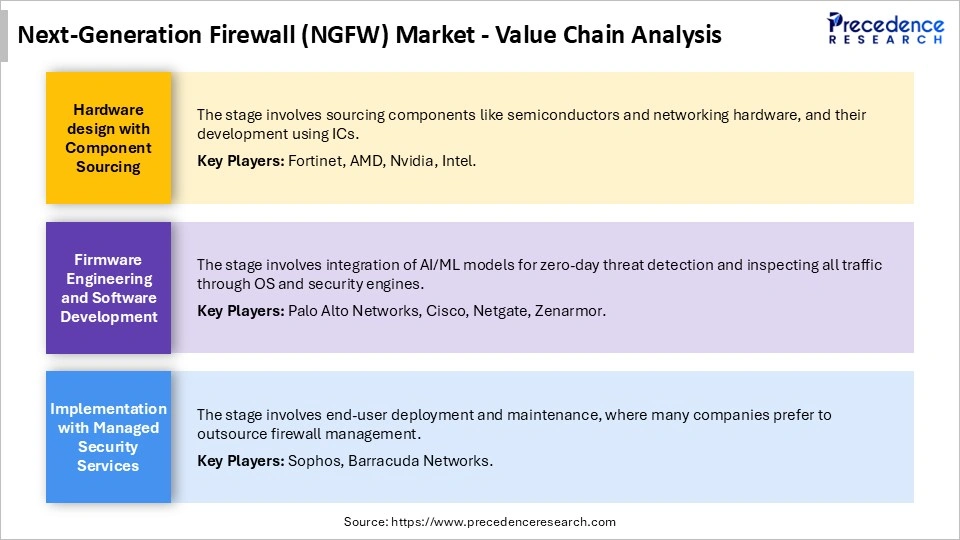
Next-Generation Firewall (NGFW) Market Value Chain
Next-Generation Firewall (NGFW) Market Companies
- Palo Alto Networks
- Fortinet
- Check Point Software
- Cisco Systems
- Juniper Networks
- Sophos
- SonicWall
- Barracuda Networks
- Forcepoint
- WatchGuard Technologies
- Hillstone Networks
- F5
- Huawei Technologies
- Trend Micro
- Zscaler
Recent Developments
- In November 2025, the global cybersecurity leader, Palo Alto Networks, announced their agreement with Chromosphere, a next-generation observability platform especially designed for AI evolution. This agreement will offer Palo Alto Networks the ability to support organizations in navigating through AI workload and growing demand for security foundations.(Source: https://www.paloaltonetworks.in)
- In May 2025, SonicWall launched a new suite of products and services by using next-generation firewalls, aiming to offer support to the evolving needs of managed service providers and consumers with end-to-end cyber protection, with service expansion on a large scale.(Source: https://www.prnewswire.com)
Segments Covered in the Report
By Product/Type
- Hardware NGFW
- Virtual NGFW
- Cloud-native NGF/FWaaS
By Component
- Hardware Appliances
- Softwar /Platform
- Professional & Managed Services
By Deployment Mode
- On-premises
- Cloud-based
- Hybrid
By End-user Industry
- BFSI
- Government & Defense
- IT & Telecom
- Healthcare
- Retail & E-commerce
By Region
- North America
- Europe
- Asia-Pacific
- Latin America
- Middle East and Africa
For inquiries regarding discounts, bulk purchases, or customization requests, please contact us at sales@precedenceresearch.com
Frequently Asked Questions





Ask For Sample
No cookie-cutter, only authentic analysis – take the 1st step to become a Precedence Research client
 Get a Sample




 sales@precedenceresearch.com
 Schedule a Meeting
