



Next-Generation Data Storage Market Trends, Pricing Strategies, Cloud Adoption, Infrastructure Expansion, and Industry Outlook
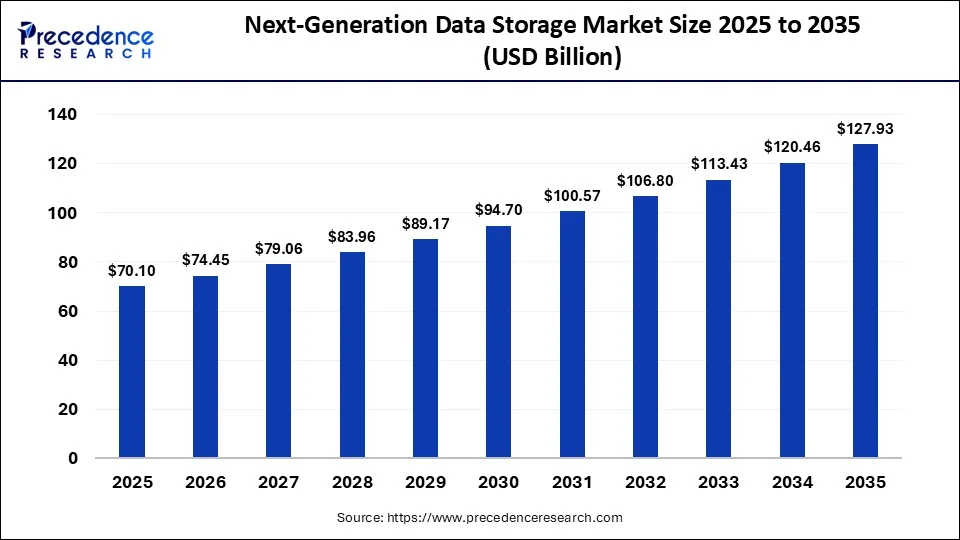
ICT industry specialist Gautam Mahajan estimates the next-generation data storage market at USD 74.45 billion in 2026, with continued technology adoption expected to take the market to USD 127.93 billion by 2035 at a CAGR of 6.20%. Leading next-generation data storage market providers such as Dell Technologies Inc. and Hewlett Packard Enterprise Company are expanding their capabilities across segments including storage medium, storage architecture, deployment mode, technology, enterprise size, application, and end user.
Source: https://www.precedenceresearch.com/next-generation-data-storage-market
 Get a Sample
 Table Of Content


Next-Generation Data Storage Market Size and Forecast 2026 to 2035
The global next-generation data storage market size is predicted to increase from USD 74.45 billion in 2026 to approximately USD 127.93 billion by 2035, expanding at a CAGR of 6.20% from 2026 to 2035.
Key Takeaways
- By Storage medium, solid-state drives (SSD) segment dominated the market with a share of 47% in 2026.
- By storage architecture, storage area network (SAN) segment dominated the market with a share of 27% in 2026.
- By storage architecture, software-defined storage (SDS) segment held a 14% share of the market in 2026 and is expected to grow at the fastest CAGR of 9.8% between 2026 and 2035.
- By deployment mode, on-premises segment dominated the market with a share of 42% in 2026.
- By deployment mode, cloud storage segment held a 39% share of the market in 2026 and is expected to grow at the highest CAGR of 8.9% between 2026 and 2035.
Market Size Description
The global next-generation data storage market is valued at USD 74.45 billion in 2026. The next-generation data storage market is projected to grow at a CAGR of 6.20% from 2026 to 2035. This rate of growth is a result of the rapid growth of digital in other parts of the world. Artificial intelligence workloads are increasing demand for high-capacity and high-performance storage infrastructure. Hyperscale data centers, cloud computing environments, and edge nodes are increasing demand for scalable storage capacity. Businesses in all industries are generating more data than ever before, on an annual basis. Pressure is added to sectors such as sensor telemetry, AI training sets and real-time analytics. This is in part the reason behind the storage buildout which will take place through 2026 and beyond.
Annual storage shipment volume says more than just dollar numbers. Seagate's total capacity shipped during a single recent quarter was 136.6 exabytes (EB) of nearline capacity, representing a 52% year-over-year increase. While other, legacy HDD capacity shipped grew 12 percent to 11.5 EB. Nearline exabyte capacity is already on allocation through calendar 2026, and there are long-term contracts with key cloud customers for additional capacity through calendar 2027. Storage pricing has increased in several categories amid strong AI-driven demand and constrained supply. On the other hand, hyperscale firms strive to maintain speed with ongoing storage increases driven by AI and planned for 2026 and 2027, these efficiencies are extremely important.
New data center deployments will set the PCIe 5.0 baseline, and NVMe drive shipments are projected to be over 60% of enterprise arrays. That is just the beginning of the Micron 9650, the world's first PCIe Gen6 data center SSD based on up to 2x the performance of PCIe Gen5 drives. This ensures maximum speed to power-hungry GPUs, maximizing AI performance. This introduces a further driver of growth in edge computing. Creating the need for low-latency, distributed storage at the location of data. Furthermore, these forces are all driving towards continued growth in the Next-Generation Data Storage Market by 2035. This is firmly rooted in AI infrastructure buildout, hyperscale demand, and the unabated rise of global data generation.
Market Snapshot
The next-generation data storage market carried a value of USD 74.45 billion in 2026. Industry watchers project a CAGR of 6.20% through 2035. Shipment volume tells the real growth story behind that figure. Pricing trends remain firmly upward, since AI-driven demand keeps outpacing available supply. Memory revenue is expected to nearly triple in 2026 alone. Driven by high-bandwidth memory and hyperscaler buying, DRAM revenues alone are projected to nearly triple in 2026 to USD 418.6 billion. Facilitated by demand for high-bandwidth memory and DDR from hyperscalers and AI infrastructure providers. Asia Pacific remains the dominant manufacturing region, anchoring the bulk of global wafer fabrication and storage component production.
North America has become the fastest-growing region commercially. Fueled by aggressive AI data center buildouts and record semiconductor equipment spending, forecast to hit USD 133 billion in 2026 and 14% to USD 151 billion in 2027, driven by surging AI chip demand for data centers and edge devices. HDD and NAND flash remain the two leading storage mediums powering this expansion. HAMR technology stands out as the fastest-growing storage innovation in recent times. Hyperscale and cloud data centers stand as the dominant application segment, consuming the bulk of both HDD and SSD output worldwide. On the other hand, the developments confirm that AI infrastructure, not traditional enterprise storage, now drives the commercial center of gravity for this entire market heading into 2027.
Executive Insights
AI-enabled demand has become the new paradigm for storage strategy in 2026. Enterprises are being compelled to modernize and move to the cloud faster. New technologies such as DNA storage, storage-class memory, and more are going from the research phase into real commercial use. According to TrendForce, in 2Q26 NAND Flash contract prices are forecast to increase 70-75% QoQ. Driven by the reallocation of capacity by suppliers into HBM, server DRAM, and enterprise SSD segments. The most promising areas for investment in AI through 2035 are AI-native storage platforms, domestic memory production, and hyperscale infrastructure.
Market Overview
What is Next-Generation Data Storage?
Next-generation data storage is new technologies designed to store both structured and unstructured data. These include NVMe flash, object storage, software-based systems, and archival media such as glass and DNA. These solutions handle the vast amounts of textual data, images, video, and sensor data. That can come out of the organization's workflows every day. They are now viewed as the foundation for enterprises to power their digital transformation (DX) initiatives in all industries. These moments highlight the advancement of archival technology. Further, to meet the demands of prolonged running, high performance, and the rise of AI and cloud infrastructure approaching 2027.
Evolution of Data Storage Technologies
In the last twenty years, there have been a number of generations in storage technology. Enterprise archives were all taken up by traditional HDD and magnetic tapes. Next, SSDs stepped in for workloads that require high performance, followed soon by new, high-speed NVMe interfaces. Next came software defined storage and object storage. This breaks the hardware-storage-locks-the-management-logic barrier. Predictive maintenance, deduplication and tiering, among other things, are now automated over large deployments with AI tools. Emerging formats are leading the conversation even further into the future, 2026. These parallel developments indicate that storage is developing not only in magnetic and optical modalities but in molecular and photonic modalities, entirely.
Scope of the Market
This encompasses everything from HDDs and NVMe SSDs to object storage platforms, archival media such as DNA and glass. It supports several deployment models such as on-premises, public cloud, hybrid deployments, and edge nodes. End users include hyperscale cloud providers, enterprises, government agencies, and media companies, as well as research institutions. Customers are served in geographic markets across North America, Asia Pacific, Europe, and emerging manufacturing in Southeast Asia.
The electrical and electronics (E&E) industry was the sole industry to have RM28.5 billion in approved electrical and electronic industry investments in 2026. Consolidating their positions as key industries in the manufacture of such goods and as a reliable hub in the global value chain for the electrical and electronic sector. This geographical dispersion is indicative of the global nature of today's storage manufacturing, deployment and use. That width helps lay the groundwork for the more in-depth technology and application analysis undertaken in the following paragraphs that make up the rest of this report.
Executive Market Intelligence
Key Industry Insights
The storage industry is experiencing a major paradigm shift in its identity like it has not seen in decades. Pure Storage dropped the word storage from its use of its name and rebranded on Feb. 23, 2026. They became Everpure, a provider of a fully integrated Enterprise Data Cloud. It's been storage administrators who we're not having conversations with who've been inhibiting us," Giancarlo said in reference to storage's impact on enterprise decision-making, data management, security, and AI strategy personas.
In response, NetApp has released the NetApp AI Data Engine, co-developed with Nvidia. This covers all data estates across on-prem, cloud, and edge locations with a smart index. AI customers grew by 76% YOY, while B2 Cloud Storage revenue increased 24% YOY in. Signaling the rapid adoption by smaller cloud providers of AI workloads. The actions reinforce the notion that storage vendors are pushing themselves downstream as intelligence platforms instead of being viewed as just another hardware vendor.
Five Critical Market Shifts
The way storage is built and sold is changing with five structural shifts. Most product roadmaps are now being driven by AI infrastructure. That demands higher throughput rather than just capacity. Vendors such as VAST Data have embraced cloud-native architectures too, such as VAST Data's announcement of pre-built. Open-source software pipelines that help transform Nvidia's AI blueprints into working ones running natively on VAST infrastructure. Edge storage continues to grow at a fast pace, and distributed AI inference moves beyond centralized data centers to remote locations. Enterprises are experiencing the fifth shift, and in its wake. Businesses are dropping siloed legacy systems in favor of data centres that are more or less unified and built for constant access to AI.
CEO Priorities
The dialogue is now more about data intelligence than specs, and storage vendor CEOs now converse in those terms. In the era of artificial intelligence. It's imperative that data can be accessed to produce competitive advantage, and Everpure's Enterprise Data Cloud does just that by unlocking data from any application silo. That empowers enterprises to leverage AI, automation, and analytics. AI model training and deployment gets hindered by the existence of scattershot data silos, making it enterprise leaders' task to align data estates. That backdrop is pushing every stakeholder, from vendors to investors, toward one shared priority: making storage an active, intelligent participant in AI workflows.
Market Trends
- AI Workloads Reshaping Enterprise Storage Infrastructure: To manage large language models, real-time inference, and high-volume training data. Organizations are turning to AI-optimized storage platforms. The need for GPUs to access high-throughput storage architectures is growing in hyperscale and enterprise settings.
- Rapid Expansion of Hyperscale Data Centers: Hyperscale data centers are growing to meet the needs of increasing enterprise workloads and AI applications. New data centres are increasingly adopting scalable, high-density storage solutions. This has the ability to efficiently manage vast amounts of data.
- NVMe Becoming the Enterprise Standard: Enterprise storage is being replaced with NVMe for lower latency and a substantial increase in data throughput. NVMe-over-Fabrics is becoming more popular. Enabling better storage performance in cloud and enterprise mission-critical applications.
- Growth of Software-Defined Storage: Software-defined storage is becoming popular. Due to its ability to streamline infrastructure management in hybrid and multicloud environments. Scalability enhanced with policy-based automation and hardware-independent approaches is helping to decrease operational complexity.
- Edge Computing Driving Distributed Storage: The deployment of the edge is driving an expectation for local storage. That can provide low-latency processing and real-time analytics. Distributed storage continues to grow across various manufacturing, telecommunications, and smart infrastructure initiatives globally.
- AI-enabled Autonomous Storage Management: Predictive analytics automatically balance storage capacity, workload distribution, and system performance through AI-powered platforms. Self-management features minimize administrative workload. While providing increased efficiency in storage and cyber-resilience.
Market Segmentation Analysis
Storage Medium Insights
Why Did Solid-State Drives (SSD) Emerge as the Dominant Segment in the Next-Generation Data Storage Market?
The solid-state drives (SSD) segment dominated the market with a share of 47% in 2026 and is expected to grow at the fastest CAGR of 9.3% in the coming years, due to accelerating deployment of AI servers, hyperscale cloud infrastructure, and enterprise digital transformation initiatives.
Storage Architecture Insights
How Did Storage Area Network (SAN) Capture the Largest Share of the Next-Generation Data Storage Market?
The storage area network (SAN) segment dominated the market with a share of 27% in 2026, due to the widespread enterprise demand for centralized, high-speed, and highly available storage across mission-critical workloads.
Next-Generation Data Storage Market Share, By Storage Architecture, 2026 (%)
| Storage Architecture | Market Share (%) | CAGR (%) |
| Direct Attached Storage (DAS) | 18.00% | 3.9 |
| Network Attached Storage (NAS) | 24.00% | 5.7 |
| Storage Area Network (SAN) | 27.00% (Dominating) | 5.8 |
| Software-Defined Storage (SDS) | 14.00% | 9.8% (Fastest Growing) |
| Object Storage | 11.00% | 8.6 |
| Hyperconverged Infrastructure (HCI) | 6.00% | 8.9 |
The software-defined storage (SDS) segment held a 14% share of the market in 2026 and is expected to grow at the fastest CAGR of 9.8% between 2026 and 2035, driven by increasing adoption of cloud-native applications, containerized workloads, and AI-driven infrastructure requiring flexible storage management.
Deployment Mode Insights
What Drove On-Premises Deployment to Lead the Next-Generation Data Storage Market?
The on-premises segment dominated the market with a share of 42% in 2026, due to the growing enterprise preference for complete control over mission-critical data, regulatory compliance, and cybersecurity.
The cloud storage segment held a 39% share of the market in 2026 and is expected to grow at the highest CAGR of 8.9% between 2026 and 2035, supported by rapid expansion of AI applications, hybrid cloud strategies, and data-intensive enterprise workloads.
Technology Insights
Why Was Flash Storage Recognized as the Leading Technology in the Next-Generation Data Storage Market?
The flash storage segment dominated the market with a share of 34% in 2026, due to the increasing enterprise demand for high-speed, low-latency, and energy-efficient data storage across AI, analytics, and mission-critical applications.
Next-Generation Data Storage Market Share, By Technology, 2026 (%)
| Technology | Market Share (%) | CAGR (%) |
| Flash Storage | 34.00% (Dominating) | 7.8 |
| NVMe Technology | 21.00% | 10.6% (Fastest Growing) |
| Storage-Class Memory (SCM) | 10.00% | 8.5 |
| AI-enabled Storage | 12.00% | 10.3 |
| Quantum Storage Research | 2.00% | 9.8 |
| Data Deduplication & Compression | 14.00% | 5.7 |
| Blockchain-based Storage | 7.00% | 9.2 |
The NVMe technology segment held a 21% share of the market in 2026 and is expected to grow at a rapid CAGR of 10.6% between 2026 and 2035, due to rising deployment of AI infrastructure, high-performance computing, and real-time analytics requiring ultra-low storage latency.
Enterprise Size Insights
How Did Large Enterprises Account for the Largest Share of the Next-Generation Data Storage Market?
The large enterprises segment dominated the market with a share of 73% in 2026, due to increasing investment in AI infrastructure, large-scale data centers, and business-critical digital transformation initiatives.
The small and medium enterprises segment held a 27% share of the market in 2026 and is expected to grow at the fastest CAGR of 7.4% between 2026 and 2035, owing to growing adoption of cloud-native applications, subscription-based storage platforms, and AI-powered business solutions.
Application Insights
What Enabled Enterprise Data Centers to Dominate the Next-Generation Data Storage Market?
The enterprise data centers segment dominated the market with a share of 26% in 2026, due to increasing deployment of mission-critical applications, virtualization platforms, and large-scale digital transformation programs across global industries.
Next-Generation Data Storage Market Share, By Application, 2026 (%)
| Application | Market Share (%) | CAGR (%) |
| Enterprise Data Centers | 26.00% (Dominating) | 5.8 |
| Cloud Computing | 18.00% | 7.6 |
| Big Data Analytics | 12.00% | 6.9 |
| Artificial Intelligence & Machine Learning | 11.00% | 10.5% (Fastest Growing) |
| Backup & Disaster Recovery | 10.00% | 5.4 |
| High-Performance Computing (HPC) | 8.00% | 7.2 |
| Media & Entertainment | 6.00% | 5.9 |
| Internet of Things (IoT) | 5.00% | 8.4 |
| Edge Computing | 4.00% | 9.6 |
The artificial intelligence & machine learning segment held a 11% share of the market in 2026 and is expected to grow at the fastest CAGR of 10.5% between 2026 and 2035, owing to rapid expansion of generative AI, large language models, and accelerated computing environments requiring ultra-fast data access.
End User Insights
Why Did IT & Telecommunications Represent the Largest End-User Segment in the Next-Generation Data Storage Market?
The IT and telecommunications providers segment dominated the market with a share of 29% in 2026, due to the continuous expansion of hyperscale data centers, 5G infrastructure, and cloud-based digital services generating massive data volumes.
Next-Generation Data Storage Market Share, By End User, 2026 (%)
The healthcare segment held a 12% share of the market in 2026 and is expected to grow at the fastest CAGR of 8.1% between 2026 and 2035, owing to increasing adoption of AI-assisted diagnostics, electronic health records, genomic sequencing, and medical imaging requiring secure, high-capacity storage infrastructure.
| End User | Market Share (%) | CAGR (%) |
| IT & Telecommunications | 29.00% (Dominating) | 6.6 |
| BFSI | 16.00% | 6.1 |
| Healthcare | 12.00% | 8.1% (Fastest Growing) |
| Government & Defense | 10.00% | 5.7 |
| Manufacturing | 9.00% | 6.4 |
| Retail & E-commerce | 8.00% | 6.3 |
| Media & Entertainment | 7.00% | 6.8 |
| Energy & Utilities | 4.00% | 6.2 |
| Education | 3.00% | 5.5 |
| Others | 2.00% | 5.9 |
Market Dynamics
Market Drivers
Explosion of Global Data Generation
The amount of data created globally is growing rapidly. The global volume of data created jumped to 173.4 ZB in 2026, and will reach 230-240 ZB in 2026. That surge is largely due to enterprise, consumer, and industrial systems. This exponential growth of data means that all storage vendors have to reexamine capacity planning for the coming years.
Enterprise Digital Transformation
Businesses are taking the middle ground and rebuilding infrastructure core to scalable software-defined storage models. Offline legacy applications designed for predictable workloads. Companies these days require storage to be capable of supporting real-time analytics, automation, and access to AI at all times. It indexes an enterprise data estate directly at the point of use in on-premises, in the cloud, or at the edge. The news of these maneuvers reinforces that in an AI-driven economy, digital transformation is no longer an option for enterprises to keep up.
Cloud Computing Expansion
Investment in hyperscale cloud has never been more unprecedented. Capital expenditure for the combined big four of Amazon, Microsoft, Google, and Meta is expected to reach about USD 725 billion in 2026. Hybrid-cloud adoption is still rising. Along with enterprises making a balance of performance-critical workloads running on-prem and elastic resources in the cloud. A scale of hyperscale investment that is transforming the global spend on both flash and nearline storage.
Increasing AI Infrastructure Investments
AI training and inference, and high-performance computing workloads, have become the cornerstones of storage demand predictions. The Stargate project is a joint venture between OpenAI, SoftBank, and Oracle, with the goal of creating a USD 500 billion network of AI data centers. That will span across the United States. These investments have veritably demonstrated the strongest growth engine for the next generation of global data storage in AI infrastructure.
Market Restraints
High Capital Cost of Enterprise Storage Infrastructure
In 2026, it's an astronomical expense to construct modern storage infrastructure. The big four hyperscalers are expected to invest in AI infrastructure this year, compared to about in 2026. Smaller companies don't always match that speed. So they may be slower to modernize, waiting for new components to become more affordable or for their budgets to increase first.
Data Security and Privacy Concerns
The threat of ransomware attacks and data breaches continues in storage systems. Despite a decrease in overall cyberattack activity, ransomware attacks are still on the rise, according to Check Point, noting a 48% year-over-year increase. Backups and snapshots, with the teams that manage them, are now a popular target for an attack. Giving attackers little choice other than moving to immutable, air-gapped storage solutions to meet compliance and resilience goals.
Integration Complexity
Integrating old infrastructure with new storage is still a very real challenge. Numerous companies are still utilizing older interfaces and storage interfaces. Combined with NVMe arrays, object storage, and AI-powered data pipelines. This lack of match makes migrations difficult and requires long-term, costly modernization plans for IT teams so they can continue to access the data while remaining secure.
Market Opportunities
Commercialization of DNA Storage
DNA storage is now starting to progress toward actual commercial products after years of experimental work. Microsoft and other researchers have demonstrated a breakthrough in DNA storage, with 360TB of data capable of being held in half a mile of DNA. The density gives rise to the idea of using DNA as a practical scale-able long term storage medium, which is otherwise not possible in anything like that.
Growth of AI-native Storage Platforms
Enterprises are definitely taking notice of the AI-native storage platforms entering the picture for 2026. To accelerate large-scale AI inference and to eliminate the memory bottleneck. WEKA now works with 12 of the Fortune 50, including hundreds of the world's top research institutions and enterprises. They are making their AI and GPU deployments work for more than 300 of the world's largest institutions. Purpose-built platform RAID arrays are increasingly starting to be used to replace legacy file system-based RAID arrays both in research and the hyperscale landscape.
Expansion of Edge Storage
The use of edge storage is growing at a rapid rate. Prime Group, Microsoft, and Hanwha pledged to construct a nationwide network of edge data centers with battery energy storage systems. That provides real-time AI inference. This kind of divided shift is generating huge new potential for small, robust storage products.
Increasing Enterprise Storage-as-a-Service (STaaS)
Cloud storage being used on subscription is steadily replacing traditional capital expenditure in enterprise organisations. By 2024, 50% of all newly deployed storage capacity will be used as a service, Gartner predicts. New vendors such as Dell APEX, HPE GreenLake and Everpure's subscription-centric Evergreen model. They are all bidding for this expanding market. That's afforded enterprises a much more flexible ability to expand their capacity without expensive first-dollar investments.
Market Challenges
Managing Exponential Data Growth
The scalability of these storage solutions is now being challenged more heavily than at any time in the past ten years, especially in 2026. The global data creation total is expected to hit 230–240 ZB in 2026 as every tier of infrastructure gets strained. This linear architecture can't support any such exponential growth. Businesses are now looking for systems that are elastic and software-defined, growing in capacity without expensive forklift investments.
Power Consumption and Sustainability
The electricity consumption of data centres driven by artificial intelligence (AI) is now indeed a serious infrastructure problem. The IEA's new numbers suggest that data centre electricity demand will increase to approximately 3% of total global electricity demand. Hyperscalers are competing to enter liquid cooling and high-density drives because it is the only way to maintain sustainable commitments.
Maintaining Data Availability
Preventing downtime and protecting against disasters are no longer IT issues but boardroom priorities. In October 2025, AWS is responsible for a massive 15-hour service outage that affected over 4 million users and more than 1,000 companies. Cloud service providers are racing to revamp legacy systems for transformative AI upgrades. This is likely to result in even more hyperscaler outages of similar severity in 2026
Market Volume Analysis
Annual Storage Shipment Analysis (Exabytes)
Annual exabytes shipments are going up at an accelerating pace, with shipments sold years in advance as production is sold out. Western Digital delivered 215 exabytes of nearline capacity for the quarter, up 22 percent year over year. They have solid customer calendar-year-2026 purchase orders in place. Nearline is now the dominant type of HDD with approximately 90 percent of industry exabyte shipments, in line with AI and hyperscale demand as the main drivers of the modern HDD market. The shipment path is firm enough, boosting yet another year of continued exabytes growth levels into 2035.
Installed Storage Capacity Outlook
The growth of global installed storage capacity is also rapid, as it needs to grow in step with new data generation. This forward-looking scaling behavior is changing the way enterprises are developing multi-year storage plans. This scaling forward is transforming multi-year storage plans in enterprises.
Enterprise Storage Consumption Trends
Now that enterprise storage usage is clearly turning to high-capacity, AI-optimized drives. The revenue from cloud-connected drives based on these high-capacity drives alone totaled USD 3 billion in one quarter, increasing by 48 percent YoY. The growth of AI workloads. Facilitating enterprises to focus on getting more out of their existing hardware footprint rather than the number of boxes they have.
Consumer Storage Consumption
Consumer storage demand is rising too, driven largely by on-device AI features. Apple has decided to end selling its popular baseline 128GB iPhone model. It has certainly done so with an eye toward capacity for on-device AI processing. This slow-commodity rise in personal device storage only entices the demand for personal devices as a sizeable, though diminishing, segment of the overall business.
Market Pricing Analysis
Manufacturing Cost Analysis
Manufacturing costs per TB are changing with some new recording technologies becoming available. The added LAYER laser components are roughly USD 10-20 per ten disk drives. Those extra bits of expense aren't enough to cancel out the lower areal density since it's cost per terabyte that matters so much. NAND wafer pricing is also rapidly rising. Kingston's Datacenter SSD Business Manager reported NAND wafer pricing had increased by 246% since the beginning of 2026. The impact of these cost pressures is changing the vendors' road map for both HDD and flash manufacturing going into 2027.
Average Selling Price (ASP) Analysis
Average selling prices are going up in almost all storage categories. Enterprise SSD transaction volumes will surge due to strong demand from North American CSPs. Prices of consumer SSDs have also already doubled. The upward price trend is compelling enterprises and consumers to re-evaluate the time and timing of purchases and capacity planning.
Flash Memory Price Trends
The tight demand for NAND flash is putting severe pressure to drive up prices for the industry. AI infrastructure is consuming available NAND flash, putting significant pressure on prices. Consumer NAND consumption is all but becoming a declining market share, as enterprise SSD becomes the top consumer of NAND on a global basis.
HDD Cost Trends
The economics of magnetic data storage are tightening, too, but for other structural reasons than those of flash. In the retail market, hyperscaler allocations have contributed to an increase of circa 20 to 50 percent in German retail HDD prices since mid-2026. Capacity for 2026 is virtually sold out, while orders for the first half of calendar year 2027 are already opening. Seagate Vice President William Mosley stated at the most recent sector Tech Perspectives event. This pricing power is being granted to both manufacturers for markets next year as never before due to this allocation discipline.
Future Price Forecast
It is not likely that price relief will be seen in the longer term until the end of 2027 at the latest. Micron CEO Sanjay Mehrotra said meaningful new fabric capacity is not expected to be ready until later. With the 12-18 months for bringing capacity online grabbing in what he called the tightness is expected to continue into the 2027 period. On the other hand, traditionally, memory prices have been more inclined to drop than rise. Those customers who are involved in setting storage budgets for years to come should see this high-priced period as a structural landscape. Rather than a short-term one
Technology Landscape
Flash Storage Technologies
Adoption of enterprise flash continues to pick up pace with the rise of AI workloads that require speedier storage. The Micron 6600 ION SSD features innovative Micron G9 QLC NAND. Up to 245TB capacity for data center, hyperscale, enterprise, or cloud applications supporting AI workloads. Additionally, enterprise SSDs this year are spilling out consumer supply, making them the largest application segment of NANDs.
NVMe Evolution
PCIe interfaces have become more commonplace in data centers, and NVMe has proliferated. The Micron 9650 delivers up to twice the performance of PCIe Gen5 drives. The Micron 9650 is the world's first PCIe Gen6 data center SSD designed for increased speed on AI workloads. NVMe shipments for enterprise storage arrays represent a major percentage of total enterprise storage array shipment volume globally.
PCIe Roadmap
PCIe interconnect speeds continue to rise as ever-greener GPU clusters. PCIe 5.0 has quickly emerged as the standard for data center and enterprise storage. Marvell's new generation of retimers and CXL switches is paving the way further into rack-size AI architectures.
Storage-Class Memory (SCM)
Long-running memory space and NAND flash are being filled with storage-class memory. Kioxia's XL-FLASH is said to deliver up to 3.5 million random IOPS via the CXL interface. This is approximately three times the speeds found in typical high-end SSDs implemented using the CXL interface. Structured on-a-rail memory pooling alleviates this challenge further, with Marvell announcing its new Structera S 30260 switch device that has 260 lanes of CXL in 2026.
AI-enabled Storage
Enterprise storage management is becoming the norm. By leveraging DDN's distributed KV Cache acceleration architecture with NVIDIA Dynamo, memory bottlenecks are eliminated. They are making large-scale AI inference fast and easy.
Object Storage Technologies
Despite the advantages of object storage for data files. It continues to be the popular architecture for large unstructured data sets. The flat-namespace design is scalable and maintains performance for both workloads, the AI training workload and the archival workload.
Blockchain Storage
Data stores that are based on decentralized networks are still a topic of interest as an alternative to centralized cloud-based providers. Datasets hosted on blockchain-based platforms are broken into pieces. They are held on different independent nodes around the world. It remains significantly behind many traditional object and cloud storage options for use with enterprise.
DNA Storage Technologies
DNA storage is slowly making the transition to real world commercialization. Density remains DNA's biggest advantage. Researchers are already demonstrating 360 terabytes stored within half a mile of strands.
Holographic Storage
Thousands of steps are being worked toward placing holographic and optical archival media in practical use. With no sign of any failure occurring, holographic tape technology nears mass market, and a 200 terabyte WORM format will be available in 2027, well before silica and ceramic media. On the other hand, Microsoft has encoded more than 2 terabytes into a single glass plate using femtosecond lasers as part of their Project Silica.
Quantum Storage Research
Quantum storage is still in its early stages. There is still steady development in this field. The remarkable coherence times of rare-earth doped crystals for both the optical and hyperfine transitions have been demonstrated. Thus led researchers to consider the crystal as a prime platform for exploring quantum storage for use in quantum networks. Not necessarily a decade in the near future, the physics is steadily progressing every year towards commercial viability.
Industry Ecosystem Analysis
Complete Industry Value Chain
The value chain spans from raw silicon and rare earth materials to wafer manufacturing. Driving drive assembly, OEM integration, and ultimately, hyperscaler deployment. AI chip demand is driving up growth in fab equipment spending, as worldwide spending is projected to reach $133 billion this year, up 18% year over year.
Semiconductor Supply Chain
The equipment layer that is a major source of Samsung's advanced fabs consists of the likes of ASML, Applied Materials, Tokyo Electron, and Lam Research. This supply chain continues to grow with the groundbreaking of the first fabrications, In New York in January of 2026, in the city where Micron is based.
Storage Controller Ecosystem
Marvell has led the enterprise SSD and HDD controller silicon market for quite some time now. Recently, with its acquisition of XConn Technologies. It has bolstered its position in the PCIe and CXL switching silicon market for AI data centers. Phison and Silicon Motion complete the competitive set, providing controllers for flash storage for consumers and enterprises around the world.
Software Ecosystem
Now, storage software focuses on helping with AI-native platforms. Such as DDN's KV Cache architecture, which was officially announced for NVIDIA Dynamo. This is dramatic acceleration for large-scale AI inference, and NetApp's AI Data Engine, which is also based on AI. This software layer is continuing to be expanded to hybrid and edge environments. Through open source and Kubernetes-native tools such as the Nutanix Cloud Native AOS.
Storage Architecture Analysis
Enterprise Storage Infrastructure Evolution
Enterprise architecture has passed through a number of different waves. Simplicity was DAS, and with enterprise growth comes shared, networked storage from NAS and SAN. The software-defined and object storage models totally separated hardware from control logic to some degree that allows for a lot more flexibility. HCI then brought compute, storage, and networking together as single building blocks. This transition demonstrates that infrastructure is gradually becoming more and more software-controlled at all layers.
Traditional vs Software-defined Storage
Predictable performance with inflexible scaling and high ownership costs were the hallmarks of traditional storage arrays. Software-driven storage removed that construct and eliminated the need for intelligence in storage hardware. It allows for flexible, incremental growth. That also holds for Kubernetes, and Nutanix's Cloud Native AOS is expanding. It generalizes storage and data services to that environment without the need for a hypervisor, with Amazon EKS coming to GA in summer 2026. This is why it is becoming a popular choice among enterprises, as it reduces overall cost of ownership and accelerates deployment.
Cloud-native Storage Architecture
Cloud-native storage is now at the heart of the enterprise's approach to deploying AI and containerized workloads. This architecture does not rely on traditional storage silo applications. But rather focuses on optimising for Kubernetes-native data services, GPU-aware placement, and NVIDIA-certified vectorization pipelines. Adoption of CSI keeps rising as clusters get workloads shifted easily from on-premises to public cloud to edge distributed locations. The move to fully cloud-native storage is a clear indication that infrastructure is now designed first to meet application requirements and second, hardware constraints.
Customer Buying Behavior
Enterprise Purchasing Criteria
The decisions in procurement are based on the security of suppliers rather than just on the specifications. Buyers are focusing their efforts more and more on suppliers who have long-term supply agreements. This drive towards supply-chain resilience has redefined the entire procurement agenda for enterprises for 2027 and the projected period.
Performance Requirements
Time to data (T2D) is now more important than storage capacity in evaluating storage. Advance DDN's algorithms are designed to directly address inference speed requirements. This helps to reduce memory bottlenecks that have hindered large model deployment in the past. Additionally, GPU utilization is a common metric used by enterprises when they're choosing vendors to consider, in addition to the more traditional IOPS and throughput metrics.
Total Cost of Ownership
The CAPEX/OPEX tradeoff continues to be at the heart of enterprise storage in 2026. Nutanix's hyperconverged infrastructure platform can minimize data center costs by approximately 36% for businesses deploying the solution. It improves data center operational efficiency at the same time. Subscription services by APEX, GreenLake, and Everpure's Evergreen are helping big enterprises move off the exceptional big-ticket capital equipment purchase. This approach allows enterprises to scale up storage budgets. According to their real AI and data growth needs instead of one-size-fits-all multi-year budgets.
Vendor Selection Criteria
Security, AI readiness, and partnerships within AI ecosystems are all key considerations when choosing storage vendors. In Gartner's Magic Quadrant for Distributed Hybrid Infrastructure, Nutanix was also named a Leader. While WEKA is a Visionary for three straight years in the Magic Quadrant for Distributed File Systems and Object Storage.
On the other hand, Nvidia's ecosystem has taken center stage, as today's AI workflows rely heavily on coordinating between the GPUs and their storage. The criteria for evaluation have become as much a requirement for a vendor's shortlist as price or raw performance measurements.
Regulatory & Compliance Landscape
Global Data Protection Regulations
The issue of data sovereignty now dictates storage architecture decisions all over the world. The EU AI Act is fully applicable on August 2, 2026, underlining mandatory transparency. Via logging and governance of the data used in high-risk AI systems. This leads to the development of more and more localized infrastructure that's aware of the jurisdictions in which data must be stored.
Cybersecurity Compliance
The number of ransomware incidents continues to grow. Facilitating the security measures for storage gear. DORA set new standards for data centre operators on fast and timeous disclosure of breaches, immediate tests, and direct communication with the regulators. Additionally, NIS2 has expanded cybersecurity requirements on an EU-wide level for the energy, healthcare, and digital infrastructure industries by 2026.
Environmental Regulations
Data center operators are not choosing to become sustainable, as it is a necessity. According to the Energy Efficiency Act (EnEfG) in Germany, new facilities built since July 2026. They will have to adhere to a stringent PUE of 1.2 within two years, with the existing facilities following a staggered timetable. This puts similar pressure on the wider European storage industry. As part of the EU's Data Centre Energy Efficiency Package, a sustainability rating scheme will come into effect in 2026.
Investment & Funding Analysis
Storage Infrastructure Investments
Increase spend on Enterprise and Hyper Scale Storage continues at a fast pace to 2026. In June 2026, Micron and Anthropic signed a strategic partnership in memory design, supply, and a direct investment in the company. This extended the collaboration to design the next generation of AI infrastructure, energy-efficient memory, and enterprise rise of AI adoption. This type of vertical purchase is changing the way storage and compute infrastructure are created.
Venture Capital Activity
Storage and infrastructure startups have secured very little venture funding from all but the established platforms. Nvidia has been making a series of repeat investments in AI infrastructure, appearing in Nscale, Groq, Lambda, Upscale AI, TensorWave, and Hydra Host over the last 12 months. This concentration suggests investors' support for deployed capacity. Rather than experimentation at the start of the project, this time.
Mergers & Acquisitions
Storage and data infrastructure is changing through 2026, with strategic acquisitions helping to shape the future. IBM acquired Confluent in 2026, adding real-time data to the mix and integrating with IBM watsonx. These mergers are part of an industry trend toward becoming data platforms ready for AI.
Data Center Expansion Investments
Capital expenditures for the storage and compute market have reached new heights with hyperscale. Switch Inc., a data center operator, is separately joining Andreessen Horowitz in conducting a private fundraising round. That could be valued at more than USD 50 billion, including debt. This round of investment highlights data center buildout as the top storage demand growth by individual category for the coming year, 2027.
Patent & Innovation Landscape
Storage Technology Patent Trends
The world's patenting rates in the perimeter of storage and semiconductors continue to rise. The applications number increasing by 0.7% to 275,900 in 2025. 2025 saw Samsung Electronics publish 4,698 applications. Trailing only Huawei Technologies, which published 7,523 applications. The sustained filing rate indicates that storage and memory innovation will continue to be among the most lucrative technological categories around the globe. Innovations are expected to spring up in each emerging storage category through 2027.
Emerging Innovation Areas
Technologies are advancing at their greatest speeds in one go. Including AI storage, DNA storage, storage class memory, quantum storage, and software-defined storage. DDN announced this innovation to the field of AI storage technology. This was integrated with NVIDIA Dynamo, directly accelerating large-scale AI inference workloads.
Rare-earth doped stores show coherence times longer than they have in laboratory conditions. Software-defined storage is the next in the wave of innovation, extending distributed storage intelligence right onto the Kubernetes environment and without hypervisor dependency, including Nutanix's Cloud Native AOS. The five innovation fronts combined form the technical platform on which the end of 2035 Next-Gen Data Storage Market will be constructed.
Competitive Benchmarking
Technology Benchmark Comparison
The range of storage technologies is quite varied in terms of cost, latency, endurance, and enterprise suitability. NVMe SSDs take a clear victory in latency and throughput. They are the benchmark for 2026 on AI Training and Inference workloads. In the middle are also storage-class memory options, significantly more than a normal high-end SSD. Flash is proving more efficient to use for hot data in relevance to increased power efficiency. These layered performance cost mechanics are what make hybrid ones now the most prevalent architecture in modern data centers – with the tiers being HDD, SSD, and SCM.
Vendor Benchmarking Matrix
Top vendors are divided tremendously when it comes to innovation depth. Partnerships with the cloud and manufacturing scale. Today's all-solid-state dominated market leaves Western Digital and Toshiba as the three remaining HDD manufacturers, with Seagate. No matter what it comes to AI-native storage, WEKA is now valued at more than USD 1.6 billion, and supports more than 300 of the world's biggest AI and GPU deployments.
Presence and manufacturing capacity in geographic areas are still confined to Asia Pacific, with Samsung, SK Hynix, and Kioxia dominating NAND production at scale. The biggest differentiator between the best and the rest in the market this year has been the financial strength and integration with the Nvidia ecosystem for smaller challengers ahead of the new year 2027.
Market Regional Analysis: North America, Europe, Asia-Pacific
Why Did North America Lead the Next-Generation Data Storage Market?
North America led the market, capturing the largest revenue share in 2026, accounting for an estimated 36% market share, due to the rapid expansion of hyperscale cloud infrastructure and AI computing facilities across the United States and Canada.
U.S. Next-Generation Data Storage Market Size and Growth 2026 to 2035
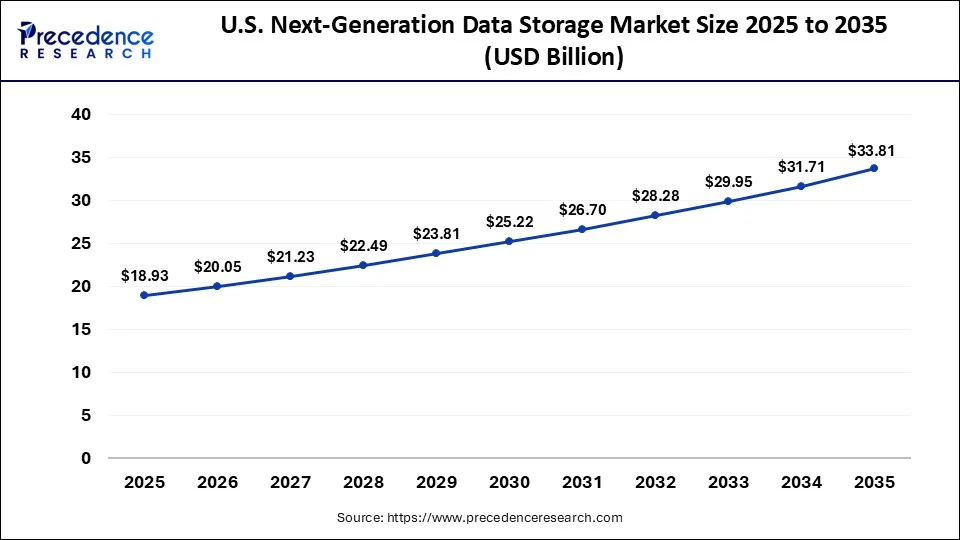
The U.S. next-generation data storage market size was evaluated at USD 20.05 billion in 2026 and is projected to reach around USD 33.81 billion by 2035, growing at a CAGR of 5.97% from 2026 to 2035.
Dominating Country – U.S.
Rising use of GPU clusters and AI factories, as well as enterprise cyber-resilient storage systems, drove sustainable trends in demand for next-generation storage solutions throughout the country in finance, healthcare and government sectors.
Fastest-Growing Country – Canada
Canada was the biggest growth market, as investments in its sovereign cloud infrastructure, AI research centers and high-tech computing for enterprise digital transformation continue to soar.
The Asia Pacific Region Expected to Grow With a CAGR of 7.8% of Market Share in 2026
Asia Pacific is the region held second largest market share, with contributed 30% to the market in 2026 and is estimated to grow at a strong CAGR of 11.4% over the projected period, supported by its accelerating investments in AI infrastructure, semiconductor manufacturing, and large-scale cloud deployments across major economies.
Dominating Country – China
Rapid domestic growth of cloud platforms, AI computing infrastructure, and enterprise semiconductor enterprises drove China to take a commanding lead in the regional storage market.
Fastest-Growing Country – India
India has become the world's fastest growing market driven by growth in hyperscale data centre build-out, digital public infrastructure and enterprise cloud migrations.
Europe Held Significant Market Share of 25% in 2026
The Europe region held a 25% share of the market in 2026 and is expected to grow at a 5.8% CAGR between 2026 and 2035, driven by increasing enterprise digitalization, data sovereignty initiatives, and modernization of cloud infrastructure.
Dominating Country – Germany
Germany stepped into the global market as a pioneer with robust industrial digitalization, Enterprise modernization, and the abundance of secure storage solutions for Industry 4.0 manufacturing environments.
Fastest-Growing Country – United Kingdom
The UK experienced the highest growth in its AI innovation initiatives, the availability of its financial technology infrastructure, and its adoption of cloud computing in the public and private arms of the government.
Latin America Held Notable Market Share with 5% in 2026
The Latin America region is expected to grow at a notable CAGR of 5.6% between 2026 and 2035, due to growing cloud adoption, enterprise modernization programs, and increasing investments in regional data center infrastructure.
Dominating Country – Brazil
Brazil's regional dominance was seen in the growth of enterprise cloud investments, financial digitalization, and growing investment in the hyperscale data center sector.
Fastest-Growing Country – Brazil
Brazil's robust expansion of e-commerce platforms, digital banking services, and enterprise modernization efforts returning high amounts of data was another factor driving the fastest volume growth.
Middle East & Africa Held a Considerable Market Share of 4% in 2026
The Middle East & Africa region is expected to grow at a strong CAGR of 6% between 2026 and 2035, fuelled by increasing investments in digital transformation, smart city development, and cloud infrastructure projects.
Dominating Country - UAE
AWS, in the UAE, has secured the regional market by implementing large and ambitious government cloud projects, smart city applications, and "fast-track" deployments of modern digital infrastructure.
Fastest-Growing Country – Saudi Arabia
Saudi Arabia is expected to grow at the fastest rate as a result of accelerating digital transformation initiatives, digitizing the national infrastructure of the kingdom through sovereign cloud initiatives and investments in AI infrastructure as part of Vision 2030.
Next-Generation Data Storage Market Supply Chain Analysis
- Raw Material Supply
High-purity silicon wafers, specialty chemicals, rare gases, and advanced substrates enable reliable NAND, DRAM, and storage chipset production.
Key Players: Shin-Etsu Chemical, SUMCO, GlobalWafers, Entegris, Air Liquide.
- Manufacturing Landscape
Semiconductor fabs manufacture NAND, DRAM, controllers, and enterprise SSDs before supplying OEMs and hyperscale infrastructure providers.
Key Players: Samsung Electronics, Micron Technology, SK hynix, Kioxia, TSMC.
- Distribution Channels
OEMs, enterprise distributors, cloud providers, and system integrators deliver storage platforms across AI, cloud, and enterprise deployments.
Key Players: Dell Technologies, Hewlett Packard Enterprise, Lenovo, Arrow Electronics, TD SYNNEX.
- Supply Chain Risks
Geopolitical restrictions, semiconductor shortages, logistics disruptions, and AI-driven demand continue challenging storage component availability.
Key Players: Micron Technology, Samsung Electronics, Western Digital, Kioxia, SK hynix.
Competitive Landscape
Market Structure
The storage sector is consolidating, and competition is increasing as we move into 2026. The HDD market is truly an oligopoly, with just three products from Seagate, Western Digital and Toshiba as options. Kioxia and SanDisk, on the other hand, shepherded their Yokkaichi joint venture further, with the agreement extended up to 31 December 2034. At the same time built up an alliance to manufacture NAND flash, with more than 25 years of history already existing. The combination of consolidation, alliance, and minimal new players in the storage market clearly demonstrates this. That storage has consolidated to a handful of dominant players.
Market Share Analysis
The allocation to capacities and supply is now a more important factor in determining competitive positioning than pure volume is. The market in CY2026 is predicted to be tight, as Kioxia confirmed that the full production capability of NAND flash for the year is already sold out. Indicating an extraordinarily tight supply situation in the industry. It's not just open market competition. It's a positioning battle that is taking place over long-term hyperscaler contracts. That guarantees an allocation of ranking for the majority of the years.
Strategic Initiatives
Strong efforts at partnership, capacity expansion, and product introductions continue across the entire spectrum of vendors throughout 2026. In August 2025, SanDisk announced its partnership with SK Hynix on the development of the HBF technology, which is expected to ship in the second half of calendar 2026, and AI-inference devices to come early calendar 2027. These measures reflect how fast vendors can speed up their capacity, collaborations, and future product development trajectory.
Innovation Benchmarking
The competition for technology leadership now focuses on how fast and efficient the solution will be for delivering AI-enhanced storage. Seagate is set to take the lead in higher-density data-storage drive technology in HAMR. On the other hand, Western Digital is using efficiency gains from ePMR and UltraSMR technology to remain competitive. The innovative Powervision that comes from integrating a GPU will help determine competitive positioning in the overall market until 2035.
Company Profiles
Seagate Technology
Seagate is Australia's top duty recording maker, located in Singapore and with over 40 years of magnetic recording experience. It has a portfolio of Mozaic HAMR-based nearline drives. Exos enterprise HDDs, and the Lyve edge-to-cloud platform for modular storage as a service (STaaS). Seagate will be charting 5-terabyte per disk technology around 2028. They maintain their dominance as the Density leader for the rest of the decade as it continues to increase the HAMR market share of majority exabyte.
Western Digital
Western Digital put its entirety behind the HDD market. They are focusing their product line on ePMR and UltraSMR nearline drives, and 26TB CMR and 32TB UltraSMR models are already shipping in record numbers. Western Digital has been considering a merger with Japan's Kioxia. This would bring its flash heritage and boost its NAND positioning against rivals Samsung and SK Hynix. Reshaped flash partnership, one that would take the company to the second medium of magnetic even as it moves into solid-state storage.
Next-Generation Data Storage Market Companies
- Dell Inc.
- Hewlett Packard Enterprise Company
- Hitachi, Ltd.
- Inspur
- International Business Machines Corporation
- Micron Technology, Inc.
- NetApp, Inc.
- Netgear Inc.
Future Outlook (2026–2035)
Short-Term Outlook (2026–2028)
AI and enterprise modernization will be the top drivers for storage priorities into 2028. Prices appear set to stay depressed for the foreseeable future, as early indicators of price improvement from Counterpoint Research are expected to happen around Q4 of 2027. New Samsung P5 powerhouse capacity is set to begin alleviating supply woes by 2028. While SK Hynix's M15X powerhouse is expected to start work by mid-2027. Companies that enter this window do so knowing there will be increased pricing instability. That accelerated the use of AI to improve infrastructure.
Medium-Term Outlook (2028–2032)
Software-defined storage and NVMe usual penetration should be the next obvious way to go by the early 2030s. By this time, AI-native storage systems, akin to WEKA, DDN and VAST Data today, will most likely cease to be niche and become standard instead. As this period of the medium-term unfolds, Micron is set to start a second Idaho fab at the end of 2026, with it coming online by the end of 2028. Improved edge capability should ramp up accordingly, driven by a growing trend of decentralizing compute and storage with distributed AI inference. The software-defined intelligence and edge-distributed approach is likely to set the course for enterprise architecture strategy through the coming decade.
Long-Term Outlook (2032–2035)
This is key to commercialising DNA storage beyond niche. Archival use into widespread enterprises. Following the successful test of an LTO tape library. Holographic tape technology may reach a commercially viable scale in the early 2030s with a 2027 debut in a 200TB WORM format. At this time, Quantum at this time storage research will be difficult to commercialize. Since it's based on experiments with rare earth crystals, not reaching mainstream use. On the other hand, magnetic, flash, DNA, and first-generation holographic media will eventually be integrated into a single, smartly managed storage continuum by 2035.
Strategic Recommendations
Recommendations for Storage Vendors
Vendors should focus on AI-oriented integration as opposed to added hardware in the coming years. NetApp provides an excellent policy from which other competitors can learn by launching the NetApp AI Data Engine. This is co-engineered with Nvidia and aims to create an intelligent index spanning an organization's entire data estate, deployed in on-premises, cloud, and edge environments. The vendors that are able to successfully integrate true AI capabilities while having actionable sustainability-conting-warrantee will likely generate more attention over the coming years.
Recommendations for Enterprise Buyers
Strategic procurement should be done now and not when demand subsides. The lead time of DRAM and NAND has already become too long for the extraordinary scale of some orders. This should be considered for reactive quarterly purchases, in the order of >40 weeks for fiscal 2026. The need for cybersecurity enhancements is just as pressing, as ransomware attacks rose. By the same amount year-over-year despite the overall cyberattack rate dropping. Customers who decide on procurement early and continue to implement architecture built in the new era with hardened security attitudes. This will be much better protected than those sticking to old thinking!
Recommendations for Investors
It also would be a good thing for investors to keep tabs on AI-native storage companies as they grow in lock step with hyperscalers. Memory manufacturing investment is also worth a look, as Micron's plan to double U.S. capacity. This covers new fabs in Idaho, New York and Virginia, and is based on the agreement of direct CHIPS Act funding. By 2035, investors holding a mix of exposure to AI-native software, home production of memory device materials and new regional offers stand to benefit from the lion's share of its growth.
Next-Generation Data Storage Market Segments
By Storage Medium
- Solid-State Drives (SSD)
- SATA SSD
- SAS SSD
- NVMe SSD
- PCIe SSD
- Hard Disk Drives (HDD)
- Enterprise HDD
- Nearline HDD
- Surveillance HDD
- Magnetic Tape Storage
- LTO Tape
- Enterprise Tape
- Optical Storage
- Blu-ray
- Archival Optical Disc
- DNA Data Storage
- Holographic Storage
By Storage Architecture
- Direct Attached Storage (DAS)
- Network Attached Storage (NAS)
- Storage Area Network (SAN)
- Software-Defined Storage (SDS)
- Object Storage
- Hyperconverged Infrastructure (HCI)
By Deployment Mode
- On-premises
- Cloud Storage
- Public Cloud
- Private Cloud
- Hybrid Cloud
- Edge Storage
By Technology
- Flash Storage
- NVMe Technology
- Storage-Class Memory (SCM)
- AI-enabled Storage
- Quantum Storage Research
- Data Deduplication & Compression
- Blockchain-based Storage
By Enterprise Size
- Large Enterprises
- Small & Medium Enterprises (SMEs)
By Application
- Enterprise Data Centers
- Cloud Computing
- Big Data Analytics
- Artificial Intelligence & Machine Learning
- Backup & Disaster Recovery
- High-Performance Computing (HPC)
- Media & Entertainment
- Internet of Things (IoT)
- Edge Computing
By End User
- IT & Telecommunications
- Banking, Financial Services & Insurance (BFSI)
- Healthcare
- Government & Defense
- Manufacturing
- Retail & E-commerce
- Media & Entertainment
- Energy & Utilities
- Education
- Others
By Region
- North America
- Latin America
- Europe
- Asia-pacific
- Middle and East Africa
For inquiries regarding discounts, bulk purchases, or customization requests, please contact us at sales@precedenceresearch.com
Frequently Asked Questions





Ask For Sample
No cookie-cutter, only authentic analysis – take the 1st step to become a Precedence Research client
 Get a Sample




 sales@precedenceresearch.com
 Schedule a Meeting
