



On-Demand Trucking Market Size, Share and Trends 2026 to 2035
On-Demand Trucking Market (By Service Type: Full Truckload (FTL), Less Than Truckload, Last Mile Delivery; By Delivery Type: First Mile / Last Mile, Same Day Delivery, Standard Delivery; By Freight Type: FTL, LTL, Intermodal; By Vehicle Type: Medium Duty Trucks, Light Duty Trucks, Heavy Duty Trucks; By Location: Domestic, International; By Industry Vertical: Retail & Ecommerce, Manufacturing, Healthcare, Food & Beverage, Others) - Global Industry Analysis, Size, Trends, Leading Companies, Regional Outlook, and Forecast 2026 to 2035zzz () - Global Industry Analysis, Size, Trends, Leading Companies, Regional Outlook, and Forecast 2026 to 2035
Source: https://www.precedenceresearch.com/on-demand-trucking-market
 Get a Sample
 Table Of Content


What is On-Demand Trucking Market Size?
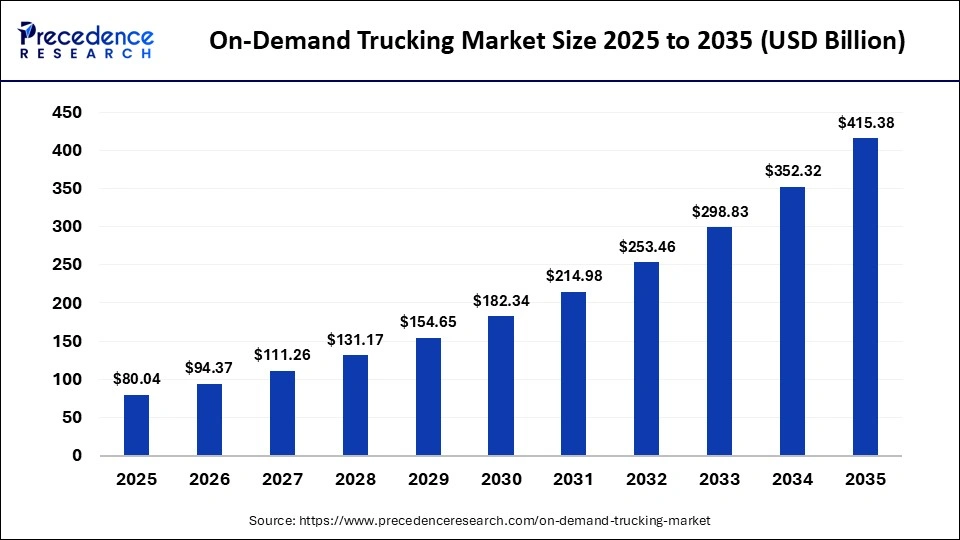
The global on-demand trucking market size was calculated at USD 80.04 billion in 2025 and is predicted to increase from USD 94.37 billion in 2026 to approximately USD 415.38 billion by 2035, expanding at a CAGR of 17.90% from 2026 to 2035. This market is growing due to the explosive rise of e-commerce and the resulting consumer need for same-day or next-day delivery.
Market Highlights
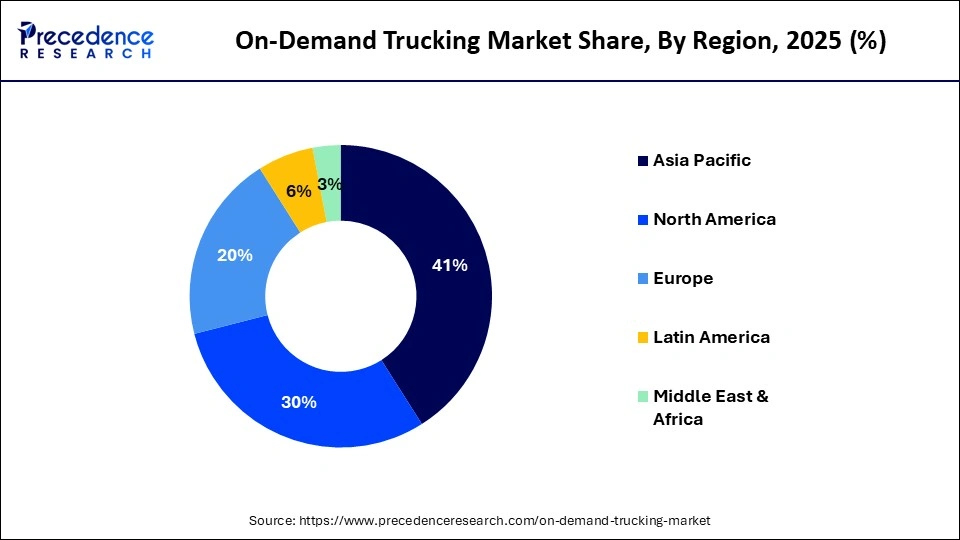
- Asia Pacific dominated the market by holding a 41% share in 2025 and is expected to grow at the fastest CAGR of 18.5% in the coming years.
- North America is expected to grow at a significant CAGR between 2026 and 2035.
- By service type, the full truckload (FTL) segment held the biggest market share of approximately 65% in 2025.
- By service type, the less than truckload (LTL) segment is expected to expand at the fastest CAGR of 16.8% between 2026 and 2035.
- By delivery type, the first mile / last mile segment contributed the highest market share of approximately 45% in 2025.
- By delivery type, the same day delivery segment is expected to expand at the fastest CAGR of 17.0% between 2026 and 2035.
- By freight type, the FTL segment held a major market share of approximately 50% in 2025.
- By freight type, the intermodal segment is expected to expand at the fastest CAGR of 17.2% from 2026 to 2035.
- By vehicle type, the medium duty trucks segment held a major market share of approximately 40% in 2025.
- By vehicle type, the light duty trucks segment is expected to expand at the fastest CAGR of 16.3% from 2026 to 2035.
- By location, the domestic segment held a major market share of approximately 65% in 2025.
- By location, the international segment is expected to expand at the fastest CAGR of 16.5% from 2026 to 2035.
- By industry vertical, the retail & ecommerce segment held a major market share of approximately 38% in 2025.
- By industry vertical, the manufacturing segment is expected to expand at a notable CAGR from 2026 to 2035.
Market Overview
The on‑demand trucking market refers to digital platforms and services that connect shippers with truck capacity on a flexible, real‑time basis. These services offer instant booking, dynamic pricing, and real‑time tracking for freight transport across Full Truckload (FTL), Less‑Than‑Truckload (LTL), and last‑mile deliveries. The market is driven by the rapid growth of e-commerce, which demands faster, more flexible, and usually same-day delivery. Customers are requiring greater visibility into their shipments, with on-demand services providing real-time tracking, GPS, and RFID capabilities.
What are the Key Trends Influencing the On-Demand Trucking Market?
- Autonomous Driving Solutions: Remarkable investments are being made in autonomous, electric, and hybrid vehicles to enhance fuel efficiency and manage long-term sustainability goals.
- Technological Advancement and Digitization: AI, machine learning, along with IoT, are being used to improve routes, enhance safety, and even facilitate real-time tracking, reducing operational expenses and human error.
Future Market Outlook
- Expansion in Emerging Markets: The markets such as India and China are characterized by fragmented truck ownership. The growth of on-demand platforms is changing these, replacing conventional informal brokers with mobile-driven apps, which raises operational efficiency and transparency.
- Integration of AI & Smart Technologies: AI determines sensor data to predict mechanical failures before they happen, decreasing maintenance expenses by up to 30% and avoiding costly downtime.
- Strategic Partnerships & M&A: Market players are collaborating to expand into new regions, mainly in Asia-Pacific and Latin America, where digital freight platforms are looking to enter high-growth markets. Cross-border acquisitions, mainly in Europe, are also enabling providers to handle complex international logistics.
How is AI Influencing the On-Demand Trucking Market?
Artificial intelligence-driven software processes traffic, live GPS, and even weather data to instantly reroute drivers, decreasing travel time and fuel consumption. AI-enabled cameras and sensors monitor driver behavior, detecting distraction or fatigue and providing immediate alerts, while supporting advanced driver-assistance systems (ADAS) such as automatic braking and lane-keeping to enhance safety. Additionally, AI streamlines administrative tasks, including document analysis, invoicing, and data entry, freeing up human resources for more strategic responsibilities.
Market scope
| Report Coverage | Details |
| Market Size in 2025 | USD 80.04 Billion |
| Market Size in 2026 | USD 94.37 Billion |
| Market Size by 2035 | USD 415.38 Billion |
| Market Growth Rate from 2026 to 2035 | CAGR of 17.90% |
| Dominating Region | Asia Pacific |
| Fastest Growing Region | North America |
| Base Year | 2025 |
| Forecast Period | 2026 to 2035 |
| Segments Covered | Service Type, Delivery Type, Freight Type, Vehicle Type, Location, Industry Vertical, and region |
| Regions Covered | North America, Europe, Asia-Pacific, Latin America, and Middle East & Africa |
Segment Insights
Service Type Insights
What made full truckload (FTL) the dominant segment in the on-demand trucking market?
The full truckload (FTL) segment dominated the market with a major share of 65% in 2025. This is mainly due to the fast evolution of logistics technologies, e-commerce growth, and globalization of trade. FTL logistics, which includes the transportation of goods that fill an entire truckload, is gaining traction because of its efficiency, speed, and cost-effectiveness.
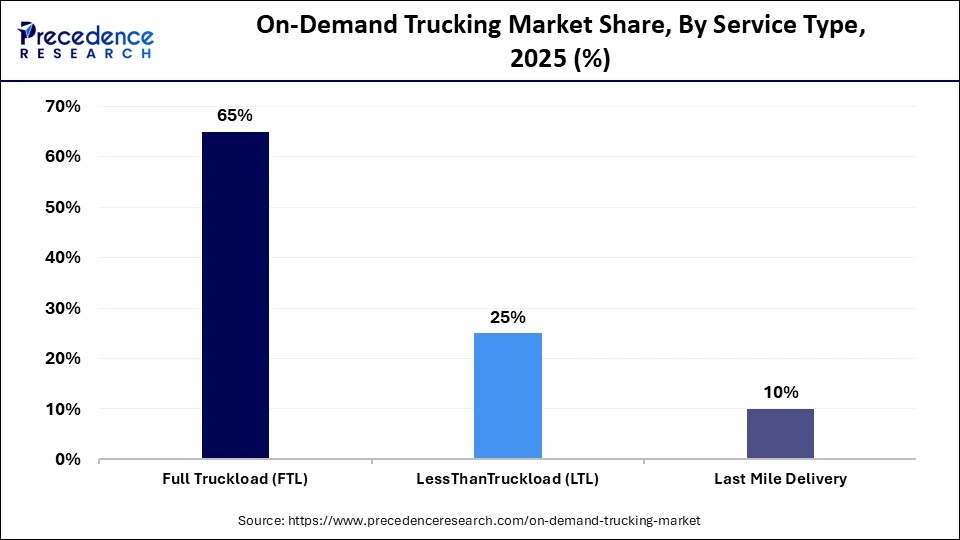
The less than truckload (LTL) segment is expected to grow at the fastest CAGR throughout the forecast period. This is because it enables multiple shippers to share trailer space, making it a cheaper alternative than full truckload for smaller shipments, thus appealing to SMEs. Less-than-truckload carriers, because of their ability to consolidate smaller shipments, provide a cost-effective and efficient way to meet these demands, mainly for last-mile and regional deliveries.
Delivery Type Insights
Why did the first mile / last mile segment dominate the on-demand trucking market?
The first mile / last mile segment dominated the on-demand trucking market with a 45% share in 2025, driven by the surge in online shopping and the resulting demand for immediate, same-day, or next-day deliveries, particularly in urban and suburban areas. The adoption of advanced technologies, such as AI-powered routing, drones, and electric vehicles, has enabled more efficient, flexible, and cost-effective last-mile operations. These innovations are helping logistics providers meet growing consumer expectations while optimizing delivery performance.
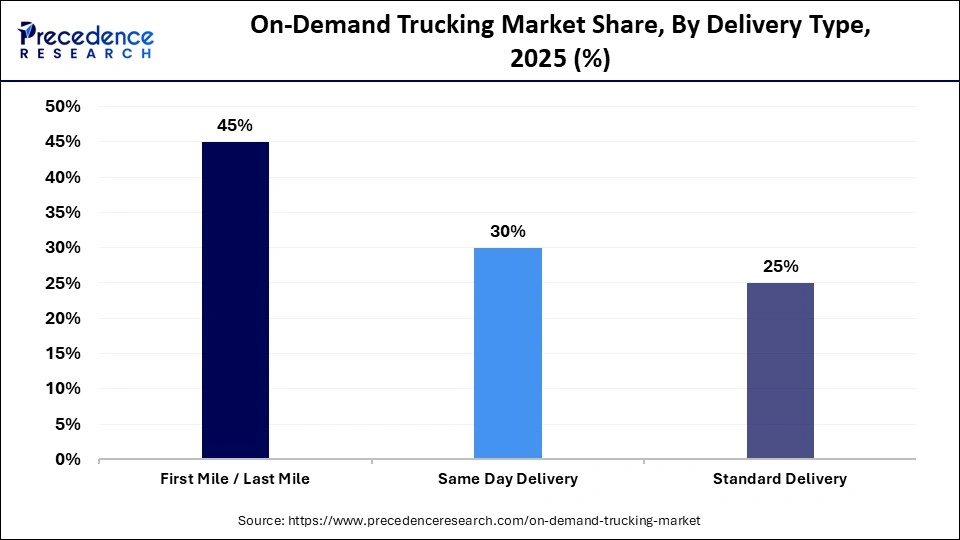
The same day delivery segment is expected to grow at the fastest CAGR in the upcoming period. The growth of this segment is driven by increasing population density in urban areas, which allows for more efficient and cost-effective logistics with rapid turnaround. Additionally, the growth of online shopping and shifting consumer preferences toward immediate convenience are fueling the demand for 24-hour, same-day delivery services.
Freight Type Insights
What made FTL the dominant segment in the on-demand trucking market?
The FTL segment led the market with a 50% share in 2025 due to its ability to offer exclusive, high-speed, and even secure transportation for large volumes of goods, which has become vital for e-commerce, manufacturing, and even just-in-time logistics. FTL is particularly preferred for high-volume shipments, time-sensitive goods, and long-distance hauls, making it ideal for industries such as e-commerce, manufacturing, and retail that require reliable, end-to-end delivery. Additionally, on-demand platforms make it easier to match shippers with available trucks in real time, enhancing flexibility and operational efficiency for FTL services.
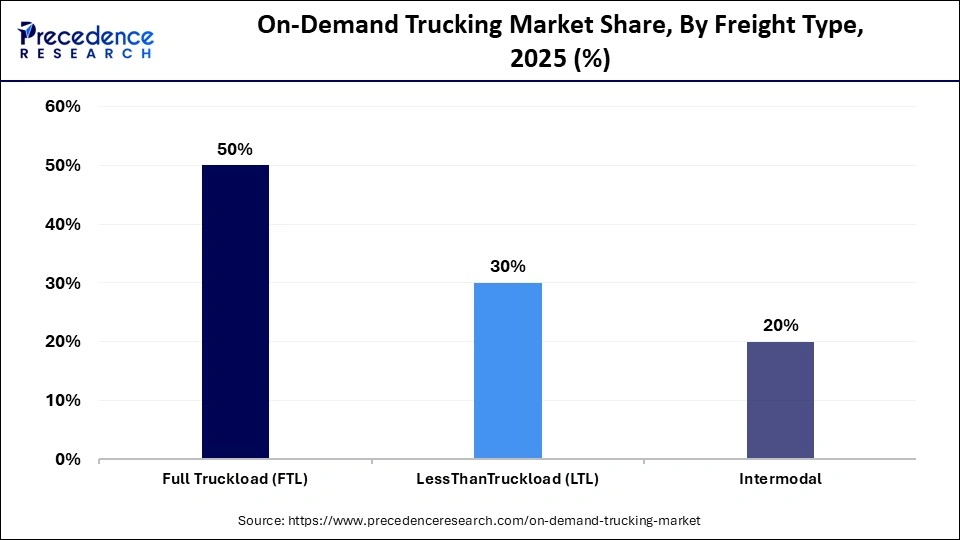
The intermodal segment is expected to grow at the fastest CAGR throughout the forecast period. This is because it combines the flexibility of trucking with the cost efficiency and environmental benefits of rail transport. Shippers increasingly prefer intermodal solutions for longer hauls, as they reduce fuel costs, congestion delays, and carbon emissions compared to pure trucking. Additionally, advancements in digital freight platforms and tracking technology make coordinating intermodal shipments faster and more reliable, fueling its adoption in on-demand logistics.
Vehicle Type Insights
Why did the medium duty trucks segment dominate the market?
The medium duty trucks segment dominated the on-demand trucking market with a 40% share in 2025 because these vehicles offer the ideal balance between payload capacity and maneuverability for urban and regional deliveries. They can handle a wide range of goods, from retail products to industrial supplies, without the higher operational costs and restrictions of heavy-duty trucks. Additionally, their fuel efficiency, lower maintenance costs, and accessibility to smaller warehouses and distribution centers make them the preferred choice for on-demand freight services.
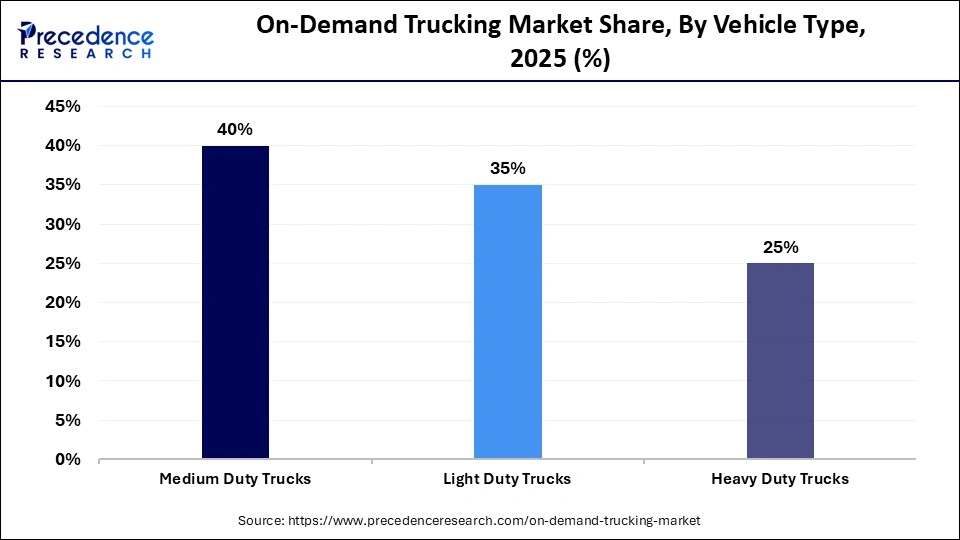
The light duty trucks segment is expected to grow at the fastest CAGR throughout the forecast period. This is because these vehicles are highly versatile, cost-effective, and ideal for last-mile deliveries in urban and suburban areas. Their smaller size allows easy navigation through congested streets and tighter spaces, while keeping fuel and maintenance costs low. Additionally, the rise of e-commerce and smaller shipment volumes is increasing the demand for quick, flexible deliveries that light-duty trucks can efficiently handle.
Location Insights
What made domestic the dominant segment in the on-demand trucking market?
The domestic segment dominated the on-demand trucking market with a 65% share in 2025, driven by the explosive growth of e-commerce, the increasing demand for rapid last-mile deliveries in urban areas, and high-volume, short-haul industrial and manufacturing cargo movements. Domestic manufacturing, particularly in the U.S., China, and India, relies heavily on on-demand logistics to transport raw materials to factories and finished goods to warehouses. The adoption of digital platforms, real-time tracking, and AI-powered route planning has further improved efficiency, enabling optimized fleet utilization and faster, more reliable deliveries.
The international segment is expected to grow at the fastest CAGR throughout the forecast period, driven by business expansion into new markets and the rise of cross-border trade. On-demand trucking offers the speed and flexibility needed to manage urgent international shipments, helping businesses navigate complex logistics efficiently. In today's globalized economy, agile transportation solutions like on-demand international trucking enable companies to manage inventory, avoid bottlenecks, and respond quickly to market changes.
Industry Vertical Insights
Why did the retail & e-commerce segment lead the on-demand trucking market?
The retail & e-commerce segment led the market with a 38% share in 2025 and is expected to grow at the fastest CAGR in the coming years. This is because retailers and e-commerce companies face unpredictable, fluctuating demand, such as during peak seasons, making flexible on-demand services essential for managing inventory and ensuring timely deliveries. With global e-commerce sales projected to grow rapidly, customer expectations for faster, on-demand deliveries are pushing firms to move away from traditional, slower logistics models.
The manufacturing segment is expected to expand at a notable CAGR in the coming years. The growth of the segment is primarily driven by the need for just-in-time deliveries to prevent production downtime, the shift toward smaller and more frequent shipments, and the goal of reducing high inventory holding costs. Manufacturers rely on on-demand trucking to maintain continuous production without storing large, costly inventories of raw materials on-site.
Regional Insights
What is the Asia Pacific On-Demand Trucking Market Size?
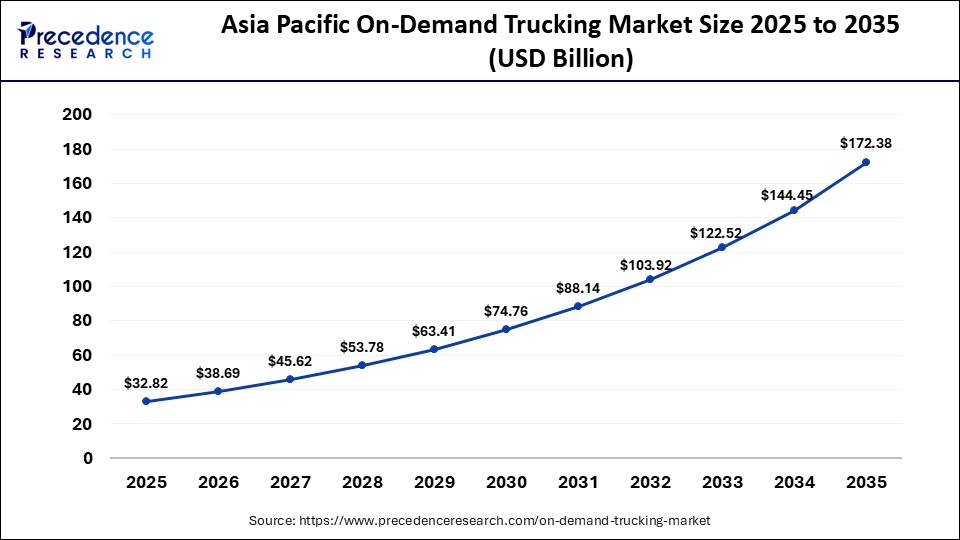
The Asia Pacific on-demand trucking market size is expected to be worth USD 172.38 billion by 2035, increasing from USD 32.82 billion by 2025, growing at a CAGR of 18.04% from 2026 to 2035.
What made Asia Pacific the leading region in the on-demand trucking market?
Asia Pacific led the on-demand trucking market while holding a major share of 41% in 2025 and is expected to grow at a CAGR of 18.5% throughout the forecast period. The region's dominance in the market is driven by advancements in machine learning, artificial intelligence, and automation technologies. Autonomous trucks are anticipated to enhance operational efficiency, reduce human errors, and optimize route management, transforming the trucking industry. Companies are investing in these technologies to lower labor costs, improve safety, and optimize fuel consumption, a trend rapidly gaining traction in both freight and passenger transportation sectors.
China Market Trends
China leads the Asia Pacific on-demand trucking market due to rapid urbanization, which has significantly increased the demand for last-mile delivery services in urban centers. Additionally, the Chinese government has heavily invested in extensive ports, highways, and logistics hubs, creating a comprehensive network that enables efficient, fast, and on-demand long-distance freight movement. These developments collectively strengthen China's position as the regional leader in on-demand trucking.
What makes North America a notably growing area in the market?
North America is expected to grow at a notable rate throughout the forecast period, driven by the rapid expansion of e-commerce and the rising demand for last-mile delivery services. Retailers and logistics providers are increasingly adopting on-demand trucking solutions to meet consumers' preference for faster and more efficient deliveries. This continued growth in e-commerce, particularly in urban areas, is creating significant opportunities for logistics companies to expand their on-demand offerings.
U.S. Market Trends
The market in the U.S. is driven by the adoption of machine learning, AI, and digital freight marketplaces, which instantly connect shippers with carriers, increasing efficiency and reducing logistics costs. Companies are also relying on third-party logistics providers to manage complex supply chains, allowing them to focus on their core business operations.
Who are the Major Players in the Global On-Demand Trucking Market?
The major players in the on-demand trucking market are C.H. Robinson, Convoy, DHL Supply Chain, Flexport, Flock Freight, J.B. Hunt Transport, Loadsmart, Uber Freight, XPO Logistics, Transfix, NEXT Trucking, uShip, Ninjatruck (Ontruck), Dropoff, and Cargomatic
Recent Development
- In September 2025, Uber Freight started its Dedicated EV Fleet Accelerator Program, targeted at driving electric truck adoption via a strategic collaboration with automaker Tesla. (Source: https://www.freightwaves.com)
Segments Covered in the Report
By Service Type
- Full Truckload (FTL)
- Less Than Truckload
- Last Mile Delivery
By Delivery Type
- First Mile / Last Mile
- Same Day Delivery
- Standard Delivery
By Freight Type
- FTL
- LTL
- Intermodal
By Vehicle Type
- Medium Duty Trucks
- Light Duty Trucks
- Heavy Duty Trucks
By Location
- Domestic
- International
By Industry Vertical
- Retail & Ecommerce
- Manufacturing
- Healthcare
- Food & Beverage
- Others
By Region
- North America
- Europe
- Asia-Pacific
- Latin America
- Middle East & Africa
For inquiries regarding discounts, bulk purchases, or customization requests, please contact us at sales@precedenceresearch.com
Frequently Asked Questions
Tags





Ask For Sample
No cookie-cutter, only authentic analysis – take the 1st step to become a Precedence Research client
 Get a Sample




 sales@precedenceresearch.com
 Schedule a Meeting
