



Organic Tobacco Market Size, Key Companies, Company Market Share, Sales Volume, Consumer Demand, Pricing Trends, Distribution Performance, Competitive Positioning, and Growth Forecast
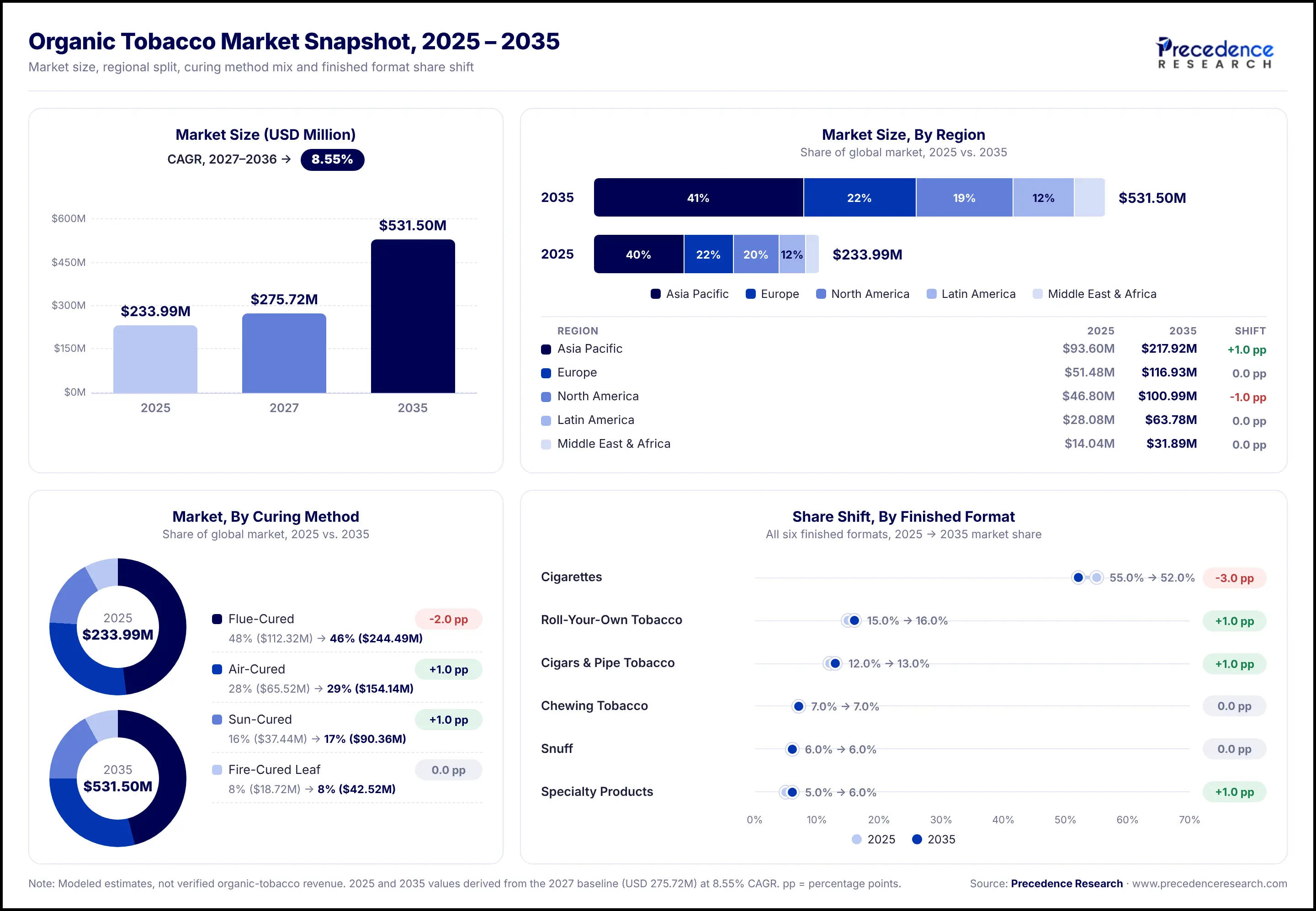
The organic tobacco market reached USD 275.72 million in 2027. The market growth is attributed to the growing demand for organic farming, cultivation practices, and traceability requirements. These trends were evaluated by our Senior Researcher, Vidyesh Swar, to curate this report. His report benefits multiple stakeholders, including tobacco manufacturers, organic tobacco farmers, private equity firms, distributors, and exporters and importers.
Source: https://www.precedenceresearch.com/organic-tobacco-market
 Get a Sample
 Report Description


Organic Tobacco Market Size, Share, Trends, and Growth Forecast 2036
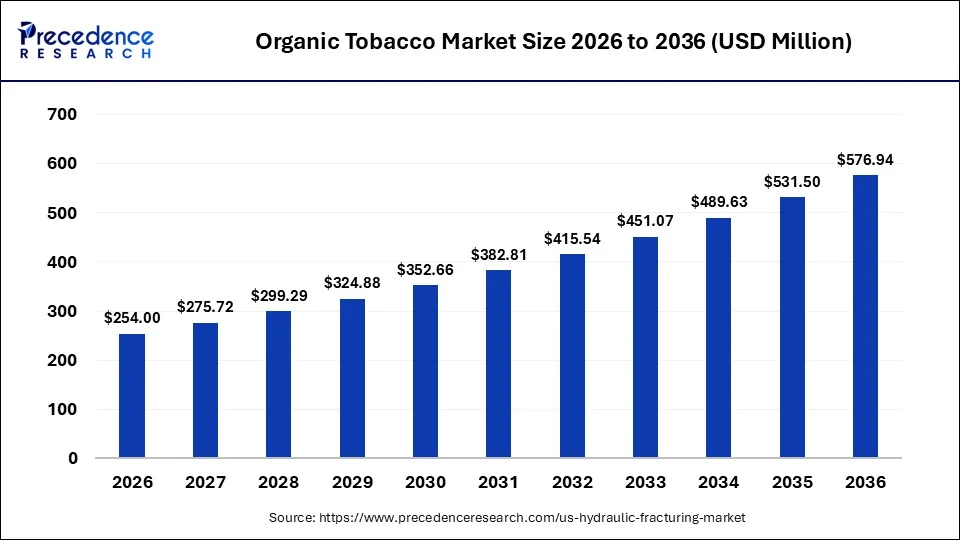
The global organic tobacco market is expected to increase from USD 275.72 million in 2027 to USD 576.94 million by 2036, exhibiting a CAGR of 8.55% throughout the forecast period.
Key Takeaways
Market Size & Growth Outlook
- Market size in 2026: USD 254.00 Million.
- Estimated market size in 2027: USD 275.72 Million.
- Projected market size by 2036: USD 576.94 Million.
- CAGR (2027–2036): 8.55%.
Regional Market Spotlight
- Asia-Pacific market share 2026: 40%.
- Europe market share 2026: 22%.
- North America market share 2026: 20%.
Segmental Spotlight
- Smoking products segment share 2026: 85%.
- Flue-cured tobacco segment share 2026: 48%.
- Tobacco distributors segment share 2026: 35%.
Organic Tobacco Market Size 2026 to 2036
The organic tobacco industry is influenced by growing interest in specialized tobacco products, evolving cultivation practices, and increasing emphasis on certified agricultural sourcing. Supply chain traceability, organic certification, product differentiation, and changing consumer preferences are expected to shape industry development throughout the forecast period.
How is the Organic Tobacco Market Evolving Through 2036?
The underlying agricultural industry is considerably larger. Globally, 6 million tons of tobacco leaves have been produced in 2026, with China accounting for about 37%, India accounting for about 12%, and Brazil accounting for 11%. Organic tobacco represents only a specialized portion of this production base; a globally harmonized figure for certified organic tobacco acreage, output, and market share is not readily established.
The complete market analysis differentiates the income of retail products from that of certified leaves, intermediate manufacturing of tobacco, and organic labeled products. It also segregates the growth in income due to higher prices from the actual growth in certified leaves.
Three forecast scenarios are relevant. The base scenario is one that continues niche usage and incremental improvements in sourcing. The upside scenario includes expanded procurement by the manufacturers, more dependable certification processes, and growth in premium products. The downside scenario involves low willingness to pay, limitations in tobacco marketing, and inadequate certified supply.
Coverage Highlights
- Historical market estimates
- Revenue reconciliations
- Volume assumptions
- Incremental opportunities
- Geographic forecast
- Base/Up Side/Down Side scenarios
What are the Most Profitable Types of Tobacco Products?
Organic tobacco requires segmentation by curing method, product application, processing stage, product form, distribution channel, and geography.
A robust global revenue share and CAGR for every organic-specific subsegment cannot be established from consistently disclosed data. Therefore, the analysis contrasts observed availability with modeled segments and does not attach unjustified accuracy to anything. The different types of tobacco leaves, namely flue-cured, air-cured, and sun-cured, should be analyzed separately since the method of curing affects the food flavor, chemicals, processability, and compatibility with blends.
The commercially attractive segment is not necessarily the largest by volume. Small formats might bring more money per kilogram, whereas large-volume producers might need more reliability, consistency, and certification.
Coverage Highlights
- Segment Revenue
- Volume Estimate
- Curing Method Mix
- Application Shares
- Specialty Formats
- Contribution to Growth
- New Niches
Organic Tobacco Market Segments Analysis
Organic Tobacco Market by Curing Method 2026 Share & Size
| Segments | Share | Value (USD Mn) |
| Flue-cured | 48.00% | 121.922 |
| Air-cured | 28.00% | 71.121 |
| Sun-cured | 16.00% | 40.641 |
| Fire-cured Leaf | 8.00% | 20.32 |
Source: Expert Interview, Secondary Sources, Precedence Research Database, Precedence Research Analysts and Researcher.
Flue-cured tobacco leads the estimated distribution due to its use in cigarette blends and demand for its characteristic flavor and leaf properties
Organic Tobacco Market by Application 2026 Share & Size
| Segments | Share | Value (USD Mn) |
| Smoking Products | 85.00% | 215.904 |
| Smokeless Tobacco | 15.00% | 38.101 |
Source: Expert Interview, Secondary Sources, Precedence Research Database, Precedence Research Analysts and Researcher.
Smoking products lead because cigarettes and other combustible products account for a substantial portion of conventional tobacco consumption
Organic Tobacco Market by Processing Stage 2026 Share & Size
| Segments | Share | Value (USD Mn) |
| Whole Leaf | 25.00% | 63.501 |
| Threshed or Stripped Leaf | 35.00% | 88.902 |
| Cut Tobacco | 30.00% | 76.202 |
| Other Processed Forms | 10.00% | 25.401 |
Source: Expert Interview, Secondary Sources, Precedence Research Database, Precedence Research Analysts and Researcher.
Threshed or stripped leaf leads the estimated distribution because processors use it for blending and downstream tobacco manufacturing.
Organic Tobacco Market by Finished Format 2026 Share & Size
| Segments | Share | Value (USD Mn) |
| Roll-your-own Tobacco | 15.00% | 38.101 |
| Cigarettes | 55.00% | 139.703 |
| Cigars and Pipe Tobacco | 12.00% | 30.481 |
| Chewing Tobacco | 7.00% | 17.78 |
| Snuff | 6.00% | 15.24 |
| Specialty Products | 5.00% | 12.7 |
Source: Expert Interview, Secondary Sources, Precedence Research Database, Precedence Research Analysts and Researcher.
Cigarettes lead the estimated distribution because of their established manufacturing and retail infrastructure, although certified organic tobacco may represent only a limited portion of this category.
Organic Tobacco Market by Sales Channel 2026 Share & Size
| Segments | Share | Value (USD Mn) |
| Specialist Retailers | 20.00% | 50.801 |
| Tobacco Distributors | 35.00% | 88.902 |
| Direct-to-Consumer Channels where lawful | 10.00% | 25.401 |
| Business-to-Business Supply Agreements | 35.00% | 88.902 |
Source: Expert Interview, Secondary Sources, Precedence Research Database, Precedence Research Analysts and Researcher.
Tobacco distributors and business-to-business agreements lead the estimated channel distribution because manufacturers and processors commonly rely on bulk procurement and established supply contracts.
Organic Tobacco Market by Region 2026 Share & Size
| Segments | Share | Value (USD Bn) |
| North America | 20.00% | 50.801 |
| Europe | 22.00% | 55.881 |
| Asia-Pacific | 40.00% | 101.602 |
| Latin America | 12.00% | 30.481 |
| Middle East and Africa | 6.00% | 15.24 |
Source: Expert Interview, Secondary Sources, Precedence Research Database, Precedence Research Analysts and Researcher.
Asia-Pacific leads the estimated regional distribution due to its substantial tobacco cultivation, processing capacity, and consumer base.
Will Sustainable Positioning Be Effective in Combating Particular Tobacco Demand?
Demand for leaf with controlled additives, interest in farming methods, preferences for specialist products, and efforts by businesses to set themselves apart with high-end goods all have an impact on the demand component. However, organic cultivation does not establish that tobacco is safer to consume, less addictive, or less harmful than conventional tobacco.
Land conversion, pest control, yield variability, certification costs, crop segregation, and the presence of trained farmers are all barriers to supply-side expansion in the organic market. Organic certification normally involves a requirement that the land has not been under the influence of forbidden substances for at least three years prior to harvesting in accordance with U.S. organic crop requirements.
The most important commercial angle is differentiation and source of supply rather than health benefits. Restrictions in marketing, reduced smoking in certain countries, high taxation of tobacco, and shift to other sources of nicotine could hinder the growth of organic products.
Coverage Highlights
- Demand drivers
- Production constraints
- Farmer economics
- Certification lead times
- Substitution risks
- Marketing restrictions
- Sensitivity analysis
Does the Organic Premium Compensate for Higher Compliance and Procurement Costs?
The price of organic tobacco is based on the type of curing process, the grade of the leaves, moisture content, nicotine and sugar properties, origin, the quality of the crop, and whether it is certified. Unlike commodity prices that have set standards, organic leaves can be supplied based on supply agreements.
For context, a recent conventional unmanufactured-tobacco benchmark was approximately USD 6,775 per tonne in July 2026, or USD 6.78 per kilogram. This is a broad leaf-trade reference, not an organic tobacco price or a direct substitute for any specific grade.
An economic premium for organic produce cannot be determined without having comparable transactions that are identical in respect of the grade, the source of the produce, the moisture content, the level of processing, and the conditions of sale. Growing organics, however, might undoubtedly result in higher costs due to certification, crop management, storage, documentation, and decreased productivity, depending on the needs of buyers.
Farm gate prices, leaf processing prices, landing costs, certification fees, distributor margin, and final product pricing are all analyzed as part of the pricing approach. The pricing approach also aims to ascertain whether higher selling prices lead to larger margins.
Coverage Highlights
- Price per kilogram and tonne
- Grade differentials
- Regional pricing
- Organic premiums
- Certification costs
- Channel economics
- Margin sensitivity
Certified Production Scale Without Compromising Quality and Traceability?
Conventional global tobacco production of approximately 6 million tonnes provides a substantial agricultural foundation, but it does not indicate how much leaf is organically certified or commercially available. The organic supply must be independently determined from the certified acres, yield per hectare, percentage of crop losses, processor stock, and contracted volume.
China, India, and Brazil collectively accounted for approximately 60% of global tobacco leaf output in 2026. The size of their agricultural operations provides possible sources, but conventional production capacity does not automatically become an organic supply source.
The main obstacles include fragmentation among growers, certification, climatic conditions affecting crop availability, curing, and the segregation of organic leaf from conventional products. All these can result in what seems to be a sufficient agricultural resource becoming commercially unattainable by the manufacturing industry due to chain-of-custody documentation.
Coverage Highlights
- Certified acreage
- Yield
- Output
- Utilization
- Inventories
- Contract coverage
- Supply deficits
- Import dependence
- Capacity expansion
Where is Organic Tobacco's Premium Captured?
The value chain analysis starts from seed selection and inputs for the farm all the way to cultivation, harvesting, curing, grading, certification, leaf processing, blending, manufacturing, distribution, and retailing.
The farmers get value through premiums on the crop, but their profit margins depend on yields, labor, cost of pest control, and the cost of certification. Finished-product manufacturers may capture the largest absolute revenue pool through branding and distribution, although revenue share should not be confused with profit share.
The crucial operational difference lies in physical separation. Certified leaf needs to have systems in place that will ensure separation from storage to processing and even transportation. Mixing with regular leaf or lack of documentation may devalue organic certification.
Coverage Highlights
- Cost breakdowns
- Processor margins
- Certification costs
- Logistics
- Traceability controls
- Value-capture opportunities
Will Compliance Become a Competitive Advantage?
Export and import of unmanufactured tobacco is generally monitored through HS 2401; however, HS 2401 does not differentiate certified organic tobacco. As a result, conventional values for the import/export of tobacco cannot be stated as the value of organic trade unless there is a product-level confirmation.
Organic items are produced using current farming methods rather than a single innovative technology. Biological pest control, soil management, precision irrigation, curing techniques, farm record keeping, residual testing, and batch tracking are technologies that are pertinent to organic farming.
Regulation is a major commercial constraint. Organic standards vary from place to place, although tobacco products will continue to be bound by their own distinct set of standards regarding advertising, packaging, excise, age-access, and product control. Organic labeling does not supersede tobacco regulations or prove risk reduction.
Coverage Highlights
- Trade corridors
- Verified organic shipments
- Certification frameworks
- Agricultural innovation
- Traceability technology
- Product-labeling requirements
- Sustainability performance
Which Buyers Will Pay for Verified Organic Leaf?
The customer list includes speciality tobacco manufacturers, premium product makers, leaf producers, distributors, retailers, and consumers buying unique tobacco products. The B2B purchaser generally looks for flavor uniformity, moisture, leaf quality, reliability of supply, documentation, and cost of delivery.
The consumer may favor natural or minimally processed products, helping to differentiate the product; however, organic certification is not an indicator of less health hazard. Purchase decisions are also influenced by product availability, taxes, price sensitivity, and marketing restrictions.
Coverage Highlights
- Customer segments
- Purchase criteria
- Demand at application level
- Contract terms
- Economics of channels
- Price sensitivity of consumers
- Under-served markets
Competitive Intelligence
Specialist Brands Protect Their Premium Pricing Against Bigger Tobacco Manufacturers?
Organic tobacco consists of tobacco manufacturing companies, specialized leaf providers, specialist brands, and niche retailers, with competitive advantages resting in certification of their organic products, knowledge in curing, consistency, brand positioning, and distribution. Nevertheless, the sales generated from certified organic tobacco products are not often broken down from sales of diversified tobacco products. Products marketed as natural or additive-free also cannot automatically be classified as certified organic.
Competitive advantage is derived from the synergy of supply chain credibility, product differentiation, and market access and not solely from size. Large companies can capitalize on their procurement channels, processing capabilities, and logistics network, while specialized companies will be able to cater to the needs of their particular customers and to prove the origin of their products.
Here emerges a tension between scale, which provides efficient operation and supply chain reliability, and specialization, which can add strength to differentiation and premium position. Yet, no advantage is going to yield higher profitability if there are no verified sales of the company's certified products at premium prices.
Competitive advantages will exist only with those companies that will be able to provide verified organic credentials of their products along with consistent product quality, reliable sourcing, and premium customer access. Competitor identification and evaluation have to make the difference between verified organic tobacco players and companies marketing natural, lightly processed, or regular tobacco.
The comprehensive research provides more information on topics including supply chains, geographic reach, brand positioning, verified use of organic products, competitive structure, and entry hurdles. Where sufficiently granular information is available, the accompanying structured competitive database can track company, brand, product category, organic certification status, geographic presence, distribution channel, product availability, and year, enabling company-level filtering, competitive benchmarking, and identification of portfolio and geographic white spaces.
Tentative Leading Company Universe
| Company | Headquarters | Potential Market Position | Core Strength/Relevant Segment |
| Japan Tobacco Inc. | Tokyo, Japan | Diversified manufacturer | Tobacco products and global distribution |
| British American Tobacco | London, UK | Diversified manufacturer | Product development and distribution |
| Imperial Brands | Bristol, UK | Diversified manufacturer | Tobacco brands and leaf procurement |
| Altria Group | Virginia, U.S. | Large domestic tobacco group | Cigarettes and smokeless tobacco |
| Scandinavian Tobacco Group | Gentofte, Denmark | Specialty tobacco producer | Cigars and pipe tobacco |
| Mac Baren Tobacco Company | Svendborg, Denmark | Specialty tobacco manufacturer | Pipe and fine-cut tobacco |
| Santa Fe Natural Tobacco Company | U.S. | Natural-tobacco specialist | Natural-style cigarette products |
| Mother Earth Tobacco | Market-specific verification required | Organic-focused specialist | Organically grown or minimally processed leaf |
| HBT Tobacco Industry and Trade | Brazil | Regional tobacco participant | Tobacco processing and trade |
| Twaksak / Quinnington Tobacco | Zimbabwe/market-specific verification required | Specialty supplier | Tobacco cultivation and supply |
| Leaf Only | U.S. | Specialty leaf retailer | Whole-leaf tobacco |
| RealOrganicVapors.com | Verification required | Niche product/channel participant | Organic-positioned specialty products |
| SEKESA | Verification required | Regional specialist | Tobacco product supply |
| The Tobacco Company | Verification required | Specialty retailer/supplier | Specialty tobacco products |
| Hi Brasil Tobacco | Brazil | Regional tobacco participant | Tobacco cultivation and processing |
| Vape Organics | Verification required | Adjacent niche participant | Organic-positioned vapor products |
| Hestia Tobacco | Verification required | Specialty participant | Niche tobacco products |
| China Tobacco International | Hong Kong, China | Tobacco trading participant | International tobacco distribution |
| Universal Corporation | Virginia, U.S. | Leaf merchant and processor | Leaf procurement and processing |
| Pyxus International | North Carolina, U.S. | Leaf sourcing and processing | Agricultural supply-chain services |
How Much of the Organic Tobacco Market is Controlled by Established Manufacturers?
A reliable top-five or top-ten ranking cannot be calculated from consolidated tobacco-company revenues because organic-specific sales are not consistently disclosed. The market share assessment therefore distinguishes verified organic revenue, estimated organic product sales, specialty-brand revenue, and broader corporate turnover.
Companies whose products can be defined as organic and who have a history of sourcing, certifications, and commercial distribution receive the greatest attention. When companies do not provide sufficient information, their classification is based on their competitive importance, not on invented percentage values.
Coverage Highlights
- Estimated market shares
- Top-five and top-ten concentration
- Company revenue exposure
- Regional shares
- Confidence-rated competitive rankings
Which Capabilities Create a Defensible Position in Organic Tobacco?
| Competitive Dimension | Large Tobacco Groups | Specialty Manufacturers | Organic-Focused Suppliers |
| Procurement scale | High | Moderate | Variable |
| Distribution reach | High | Moderate | Low to moderate |
| Organic positioning | Product-specific | Product-specific | Potentially strong |
| Traceability infrastructure | Potentially strong | Variable | Critical differentiator |
| Premium product flexibility | Moderate to high | High | High |
| Financial disclosure | Generally stronger | Variable | Often limited |
The central competitive trade-off is scale versus specialization. While larger producers may be able to obtain dependable leaf supply and wide distribution, specialty producers will be able to concentrate on meeting narrow market needs and origins.
Coverage Highlights
- Sourcing scale
- Certified origins
- Brand strength
- Manufacturing capacity
- Distribution
- Financials
- Growth readiness
Specialized Portfolios Earn Premium Pricing While Maintaining Consistency?
Product differentiation is achieved through the curing process, leaf source, taste, processing degree, additive composition, and certification status. Tobacco companies that have diversified offerings may offer different formats, while others specialize in whole leaf, pipe, roll your own, or regional leaf products.
The comparison focuses on the scope of products offered and the degree of organic certification for the respective portfolios. Products that are natural, additive-free, and organic are considered in different categories in order to avoid inflating the organic exposure of a brand.
Traceability and Agricultural Practices Improve Supply Reliability?
Innovation is primarily agricultural and operational. Biological crop protection, soil management, precision irrigation, curing control, residue testing, and digital documentation can increase uniformity and decrease compliance risk.
This assessment gauges the maturity of these capabilities, public evidence of commitment, product development activities, and the interface between grower and processor. The number of organic patents and organic R&D spending is not consistently available for benchmarking, thus these measures must be verified at the corporate level.
Coverage Highlights
- Cultivation methods
- Curing technology
- Certification systems
- Testing capabilities
- Partnerships
- Commercialization
Where can Organic Tobacco Sourcing and Premium Demand Align?
Asia-Pacific benefits from a substantial conventional tobacco-growing base, with China and India together accounting for approximately 49% of global leaf production in 2024. Brazil also offers an important source for agricultural supplies, while North America and Europe provide appropriate specialty markets.
However, agricultural scale is not equivalent to certified organic capacity. Competitive mapping requires validation of organic land, capacity to export, certification status, processing capabilities, and presence in destination markets.
Coverage Highlights
- Regional sourcing
- Country-level demand
- Export readiness
- Certification compatibility
- Manufacturing footprints
- Local distribution
What Suppliers can Ensure Reliable Certified Amounts?
The effectiveness of manufacturing depends on the quantity of usable leaves, curing, grading, batching, stock management, and maintaining certification during processing. Conventional tobacco-processing capacity should not be classified as organic capacity without evidence of compliant production and handling.
Benchmarking is conducted on the disclosed facilities, supply chains, processing capacity, contractual acres, and expansion possibilities. Capacity utilization and organic-specific throughput are reported only where verifiable.
Coverage Highlights
- Facilities
- Organic processing capacity
- Supplier networks
- Utilization
- Traceability controls
- Expansion potential
Will Consolidation Improve Organic Sourcing and Distribution?
The strategic themes that are pertinent to the market include specialty brand acquisitions, leaf sourcing deals, traceability investments in agriculture, geographic expansion, and vertical integration with growers and processors.
Organic-specific valuation multiples and premiums are not always made known, thus precluding accurate benchmarking at the transaction level.
A transaction should be considered relevant only when there is exposure to organic tobacco, or capabilities in cultivation, processing, and distribution through certification. Broader tobacco acquisitions are contextual rather than proof of consolidation in the organic segment.
Coverage Highlights
- Recent transactions
- Partnership announcements
- Portfolio expansion
- Sourcing agreements
- Investment priorities
- Potential acquisition targets
What are the White Spaces in the Organic Tobacco Market?
Potential success areas would be in the area of confirmed organic leaf procurement, specialty tea formats, direct sourcing from growers, and transparency at the batch level. Potential expansion in Asia-Pacific and specialty markets in North America and Europe should be assessed against local regulation, certification requirements, and realistic customer willingness to pay.
Opportunity sizing should consider the incremental sales that could be gained through increased acres, increased yields, increased quality grades of leaf, distribution deals, and converting eligible buyers. Since there is no information about the volume of organic sales or the price per pound, it is impossible to assign a monetary value to this opportunity.
Coverage Highlights
- Premium niches
- Sourcing partnerships
- Underserved customers
- Geographic expansion
- Traceability services
- Scenario-based opportunity sizing
How Difficult is it to Build a Profitable Organic Tobacco Business?
| Competitive Force | Indicative Intensity | Market-Specific Rationale |
| Supplier power | Medium-High | Certified growers and consistent grades may be difficult to replace |
| Buyer power | High | Large manufacturers can negotiate on volume, specifications, and price |
| Threat of new entrants | Medium | Certification, agronomy, working capital, and distribution create barriers |
| Threat of substitutes | High | Conventional tobacco and alternative nicotine products compete for demand |
| Competitive rivalry | Medium-High | Specialty differentiation is possible, but the customer base remains constrained. |
Organic Differentiation Remain Commercially Viable?
Political/legal factors include tobacco control policy, taxes on excise, labeling regulations, and organic certification requirements. Economic factors include pricing of agricultural products, labor costs, currency fluctuations, and consumer disposable income. Social factors affect interest in natural product positioning, while environmental factors include soil condition, water management practices, pest management practices, and climate-dependent yield variation.
The market is selectively attractive for specialists with reliable certified supply, differentiated products, and disciplined distribution. It is difficult for those entering the market using only the organic designation without having any price advantage or a value proposition for the consumer.
Coverage Highlights
- Regulatory risk
- Cost competitiveness
- Certification credibility
- Environmental risk
- Entry requirement
- Region attractiveness
Which Capabilities Will Drive the Growth of Organic Tobacco up Until 2036?
The growth of the organic tobacco market will be contingent on the availability of certified supply, premium pricing, manufacturer involvement, and the general perspective regarding combustible and smokeless tobacco products.
In the base scenario, slow but steady growth is predicted. The upside scenario is characterized by greater procurement commitment, expanded certification, and distribution of premium products. The downside scenario incorporates lower consumer demand, stricter tobacco regulations, low willingness to pay, and higher production costs.
Future competitive advantage is most likely to accrue to businesses that combine credible organic claims with traceability, consistent leaf quality, efficient procurement, and regulatory compliance. Organic positioning does not eliminate the underlying health risks of tobacco or the commercial effects of declining smoking prevalence.
Coverage Highlights
- Regional growth
- Pricing and margin outlook
- Certified supply expansion
- Emerging competitors
- Future profit pools
Key Strategic Questions
- What is the defensible global market size for organic tobacco when certified leaf and finished products are separated?
- What curing, forms, and uses yield the greatest opportunity for premiums?
- How large is the price premium for certified organic leaf after controlling for grade and origin?
- Which countries can supply commercially viable volumes of certified organic tobacco?
- What impact does certification, segregation, and traceability have on the cost structure and profits?
- Which manufacturers and specialist suppliers have verifiable organic tobacco exposure?
- How concentrated is the market, and what can reasonably be established about company market shares?
- What distribution channels can get the product to specialty customers with the greatest efficiency?
- What effect will tobacco control regulations, excise taxes, and labeling laws have on demand?
- Which agricultural and processing technologies can improve yield reliability and quality?
- Where are the most attractive sourcing, product-development, and geographic expansion opportunities?
- What strategic relationships and acquisitions would strengthen certification supply or specialty distribution channels?
- What conditions would support the upside and downside market scenarios?
- What is necessary to be profitable and competitive in the organic tobacco category?
Organic Tobacco Market Segments
By Curing Method
- Flue-cured
- Air-cured
- Sun-cured
- Fire-cured Leaf
By Application
- Smoking Products
- Smokeless Tobacco
By Processing Stage
- Whole Leaf
- Threshed or Stripped Leaf
- Cut Tobacco
- Other Processed Forms
By Finished Format
- Roll-your-own Tobacco
- Cigarettes
- Cigars and Pipe Tobacco
- Chewing Tobacco
- Snuff
- Specialty Products
By Sales Channel
- Specialist Retailers
- Tobacco Distributors
- Direct-to-Consumer Channels where lawful
- Business-to-Business Supply Agreements
By Region
- North America
- Europe
- Asia-Pacific
- Latin America
- Middle East and Africa
For inquiries regarding discounts, bulk purchases, or customization requests, please contact us at sales@precedenceresearch.com
Frequently Asked Questions
Tags





Ask For Sample
No cookie-cutter, only authentic analysis – take the 1st step to become a Precedence Research client
 Get a Sample




 sales@precedenceresearch.com
 Schedule a Meeting
